














Your customer dashboard looks healthy, but support is investigating an account that shouldn't have been suspended. The record passed its format checks. Its eligibility status was wrong, and teams have already copied it into billing, reporting, and an AI assistant's retrieval index. You're not dealing with a broken pipeline. You're dealing with a pipeline that reliably delivered unreliable data.
Table of Contents
- Why Data Quality Engineering Matters Now
- How Data Quality Engineering Evolved
- Core Data Quality Dimensions and Metrics
- Build Controls Into the Data Lifecycle
- Handle Batch Streaming and AI Data Patterns
- Choose Tools Through Automation Patterns
- Governance for Regulated and High-Risk Domains
- Turn Data Quality into an Executive Decision
Why Data Quality Engineering Matters Now
Data quality engineering makes data products testable, observable, and dependable throughout their operating life. Instead of asking whether a job completed, engineers ask whether its output is suitable for the decisions and services that depend on it.
That distinction matters in the account-suspension scenario. A successful database write doesn't establish that the eligibility status is correct. A populated field doesn't establish that someone updated it recently enough to authorize an action.
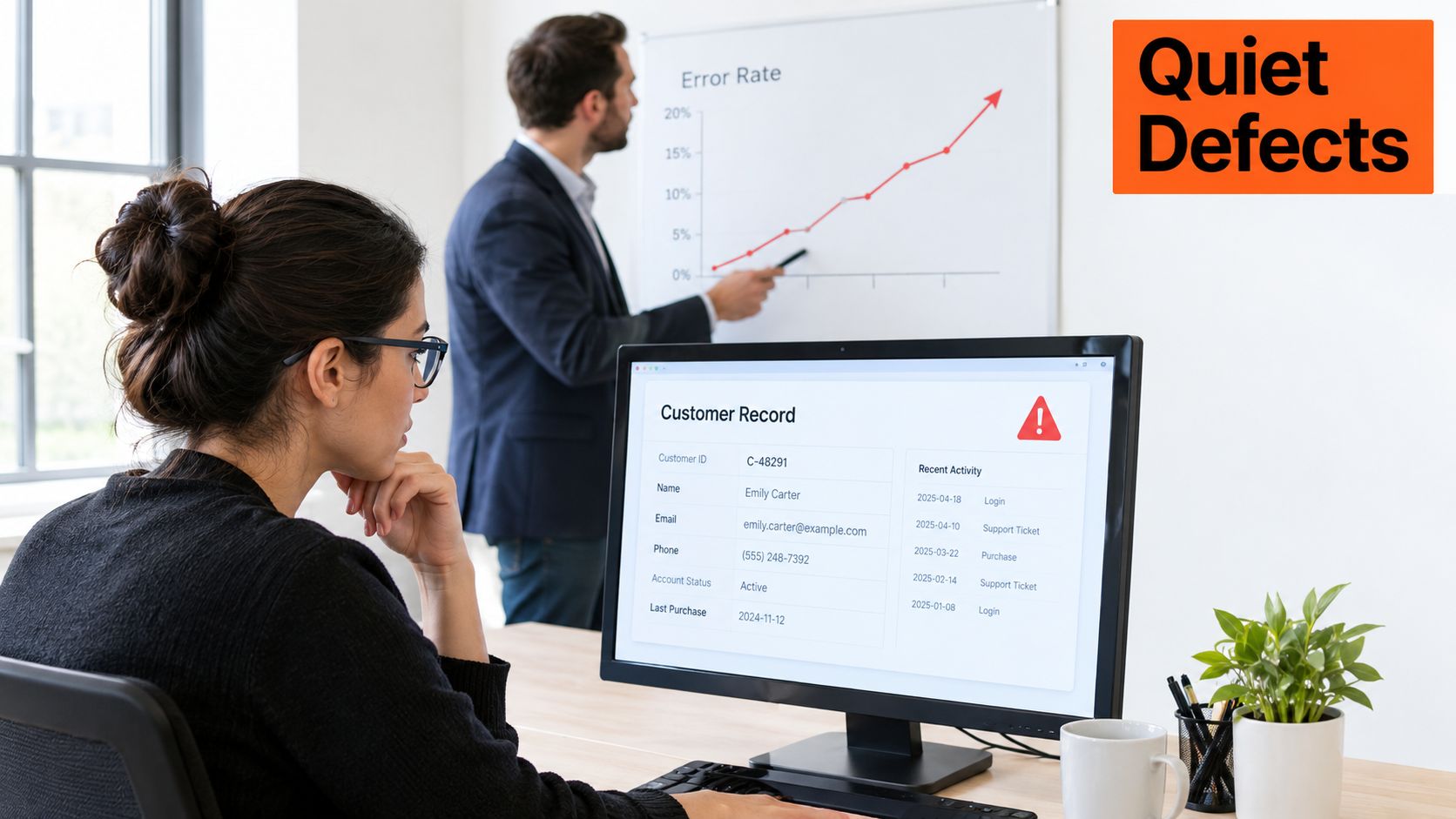
The cost extends beyond correction
The UK Government's discussion of hidden data-quality costs cites estimates that organizations spend 10% to 30% of revenue handling quality problems, while cautioning that costs vary. It identifies operational failures, manual verification, re-entry, poor decisions, and reputational damage, as well as the expense of remediation itself.
Treat that range as context, not a forecast for your organization. Build your own baseline from observable work:
- Correction effort: Record the time employees spend investigating, verifying, and repairing defects.
- Operational disruption: Track incorrect transactions, delayed services, and blocked decisions.
- Customer exposure: Identify where an unreliable value can affect access, eligibility, payment, or advice.
These categories connect engineering work to business outcomes. A check that prevents an incorrect account restriction deserves different treatment from a check that catches inconsistent capitalization in an internal directory.
Reliability requires selective rigor
A useful program doesn't promise perfectly clean data everywhere. It defines acceptable behavior for each data product, detects departures, and gives an accountable team a recovery path.
Practical rule: Prioritize the defects that can change consequential decisions, not the defects that are easiest to count.
That approach changes the investment discussion. Leaders can evaluate source controls, monitoring, tools, and governance against identifiable failure modes rather than approving an expanding library of rules with unclear value.
How Data Quality Engineering Evolved
The manufacturing analogy explains why data quality requires more than inspection. A factory doesn't accept a component merely because a machine produced it. Engineers define requirements, control production, inspect relevant characteristics, and investigate why defects occur.
Total Data Quality Management, or TDQM, applies that reasoning to data. MIT researchers proposed TDQM in 1992, adapting total quality management to a data-manufacturing process. The framework treats data as a product created through production, distribution, assurance, and governance activities, with a continuous cycle of defining requirements, measuring results, analyzing defects, and improving processes.
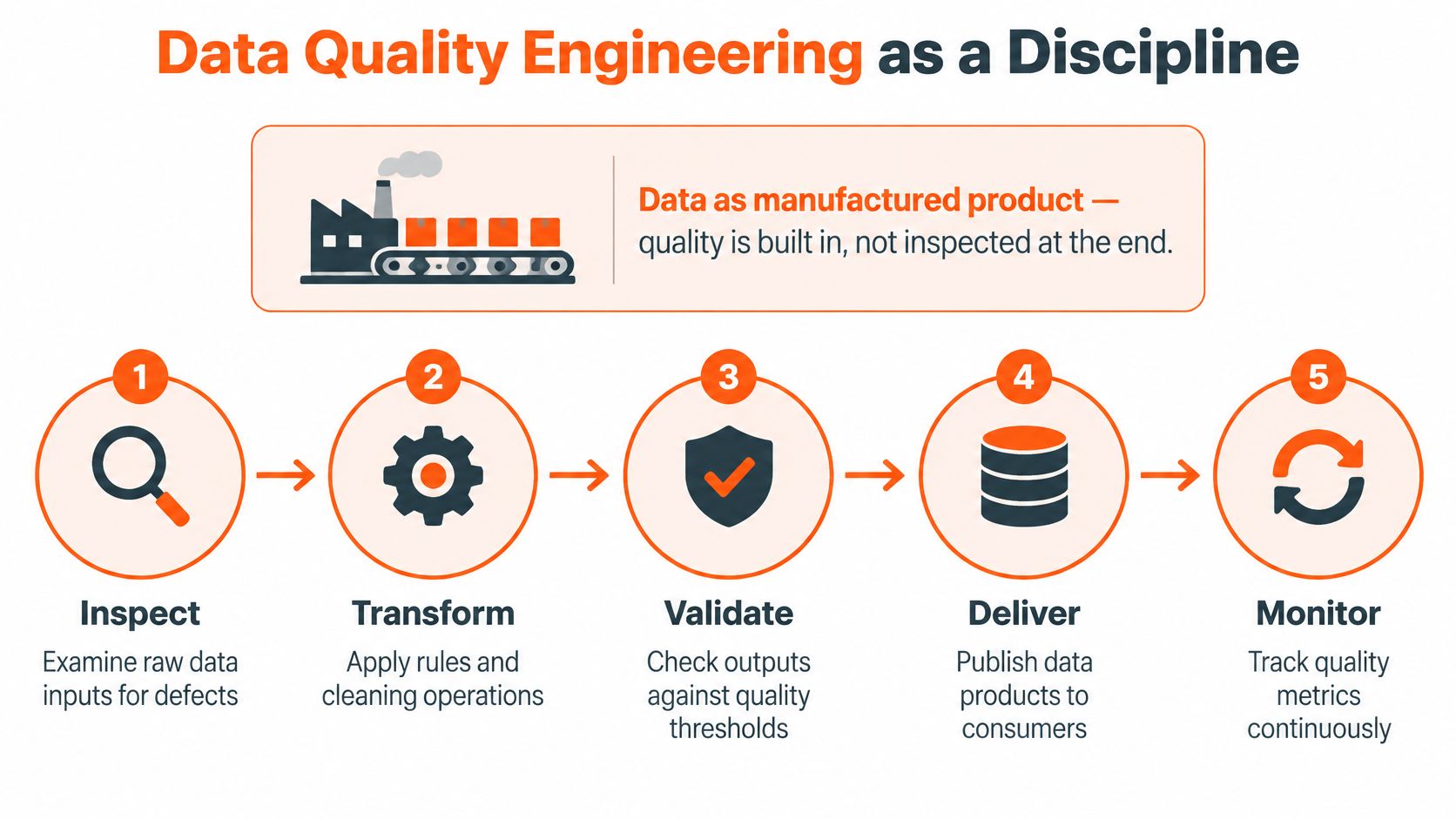
From repair work to production responsibility
Consider a hypothetical address-entry workflow. Employees repeatedly repair delivery addresses after shipments fail. Cleaning the destination table may resolve the immediate backlog, but it leaves the entry process unchanged.
An engineering response investigates the production conditions. Does the interface distinguish delivery addresses from billing addresses? Can users select an obsolete address? Does an integration truncate a required field?
The important shift is from repairing outputs to improving how teams produce them. Inspection still matters, but it becomes evidence for process redesign rather than the final destination of quality work.
- Requirements establish purpose: Producers need to understand what consumers require, not just which columns to populate.
- Measurement makes defects visible: Teams need evidence that distinguishes occasional exceptions from recurring process failures.
- Ownership enables improvement: Someone must have the authority to change the originating workflow.
A data product includes operating obligations
A dataset becomes an engineered product when teams agree on its meaning, delivery expectations, supported uses, and response to failure. Its owner isn't merely responsible for storing it.
That foundation explains why modern practice includes contracts, lineage, automated tests, quality gates, and remediation workflows. These mechanisms connect an operating obligation to something engineers can enforce or investigate.
The manufacturing analogy also has a limit: consumers may reuse data for purposes its producer never anticipated. Engineers should therefore make supported uses and limitations explicit. Data that's suitable for an exploratory analysis isn't automatically suitable for an automated eligibility decision.
Core Data Quality Dimensions and Metrics
Start measurement with separate dimensions, not a universal health score. IBM's documentation of data-quality dimensions describes accuracy, completeness, consistency, timeliness, uniqueness, and validity, and emphasizes benchmarks appropriate to the intended use.
Data Quality Dimensions and Engineering Checks
| Dimension | Business question | Example check | Useful evidence |
|---|---|---|---|
| Accuracy | Does the value represent reality? | Compare an eligibility attribute with an authoritative record | Reference version and verification outcome |
| Completeness | Is required information present? | Check required fields for missing or unusable values | Field-level missingness and affected records |
| Consistency | Do systems express the same meaning? | Compare mapped account statuses across applications | Mapping version and conflicting values |
| Timeliness | Was data available when needed? | Compare event time with availability time | Timestamps and measured delay |
| Uniqueness | Does each intended entity appear appropriately? | Detect repeated identifiers or likely duplicate entities | Matching criteria and duplicate groups |
| Validity | Does the value satisfy permitted constraints? | Check formats, ranges, and reference values | Failed rule and permitted values |
Validity isn't accuracy. An email address can have the expected format and still belong to the wrong person. Similarly, matching statuses across applications establishes consistency, but both applications could contain the same incorrect status.
Set thresholds at the level of consequence
The City of Cambridge's data-quality guide provides a concrete publication benchmark of 95% for accuracy and completeness. The following threshold chart represents that policy example, not observed dataset performance or a recommendation for every enterprise.
| Publication threshold chart | Required level | Visual threshold |
|---|---|---|
| Accuracy | 95% | ███████████████████░ |
| Completeness | 95% | ███████████████████░ |
An aggregate score can conceal a dangerous exception. A broadly complete dataset may still lack the particular field needed to make a safe decision. Apply checks at the field level for consequential attributes, the record level for valid combinations, and the dataset level for coverage or reconciliation.
Use a service-level view when consumers depend on delivery behavior. Canadian Government guidance defines timeliness as the delay between the time data describes and when users can access it for their needs.
A quality metric should tell an investigator what failed, where it failed, and why the failure matters.
Retain the evaluated population, rule version, execution time, and relevant source context. Without that evidence, a passing score offers little help when a consumer challenges a result.
Build Controls Into the Data Lifecycle
Begin with profiling, not a large rule library. Examine actual structures, distributions, nullability, duplicate patterns, and relationships. Then ask domain owners which observations represent defects and which reflect legitimate exceptions.
For example, a missing completion date may be correct for an unfinished course. Making that field universally mandatory would produce false failures rather than better data.
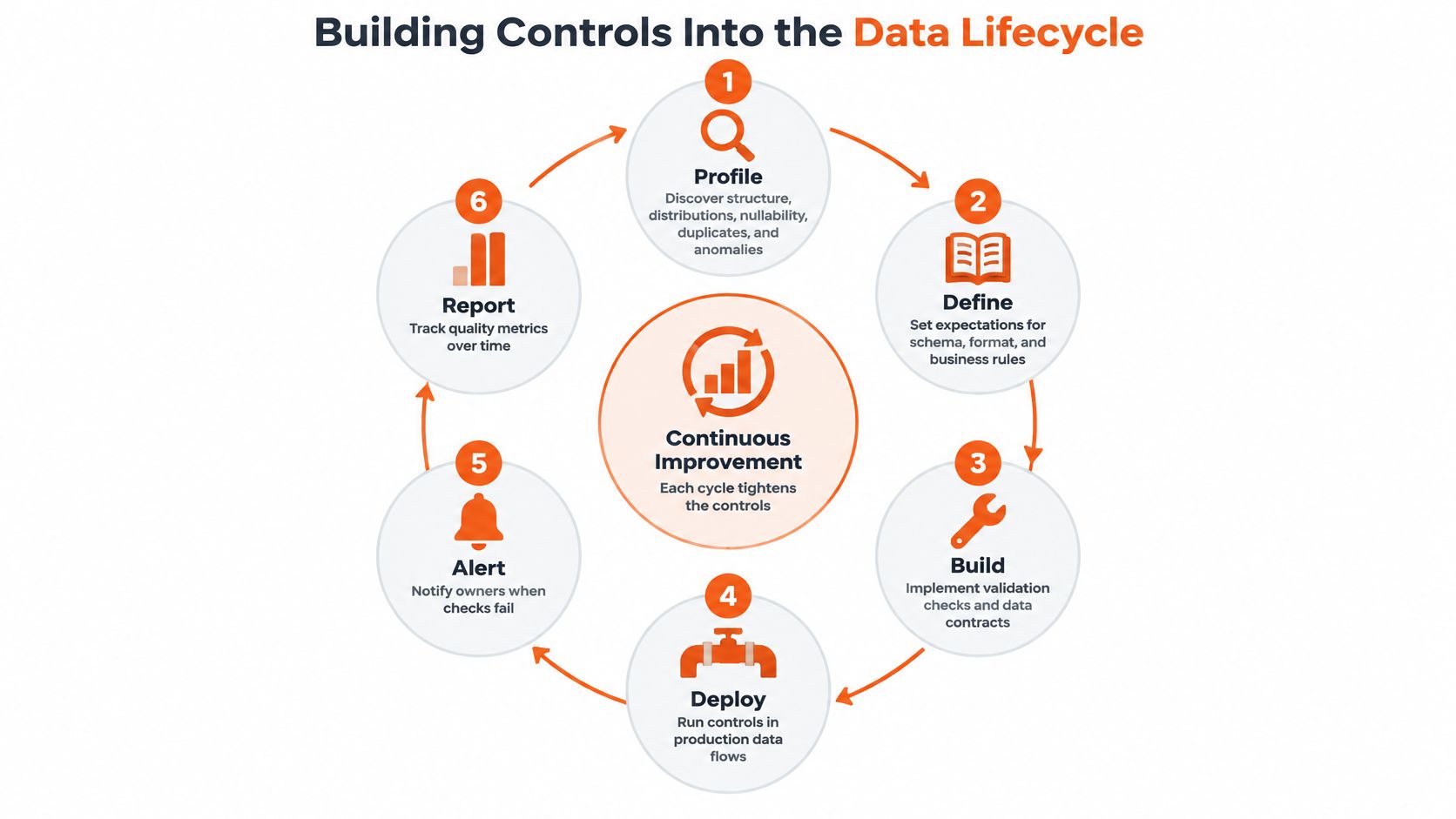
Define expectations before enforcing them
Translate consumer requirements into a data contract that covers structure and meaning. A schema can declare a status field's type, but a semantic agreement must explain permitted transitions, authoritative sources, and how consumers should interpret missing values.
Build controls in the order data moves:
- At ingestion: Validate required structure, identifiers, and essential business constraints before accepting data into a trusted area.
- After transformation: Test joins, derived values, and relationships that transformation logic could alter.
- Before publication: Reconcile output with expected source coverage and apply release criteria appropriate to the consumer.
For modernization work, preserve a baseline before migration, compare old and new behavior during parallel operation, and reconcile after cutover. This helps teams distinguish inherited defects from migration-induced changes.
Design failure handling with the check
A failed check needs a defined action. Rejecting an entire delivery may be appropriate when a critical schema changes. Quarantining affected records may be preferable when safe records can proceed without distorting downstream results.
Quarantine must include an owner, reason, repair procedure, and controlled re-entry path. Otherwise, teams have created a hidden backlog rather than a recovery mechanism.
For retrieval-based applications, connect publication controls to ingestion and indexing decisions. AletheionAGI's resource on production RAG pipeline design is useful context for planning where source preparation, retrieval, and application delivery meet.
Close the loop after release
Monitor delivered behavior because integrations and consumer-facing copies can introduce failures after upstream validation. Use lineage to connect an alert to the source, transformation, affected consumers, and responsible team.
An actionable incident record should retain:
- Scope: Which records, partitions, or content versions are affected.
- Decision: Whether to pause delivery, use a known-good version, or continue with restrictions.
- Recovery evidence: What was repaired, replayed, reconciled, and verified.
Fix the originating cause before closing the incident. Replaying data without changing the faulty production condition only prepares the next recurrence.
Handle Batch Streaming and AI Data Patterns
A scheduled export and a live event stream shouldn't share identical acceptance logic. Batch consumers can evaluate a bounded delivery. Streaming consumers must decide what to do while events continue arriving and earlier events may still be missing.
The engineering question is not whether data passed. It's when enough evidence exists to trust it for the intended action.
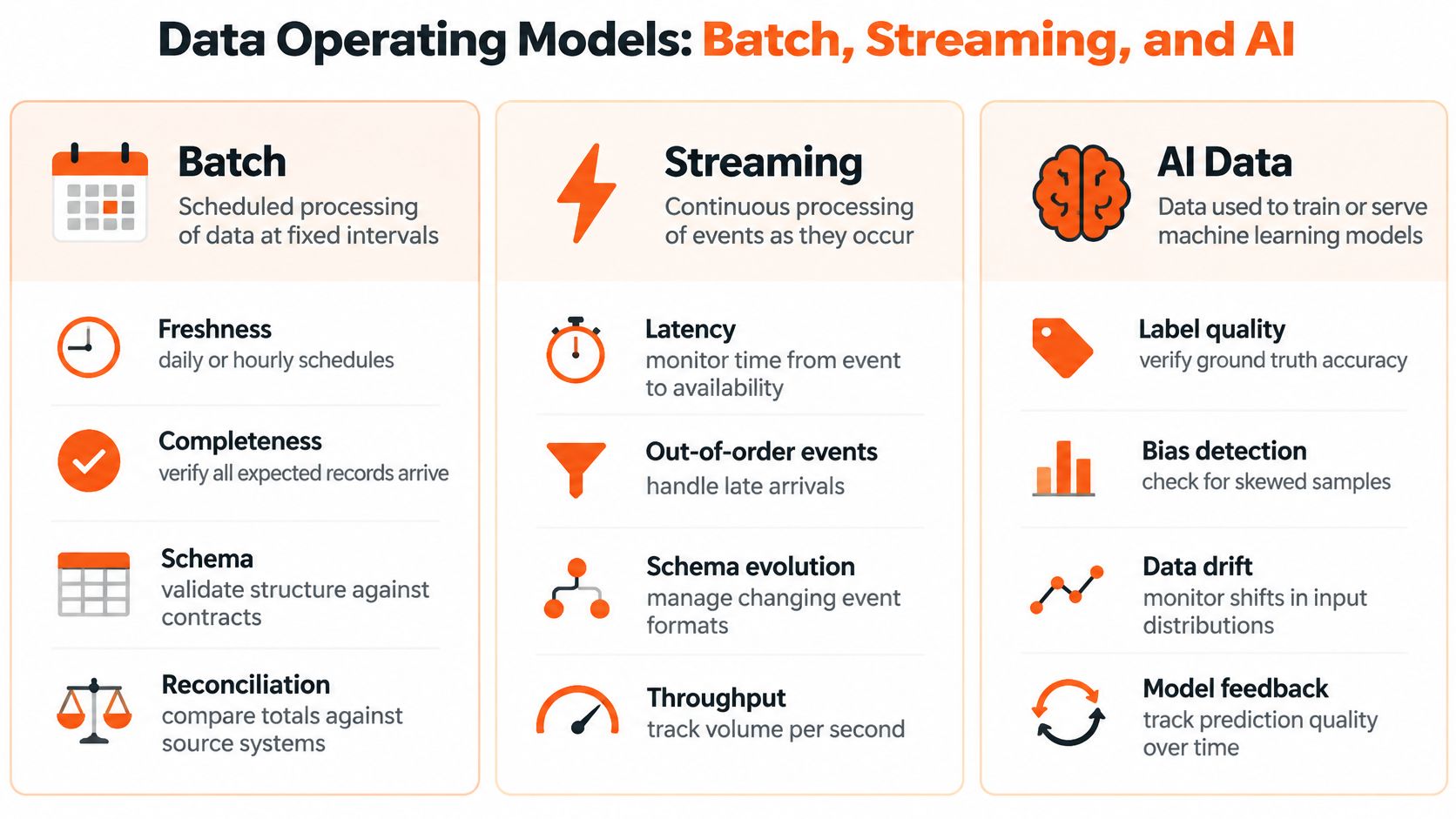
Match the control to the operating model
Quality Controls by Data Workload
| Workload | Typical failure | Control pattern | Operational signal |
|---|---|---|---|
| Batch | Missing delivery or incomplete extract | Scheduled arrival checks and source reconciliation | Missed delivery or unexplained coverage gap |
| Streaming | Late, duplicate, or out-of-order events | Event-time rules, deduplication, and bounded replay | Lag, late-event volume, duplicate frequency |
| Event-driven | Changed payload or incompatible interpretation | Versioned contracts and consumer compatibility tests | Contract failures and rejected events |
| Unstructured content | Missing metadata or unreadable material | Parse validation and required metadata checks | Extraction failures and excluded documents |
| AI training and evaluation | Unsuitable labels or unrepresentative inputs | Provenance review and suitability checks | Label disagreements and coverage gaps |
| Retrieval-based AI | Irrelevant, inaccessible, or obsolete context | Retrieval evaluation and permission-aware filtering | Unsupported answers and source-access failures |
For batch workloads, define when a delivery is complete and how corrections are published. A file arriving on schedule doesn't prove that all expected records arrived.
Streaming introduces a different trade-off. Waiting longer can improve completeness, but consumers may need prompt decisions. Specify how late arrivals revise previous results and how far operators can replay safely.
In event-driven software architecture, distinguish a producer's successful publication from a consumer's successful interpretation. Contract compatibility must cover meaning, not just payload shape.
AI quality includes access and context
For retrieved content, a successful parser isn't enough. Check document identity, version, metadata, source accessibility, and whether retrieved passages support the task. Retain provenance so reviewers can trace an answer's supporting material.
The MIT Technology Review Insights data and AI report found that 38% of respondents struggled with timely access to fresh data, 34% with lineage, 33% with security complexity, and 31% with poor quality and management.
These are connected constraints, but they aren't interchangeable. Diagnose whether a source is wrong, stale, irrelevant, or inaccessible before choosing a remedy. Reindexing won't fix an authorization problem, and relaxing access won't make obsolete content accurate.
Choose Tools Through Automation Patterns
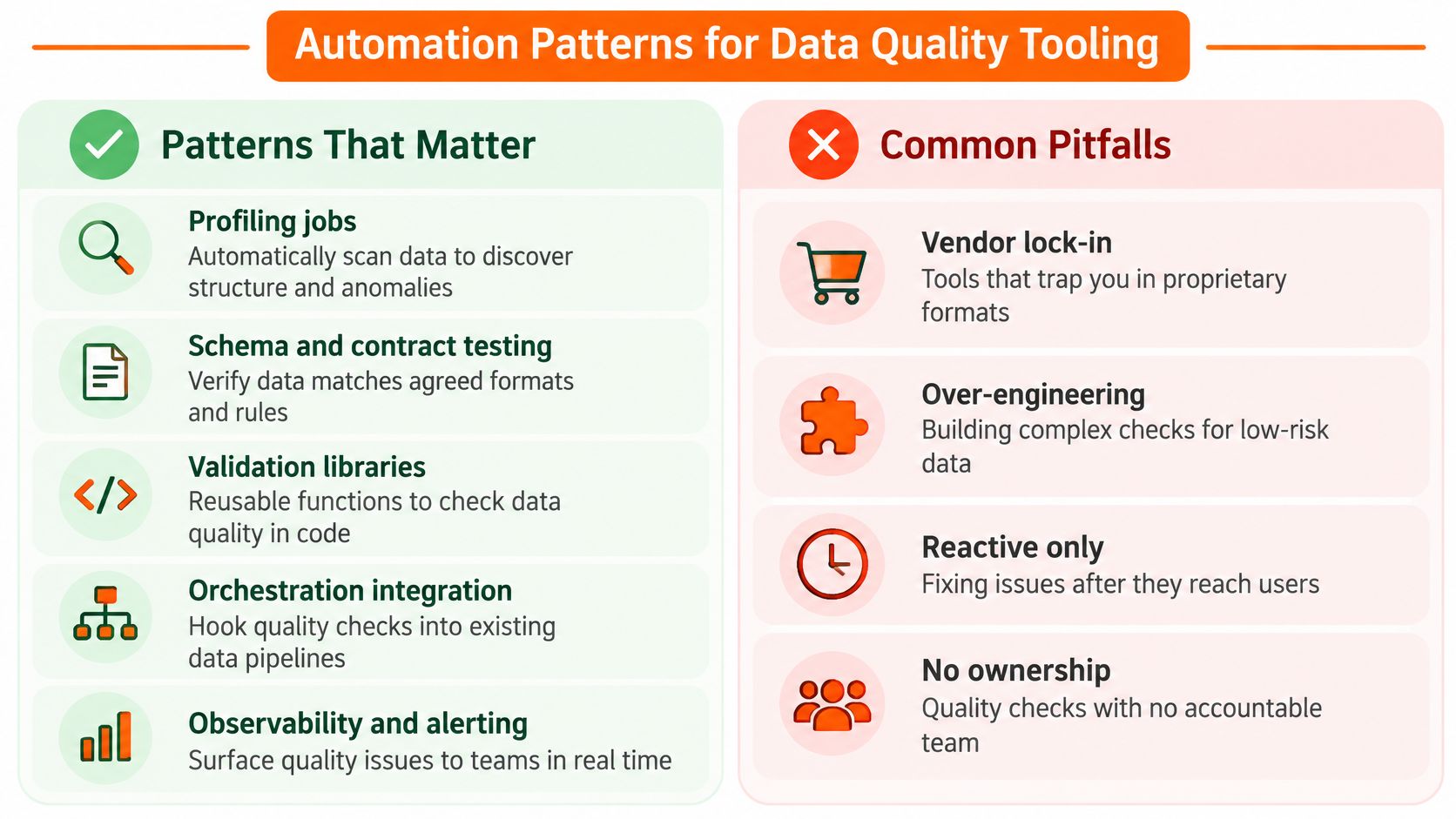
Evaluate tools by the control they must operate, not by the breadth of their product category. A profiling interface won't replace publication gates, and an observability dashboard won't repair a failed delivery.
Write an operational requirement first: detect a contract violation, identify affected consumers, notify the owner, and support controlled recovery. Then evaluate which capabilities already exist in your platform.
Compare the ownership burden
| Approach | Useful when | Burden to evaluate |
|---|---|---|
| In-house implementation | Domain rules need specialized behavior | Maintenance, documentation, and on-call support |
| Pipeline-native checks | Controls belong directly in existing jobs | Cross-system visibility and coverage gaps |
| Centralized quality platform | Teams need shared results and governance | Integration effort and domain expressiveness |
| Shared platform with domain checks | Common reporting must coexist with specialized logic | Consistent evidence and divided ownership |
Ask candidates to demonstrate profiling jobs, contract tests, reusable validation, lineage capture, quality gates, alerting, and remediation orchestration using your failure scenarios. Don't accept a dashboard demonstration as proof that operators can recover safely.
The relationship with workflow orchestration tools deserves particular attention. A check's result must affect the workflow appropriately, including dependencies, retries, pauses, and authorized replay.
Run a failure-oriented evaluation
Choose a critical dataset and its dominant failure mode. Test the smallest viable control stack against malformed input, an unexpected source change, and a recovery attempt.
- Integration fit: Can checks run near the data without unnecessary movement?
- Workload coverage: Does the implementation support your batch and streaming behavior?
- Metadata context: Can an investigator reach the relevant owner, rule, and lineage?
- Alert quality: Can teams distinguish actionable incidents from harmless variation?
- Governance fit: Can teams audit changes and protect sensitive evidence?
Measure operational burden alongside detection capability. Include execution cost, configuration upkeep, false alerts, upgrades, and support responsibilities.
Selection principle: Buy or build the missing control capability, not another place to display the same unresolved incident.
Expand only when the evaluation exposes a specific gap. Standardize result formats and rule ownership early so domain teams can add checks without creating incompatible operating practices.
Governance for Regulated and High-Risk Domains
Governance becomes engineering work when a policy changes what a system accepts, publishes, exposes, or retains. A document that assigns accountability won't protect a customer unless engineers can connect that accountability to enforceable behavior.
Use a risks and controls matrix to connect consequential failure scenarios with preventive controls, evidence, accountable owners, and escalation decisions. Start with the decision at risk, then work backward to the fields and dependencies that support it.
Make rigor proportional to harm
Consider these illustrative domain patterns rather than treating every field alike:
- Healthcare: Require stronger assurance for clinical attributes used in care decisions than for optional administrative descriptions.
- Legal: Preserve document version, jurisdictional context, and provenance where users rely on retrieved material.
- Education: Protect learner identity and eligibility inputs where mistakes could affect access or assessment.
- Cybersecurity: Distinguish stale observations from current exposure so operators understand what a finding represents.
- Enterprise operations: Apply rigorous reconciliation to financial and authorization inputs while allowing proportionate treatment of low-impact descriptive data.
Business owners should approve the consequence model. Engineers should translate it into testable requirements, and compliance teams should identify evidence and retention obligations relevant to the organization.
Protect evidence without blocking recovery
Use minimum-necessary test data, masked or synthetic examples where suitable, and restricted access to sensitive failure samples. Test whether those substitutes preserve the relationships required to exercise the control; removing identifying details can also remove the condition that triggers a defect.
Record rule changes with their rationale, approver, effective version, and rollback procedure. Investigators need to know which policy governed a result when it was produced, not merely which policy exists today.
Stricter controls can reduce usable data when privacy approval and delivery workflows operate separately. Design permission checks, approved diagnostic access, and escalation together so responders don't have to choose between unsafe copying and an unresolved incident.
- Accountability: Name a data-product owner and a technical responder.
- Escalation: Define who can stop publication or authorize degraded service.
- Recovery: Establish a recovery-time objective suited to the consequence.
- Evidence: Preserve verification results without exposing unnecessary sensitive content.
The standard should be defensible rigor, not uniform restriction. Spend assurance effort where a failure could materially harm a person, violate an obligation, or undermine a critical decision.
Turn Data Quality into an Executive Decision
Executives don't need a longer list of failed assertions. They need to know which services remain dependable, where exposure is unacceptable, and what investment will change that position.
Make the next funding or modernization discussion specific. Select a consequential data product and require a short operating assessment before committing to a broader platform purchase.
Use a decision checklist
- Critical use: Which customer action, operational process, or regulated decision depends on this product?
- Consequential fields: Which attributes can change that outcome?
- Acceptance criteria: Which dimensions and thresholds determine whether those attributes are usable?
- Control placement: Where can engineers prevent the dominant failure, and where must they verify delivery?
- Accountability: Who owns the requirement, the implementation, and the incident?
- Recovery: How will consumers recognize degraded data, and how will the owner restore trust?
For prioritization, the MIT Sloan Management Review discussion of data-quality opportunity supports an expected-loss approach: defect volume × probability of business impact × cost per incident. Use it as a decision model, with assumptions made explicit, rather than as a claim of precise financial certainty.
The best data quality program isn't the one with the most rules, but the one that prevents the most consequential defects at an acceptable operational cost.
Review outcomes that business leaders can recognize: avoidable rework, disrupted services, incorrect actions, and recovery performance. Keep dimension-level engineering evidence available beneath that executive view rather than compressing every issue into a cleanliness score.
A dependable data product requires coordinated architecture, delivery automation, observability, and operational governance. Treat its quality requirements as part of the service commitment, including during legacy modernization, rather than as cleanup work to fund after release.
devPulse offers enterprise engineering, governance, DevOps, observability, and modernization services that can connect data-quality controls to the systems your teams build and operate. Visit devPulse to discuss assessing a critical data product, identifying its highest-consequence failure modes, and defining a practical control and recovery roadmap.