














Only 33% of respondents prioritized improving data governance and quality in the 2025 BetaNXT Data Modernization Benchmarking Survey, despite respondents identifying inconsistent data quality, migration cost, and integration difficulty as modernization barriers. That's a dangerous gap: a successful transfer doesn't prove that people can trust what arrived.
The most useful data migration best practices treat migration as a controlled release of business information. Your team must prove that records retain their meaning, permissions remain appropriate, and operational workflows still work. Schedule and cost reserves belong beside that evidence, not in a separate conversation after the project slips.
Table of Contents
- Core Practices and Pass Checks at a Glance
- Assess Source Data Before Moving Anything
- Map Every Field to Its Target Rule
- Prove the Migrated Data Means What It Meant
- Rehearse, Phase and Plan the Rollback
- Budget for Overruns Before They Happen
- Keep Migrated Data Governed and AI Ready
- Confirm Go or No-Go Before Cutover
Core Practices and Pass Checks at a Glance
| Phase | Core practice | Pass check before moving on |
|---|---|---|
| Assess | Profile fields, volumes and duplicates | Every source system inventoried and profiled |
| Map | Document source-to-target rules | Every field has a target, a rule and a null policy |
| Rehearse | Run full-volume mock conversions | Reconciliation variance within the agreed threshold |
| Validate | Reconcile counts, totals and business rules | Zero unexplained exceptions |
| Cut over | Move data in controlled waves with a rollback path | Rollback tested in rehearsal |
| Operate | Monitor the system after go-live | Critical checks repeated after launch |
The sections below follow the working order for a mid-size single-system project, from assessment through mapping and proving meaning to rehearsal and cutover, then budgeting, governance, and the final go/no-go decision. Look for the section matching your phase rather than following the next table row.
Use this as a gate list, not a timeline. A fast project still has to pass every check, and a completed task doesn't automatically authorize the next one. If engineering finishes a load but the business owner can't explain a reconciliation difference, the validate gate remains closed.
Three principles behind the gates
Meaning matters more than arrival. A migrated customer record must still represent the same customer, with the same relevant history and status. A technically valid target schema isn't enough if users interpret its fields differently.
Rehearsals belong in the delivery plan. They aren't optional demonstrations for stakeholders. They're working attempts to expose conversion defects, operational bottlenecks, and recovery gaps before users depend on the target.
Waves contain errors. Moving a bounded business unit gives the team a manageable scope for acceptance and correction. It doesn't eliminate dependency problems, so each wave still needs a clearly defined boundary.
Gate discipline: Passing means producing reviewable evidence, not reporting that a task is nearly finished.
For a mid-size enterprise moving a core system, use every row, even when the same engineer performs several activities. For a regulated healthcare or legal platform, add formal business-owner and compliance sign-offs at validate and cut over. Engineering should attest to execution; accountable owners should accept operational and regulatory risk.
Find the phase your project is in and use its matching section to identify the artifact or decision you can finish today.
Assess Source Data Before Moving Anything
Teams get into trouble when they plan the copy before they know what they're copying. Start with an inventory that names each source system, its business owner, extraction method, record volume, downstream dependencies, and authoritative fields.
The United Nations guidance on integrating administrative and other data sources emphasizes accurate record matching and validation of differences in definitions, coverage, and internal consistency before integration. Its subject is statistical integration, but the engineering lesson applies: matching schemas doesn't establish that records describe equivalent entities.

Inventory meaning, then profile values
Ask owners to define key business terms. An active customer might mean an account with a current contract in billing, but anyone with a recent login in the application. Don't merge those definitions without an explicit decision.
Profile individual fields, not just tables. SQL queries or a profiling tool should expose:
- Formats and patterns: Date representations, identifier lengths, character encodings, and unexpected status values.
- Completeness: Missing values by field and business category, including blanks disguised as populated strings.
- Uniqueness: Duplicate identifiers, duplicate entities, and identifiers reused across organizations.
- Relationships: Missing parent records and references that only work because application code compensates for them.
Use deterministic matching when identifiers are reliable and appropriately scoped. Where they aren't, use probabilistic matching with reviewable confidence rules and an exception queue. Don't let an uncertain match become an irreversible merge.
Decide what deserves to move
Classify sensitive fields before extraction, including personal identifiers, consent context, and retention dates. This establishes which extraction accounts, temporary files, and staging environments need restricted access before anyone creates a copy.
The Federal Student Aid Data Migration Roadmap recommends migrating only the data needed to support the future application. Record each inclusion, exclusion, and archival decision, including who approved it and how retained history will remain accessible.
Business goals should become testable requirements. If the goal is uninterrupted clinical-record retrieval, identify the historical records, relationships, and access conditions required to support that workflow. At devPulse, our Discovery phase translates clients' business goals into actionable technical requirements and strategic project roadmaps.
Finish with a written assessment report containing sources, owners, defect counts, scope decisions, and agreed definitions. Have business owners approve it before mapping begins, rather than asking engineers to resolve conflicting meanings during conversion.
Map Every Field to Its Target Rule
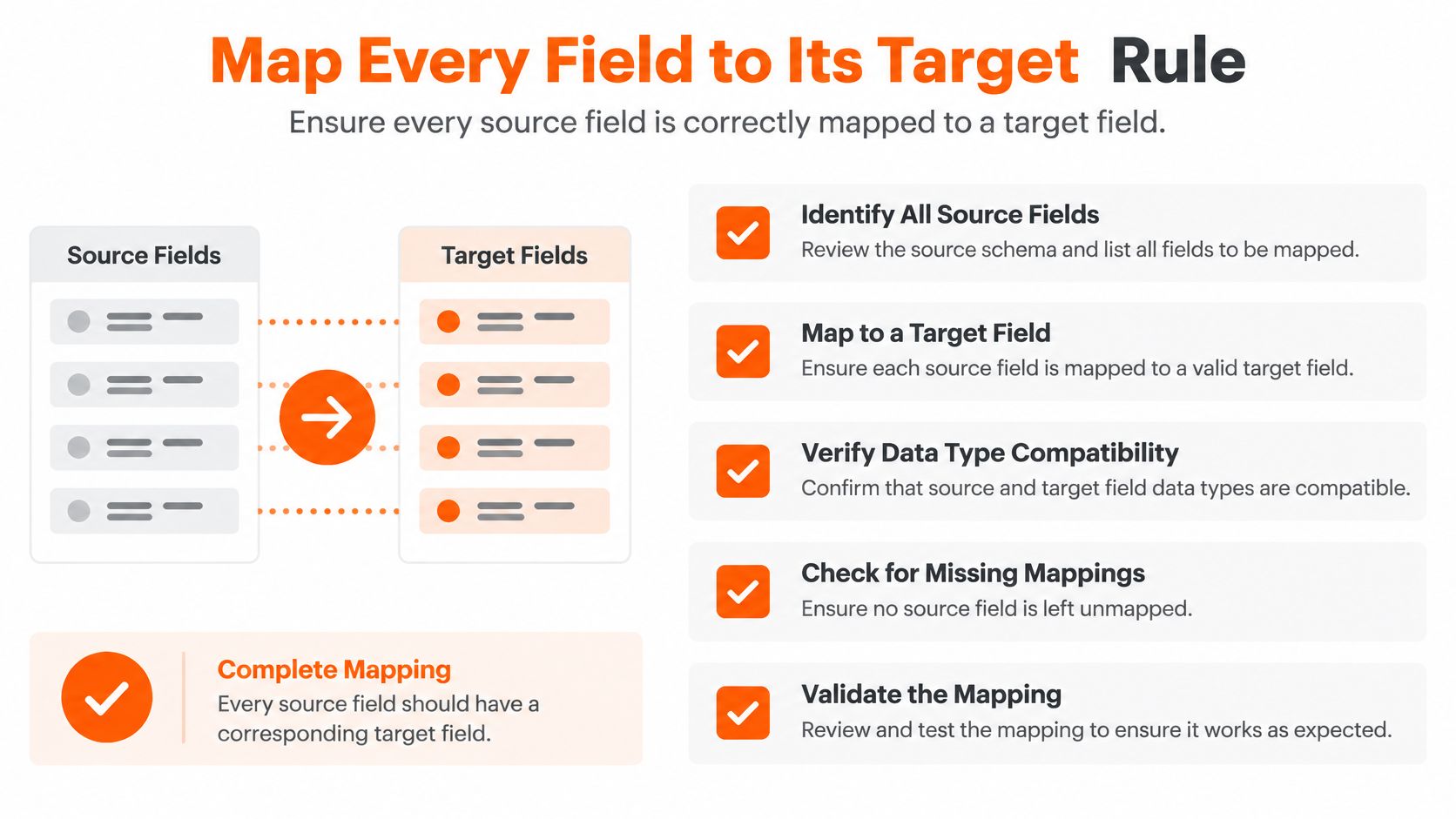
A mapping document is an executable specification, not a diagram of connected boxes. A second engineer should be able to implement its rules without guessing what the author intended.
The Government Accountability Office's migration-control guidance identifies mapping, cleansing, validation, and mock conversions as pre-conversion controls, and emphasizes checking edit and validation tables themselves. Test the rules that judge the data, not just the application that displays it.
Build a mapping another engineer can execute
List every source field and its owner. Include fields used only by reports, exports, or scheduled jobs. The common slip is treating an undocumented column as unused without checking its consumers.
Assign a target or an explicit drop decision. Record the reason and approver for excluded fields. Otherwise, teams can mistake an accidental omission for an intentional scope reduction.
Write the transformation rule. Specify status translations, units, precision, and timezone handling in unambiguous terms. Local timestamps without timezone context and currency values converted twice are examples worth testing explicitly.
Set defaults and null behavior. Distinguish unknown, not applicable, empty, and deliberately withheld values. An unmapped status code mustn't fall back to active because the target requires a value.
Define the exception route. State whether invalid records stop the batch, enter quarantine, or proceed under an approved exception. Logging a failure without assigning anyone to resolve it is not an exception process.
Version the mapping and record approvals. Keep SQL, transformation code, lookup tables, and the workbook aligned in version control. A mid-project change needs data-owner review and targeted regression tests, not an overwritten spreadsheet cell.
Test a representative sample before a full load. Include boundary dates, retired codes, missing identifiers, and unusual numeric values. A convenient sample of clean records won't challenge the rules most likely to fail.
Freeze the rule version alongside each test result. Otherwise, you can't establish which behavior produced the accepted output.
Deliver a versioned mapping workbook linked to runnable transformation code and validation queries. Include input assumptions, exception handling, and restart instructions so another engineer can run it without asking the author to interpret undocumented decisions.
Prove the Migrated Data Means What It Meant
Matching row counts can hide a failed migration. Every record may arrive while a translated status reverses eligibility, a date changes reporting periods, or a broken relationship connects a document to the wrong case.
The GAO's review of an Army migration found that initial testing focused on whether software worked rather than whether migrated data were accurate and reliable enough for operational missions. It describes data-specific scenario testing and user participation in critical business-process tests as important controls.
Combine reconciliation with operational proof
Use automated reconciliation after each major transformation stage. Then have users execute representative workflows against migrated records, not only synthetic fixtures.
| Control | What it catches | Example threshold |
|---|---|---|
| Source-to-target record counts | Lost or duplicated records | Every record accounted for, exceptions listed |
| Totals by business category | Wrong sums or dropped categories | Zero variance on financial totals |
| Duplicate and null rates | Merge errors and missing values | Null rate within the baseline agreed with data owners |
| Referential integrity checks | Broken links between tables | Zero orphaned child records |
| Business-rule exception counts | Wrong status or date logic | Each exception signed off by a named owner |
| User scenario tests on migrated records | Semantic defects in real workflows | Critical processes pass with migrated data |
These are example acceptance rules, not universal tolerances. Where transformations intentionally change populations or aggregates, reconcile against the approved transformation outcome rather than demanding an inappropriate raw equality.
Compare totals by currency, entity, and business category before combining them. Offsetting errors can make an overall total look correct while individual accounts are wrong. Similarly, compare source and target at a common extraction boundary so ongoing transactions don't masquerade as conversion defects.
Give process owners the difficult cases
A user-led test should follow a critical process from input to outcome. Ask the operator to explain the result and compare it with the expected business behavior, not merely confirm that the screen opens.
Watch for incorrect status mappings, ambiguous date interpretation, repeated unit conversions, and relationships that preserve valid keys but attach the wrong entities. These defects require semantic validation, which belongs within a broader data quality engineering practice.
Agree thresholds before execution. Every accepted exception needs a named owner, a business impact statement, and a resolution or containment decision.
Leave this gate with a stage-by-stage reconciliation checklist and these five scenario types, adapted to your domain:
- Retrieve history: Open a migrated clinical, student, or legal record with its attachments.
- Complete a transaction: Fulfill an order or complete the equivalent core workflow.
- Reproduce a report: Generate an agreed financial or regulatory output.
- Apply a status change: Update eligibility, enrollment, or case state and verify downstream effects.
- Exercise an edge case: Process a merged identity, missing optional value, or boundary-date record.
Rehearse, Phase and Plan the Rollback
Run at least one full-volume mock conversion and several representative subset rehearsals before production cutover. Measure throughput, failure rates, reconciliation variance, restart behavior, and elapsed cutover time, including validation and recovery work rather than just extraction and loading.
A rehearsal defect may take hours to fix in isolation; the same defect after launch can create weeks of investigation and correction across users, integrations, and reports. That's a planning scenario, not a promised recovery duration. The practical advantage is finding the problem while the source remains authoritative and users haven't added new target transactions.
Choose the exposure you can manage
| Strategy | Risk exposure | Rollback effort | Best fit |
|---|---|---|---|
| Big bang cutover | All data moves at once | High, reversal after a full load | Small, low-volume systems |
| Phased waves | One business unit at a time | Low per wave | Large estates with many business units |
| Parallel run | Old and new systems compared before the switch | Lowest while the old system stays authoritative | Systems where errors are costly |
Parallel operation has a cost: teams must define the authoritative writer and prevent conflicting updates. Phased execution also requires dependency analysis because shared customer, identity, or reference tables can cross wave boundaries.
A practitioner study of 270 data professionals found that 62% of migration projects used phased execution. Use that approach deliberately: start with a low-risk business unit, accept its results, correct defects, and expand only after its gate closes.
We modernize legacy systems incrementally, focusing on high-impact areas first. Distinguish modernization priority from cutover sequence: a high-impact capability can lead the engineering roadmap while a lower-risk unit proves the migration mechanism. Align both decisions with your cloud migration strategy.
The historical overrun chart is a reminder to include rehearsal and recovery effort in the delivery plan.
Make rollback an executable decision
For each wave, document the trigger, decision-maker, latest safe decision time, and maximum revert window. Triggers might include failed financial reconciliation, inaccessible critical records, or an access-control defect.
The runbook must identify the recovery point, commands, dependencies, verification queries, and treatment of transactions created after the switch. Test the actual restoration path, not just whether a backup file exists.
Recovery boundary: If you can't explain how target-side transactions return safely to the source, you haven't finished the rollback plan.
Finish rehearsal with a rollback transcript and named trigger conditions. If the measured recovery duration exceeds the available window, change the strategy before approving production.
Budget for Overruns Before They Happen
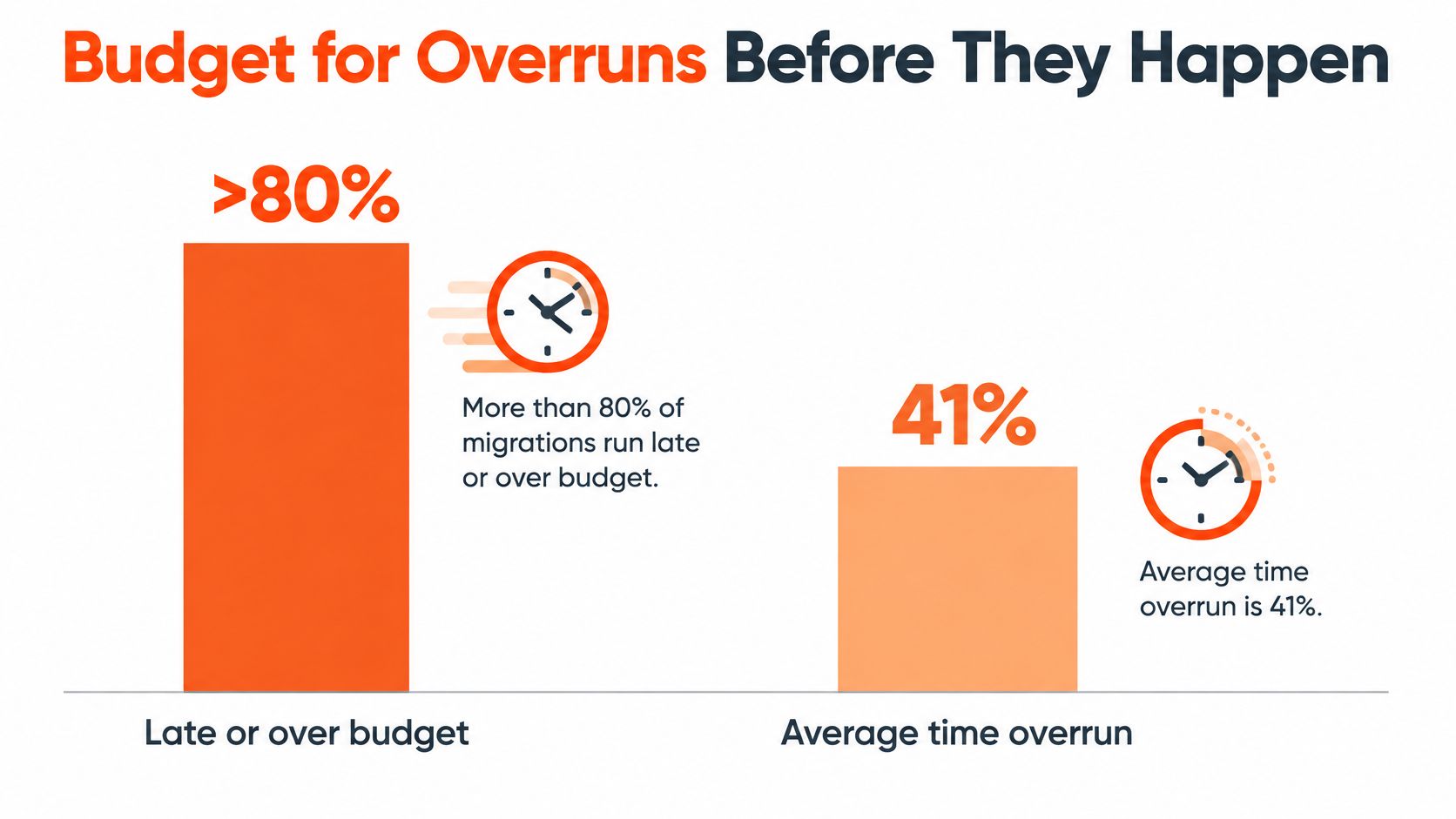
More than 80% of projects ran over time or budget in historical migration research summarized in Oracle's data migration white paper, citing Bloor. The same historical evidence reports the measures below; treat them as planning context, not a forecast for your particular project.
| Reported measure | Figure | What to plan for |
|---|---|---|
| Projects running over time or budget | More than 80% | Schedule and cost reserves from day one |
| Average time overrun | 41% | Milestones with weekly variance tracking |
| Average cost overrun | 30% | A contingency line in the budget |
| Projects finishing on time and under budget | About 16% | Treat on-budget delivery as the exception to plan for |
Build a chart you can manage against
Create paired bars for planned versus actual elapsed weeks at assess, map, rehearse, validate, and cut over. Use an adjacent cost panel with the same milestones, not a misleading shared axis for money and time.
Draw contingency reserve as its own bar, label variance at each milestone, and add the historical time and cost averages as reference lines on corresponding percentage-variance panels. Populate actuals from your project tracker and finance records rather than inventing illustrative performance.
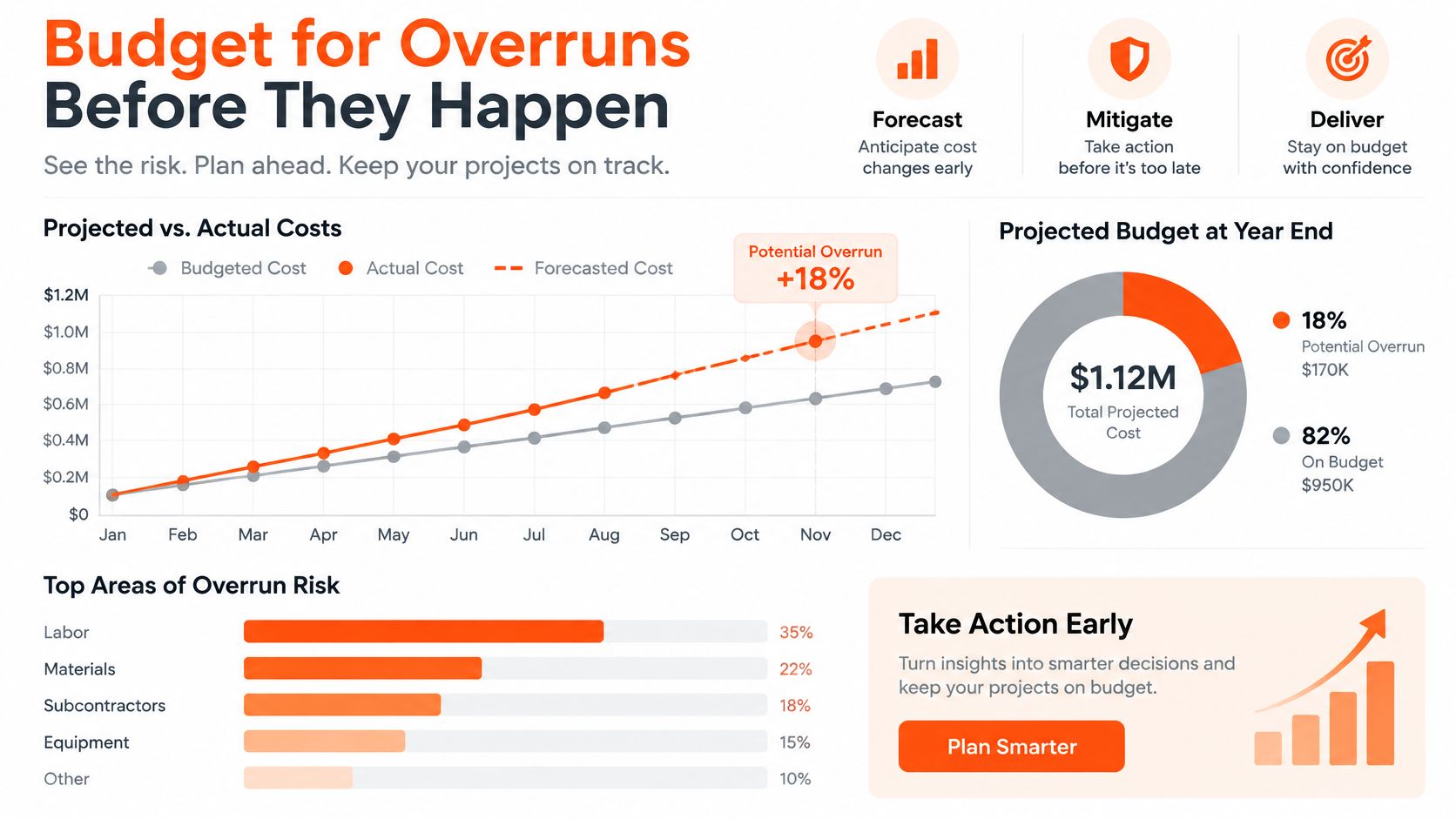
Size your reserve from rehearsal variance, unresolved source defects, dependency uncertainty, and recovery work. Name separate schedule contingency and cost contingency lines, with an owner authorized to approve their use.
For example, consider a hypothetical twelve-month project with a 30 percent cost reserve. An unmapped source system adds three weeks of work; the project lead records the schedule impact and draws approved remediation effort from the reserve instead of hiding it inside testing estimates.
Review planned against actual effort weekly and at each wave boundary. A reserve isn't permission to tolerate uncontrolled scope: every draw should identify its cause, remaining exposure, and effect on the forecast. Leave planning with a milestone sheet, explicit reserve lines, and a named variance-review owner.
Keep Migrated Data Governed and AI Ready
Loading data into a lake, warehouse, or cloud platform doesn't make its AI use defensible. Without classification, lineage, and permission translation, an AI tool may retrieve information that users shouldn't access or that the organization can't explain.
The 2025 CTERA State of Data and Cloud Strategy survey, as summarized by Infocepts, found that 67% of respondents identified compliance and regulatory concerns as a significant challenge, 57% cited security risks such as exposure or misuse, and 45% were concerned that siloed data was inaccessible to AI tools. Accessibility and control must be designed together.
Preserve policy meaning alongside business meaning
Classify target fields before loading. Identify personal identifiers, special-category information where applicable, confidential content, and public information. Record the classification basis and accountable reviewer rather than inferring sensitivity from column names alone.
Capture lineage for each target table. Store the source system, mapping version, load date, and transformations applied. Preserve record-level provenance where merges or aggregations make table-level lineage insufficient.
Carry obligations with the data. Keep consent context, retention rules, residency requirements, and deletion status in managed metadata that applications can enforce. A side spreadsheet won't reliably govern an export or AI retrieval pipeline.
Translate permissions into least-privilege roles. Don't copy legacy groups wholesale. Map business entitlements to target roles, resolve accumulated grants, and test service accounts separately from human users.
Test retrieval and denial. Confirm that an authorized analyst or AI tool can find a known record and establish its provenance. Then test an unauthorized identity and verify that it can't retrieve the record, attachment, or sensitive excerpt.
AI readiness means governed discoverability and trustworthy reuse, not simply putting more information within a model's reach.
Use an AI governance framework to connect these controls to approval, monitoring, and incident ownership. Tokenization or anonymization may be appropriate, but each transformation must preserve the relationships needed for approved use without exposing unnecessary identifiers.
Deliver a classification register covering every target table and a lineage record with a named steward per domain. Those artifacts should remain maintained operational records after the migration team disbands.
Confirm Go or No-Go Before Cutover
Cutover is a documented decision, not a feeling that the data looks right. In its review of population-stock and flow validation, the UK Office for Statistics Regulation notes there is “no gold standard.” Enterprise teams should likewise avoid treating a single comparison as conclusive proof.

Attach the decision evidence
- Signed comparison results: Attach the reviewed parallel-run reconciliation report and scenario-test log, including business-owner acceptance.
- Frozen deployment rules: Attach the approved mapping version, code release identifier, and checksum manifest. Confirm that the tested package is the package being deployed.
- Exercised recovery: Attach the rollback transcript, named trigger conditions, decision authority, and maximum revert window.
- Approved governance records: Attach the classification register, least-privilege permission mapping, and target-table retention and residency obligations.
- Assigned operational monitoring: Attach a dated monitoring schedule with a named owner, escalation route, and checks for incremental loads.
Schedule critical check re-runs for day 1, day 7, and day 30 as an operational recommendation. Environment-specific configuration and incremental loads can introduce defects after the initial acceptance run, so assign these checks before launch.
Record a one-page verdict containing met thresholds, accepted exceptions with named owners, and the accountable approvers. A go decision includes the cutover window; a no-go identifies the specific condition and evidence that would change the verdict. Don't replace an unresolved blocker with a promise to investigate after launch.
devPulse offers discovery, cloud migration engineering, quality engineering, and incremental legacy modernization to turn migration plans into controlled releases. Our Compliance Consultancy includes structured assessments to check that a product meets regulatory and industry standards. Visit devPulse to discuss your source assessment, validation gates, and cutover readiness.