














A Monday morning release review often starts with a reassuring dashboard. The regression suite is green, the deployment completed, and the application appears to work. Then customers report that loan origination has become painfully slow during peak demand, while an audit discovers that a privacy control wasn't enforced as expected.
That failure isn't a contradiction. Functional testing may have confirmed that the screen rendered, accepted valid input, and saved the application. It didn't necessarily measure latency, capacity, recovery behavior, or security posture under realistic conditions. Enterprise release readiness requires two separate answers: does the system do what the specification requires, and does it behave safely under the conditions the business operates in?
Table of Contents
- Why Both Testing Types Decide Whether an Enterprise Release Holds Up
- Defining Functional and Non-Functional Testing Through ISTQB and ISO/IEC 25010
- Side-by-Side Comparison of Functional vs Non-Functional Testing
- How Non-Functional Requirements Become Measurable SLIs
- Mapping Functional and Non-Functional Tests Into a CI/CD Pipeline
- Enterprise Scenarios That Decide Which Type Leads
- A Recommended QA Strategy for Enterprise Systems
- Common Misconceptions and Practical Edge Cases
Why Both Testing Types Decide Whether an Enterprise Release Holds Up
The bank's green build answered only the first question. Test cases checked validation rules, calculated values, database updates, and confirmation messages. Those checks were valuable, but they were designed around expected behavior in a controlled environment.
They didn't establish whether the service would remain responsive under peak load. They didn't prove that a privacy control would resist unauthorized access, preserve an audit trail, or satisfy the organization's compliance evidence requirements. A feature can be functionally correct in isolation and still be operationally unsafe.
Practical rule: A passing regression suite is evidence of functional confidence, not a complete production-readiness verdict.
The dual verdict
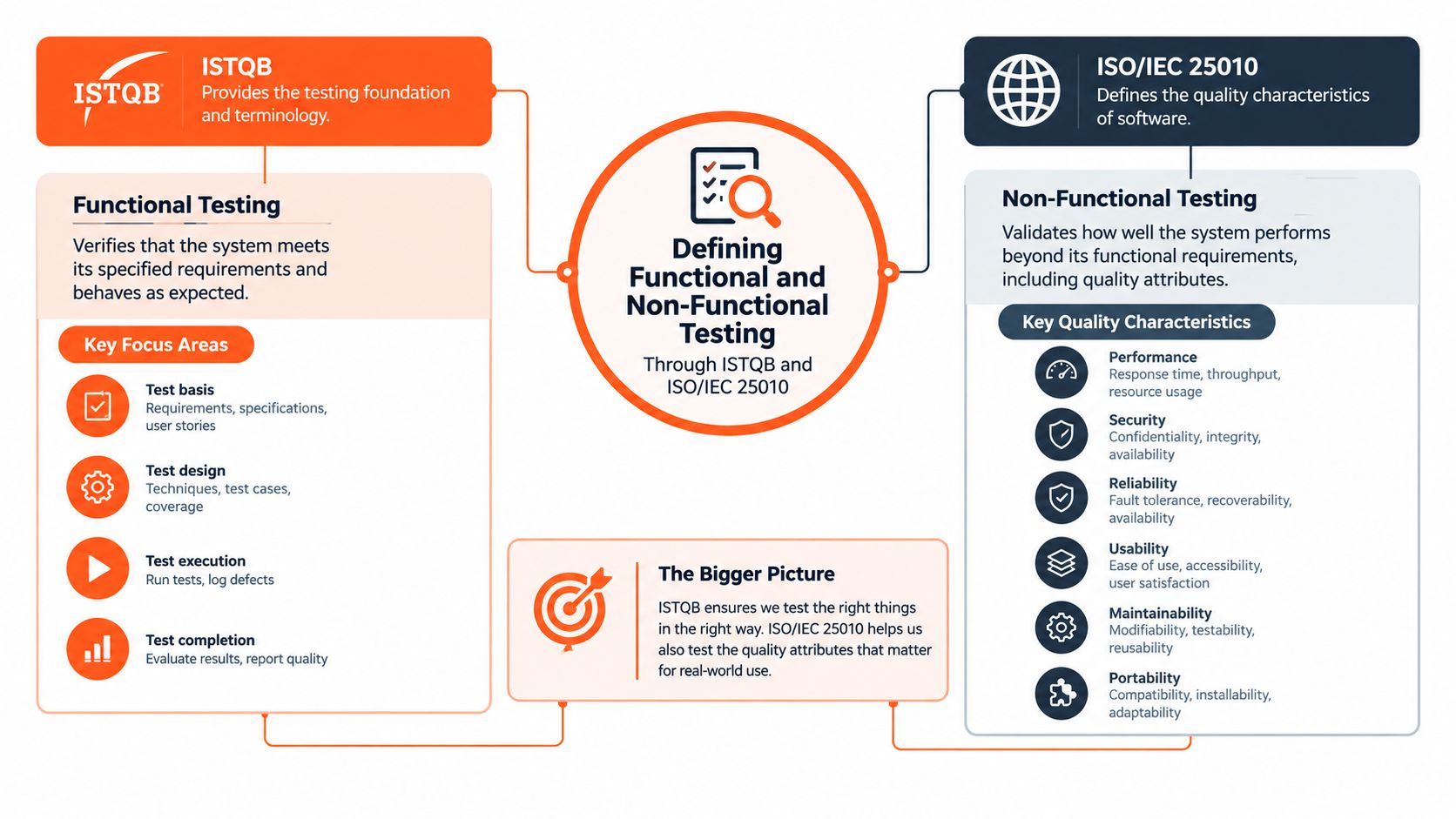
ISTQB provides the useful dividing line. Functional testing evaluates whether a system satisfies its functional requirements. Non-functional testing evaluates attributes other than functional characteristics, including performance, security, usability, reliability, and compatibility, as described in the ISTQB testing classification.
This distinction has historical roots in William Howden's 1978 introduction of functional program testing, a milestone in treating what software does as a distinct engineering concern, as summarized by GeeksforGeeks' history of software testing. Modern enterprise programs need both disciplines because correctness and quality under conditions are different risks.
A strong release process therefore combines requirements traceability, functional coverage, measurable service-level indicators, production-like performance environments, security evidence, and explicit ownership. The practical path is to use ISTQB for definitions, ISO/IEC 25010 for quality vocabulary, AWS guidance for operational metrics, and CI/CD gates that prevent a green functional build from masking a non-functional failure.
Defining Functional and Non-Functional Testing Through ISTQB and ISO/IEC 25010
Start with the requirement, then ask which kind of evidence would prove it.
Functional testing checks what the system does. A requirement might state that an approved applicant can submit a loan application, that a transfer is rejected when authorization fails, or that a billing record is created after a successful payment. The tester supplies relevant inputs and compares the observable result with the specified behavior.
Non-functional testing checks how well the system behaves. The questions shift to response time, supported devices, reliability during dependency failure, access control, maintainability, portability, and usability. The result isn't limited to a binary feature outcome. It must be compared with a defined threshold, target, or quality expectation.
The ISTQB Foundation syllabus maps non-functional quality characteristics to the ISO/IEC 25010 model:
- Performance efficiency, including responsiveness and resource use.
- Compatibility, including coexistence and interoperability.
- Usability, including interaction quality and accessibility considerations.
- Reliability, including consistent operation and recoverability.
- Security, including protection of data and controlled access.
- Maintainability, including analyzability, modifiability, and testability.
- Portability, including adaptability across environments.
- Safety, which the ISTQB model identifies as a quality characteristic.
Functional suitability remains part of the broader product-quality conversation, but ISO/IEC 25010 separates purely functional properties from the other product-quality characteristics while still including functional suitability. That structure helps teams avoid treating functional and non-functional testing as unrelated workstreams.
The operational difference
Functional tests generally produce pass or fail evidence against a requirement. Non-functional tests produce measurements against thresholds. Statement coverage, for example, is calculated as executed statements divided by total statements, while branch coverage is executed branches divided by total branches. 100% branch coverage means every decision outcome has been exercised, according to the ISTQB material above.
That measurement logic matters beyond code coverage. Non-functional coverage can also be measured against supported devices or other quantifiable elements. The threshold is where enterprise risk becomes visible. “The page works” is insufficient if the business requires a defined response-time band, a security control, or dependable behavior across supported platforms.
Side-by-Side Comparison of Functional vs Non-Functional Testing
The same business capability can generate two very different test portfolios. The table below keeps ownership and execution visible, because teams often confuse test level with test purpose.
Functional vs Non-Functional Testing Criteria
| Criteria | Functional Testing | Non-Functional Testing |
|---|---|---|
| Objective | Verify that features and business rules behave as specified | Verify quality attributes under defined conditions |
| What is verified | Inputs, outputs, workflows, calculations, authorization, and data state | Latency, throughput, resource use, security, usability, reliability, and compatibility |
| Input source | Requirements, user stories, acceptance criteria, and business rules | Quality requirements, risk assessments, SLIs, SLOs, and operational constraints |
| Output | Pass or fail against expected behavior | Measurements compared with thresholds or targets |
| Pass criteria | Expected result is produced for the tested scenario | Measured behavior stays within the agreed quality boundary |
| Suite ownership | Developers, QA engineers, and product or business representatives | QA, performance engineering, security, operations, and platform teams |
| Delivery location | Unit, API, component, integration, system, and acceptance layers | CI checks, scheduled environments, release rehearsals, security tooling, and production-like infrastructure |
Consider a customer submitting a wire transfer. Functional cases verify that the amount is validated, the user is authorized, the ledger is debited correctly, duplicate submission is handled, and a confirmation is created.
The non-functional portfolio asks different questions. Does the transaction remain within a response-time target under the required transaction rate? Is the audit log immutable? Does the confirmation screen remain usable with assistive technology? Does the service recover correctly if a downstream fraud system becomes unavailable?
A practical decision matrix
| Change or risk signal | Functional emphasis | Non-Functional emphasis | Release concern |
|---|---|---|---|
| New feature work | Deep requirement and business-rule coverage | Targeted checks for affected quality attributes | Incorrect behavior or incomplete workflow |
| Regulatory rule change | Traceability, negative cases, and acceptance evidence | Security, auditability, and data-protection checks | Non-compliance and incorrect decisions |
| Platform or database change | Integration and regression coverage | Performance efficiency, reliability, and resource utilization | Degraded service under normal or peak conditions |
| Traffic-shaping event | Critical-path regression | Load, stress, capacity, and recovery testing | User impact during demand changes |
| Cloud migration | Functional parity and contract testing | Latency, portability, resilience, and security validation | Environment-specific failure |
Functional depth should lead when business behavior changes. Non-functional depth should lead when infrastructure, traffic, data sensitivity, or operating conditions change. The two portfolios should still share traceability, evidence storage, and release governance.
How Non-Functional Requirements Become Measurable SLIs
“Fast and secure” isn't a testable requirement until an engineering team defines what fast means, what secure means, and how the result will be observed. AWS DevOps guidance identifies useful non-functional testing metrics such as availability, latency, peak-load threshold, infrastructure utilization, time to restore service, Apdex, and test-case run time in its metrics guidance for non-functional testing.
A practical translation looks like this:
Non-Functional Requirements Translated to SLIs
| Quality Characteristic | Measurable SLI | Target Threshold | Tool Category |
|---|---|---|---|
| Performance efficiency | Response time, throughput, resource utilization | Set a percentile, throughput, and utilization boundary for the critical journey | JMeter, Gatling, k6, APM |
| Compatibility | Successful behavior across supported browsers, devices, and operating systems | All defined support combinations pass critical workflows | Browser and device farms |
| Usability | Task completion observations, accessibility findings, user feedback | No release-blocking accessibility or usability defect on critical flows | axe-core, usability platforms |
| Reliability | Availability, recovery time, failed-request rate, data consistency | Agreed availability and recovery objectives are met | Chaos tools, monitoring, fault injection |
| Security | Vulnerability findings, authorization outcomes, protected-data exposure | No unresolved critical security finding and all sensitive paths enforce controls | OWASP ZAP, Burp Suite, threat-model tooling |
| Maintainability | Static-analysis findings, testability signals, test execution time | Defined quality gate for code health and sustainable suite runtime | Static analysis, coverage tools, CI telemetry |
| Portability | Deployment and runtime behavior across target environments | Critical workflows behave consistently in supported environments | Infrastructure automation, environment matrix |
| Safety | Hazard-control behavior and safe failure outcomes | Safety requirements and failure controls are evidenced | Simulation, fault injection, domain-specific tooling |
Avoid inventing targets inside the test script. Product, architecture, security, operations, and compliance owners should agree on them before execution. A service-level agreement defines the external commitment, while the service-level agreement guide for business leaders helps frame that commitment in business terms.
For performance reporting, a neutral benchmark source lists response-time reference points of under 500 ms for internet services, under 1 second for financial services, under 3 seconds for insurance, and under 5 seconds for manufacturing, and gives an error-rate threshold of below 0.6%, equivalent to a success rate of 99.4% or higher. These figures from Alibaba Cloud's performance-test metrics documentation are useful as chartable reference points, not universal substitutes for a product-specific SLO.
A bank planning a capacity exercise can also use the Visbanking stress testing guide as contextual reading when shaping scenarios around financial-system risk. The test report should expose percentile latency, errors, throughput, infrastructure saturation, and recovery behavior rather than display a single green or red result.
Mapping Functional and Non-Functional Tests Into a CI/CD Pipeline
A pipeline works best when each test runs where its feedback is cheap enough to influence the next engineering action.
Commit and pull request stages
On commit, developers run fast unit tests, static analysis, and focused functional checks. These tests catch incorrect calculations, broken conditions, and maintainability regressions before a change reaches shared infrastructure.
A pull request should add contract tests and API functional suites against an ephemeral environment. A failed unit or API test blocks merge because the defect is close to the change and the fix is usually straightforward.
After merging to the main branch, component and integration tests exercise service boundaries. Service virtualization helps the team test unavailable or expensive downstream dependencies without pretending those dependencies have been validated. The integration suite should verify both the returned response and the resulting business state.
Scheduled and promotion stages
Nightly execution is appropriate for broader end-to-end functional flows, cross-browser checks, and accessibility scans. The suite can include critical user journeys without forcing every full-system test into the fastest developer feedback loop.
Performance, load, stress, recovery, and deeper security testing need production-like infrastructure and controlled data. Teams commonly run them on a schedule, during major architecture changes, or before a release candidate is promoted. A failed performance or security gate should block promotion when the affected quality attribute is release-critical.
The test pyramid still applies, but purpose and level shouldn't be confused. Functional tests usually form the broad, fast base and middle, through unit, API, component, and integration coverage. Non-functional tests sit higher because they often need realistic topology, controlled load, specialized tooling, or human observation.
A DevOps implementation guide can help teams connect these gates with build orchestration, infrastructure automation, observability, and release controls. The key design choice is simple: fail the pipeline where the evidence is actionable, not after customers discover the defect.
Enterprise Scenarios That Decide Which Type Leads
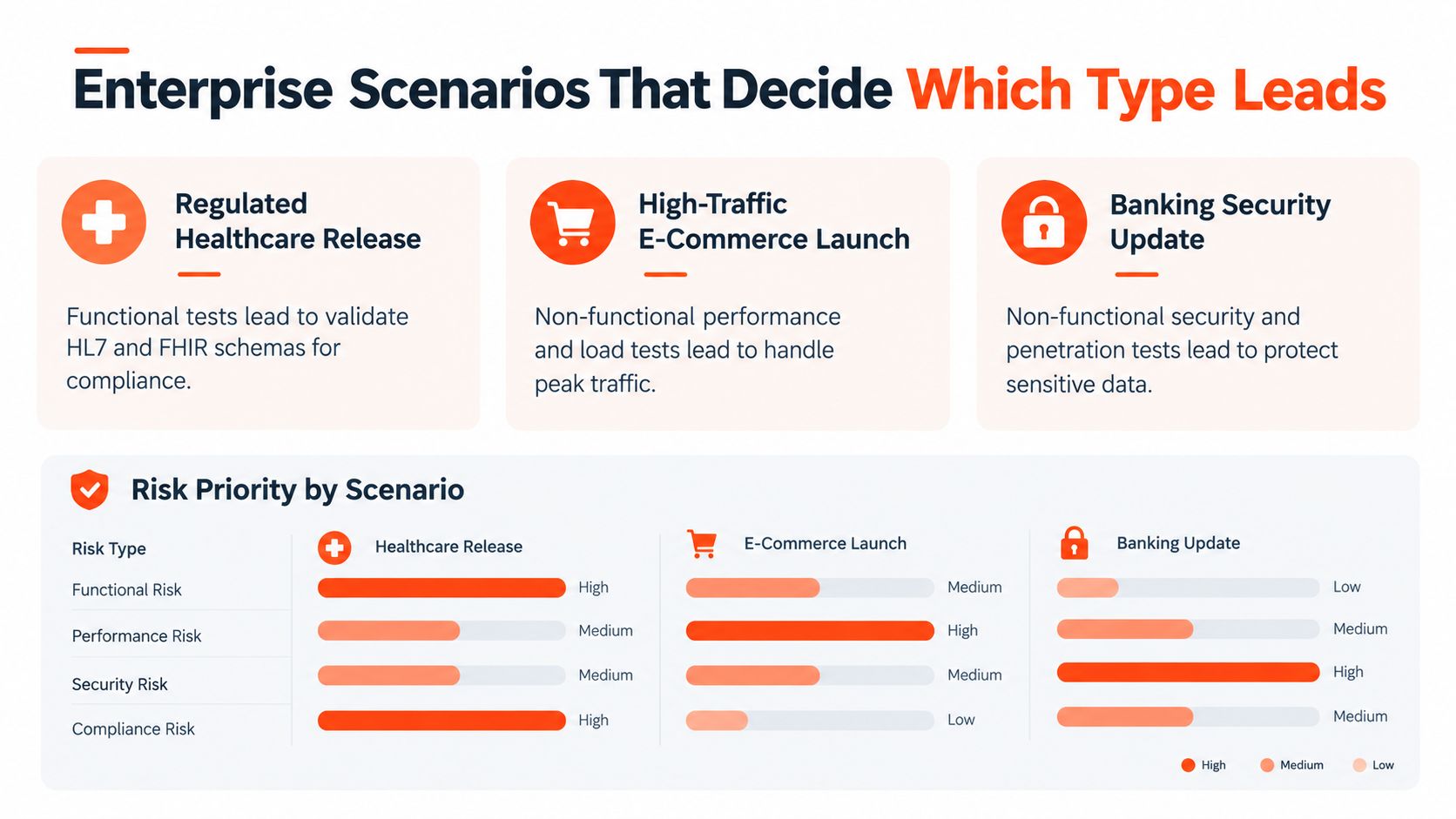
Testing priorities follow business risk, not a universal checklist. Three enterprise situations illustrate the difference.
Regulated healthcare release
A healthcare billing platform introducing a new integration should put functional testing first. The team validates HL7 and FHIR schemas, required fields, mapping rules, authorization behavior, and audit traceability. Contract tests and integration tests protect data exchange with connected systems.
Non-functional testing remains a guardrail. Security scans, access-control verification, compatibility checks, and reliability exercises support the release decision. The blocker criteria are failed schema or business-rule validation, missing audit evidence, and unresolved security or privacy defects. Large programs might combine API automation, schema validators, database assertions, OWASP ZAP, and an evidence repository.
Performance-sensitive customer platform
For payments, streaming, or another customer-facing platform, performance and load testing may lead every major release. Engineers model realistic journeys, monitor latency and errors, observe infrastructure utilization, and test how the service behaves as dependencies slow or fail.
Functional regression still protects the critical path. It confirms that authentication, payment authorization, playback, or another central workflow remains correct before and after the load exercise. Promotion should stop when the agreed performance boundary, error threshold, or recovery objective fails, even if functional scenarios pass in isolation.
Monolith-to-microservices modernization
During a strangler migration, contract and integration functional testing usually leads. The team must prove that the new service preserves the old system's externally visible behavior, data semantics, and integration contracts. Consumer-driven contracts, REST Assured, Postman, database comparisons, and service virtualization can provide targeted evidence.
As cutovers approach, reliability testing gains weight. Engineers test dependency failures, rollback behavior, message handling, and data consistency across old and new paths. A release blocker is a contract break, an unreconciled data state, or a failed recovery path, not merely a failing screen test.
A Recommended QA Strategy for Enterprise Systems
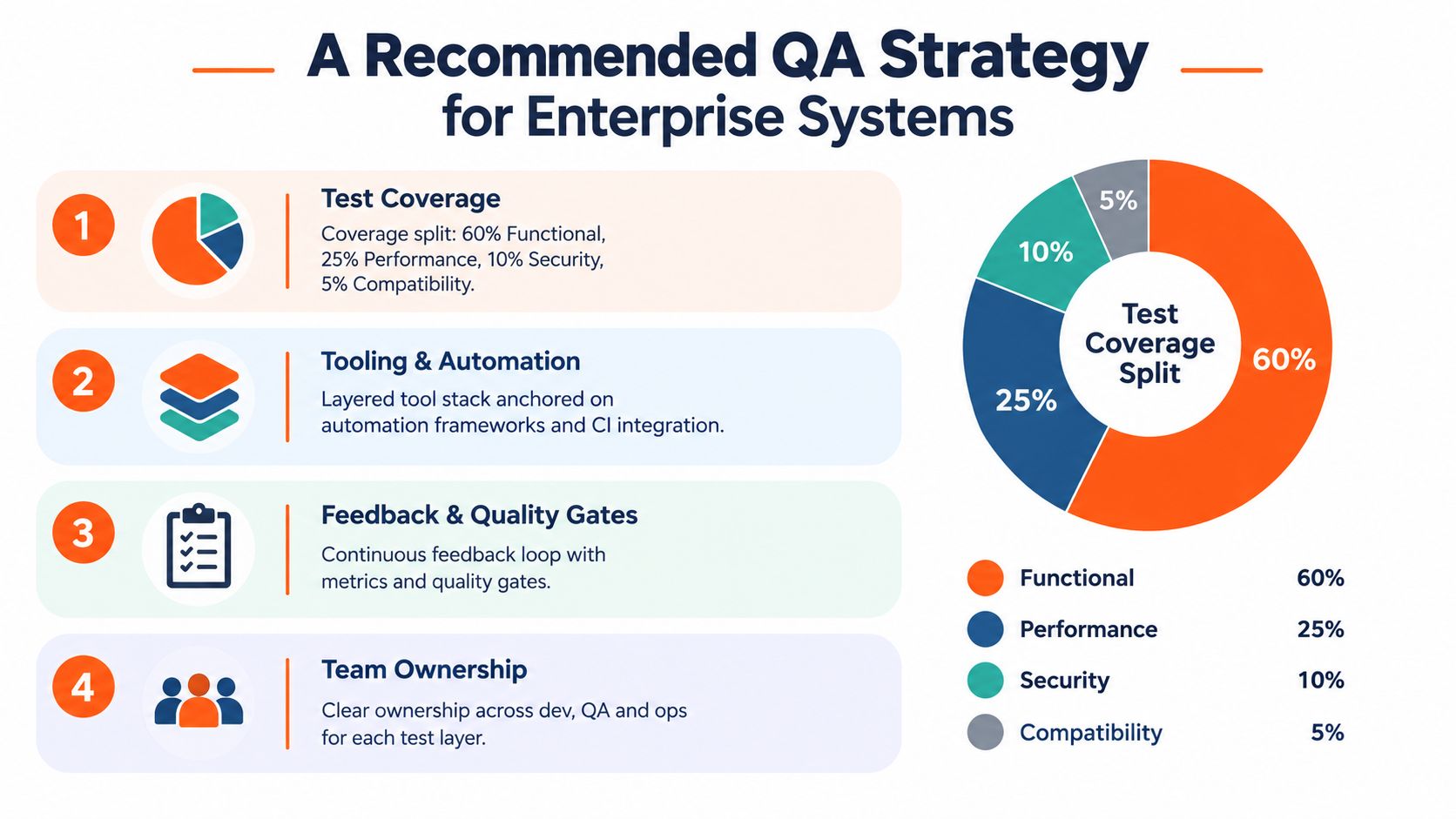
A workable enterprise strategy has four layers: coverage allocation, specialized tooling, governance, and continuous improvement. The suggested split shown in the strategy visual is 60% functional, 25% performance, 10% security, and 5% compatibility. Treat it as a planning baseline, not a universal law. A safety-critical or security-sensitive change may justify shifting effort toward non-functional validation.
Coverage and ownership
Developers own unit tests and much of the component layer. QA engineers own functional integration, regression, acceptance support, and exploratory testing. Performance engineers own workload models and bottleneck analysis. Security teams own threat-driven testing and vulnerability disposition, while operations and platform teams own reliability, recovery, and production telemetry.
Dashboards should report functional pass status, requirement traceability, branch and statement coverage where relevant, latency, error rate, peak-load behavior, infrastructure utilization, recovery time, security findings, compatibility results, and test-suite runtime. AWS's metric set is a useful operational reference, but each organization must connect indicators to its own service objectives.
A layered stack might include JUnit or PyTest for unit tests, Playwright or Cypress for UI flows, Postman or REST Assured for APIs, JMeter or Gatling for performance, OWASP ZAP or Burp Suite for security, axe-core for accessibility, BrowserStack for compatibility, and chaos tooling for resilience. devPulse also provides quality assurance services covering functional, performance, security, user acceptance, and load testing, which can fit where an enterprise needs additional delivery capacity.
Governance and maturity
ISTQB-derived exit criteria should sit inside the quality gate, not in a document reviewed after deployment. Each release should identify affected ISO/IEC 25010 characteristics, assign owners, define evidence, and record accepted residual risk.
Use a simple decision rule:
- Change size: Larger architectural or platform changes require broader non-functional validation.
- Risk class: Revenue, safety, privacy, and availability risks determine which tests can block promotion.
- Regulatory exposure: Regulated behavior requires traceability, reproducible evidence, and explicit approval.
A test strategy template can help teams document this model. Progress quarterly by first stabilizing regression and pipeline reporting, then adding measurable SLIs, then introducing production-like performance and resilience exercises, and finally using historical evidence to forecast likely release risks. The objective isn't more tests. It's earlier, trusted evidence about the failures the business cannot afford.
Common Misconceptions and Practical Edge Cases
Myth one, non-functional testing can wait until production. Production monitoring is valuable, but it isn't a safe substitute for controlled load, security, compatibility, or recovery testing. Teams need production-like evidence before exposing customers to known operating conditions.
Myth two, 100% functional coverage guarantees release safety. Coverage measures what was exercised, not whether the requirements were complete, the assertions were meaningful, or the system behaves acceptably under stress. ISTQB's coverage definitions make measurement concrete, but coverage is still one signal among many.
Myth three, performance and security sit outside functional validation. They use different methods, yet they protect the same business workflows. A transfer that produces the correct ledger result but exposes private data or becomes unusable under demand isn't a successful enterprise transaction.
Edge cases teams should classify deliberately
- API contracts: The schema and response behavior are functional concerns. Latency, capacity, encryption, and failure recovery add non-functional concerns.
- Accessibility: It is commonly treated as non-functional usability validation, but a blocked critical journey should prevent functional sign-off.
- Observability: A check that verifies a metric or trace is emitted may look operational, yet it validates functional behavior of the monitoring contract.
- Documentation and training: These can ship with the product without fitting neatly into either category. Give them their own release checklist rather than forcing a false classification.
FAQ
When is usability testing functional? If it verifies that a required user action can be completed, it supports functional acceptance. If it measures ease, clarity, accessibility, or interaction quality against a criterion, it is non-functional.
How should AI-driven recommendations be classified? Test the recommendation's required behavior functionally, including inputs, outputs, permissions, and fallback rules. Test quality attributes non-functionally, including response time, reliability, security, explainability expectations, and behavior across supported conditions.
devPulse helps enterprise teams connect functional coverage with performance, security, usability, and release governance across modernization programs. Visit devPulse to discuss a practical QA strategy, CI/CD quality gates, or production-like testing for your next release.