













The product development life cycle breaks down into eight practical phases: ideation, market validation, planning and definition, prototyping and MVP creation, design, engineering, testing and QA, and launch. This framing folds neatly into the 5 to 7 stage variants you’ll see elsewhere, since those usually just merge design into engineering or skip post-launch iteration. Each phase below carries its own deliverables, decision gates, and success criteria that determine whether the next phase inherits a strong foundation or a mess.
TL;DR:
- Validation during market research is crucial to prevent expensive failed launches and should include quick experiments and layered qualitative interviews.
- Clear scope definition and stakeholder sign-off at the planning stage prevent scope creep and costly rework during development.
- Testing and QA need to be integrated throughout the process, with emphasis on early smoke, regression, and security tests rather than last-minute checks before launch.
- Effective handoffs between design and engineering rely on complete, annotated deliverables and standardized component libraries, reducing rework during implementation.
- Prioritization and risk management must be treated as core governance activities, with frequent updates to risk registers and strict adherence to go/no-go gates to avoid costly mistakes.
Ideation and Opportunity Discovery: Where the PDLC Actually Starts
Every product development life cycle phase after this one inherits the quality of what happens here. Weak ideation produces a backlog of pet features; strong ideation produces validated problem statements with evidence behind them.
Opportunity mapping starts with problem interviews, not solution brainstorms. Teams that jump to “what should we build” before “what’s actually broken” waste engineering cycles later. Jobs-to-be-done framing forces you to articulate the job a customer is hiring your product to do, which surfaces opportunities competitors haven’t spotted. Design sprints and structured discovery workshops compress weeks of debate into days of testable output.
- Idea backlog: raw opportunities ranked loosely by signal strength
- Opportunity hypothesis: a specific, falsifiable statement about a user problem
- Assumption list: the riskiest guesses that need testing before you spend real budget
Pro Tip: Write every opportunity hypothesis as “We believe [user] struggles with [problem] because [cause].” If you can’t fill in the cause, you haven’t done enough discovery yet.
Market Research and Validation: Screening Ideas Before They Cost You
Validation exists to kill bad ideas cheaply, before they reach engineering where they get expensive. Teams that skip this step tend to discover product-market misfit six months and a full sprint cycle too late.
- Run quantitative checks first. Surveys, landing page conversion tests, and lightweight analytics on existing features tell you whether demand is real or assumed.
- Layer in qualitative interviews. Five to eight structured conversations with target users often reveal more than a hundred survey responses, because you can follow up on the “why.”
- Screen against four criteria. Value to the user, technical feasibility, strategic fit with your roadmap, and legal or regulatory constraints that might block launch entirely.
- Design one quick experiment. A fake-door test, a concierge MVP, or a smoke test landing page. Set a pass/fail threshold before you launch it, not after you see the results.
Screening decisions made here are largely irreversible once engineering commits resources, which is why ProductPlan’s glossary treats prioritization as the single most consequential step in the entire cycle.
Product Planning and Definition: Turning Validated Ideas Into a Real Plan
A validated idea without a defined scope is just an expensive conversation waiting to happen. This phase converts evidence into a document engineering can actually build against.
The product requirements document, or PRD, needs a problem statement, target user, success metrics, and explicit out-of-scope items. That last part matters more than most teams admit. Monday points to a well-scoped definition phase as the main defense against scope creep once engineering starts moving.
- Define MVP scope by cutting everything that isn’t required to test the core hypothesis
- Weigh roadmap trade-offs explicitly: shipping faster usually means narrower scope, not lower quality
- Set acceptance criteria and OKRs before development begins, not during a retrospective
- Establish a go/no-go gate that a real stakeholder owns and signs off on
Skipping the gate is how “we’ll figure it out as we build” becomes six months of rework.
Prototyping and MVP Creation: Proving the Idea Before You Build It
Fidelity should match the question you’re trying to answer, nothing more. A clickable Figma prototype answers “does this flow make sense?” A coded MVP answers “will people actually pay for or adopt this?” Using a high-fidelity build to answer a low-fidelity question burns budget for no extra insight.
- Lo-fi prototypes (wireframes, paper sketches) validate flow and information architecture cheaply
- Hi-fi prototypes validate visual design, interaction detail, and stakeholder buy-in
- Coded MVPs validate real behavior: will users complete the action, return, or convert
MVP success isn’t measured by feature count. It’s measured by learning velocity against production risk, since ProductPlan’s framework makes the case that speed to validated learning beats feature completeness every time you’re testing product-market fit. A short discovery sprint that produces one testable prototype and one measurable experiment usually beats a month spent perfecting a demo nobody’s asked to see, which is a big part of why DevPulse structures product discovery engagements around exactly that cadence. Whatever the prototype fails at becomes your next backlog item.
Design and User Experience: The Handoff That Makes or Breaks Engineering
Bad handoffs, not bad designers, cause most of the rework that shows up two sprints into engineering. The deliverables here need to be complete enough that a developer never has to guess.
A clean handoff includes wireframes, a UI specification, and an accessibility checklist covering contrast ratios, keyboard navigation, and screen reader labels. Design tokens and shared component libraries reduce the back and forth between design and engineering, since both teams pull from the same source instead of eyeballing a static mockup. Inspect tools built into modern design platforms let engineers pull exact spacing and color values without a Slack thread. Figma’s own product development resources note that design and engineering already overlap in most real teams, and that this overlap works better when handoff hygiene is treated as a discipline rather than an afterthought.
- Wireframes and annotated UI specs, versioned alongside the PRD
- An accessibility checklist reviewed before, not after, development starts
- Usability testing on at least one core flow, tracking task success rate and time on task
Weak spots you catch here cost a fraction of what they cost after launch. For teams building out this discipline, DevPulse’s guide to UX and UI best practices covers the specifics worth building into your own checklist.
Development and Engineering: Where the Product Gets Built
This phase eats the largest share of calendar time in most product development processes, and it’s where sprint discipline either holds or collapses under pressure. Teams running two-week sprints get predictable checkpoints; teams running continuous delivery get faster feedback but need stronger automated testing to avoid shipping regressions unnoticed.
Quality engineering isn’t a phase that happens after code is written. Unit tests and integration tests run alongside development, and observability tooling (logging, tracing, error monitoring) needs to ship with the feature, not get bolted on after a production incident.
- Agree on a definition of done before the sprint starts, not during sprint review
- Use feature flags to decouple deployment from release, so code ships dark and activates on your schedule
- Run release trains on a fixed cadence rather than ad hoc pushes, so QA knows what’s coming
- Hand off to QA with a clear test plan, not just a pull request and a shrug
Legacy systems complicate all of this. A brownfield project modernizing a decade-old codebase needs a different engineering rhythm than a startup shipping a greenfield MVP, and DevPulse’s engineering services are built around exactly that distinction.
Testing, QA, and Launch Readiness
Testing that only happens right before launch is testing that happens too late to fix anything meaningful. A real QA playbook runs testing types in parallel throughout development, not as a single gate at the end.
- Smoke test every build to confirm core flows haven’t broken.
- Regression test against prior functionality before every release.
- Performance test under realistic load, not just happy-path traffic.
- Security test, including dependency scans and basic penetration checks, especially for anything handling user data.
- Run a beta or pilot with a defined cohort and clear success metrics: activation rate, bug reports per user, and qualitative satisfaction.
- Confirm launch readiness with a checklist covering analytics instrumentation, an error budget, a support plan, and a rollback plan if something breaks in production.
That last point matters more than teams expect. Monday.com’s product development guidance flags a concise launch-readiness checklist, covering analytics, error tolerance, support, and rollback, as the difference between a controlled launch and an emergency one.
Launch, Commercialization, and Post-Launch Iteration
Launch day is a coordination problem, not a technical one. Positioning needs to be locked, channels need to be activated, and analytics need to be live before the first user touches the product, not patched in afterward.
- Confirm positioning and messaging align with what validation actually proved, not what the original pitch assumed
- Activate marketing and sales channels on a synchronized timeline
- Instrument analytics for activation, retention, and engagement before traffic arrives
- Watch error rates and support ticket volume closely during the first two weeks
The initial period after launch provides more insights than the launch event itself. Activation rate, week-one retention, and feature engagement reveal whether the product solves the problem you validated back in phase two. Customer feedback loops built into this window can drive meaningful revenue growth when teams act on the signal quickly instead of shelving it for the next planning cycle.
Post-launch data doesn’t close the cycle. It restarts it. Figma’s product teams and industry practitioners are consistent on this point: launch is rarely the end, and mature products run this loop repeatedly to stay competitive rather than treating development as a one-time project.
How Teams Run the PDLC: Frameworks, Roles, and Handoffs
Two frameworks dominate how teams actually execute these phases, and picking the wrong one for your context creates friction regardless of how good your team is.
Concurrent, iterative delivery (the Agile-flavored approach) overlaps phases: design starts before engineering finishes the prior sprint, testing runs continuously, and feedback loops are short. It fits fast-moving SaaS products where the cost of a wrong guess is low and reversible.
Stage-Gate treats each phase as a distinct stage with a formal go/no-go gate before the next one starts. It fits regulated industries, hardware, or enterprise platforms where a bad decision six weeks into engineering is expensive to unwind.
Ownership needs to be explicit regardless of framework:
- Discovery: product manager, with design and a technical lead consulted
- Definition: product manager owns the PRD; engineering leads sign off on feasibility
- Design: design lead owns deliverables; product manager owns scope trade-offs
- Engineering: engineering manager owns delivery; QA owns test coverage
- Launch: product marketing owns GTM; product manager owns the readiness checklist
Prioritization remains the one truly irreversible decision point in the whole cycle, since ProductPlan’s framework on the product development cycle frames it as the step where downstream work inherits every choice made upstream. Treating prioritization as a governance process, scored on impact, confidence, and effort, with an explicit sign-off, keeps that decision from becoming a gut call made in a hallway.
Pro Tip: If your gate checklist fits on a sticky note, it’s not thorough enough. If it takes more than one page, nobody will follow it. Aim for one page, five criteria, one named approver.
Risk Management and Mitigation Strategies During Product Development
Risk in product development clusters into four categories, and most failed launches trace back to one of them going unmanaged rather than a single catastrophic mistake.
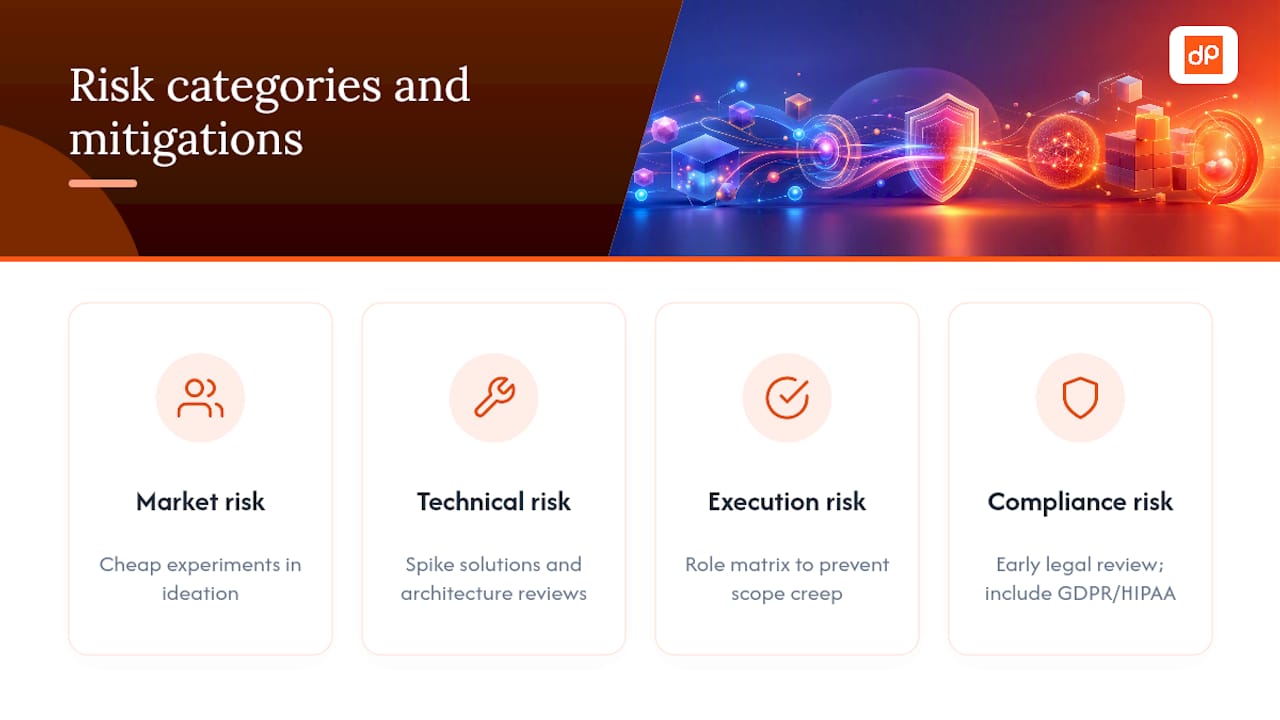
Market risk is the chance nobody wants what you’re building. Mitigate it early, in ideation and validation, with cheap experiments before expensive commitments. Technical risk covers whether the engineering approach can actually deliver at the scale or complexity required. Spike solutions, architecture reviews, and proof-of-concept builds surface this before a team is six sprints deep into an approach that doesn’t scale.
Execution risk shows up as scope creep, missed handoffs, or unclear ownership, which is exactly why the definition phase and the role matrix above matter as much as they do. Regulatory and compliance risk varies heavily by industry. Healthcare products face HIPAA considerations, financial products face data handling and audit requirements, and anything processing European user data needs GDPR compliance built in from the design phase, not retrofitted before launch. Legal review at the planning gate, not the launch gate, catches most of these before they become expensive.
A practical mitigation habit: maintain a lightweight risk register alongside the PRD, updated at every gate. List the risk, its likelihood, its impact, and the owner responsible for watching it. Review it at each go/no-go decision rather than letting it sit untouched until something breaks. Teams that skip this step tend to discover their biggest risk the same week it becomes a crisis, which is a far more expensive way to find out.
Metrics and KPIs to Measure Success at Each Phase
Different phases need different success signals, and applying launch metrics to a discovery-stage prototype (or vice versa) gives you false confidence in either direction.
| Phase | Primary metric | What it tells you |
|---|---|---|
| Ideation | Number of validated problem hypotheses | Whether discovery is producing real signal, not just ideas |
| Validation | Conversion rate on test experiments | Whether demand is real before you commit engineering budget |
| Planning | Scope stability (change requests post-sign-off) | Whether the PRD was thorough enough to hold |
| Prototyping | Learning velocity (hypotheses tested per week) | Whether the MVP is proving or disproving the idea fast enough |
| Design | Usability task success rate | Whether users can complete core flows without help |
| Engineering | Sprint velocity and defect escape rate | Whether delivery is predictable and quality is holding |
| Testing/QA | Test coverage and critical bug count pre-launch | Whether the product is genuinely ready to ship |
| Launch | Activation rate, week-one retention | Whether the product delivers on the validated promise |
Activation rate deserves particular attention because it’s the metric most teams misread. A high install or signup count means nothing if users never reach the moment where your product actually delivers value. Track the specific action that correlates with retention, not the vanity number that looks good in a board deck.
What Most Teams Get Wrong About Running This Cycle
The conventional advice treats the product development life cycle phases as a checklist to complete in order. That’s backwards. The real skill is knowing which phases to compress and which to protect, because treating every phase with equal rigor wastes time on low-risk decisions and rushes the ones that actually matter.
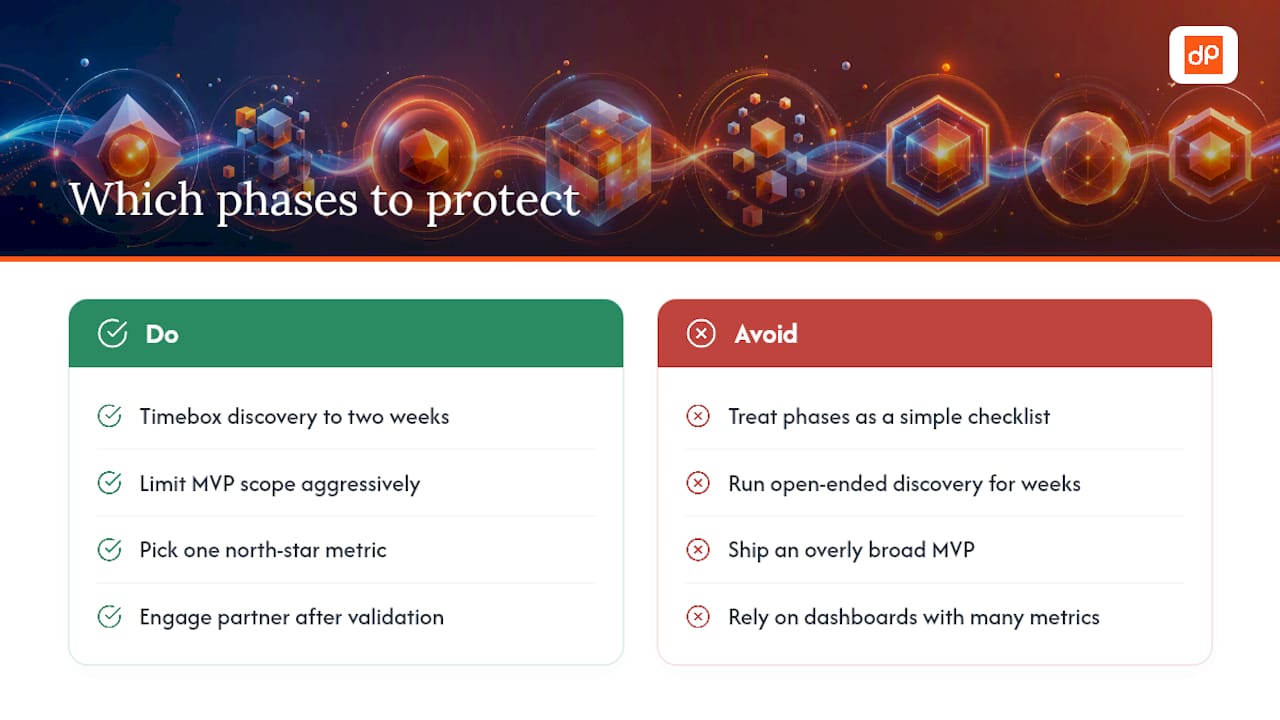
Here’s what I’d tell any product leader running this cycle for the first time. First, timebox discovery hard. Two weeks of structured ideation beats six weeks of open-ended exploration, because teams find diminishing returns past a certain point and start mistaking activity for progress. Second, limit MVP scope more aggressively than feels comfortable. If your MVP doesn’t feel slightly embarrassing in its narrowness, it’s still too broad. Third, pick one north star metric per phase and ignore the rest until that one moves. Dashboards with fifteen metrics produce paralysis, not clarity.
On when to bring in outside engineering help: the right moment is right after validation, once the business case is proven but before your internal team has sunk months into an architecture that might not scale. A partner engaged at that point should deliver a working prototype, a clear technical risk assessment, and a realistic engineering estimate, not just a proposal deck. That’s the gap where a specialized partner earns their fee.
— Vlad
How DevPulse Supports Every Phase of Product Development
Many internal teams hit a gap right after validation: the moment you know the idea works but don’t yet have the engineering capacity or specialized expertise to build it right. Rather than choosing between a slow internal hire cycle and a rushed in-house build, partnering with an external team who plugs directly into whichever phase you’re stuck on can help.
Our product discovery engagements turn a validated hypothesis into an implementation-ready plan, complete with technical risk assessment and realistic scope. When you’re ready to build, our MVP development services get a testable product in front of real users fast, without over-engineering features nobody’s asked for yet. For teams past MVP and scaling, our software development services handle the engineering rigor, testing discipline, and observability that production systems demand. Explore our case studies to see how these phases play out on real projects, and reach out when you’re ready to move a validated idea into engineering.
Sources
This guide draws on frameworks from ARAS’s product development process overview, ProductPlan’s product development cycle glossary, Figma’s product development resource library, and Monday.com’s product development process guide. Each source is a recognized reference point for product teams defining phases, gates, and deliverables.
- Product development process (Figma resource library)
- Product development cycle (ProductPlan glossary)
- Monday
FAQ
What Are the 5 Stages of the Product Development Life Cycle?
A common 5-stage version compresses ideation, validation, and planning into fewer steps, and combines design with engineering into one build phase, ending at launch. The 8-phase framing in this guide simply breaks those same activities into more granular, actionable steps.
What Are the 7 Phases of the Product Development Life Cycle?
Most 7-phase models add either a distinct design phase or a separate post-launch iteration phase to the standard 5-stage structure. Stage-count differences generally come down to whether design is split from engineering and whether post-launch work is explicitly called out.
What Are the 7 Steps of R&D in Product Development?
R&D-specific processes typically mirror the broader PDLC but front-load technical feasibility work: idea screening, concept development, feasibility research, prototyping, testing, engineering refinement, and commercialization. The core logic matches the 8-phase model, with heavier emphasis on technical validation before design work begins.
How Is Product Development Different From the Product Life Cycle?
Product development ends at launch, while the product life cycle covers what happens after, tracking a product through market introduction, growth, maturity, and eventual decline. The phases in this guide describe development; the life cycle describes what happens once the product is live and competing in its market.
Which Phase of Product Development Is Most Important?
Prioritization and validation carry the most weight, since decisions made there are largely irreversible once engineering commits resources. A weak idea that clears screening wastes far more budget than a strong idea that gets delayed.