











An MVP in software development is the smallest functional product that can complete a build-measure-learn cycle and validate a riskiest assumption with the least development effort. The term minimum viable product was coined in 2001 by Frank Robinson and later popularized by Steve Blank and Eric Ries, making it a relatively recent but foundational idea in product development (history of the minimum viable product).
You may be facing the problem right now. A large software renewal has a signed roadmap, an approved budget, and a delivery team, yet nobody has proved that users will adopt the new workflow, that the architecture can support the critical integration, or that security and compliance requirements fit the proposed design. The team can build for months and still learn too late that it solved the wrong problem.
An MVP changes the order of decisions. Instead of treating “minimum” as the smallest possible feature list, treat it as a boundary around the riskiest hypothesis. Build only enough of the product, process, and controls to test that hypothesis with real users, collect evidence, and decide what deserves investment next.
Table of Contents
- Why Software Teams Build an MVP First
- Understanding the Core MVP Concept
- Comparing Practical MVP Types
- Seeing How MVP Examples Work
- Connecting MVP to Product Discovery
- Recognizing MVP Benefits and Risks
- Applying MVP Practices in Enterprises
- Using Evidence to Guide the Next Product Decision
Why Software Teams Build an MVP First
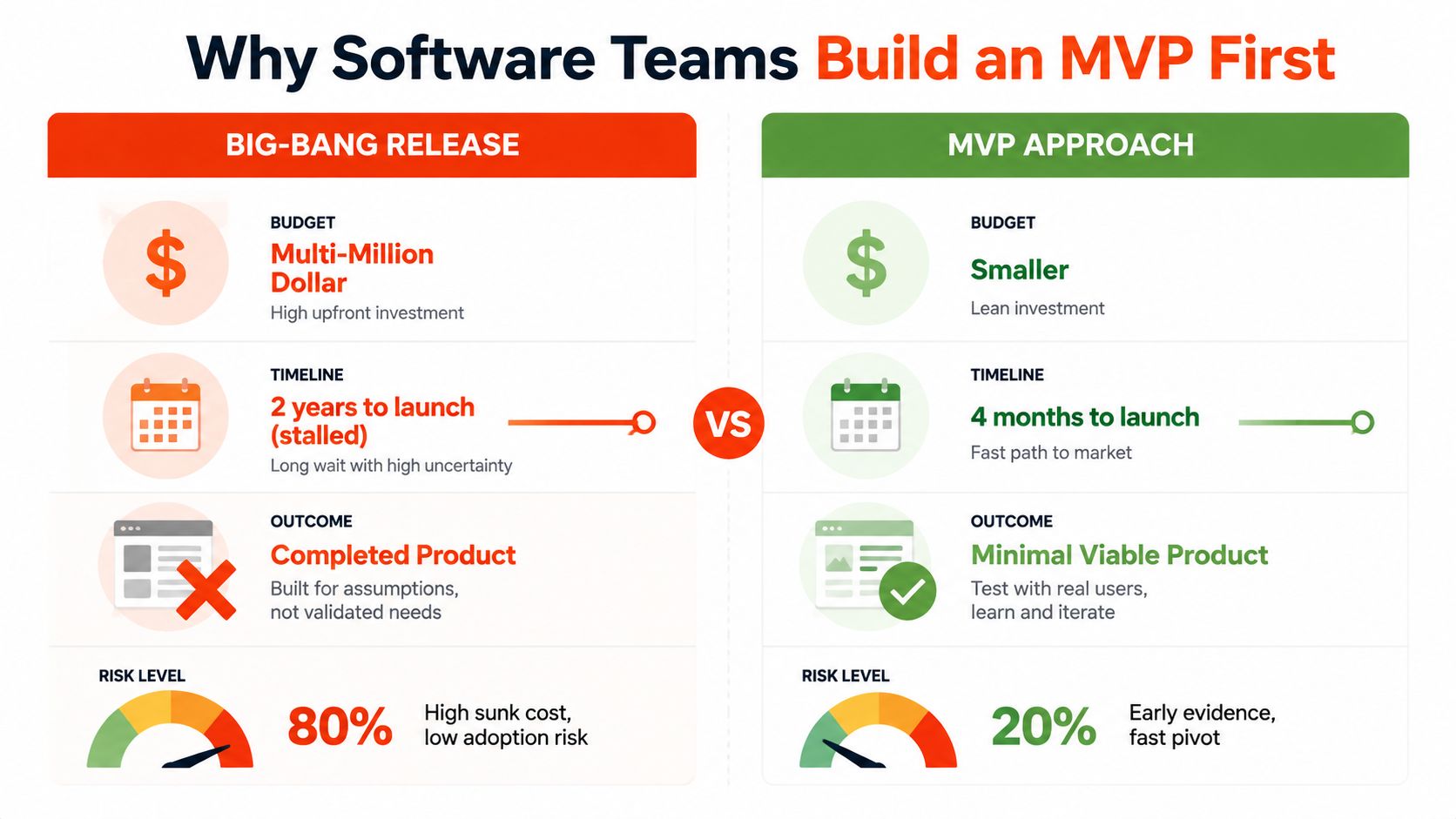
A large enterprise platform renewal often begins with reasonable intentions. A business sponsor wants to replace aging systems, improve reporting, reduce manual work, and give several departments a shared experience. The roadmap expands to include role management, integrations, dashboards, workflow automation, analytics, administration, and migration tooling.
Two years later, the organization may have a technically impressive release that users avoid because the workflow doesn't match how they work. The compliance team may object to the audit model. An integration may perform poorly under real conditions. The product group has then accumulated substantial sunk cost before discovering assumptions that a narrower release could have tested much earlier.
An MVP gives the team a smaller learning surface. It might include one workflow for one department, a controlled data set, and enough instrumentation to observe completion, errors, and repeated use. The release isn't valuable because it has fewer screens. It's valuable because it answers a decision-critical question before the organization commits to the rest of the system.
The three pressures an MVP addresses
- Portfolio risk: Leaders can compare evidence from a focused initiative with competing investments instead of funding a broad concept on confidence alone.
- Capital discipline: Teams limit early development to the work required for a meaningful test, reducing exposure when demand, feasibility, or workflow fit remains uncertain.
- Stakeholder alignment: Product, engineering, security, legal, and operations teams can react to the same observed behavior rather than debating a future-state presentation.
This approach doesn't mean an enterprise team should ignore the final architecture or regulatory obligations. It means the team should distinguish between necessary safeguards and premature scope. Authentication, access controls, data handling rules, and audit requirements may belong in the first release. A complex reporting suite may not.
For a broader view of how iterative delivery supports product work, mastering agile in product development provides useful context. The practical lesson is simple: an MVP is an investment in information. It helps leaders decide whether to continue, change direction, or stop before the organization confuses delivery progress with product progress.
Understanding the Core MVP Concept
A software MVP is the smallest functional release that can test a specific hypothesis with real users and complete the build-measure-learn loop. Gartner describes an MVP as a release used to validate customer needs before developing a fuller product, while ProductPlan connects the approach to validated learning with the least effort (Atlassian's MVP guide).
The word “minimum” describes a decision boundary, not a number of features. Ask, “What must exist for a user to perform the behavior that tests our riskiest assumption?” Everything outside that path is a candidate for later work, unless it protects security, compliance, reliability, or the integrity of the experiment.
Build, measure, learn
- Build: Create the smallest usable path that tests the assumption. If the question is whether claims reviewers can complete a new approval flow, the build might include intake, review, decision, and audit capture. It doesn't need every possible claim type.
- Measure: Observe behavior and operational signals, not just stated enthusiasm. Instrument completion, abandonment, errors, time in workflow, support requests, and qualitative feedback where those signals relate to the hypothesis.
- Learn: Compare evidence with the decision rule. The team may persevere, iterate, pivot, or stop. A result that disproves the assumption is useful if it prevents a larger investment in the wrong direction.
A product discovery process helps identify the assumption before engineers start building. For a useful overview of product development lifecycle stages, connect the MVP to the wider sequence of discovery, design, delivery, validation, and evolution rather than treating it as an isolated shortcut.
What an MVP isn't
A prototype explores an idea, often through sketches, clickable screens, or simulated interactions. It can test comprehension and usability without implementing a working service.
A proof of concept tests whether a technical approach can work. It might validate an integration, algorithm, data pipeline, or performance constraint while offering little user value.
An MVP combines enough functional product behavior with a measurable user or business test. It may use temporary components, but users must be able to produce evidence relevant to the decision.
A production-ready release meets the organization's broader expectations for scale, resilience, supportability, and operational maturity. An MVP can be production-facing, especially in an enterprise pilot, but it doesn't automatically represent the final operating model.
Comparing Practical MVP Types
Different risks call for different MVP shapes. A team validating willingness to pay needs evidence of commitment or sustained use. A team validating usability needs a coherent interaction. A team validating technical feasibility may need a narrow integration rather than a complete product.
| MVP type | Best learning objective | Enterprise example | Main limitation |
|---|---|---|---|
| Concierge MVP | Validate workflow value through human delivery | A service team manually prepares compliance summaries for selected clients | Manual work can hide automation complexity |
| Wizard-of-oz MVP | Test the user experience before automating the back end | A portal appears to generate recommendations while specialists prepare them behind the scenes | Users may respond to a service that won't scale as designed |
| Single-feature MVP | Test one focused capability in a real environment | A claims platform launches only document classification for one operational team | It may not reveal adjacent workflow dependencies |
| Design MVP | Test usability, comprehension, and trust | A clickable onboarding wizard helps a regulated fintech team assess whether applicants understand consent steps | It doesn't prove production integration or data handling |
| Open-source or internal tool MVP | Validate adoption and technical usefulness inside a known community | An engineering team releases a narrow observability utility for internal platform users | Internal enthusiasm may not translate into external demand |
A concierge approach works when the team needs to learn whether the outcome matters, not whether automation is already efficient. A wizard-of-oz model is useful when a polished user journey must be tested before expensive backend work begins. A single-feature release is stronger when the product already has a clear operational setting and one capability carries most of the uncertainty.
Use the form deliberately:
- Willingness to pay: Choose a concierge or narrow service MVP that exposes real commitment, not only opinions.
- Compliance: Choose a controlled pilot or technical MVP that tests the required data, access, retention, and audit behavior.
- Usability: Choose a design MVP or wizard-of-oz experience that lets representative users complete the critical journey.
The smallest experiment can also be a landing page, concierge service, wizard-of-oz test, or video, because the goal is validated learning rather than a polished feature set (Lean Startup and build-measure-learn examples). The right form is the one that produces trustworthy evidence about the uncertainty that could invalidate the investment.
Seeing How MVP Examples Work
Consider an internal workflow tool for a large organization. The team suspects that a department loses time because approvals move through email and spreadsheets, but it hasn't proved that staff will adopt a shared queue. Rather than support every department, exception type, and escalation path, the team releases one approval journey to one department.
The test includes identity integration, role-based access, status history, and audit logging. It excludes broader reporting and cross-department routing. The team observes completion behavior, abandonment, exception handling, and interviews with the people who approve and receive work. Governance remains intact because the pilot uses controlled access and appropriate data handling, even though the feature scope is narrow.
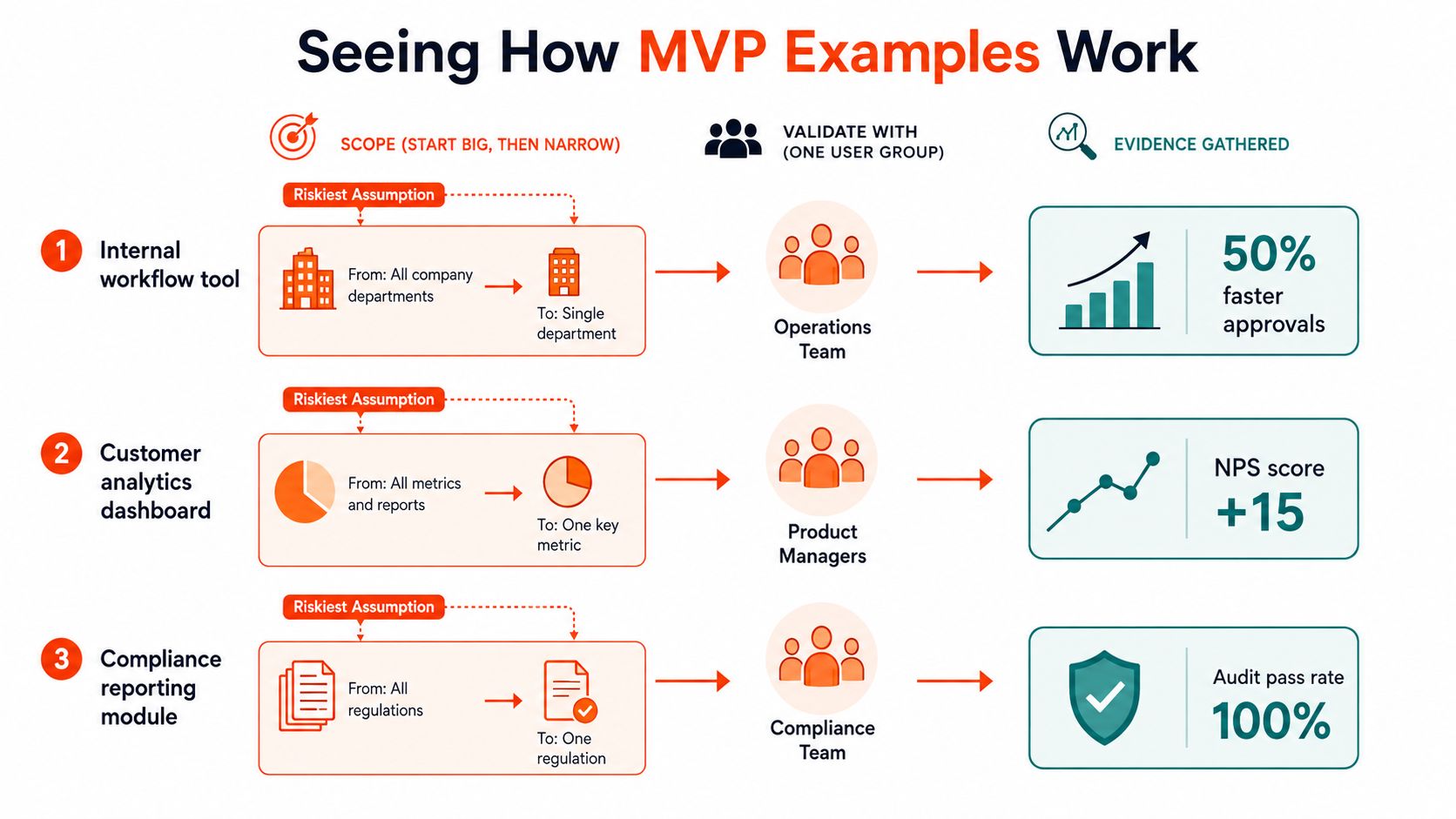
A regulated fintech team faces a different uncertainty. It wants to know whether applicants can complete an onboarding sequence that includes identity checks, consent, and document submission. A clickable wizard can test language, sequence, and perceived trust with a small, carefully selected cohort before the organization builds every integration.
The wizard can't prove that production verification will succeed. That isn't its purpose. The team can still protect the experiment by avoiding unnecessary personal data, using synthetic or controlled records, documenting consent behavior, and involving security and compliance reviewers before the test begins.
A data platform presents a third shape. Its sponsors want a broad lakehouse, but the immediate question is whether analysts can act on one high-value data product. The MVP exposes one use-case dashboard for design partners, with a defined data lineage, controlled access, and observable refresh behavior.
The surface looks like an analytics product, but the learning objective concerns data quality, workflow fit, and trust. The team doesn't need to build every dashboard or support every source system to learn whether this use case is viable. It does need enough lineage and operational visibility for users and reviewers to judge the result.
For interface decisions in enterprise settings, enterprise UX and UI design best practices can complement the experiment design. A narrow MVP still needs a credible experience, because confusing interactions can create false negative feedback.
These examples differ in form, but they follow the same discipline:
Minimum means the smallest path that creates actionable evidence, not the smallest collection of screens.
Connecting MVP to Product Discovery
Product discovery identifies the assumptions that could make an initiative fail. Those assumptions usually concern desirability, value, feasibility, viability, or operational fit. An MVP becomes justified only when a functional release is the most credible way to test one of those assumptions.
Start with a hypothesis that names the actor, behavior, and expected outcome. “Employees will like a better approval tool” is too vague. “Reviewers in the selected department will complete the defined approval journey in the controlled system and prefer it to email-based handling” gives the team something observable.
Then connect five elements.
Hypothesis
Write the riskiest assumption in a form that could be supported or weakened by evidence. Separate user behavior from technical feasibility. A team may need one experiment to test whether people want a workflow and another to test whether the workflow integrates with a legacy system.
Minimum user journey
Map the shortest path from entry to the behavior under test. Remove secondary roles, edge cases, settings, and reports unless they affect the hypothesis or protect the experiment. The journey must still be coherent enough that users aren't forced to judge an artificial fragment.
Signals
Combine quantitative instrumentation with qualitative observation. Product analytics can show where users stop or repeat actions. Interviews, usability sessions, support conversations, and reviewer notes can explain why. The MVP should make those signals available by design, not attempt to reconstruct them after launch.
Decision threshold
Define what evidence will trigger each response before the team becomes attached to the build. The threshold may involve activation, successful completion, repeated use, error patterns, stakeholder acceptance, or a feasibility finding. It should lead to one of four decisions: continue the current scope, iterate, pivot the hypothesis, or stop.
Feasibility guardrails
Architecture, security, privacy, compliance, and data residency can determine whether evidence is trustworthy. A test that bypasses access controls may demonstrate a workflow while teaching the team nothing about whether the product can operate safely. An assumption map or opportunity tree can show where these constraints belong, while lightweight experiment design keeps the release focused.
The product discovery process in agile works best when discovery continues after launch. New evidence updates the assumption map and changes the next bet. The MVP isn't a delivery milestone that ends discovery. It's an evidence-producing step inside a continuing product strategy.
Recognizing MVP Benefits and Risks
An MVP can provide earlier evidence on demand, limit sunk cost around unproven ideas, expose architectural and integration risks, align delivery teams with sponsors, and create a shared language for investment decisions. Those benefits appear only when the team designs the release around learning rather than using “MVP” as a softer name for a rushed first version.
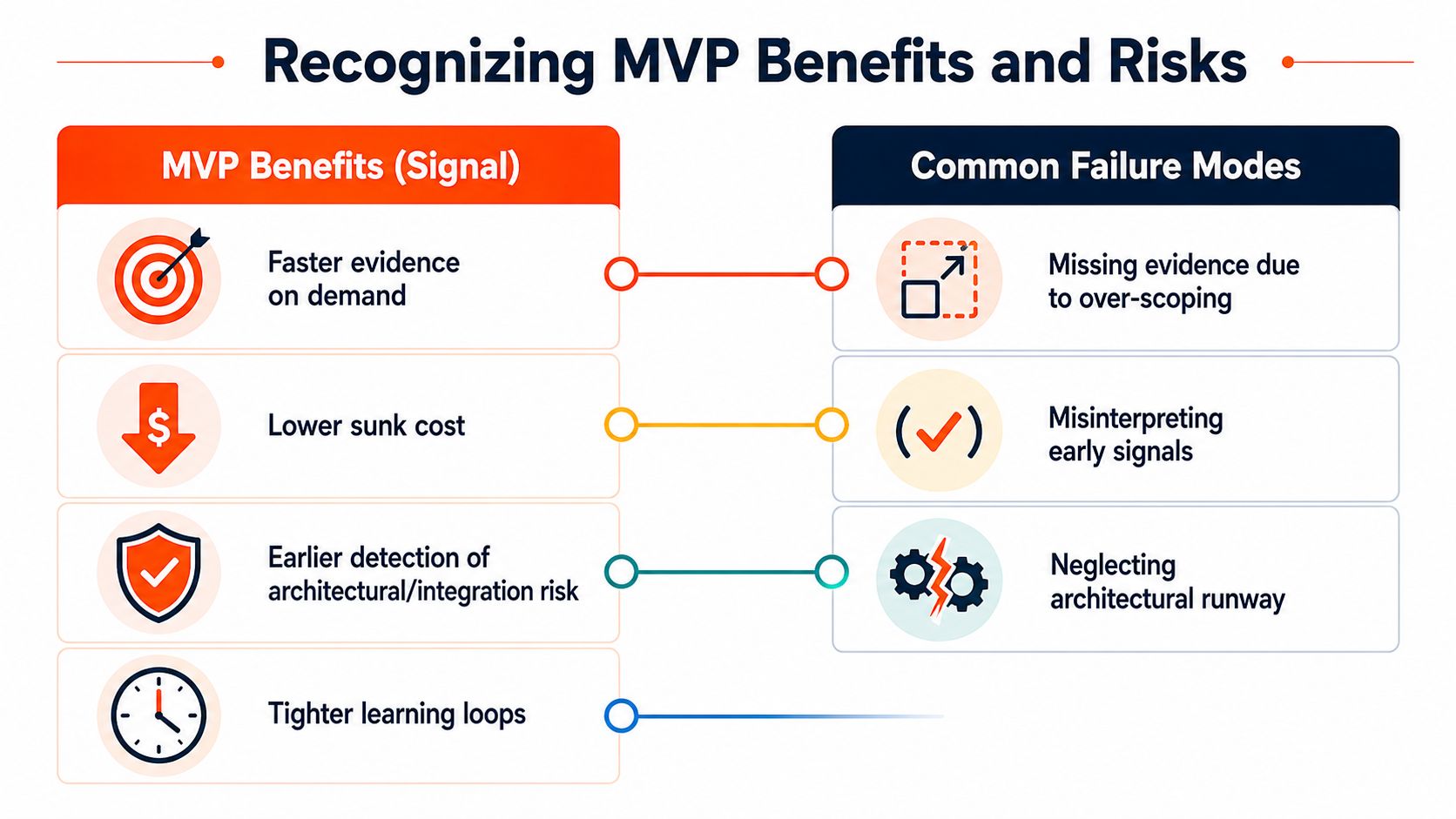
Several failure modes deserve direct attention:
- A disguised demo: If the release has no hypothesis, instrumentation, or decision rule, stakeholders are evaluating presentation quality rather than product evidence. Write the learning objective first and reject features that don't support it.
- Premature scaling: If the team expands users, integrations, or infrastructure before proving feasibility, the MVP recreates the risk of a broad launch. Keep the cohort and operational surface controlled until the critical uncertainty is resolved.
- Weak user experience: A rough interface can cause abandonment for reasons unrelated to the underlying value. Reduce visual and interaction noise, then test whether the experience is credible enough to elicit honest behavior.
- Ungoverned production data: Early experimentation can expose sensitive information or create audit gaps. Use synthetic or minimized data where possible, classify what remains, and establish access and retention controls before release.
- Polite feedback: Users may praise an idea without changing behavior. Treat interviews as context, then compare statements with completion, repeated use, workarounds, and other observable signals.
Negative evidence is a product asset when the team records it and acts on it.
A risk register should name the owner of each assumption, the evidence required, and the decision forum that will review it. Security and compliance reviewers shouldn't appear only after the experiment has generated momentum. Their participation helps distinguish a useful MVP from a misleading demonstration.
Applying MVP Practices in Enterprises
Enterprise teams can preserve MVP speed without removing the controls that make results credible. The operating model starts by separating minimum product scope from minimum enterprise readiness.
Architecture runway should support fast deployment without forcing the experiment into an unreviewed environment. Identity integration, single sign-on, role-based access control, secure secrets handling, encryption, data classification, and audit logging may be essential from the first controlled release.
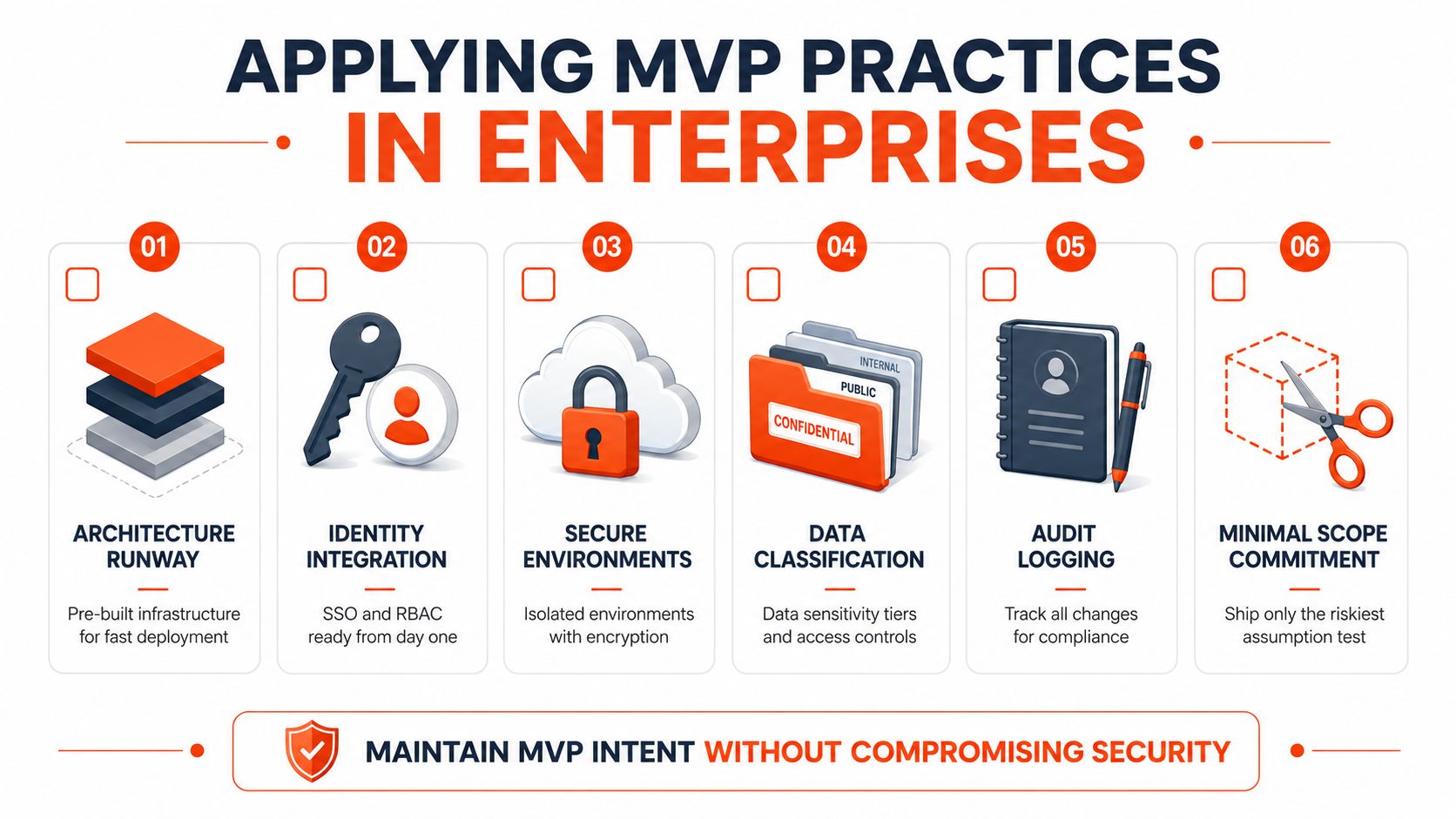
Use the following operating sequence:
- Name the assumption owner: A product lead owns the learning question, while engineering, security, compliance, and operations own their relevant constraints.
- Prepare the environment: Use isolated tenants, synthetic data, controlled identities, and automated pipelines so the team can release quickly without improvising access or deployment practices.
- Instrument the journey: Capture events, errors, latency, completion, and abandonment. Add observability that lets engineers distinguish a product problem from an infrastructure problem.
- Protect iteration: Feature flags and reversible releases allow the team to adjust scope without exposing every user to unfinished behavior.
- Set the funding gate: A sponsor or decision forum reviews the evidence against the predefined threshold before approving expansion.
- Document the outcome: Record what the team learned, what remains uncertain, and whether the next step is iteration, expansion, pivot, or termination.
The definition of done should include security review, compliance evidence, operational ownership, and rollback planning. It shouldn't require every future capability. This distinction lets an organization test a narrow workflow while maintaining contractual and regulatory baselines.
For teams modernizing complex systems, custom software development for enterprise provides relevant context on discovery, architecture, delivery, integration, and ongoing support. A consultancy such as devPulse can contribute across those areas, including MVP definition, custom development, DevOps, security-conscious architecture, and product iteration.
Using Evidence to Guide the Next Product Decision
Validated learning is the MVP's real output. The team combines predefined metrics, qualitative observations, adoption behavior, operational data, and feasibility findings to decide what happens next.
A strong decision record answers four questions:
- Iterate: Which part of the current journey should change?
- Expand: Which adjacent user group or use case is now worth testing?
- Pivot: Which underlying assumption needs a different solution?
- Terminate: Which evidence shows that further investment isn't justified?
Document the result even when the initiative stops. Future teams need the reasoning, evidence, and unresolved constraints, not a polished story about why the original roadmap continued.
The most useful answer to “what is MVP in software development” is therefore not “a small first release.” It's a disciplined method for making faster, cheaper, and safer portfolio decisions. The team builds only what the riskiest assumption requires, measures behavior in a credible environment, and lets evidence determine the next investment.
If your enterprise needs to test a product idea without overlooking architecture, security, compliance, or workflow fit, visit devPulse to explore discovery, MVP development, custom software engineering, and ongoing platform support. Bring a high-risk assumption or stalled modernization initiative, and use that starting point to define a focused experiment with a clear decision path.