














Web design architecture is the structured arrangement of components, data flows, and infrastructure decisions that determines how a web application scales, performs, and evolves over time. The term “web design architecture” is commonly used, but the recognized industry term is web application architecture, which encompasses both software structure (how code is organized) and system structure (how infrastructure is arranged). Getting both layers aligned is what separates systems that hold up under load from those that fail at the worst moment.
Before you read further, here are the three decisions that matter most:
- Start with a monolith if your team is small (under 10 engineers), your traffic is unproven, and time-to-market is the primary constraint. A well-structured monolith ships faster and is easier to reason about.
- Move to microservices when you have independent scaling needs, multiple teams owning separate domains, and the operational maturity to run distributed systems. Splitting too early is one of the most common and costly architectural mistakes.
- Choose serverless or edge when your workload is event-driven, globally distributed, or highly variable in traffic, and when your team can accept vendor-managed infrastructure in exchange for reduced operational overhead.
The most important architectural constraints are not technical. They are scale, team skills, data consistency requirements, latency targets, and cost tolerance. Every architecture decision should be traceable back to at least one of these five dimensions.
Key Takeaways
Sound web application architecture is built on five decisions: the right architecture style for your scale and team, a data consistency model matched to your workload, a communication pattern that limits coupling, an observability stack in place before production, and documented ADRs that make trade-offs explicit.
| Point | Details |
|---|---|
| Match architecture to team size | Monoliths fit teams under 15 engineers; microservices require 30+ with distributed systems experience. |
| Containerize from day one | Docker and Kubernetes provide environment parity and simplify scaling before and after service decomposition. |
| Observability is not optional | Prometheus metrics, OpenTelemetry traces, and structured logs must be in place before the first production deployment. |
| Document decisions with ADRs | Architecture Decision Records stored in the codebase prevent costly “why did we build it this way?” rework. |
| Devpulse for modernization | Devpulse designs and implements web application architectures for SaaS, enterprise, and AI-powered products. |
Table of Contents
- What web application architecture actually means
- Core components of modern web architecture
- Architecture styles and when each one fits
- How a web request flows from browser to database and back
- Data and state management patterns
- API and inter-service communication patterns
- Deployment and infrastructure primitives
- Non-functional requirements: security, scalability, observability, and resilience
- How to choose an architecture: decision checklist and ADR template
- Reference architectures for common use cases
- Practical implementation checklist for the first 90 days
- Lessons from modernization and scaling projects
- The architecture decision most teams get wrong
- Devpulse builds the architecture your product actually needs
- Sources
What web application architecture actually means
Web application architecture defines how the components of a system, its presentation layer, business logic, data stores, and infrastructure, are organized and how they communicate. It is not a single diagram. It is a set of decisions that determine how your system behaves under load, how quickly you can ship changes, and how much it costs to operate.
The distinction between software architecture (how code is structured) and system architecture (how hardware, networks, and services are arranged) matters more than most teams acknowledge. Misaligning the two causes production failures that are difficult to diagnose: a microservices codebase deployed on a single VM, or a monolith that assumes shared memory deployed across stateless containers. Treating these as separate concerns, then reconciling them deliberately, is a prerequisite for reliable systems at scale.
The foundational principles come from two canonical sources. Roy Fielding’s work on principled design of the modern Web architecture establishes separation of concerns, generic interfaces, and intermediary components (proxies, caches, gateways) as the mechanisms that allow components to evolve independently and reduce latency. The W3C Web Architecture formalizes how URIs identify resources, how representations carry state, and how interaction protocols govern communication between agents.
Three principles deserve particular attention:
- Separation of concerns: each component should have a single, well-defined responsibility. A component that handles both business logic and database access is harder to test, scale, and replace.
- Generic interfaces: components should communicate through stable, well-defined contracts. This is what makes it possible to swap a PostgreSQL instance for a read replica, or replace a cache layer, without rewriting the application.
- Self-descriptive messages: requests and responses should carry enough context for intermediaries (load balancers, CDNs, API gateways) to process them correctly without out-of-band knowledge.
Amdahl’s Law is worth keeping in mind throughout: the maximum speedup from parallelizing a system is limited by its sequential portions. No amount of horizontal scaling compensates for a bottleneck in a single-threaded database write path or a synchronous external API call.
Core components of modern web architecture
Every production web system is composed of a predictable set of building blocks. Understanding what each one does, and where it fails, is the foundation of sound web architecture design.
The components you choose are less important than understanding the failure mode of each one and designing for graceful degradation when that failure occurs.
DNS and TLS termination. DNS resolves hostnames to IP addresses. Cloudflare and similar edge providers handle TLS termination at the network edge, reducing latency and offloading certificate management from your application servers. A misconfigured TTL is one of the most common causes of slow failover during incidents.
Load balancer and API gateway. NGINX serves as both a high-performance reverse proxy and a load balancer. An API gateway adds authentication, rate limiting, request routing, and protocol translation on top of basic load balancing. These two components often overlap in practice; the distinction matters when you need per-route policies.
Web and application servers. The runtime layer executes your business logic. Node.js is a common choice for event-driven I/O workloads because its non-blocking model handles high concurrency without spawning threads per connection. For CPU-bound workloads, Go, Java, or .NET runtimes are better fits.
Caching tier. Redis is the standard in-memory cache for session storage, rate limiting counters, and hot-read acceleration. The most common failure mode here is a cache stampede: when a popular key expires and hundreds of requests hit the database simultaneously. Probabilistic early expiration or a mutex lock on cache population prevents this.
Relational and document databases. PostgreSQL handles transactional workloads, complex queries, and strong consistency requirements. For document-oriented or schema-flexible data, NoSQL stores trade ACID guarantees for horizontal write scalability. The choice is rarely either/or; most production systems use both.
Message brokers. Apache Kafka handles high-throughput event streaming, audit logs, and event sourcing. RabbitMQ is better suited to task queues, work distribution, and scenarios where message acknowledgment and routing flexibility matter more than raw throughput. Both decouple producers from consumers, which is the primary architectural benefit.
CDN. AWS CloudFront and Cloudflare distribute static assets and cached responses globally, reducing origin load and cutting latency for geographically distributed users. CDNs also absorb DDoS traffic before it reaches your infrastructure.
Container runtime and orchestration. Docker packages application code and its dependencies into portable images. Kubernetes orchestrates those containers across a cluster, handling scheduling, health checks, rolling deployments, and autoscaling. Together, they provide environment parity from development through production.
Observability stack. Metrics, distributed traces, and structured logs are not optional. Without them, you are operating blind. Prometheus collects metrics, Jaeger or OpenTelemetry handles distributed tracing, and a centralized log aggregator (Elasticsearch, Loki, or a managed equivalent) makes logs queryable. These three signals together let you diagnose latency regressions, error spikes, and capacity issues before they become outages.
Authentication and authorization. OAuth 2.0 and OpenID Connect are the standard protocols for delegated authentication. Authorization logic belongs in a dedicated service or middleware layer, not scattered across individual endpoints.
Architecture styles and when each one fits
Microsoft’s architecture guidance catalogs the major styles clearly. Each has a primary use case, a set of trade-offs, and a failure mode that becomes apparent only at scale.
Monolithic architecture packages all application functionality into a single deployable unit. It is the right starting point for most new products. Deployment is simple, local development is fast, and there are no distributed system failure modes to manage. The failure mode is coupling: as the codebase grows, changes in one area break unrelated areas, and the deployment unit becomes too large to release safely at high frequency.
Layered (N-tier) architecture organizes a monolith into horizontal layers: presentation, business logic, and data access. This is the default structure for most enterprise applications. It enforces separation of concerns within a single process and is easy to reason about, but it does not solve the deployment coupling problem.
Microservices decompose the system into independently deployable services, each owning its data. This enables independent scaling, independent release cycles, and fault isolation. The operational cost is significant: you now manage service discovery, distributed tracing, inter-service authentication, and eventual consistency across service boundaries. Teams smaller than 30–50 engineers rarely have the capacity to absorb this overhead productively.
Serverless runs functions in response to events, with infrastructure managed entirely by the cloud provider (AWS Lambda, Azure Functions, GCP Cloud Run). Cold start latency and vendor lock-in are the primary trade-offs. Serverless is well-suited to event-driven workloads, background jobs, and APIs with highly variable traffic.
Event-driven architecture uses message brokers (Kafka, RabbitMQ) to decouple producers and consumers. It excels at high-throughput data pipelines, audit trails, and systems where downstream processing can be asynchronous. The complexity is in managing event schemas, ordering guarantees, and consumer group offsets.
Edge architecture moves compute closer to users using edge functions (Cloudflare Workers, Lambda@Edge). It reduces latency for personalization, A/B testing, and authentication at the network edge. The constraint is that edge runtimes have limited compute budgets and restricted access to stateful services.
The table below maps each style against the decision dimensions that matter most:
| Architecture | Scale & traffic | Operational complexity | Cost & time-to-market | Fault isolation | Latency & distribution | Data consistency | Vendor lock-in | Security & compliance |
|---|---|---|---|---|---|---|---|---|
| Monolith | Low–medium | Low | Low cost, fast TTM | Poor (single failure domain) | Single region | Strong (single DB) | Low | Easier to audit |
| Layered N-tier | Medium | Low–medium | Low cost | Moderate | Single region | Strong | Low | Straightforward |
| Microservices | High | High | High cost, slower TTM | Strong | Multi-region capable | Eventual (by default) | Low–medium | Complex (per-service) |
| Serverless | Variable/spiky | Very low | Pay-per-use, fast TTM | Strong | Global (with edge) | Eventual | High | Shared responsibility |
| Event-driven | Very high | Medium–high | Medium | Strong | Async (higher latency) | Eventual | Medium | Requires audit trail |
| Edge | High, global | Low–medium | Low–medium | Moderate | Very low (edge PoPs) | Limited | High | Jurisdiction-sensitive |
On incremental evolution: containerizing a monolith with Docker delivers immediate benefits (environment parity, easier horizontal scaling) and is a pragmatic step before any service decomposition. The path from monolith to microservices should be driven by a specific pain point, a team ownership boundary, or an independent scaling need, not by architectural fashion.
Pro Tip: Before splitting a monolith into microservices, identify the specific bounded context that is causing the bottleneck. Splitting along technical layers (e.g., “the database service”) rather than business domains creates distributed monoliths that are harder to operate than the original.
How a web request flows from browser to database and back
Understanding the end-to-end request lifecycle tells you where latency accumulates and where failures propagate.
-
DNS resolution. The browser queries a DNS resolver for the domain’s IP address. Cloudflare’s 1.1.1.1 or AWS Route 53 returns the address, often with a short TTL for failover flexibility. DNS lookup adds 20–120ms on a cold start; subsequent requests use the cached result.
-
TLS handshake. The client and server negotiate a TLS session. TLS 1.3 reduces this to one round trip. Session resumption (via session tickets or 0-RTT) eliminates the handshake cost on reconnection. This step is where certificate misconfiguration causes hard failures.
-
Edge and CDN. Cloudflare or CloudFront intercepts the request at the nearest point of presence. Static assets (JS bundles, images, fonts) are served directly from cache. Dynamic requests are forwarded to the origin. Cache hit rates above 80% are achievable for content-heavy sites and dramatically reduce origin load.
-
Load balancer / API gateway. NGINX or a cloud load balancer distributes the request across healthy application instances. The API gateway applies rate limiting, authentication token validation, and request routing before the request reaches application code.
-
Application runtime. The application server processes the request: validates input, applies business logic, and determines what data it needs. This is where most latency is introduced by inefficient queries, synchronous external calls, or missing indexes.
-
Cache lookup. Before hitting the database, the application checks Redis for a cached result. A cache hit returns in under 1ms. A cache miss triggers a database query, which should then populate the cache for subsequent requests (cache-aside pattern).
-
Database query. PostgreSQL executes the query. Connection pooling (PgBouncer is the standard tool) prevents connection exhaustion under load. Slow query logs and EXPLAIN ANALYZE are the primary tools for diagnosing query performance.
-
Async queues. For operations that do not need to complete synchronously (email delivery, report generation, webhook dispatch), the application publishes a message to Kafka or RabbitMQ and returns immediately. A background worker processes the job asynchronously.
-
Response assembly and delivery. The application assembles the response, applies HTTP caching headers (Cache-Control, ETag), and returns it to the client via the load balancer and CDN. HTTP/2 multiplexing and HTTP/3’s QUIC transport reduce head-of-line blocking for clients fetching multiple resources.
Pro Tip: Instrument every hop with OpenTelemetry spans. A distributed trace that shows DNS → TLS → gateway → app → DB → queue latency per request is the single most effective tool for diagnosing where a performance regression was introduced.
Data and state management patterns
The data layer is where most architectural decisions become irreversible. Choosing the wrong consistency model or state management pattern early creates migration work that compounds over time.
Cache-aside is the most common read pattern: the application checks the cache first, fetches from the database on a miss, and writes the result to the cache. Redis is the standard implementation. It works well for read-heavy workloads with tolerable staleness windows.
Write-through caching updates the cache synchronously on every write. This keeps the cache consistent but adds write latency. It is appropriate when read consistency is critical and write throughput is moderate.
Read replicas offload read traffic from the primary database. PostgreSQL’s streaming replication is reliable and widely used. The trade-off is replication lag: a replica may return stale data for a window of milliseconds to seconds after a write.
Stateless services with centralized state store all session and user state in Redis or a database rather than in application memory. This is a prerequisite for horizontal scaling: any instance can handle any request without affinity.
CQRS (Command Query Responsibility Segregation) separates the write model (commands) from the read model (queries). This allows each model to be optimized independently: the write model enforces business rules and consistency, while the read model is denormalized for query performance. CQRS adds complexity and is justified only when read and write patterns diverge significantly.
Event sourcing stores state as an immutable sequence of events rather than as current values. The current state is derived by replaying events. This provides a complete audit trail and enables temporal queries, but it requires careful schema evolution and increases storage and replay complexity.
| Pattern | Consistency | Complexity | Scalability | Recovery |
|---|---|---|---|---|
| Single canonical DB | Strong | Low | Vertical | Point-in-time restore |
| Read replicas | Eventual (reads) | Low–medium | Read horizontal | Replica promotion |
| Cache-aside (Redis) | Eventual (cache) | Low | High read throughput | Cache rebuild on restart |
| Write-through cache | Strong (cache) | Medium | Moderate write | Cache rebuild on restart |
| CQRS | Eventual (read model) | High | Independent scaling | Event replay |
| Event sourcing | Strong (event log) | Very high | High write throughput | Full replay |
Schema evolution in distributed systems deserves explicit planning. Additive changes (new nullable columns, new event types) are safe. Removing or renaming fields breaks consumers. Versioned schemas with a schema registry (Confluent Schema Registry for Kafka) enforce compatibility contracts across services.
API and inter-service communication patterns
The communication layer shapes how services couple, how failures propagate, and how much operational overhead your team carries.
REST remains the default for public APIs and browser-facing endpoints. Its stateless request model, HTTP caching semantics, and broad tooling support make it the lowest-friction choice. Versioning via URL path (/v1/, /v2/) is the most common approach; header-based versioning is cleaner but less visible. The Fielding REST paper establishes that generic interfaces and self-descriptive messages are what give REST its evolvability.
GraphQL gives clients control over what data they fetch, eliminating over-fetching and under-fetching. It is well-suited to product APIs consumed by multiple client types (web, mobile, third-party). The operational overhead is higher: schema management, query complexity limits, and N+1 query prevention (via DataLoader) require deliberate tooling.
gRPC uses Protocol Buffers for binary serialization and HTTP/2 for transport. It delivers lower latency and smaller payloads than REST for inter-service communication. The trade-off is that browser clients cannot call gRPC directly without a proxy (gRPC-Web or Envoy). It is the right choice for high-throughput internal service calls where latency matters.
- When to use Kafka vs RabbitMQ: Kafka is the right choice for high-throughput event streams, audit logs, event sourcing, and scenarios where consumers need to replay historical events. RabbitMQ fits task queues, work distribution, and routing-heavy scenarios where message acknowledgment and dead-letter handling are the primary concerns.
- Idempotency: every message consumer and API endpoint that mutates state should be idempotent. Assign idempotency keys to writes so that retries do not create duplicate records.
- Retries with exponential backoff: synchronous calls between services should retry on transient failures with exponential backoff and jitter. Without jitter, synchronized retries from multiple clients create thundering herd problems.
- Distributed tracing: propagate trace context (W3C Trace Context headers) across all service calls. Without end-to-end traces, diagnosing latency in a distributed system is guesswork.
Pro Tip: Define your API contract in OpenAPI (for REST) or a .proto file (for gRPC) before writing implementation code. Contract-first design forces you to think about versioning and backward compatibility before you have consumers depending on the current behavior.
Deployment and infrastructure primitives
Infrastructure decisions are not separate from architecture decisions. They shape what your architecture can actually do in production.
Containers and orchestration. Docker packages your application and its runtime dependencies into a portable, immutable image. Kubernetes orchestrates those images across a cluster, providing declarative configuration, automated health checks, rolling deployments, and horizontal pod autoscaling. The combination gives you environment parity from a developer’s laptop to production, which eliminates an entire class of “works on my machine” failures.

Managed platforms vs container orchestration. Azure App Service and equivalent managed platforms (AWS Elastic Beanstalk, GCP App Engine) abstract away cluster management in exchange for less control over the runtime environment. For teams without dedicated platform engineering capacity, managed platforms reduce operational overhead significantly. The trade-off is less flexibility in networking, custom runtimes, and cost optimization at scale.
CI/CD pipeline essentials. A production-grade pipeline builds an immutable Docker image, runs unit and integration tests, pushes the image to a registry, and deploys to a staging environment before promoting to production. Blue/green deployments maintain two identical environments and switch traffic atomically. Canary releases route a small percentage of traffic to the new version, allowing validation before full rollout. Feature flags decouple deployment from release, letting you ship code dark and enable features independently.
Edge, CDN, and serverless. CloudFront and Cloudflare distribute static assets and cached API responses globally. AWS Lambda and Cloudflare Workers run code at the edge without managing servers, which is well-suited to request transformation, authentication, and A/B testing at the network layer. The web.dev PWA architecture guidance covers service worker caching strategies that complement edge caching for offline reliability and perceived performance.
- Immutable infrastructure: never modify a running container in production. Rebuild the image, push it, and deploy. This makes rollbacks deterministic.
- Infrastructure as code: Terraform or Pulumi manages cloud resources declaratively. Drift between your IaC definition and actual infrastructure is a security and reliability risk.
- Secrets management: never bake secrets into container images. Use AWS Secrets Manager, HashiCorp Vault, or Kubernetes Secrets with appropriate RBAC.
Pro Tip: Run your Kubernetes manifests through a linter (kubeval, kube-score) in CI before they reach the cluster. Catching misconfigured resource limits and missing health checks at the PR stage is far cheaper than debugging them in production.
Non-functional requirements: security, scalability, observability, and resilience
Non-functional requirements (NFRs) are the constraints that determine whether a system is actually production-ready. They are frequently underspecified at the design stage and expensive to retrofit.
Security architecture checklist:
- Threat model the system before writing code. STRIDE (Spoofing, Tampering, Repudiation, Information disclosure, Denial of service, Elevation of privilege) is a practical starting framework.
- Apply OWASP Top 10 controls: input validation, parameterized queries, output encoding, and secure HTTP headers (Content-Security-Policy, HSTS, X-Frame-Options).
- Implement zero-trust network policies: services should authenticate each other, not just external clients. mTLS between services is the standard approach in Kubernetes environments.
- Use short-lived tokens (JWT with appropriate expiry) and rotate secrets on a schedule. Never log tokens or credentials.
- Apply least-privilege IAM policies to every service account and cloud resource.
Scalability and cost control:
- Horizontal scaling (adding instances) is more resilient than vertical scaling (larger instances) for stateless services. Kubernetes Horizontal Pod Autoscaler scales on CPU, memory, or custom metrics.
- Database sharding distributes write load across multiple database nodes. It adds significant operational complexity and should be deferred until read replicas and query optimization are exhausted.
- Spot instances (AWS Spot, GCP Preemptible) reduce compute costs by 60–90% for fault-tolerant, interruptible workloads. Pair them with on-demand instances for baseline capacity.
- Caching at every appropriate layer (CDN, API gateway, application, database query cache) is the highest-ROI cost reduction tactic for read-heavy systems.
Observability. The three pillars are metrics (Prometheus), distributed traces (OpenTelemetry), and logs (structured JSON to a centralized aggregator). Define SLIs (Service Level Indicators) for the metrics that matter to users: request latency at p99, error rate, and availability. SLOs (Service Level Objectives) set targets for those SLIs. SLAs are the contractual commitments derived from SLOs.
Resilience patterns:
- Circuit breaker: stops sending requests to a failing downstream service after a threshold of failures, allowing it time to recover. Hystrix and Resilience4j are common implementations.
- Retry with exponential backoff and jitter: prevents synchronized retry storms.
- Bulkhead: isolates thread pools or connection pools per downstream dependency so that one slow service cannot exhaust resources for all others.
- Disaster recovery: define RTO (Recovery Time Objective) and RPO (Recovery Point Objective) before choosing backup strategies. Daily snapshots with a 24-hour RPO are appropriate for some systems; others require continuous replication with near-zero RPO.
How to choose an architecture: decision checklist and ADR template
Architecture decisions made without a documented rationale are the primary source of “why did we build it this way?” confusion six months later. An Architecture Decision Record (ADR) captures the context, the decision, and the consequences in a format that survives team turnover.
Decision checklist:
- Traffic profile: What is your expected peak RPS? Does traffic spike unpredictably? A system expecting 100 RPS has different needs than one expecting 100,000.
- Data needs: Do you need strong consistency, or is eventual consistency acceptable? What are your read/write ratios? Do you need full-text search?
- Team skills: How many engineers do you have? Do they have experience operating Kubernetes, managing distributed systems, or debugging eventual consistency bugs?
- Cost: What is your infrastructure budget? Microservices on Kubernetes cost more to operate than a monolith on a managed platform, especially at low traffic.
- Time-to-market: How quickly do you need to ship? A monolith ships faster initially. Microservices pay off when multiple teams need to release independently.
- Operability: Who will be on-call? What is your incident response maturity? Complex architectures require mature observability and runbooks.
- Compliance: Do you have data residency, HIPAA, SOC 2, or PCI requirements? These constrain where data can live and how it must be encrypted and audited.
Sample ADR fields:
- Title: Short, imperative description (e.g., “Use PostgreSQL as the primary data store”)
- Status: Proposed / Accepted / Deprecated / Superseded
- Context: The problem and constraints driving the decision
- Decision: The choice made and why
- Alternatives considered: What else was evaluated and why it was rejected
- Consequences: What becomes easier, what becomes harder, what follow-up decisions are required
- Follow-ups: Open questions and next ADRs to write
Mapping common scenarios to architecture choices:
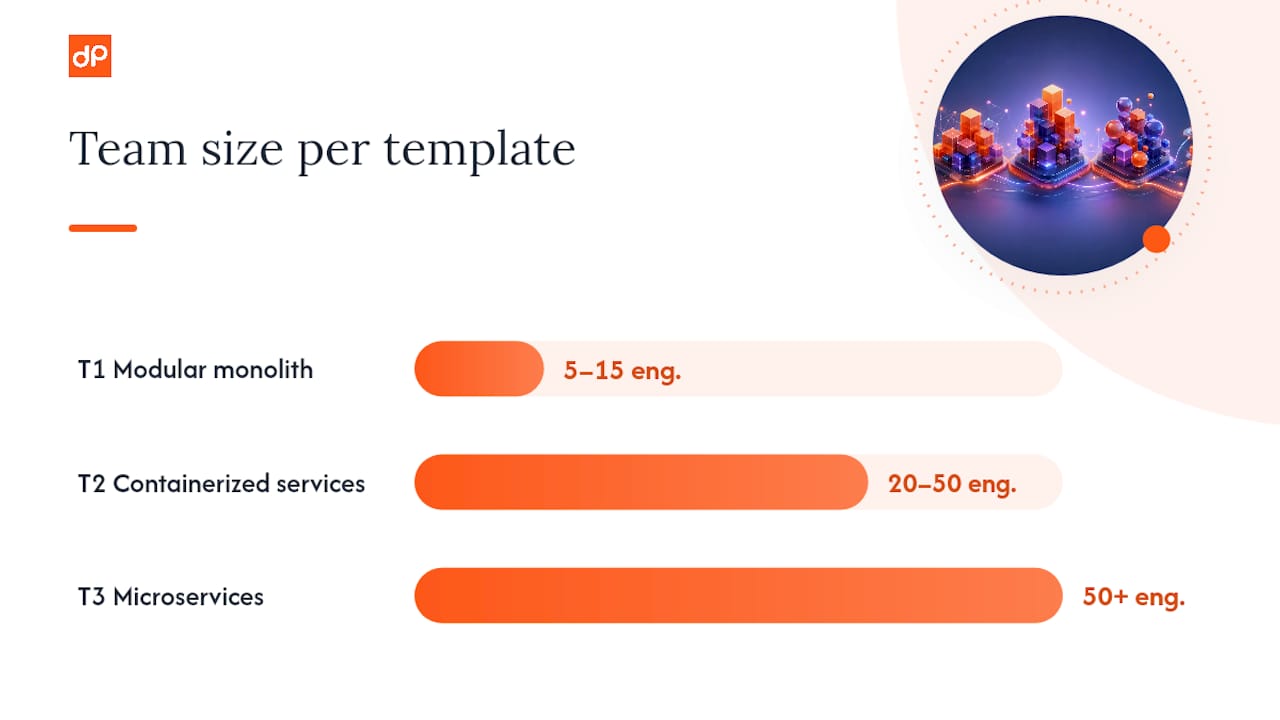
- A SaaS product with a small team (5–15 engineers, early-stage): modular monolith on a managed platform (Azure App Service or AWS Elastic Beanstalk), PostgreSQL, Redis, and a job queue. Containerize with Docker from day one.
- An e-commerce platform with seasonal traffic spikes: containerized services on Kubernetes with autoscaling, CloudFront for static assets, Redis for sessions and cart state, PostgreSQL with read replicas.
- A low-latency streaming service (real-time analytics, live collaboration): event-driven architecture with Kafka, stateless consumers, Redis for ephemeral state, and edge functions for client-facing latency reduction.
Red flags that signal re-evaluation:
- Monitoring gaps: services with no SLOs or no distributed tracing
- Spiking infrastructure costs without corresponding traffic growth
- Feature coupling: a change in one service requires coordinated deployments in three others
- Deployment frequency below once per week for a team of more than five engineers
Pro Tip: Write ADRs in the same repository as the code they govern. An ADR that lives in a Confluence page no one reads is not a decision record. It is archaeology.
Reference architectures for common use cases
These five templates cover the scenarios most engineering teams encounter. Each is a starting point, not a prescription.
Template 1: Modular monolith for early-stage SaaS
A single deployable unit organized into domain modules (billing, users, notifications), deployed as a Docker container on a managed platform. PostgreSQL for persistence, Redis for caching and sessions, a background job queue (Sidekiq, BullMQ) for async work. NGINX as a reverse proxy. This fits a team of 5–15 engineers shipping a new product. The Statista developer survey confirms that the most-used frameworks globally have strong community support, which matters for hiring and long-term maintainability.
Template 2: Containerized services on Kubernetes
Multiple services (each a Docker image) orchestrated by Kubernetes, with NGINX Ingress as the entry point, Redis for shared cache and session state, PostgreSQL per service (or a shared cluster with schema-level isolation), and Kafka for inter-service events. CloudFront or Cloudflare handles CDN and DDoS protection. This fits a team of 20–50 engineers with platform engineering capacity. Microsoft’s architecture guidance notes that containerizing even a monolith delivers immediate operational benefits before any service decomposition.
Template 3: Microservices with event streaming
Fully decomposed services, each owning its data store, communicating via Kafka for async events and gRPC for synchronous calls. An API gateway (Kong or AWS API Gateway) handles external traffic. Kubernetes manages orchestration. This fits large teams (50+ engineers) with clear domain boundaries and the operational maturity to manage distributed tracing, schema registries, and per-service SLOs.
Template 4: Serverless API with edge CDN
AWS Lambda functions behind API Gateway, with DynamoDB or Aurora Serverless for persistence and CloudFront for global distribution. Cloudflare Workers handle edge-layer authentication and request transformation. This fits event-driven workloads, low-traffic APIs, and teams that want to minimize operational overhead. Cold start latency (typically 100–500ms for Lambda) is the primary constraint for latency-sensitive endpoints.
Template 5: PWA with app shell architecture
A Progressive Web App using an app shell cached by a service worker, with API calls to a backend that may be any of the above templates. The web.dev PWA architecture guidance covers service worker caching strategies that enable offline reliability and fast perceived load times. SPAs and MPAs each remain valid patterns; mixing them within a product (SPA for the interactive checkout flow, MPA for the catalog) is a practical approach that optimizes for both performance and SEO.
When to mix patterns: a content-heavy marketing site benefits from MPA rendering (fast initial load, good SEO) while the authenticated product dashboard uses SPA patterns (rich interactivity, no full-page reloads). Architecture decisions at the rendering layer should follow the same decision criteria as the backend: what does this specific part of the product need?
| Use case | Recommended template | Key constraint |
|---|---|---|
| Early SaaS, small team | Modular monolith | Time-to-market, team size |
| E-commerce, seasonal spikes | Containerized services + Kubernetes | Autoscaling, session state |
| Real-time collaboration | Microservices + Kafka | Latency, data sync |
| Event-driven API | Serverless + edge CDN | Variable traffic, low ops overhead |
| Content + interactive product | PWA app shell + MPA catalog | SEO + interactivity balance |
Practical implementation checklist for the first 90 days
Moving from an architecture decision to a shippable, observable system requires a prioritized sequence of steps. The goal for the first 90 days is not perfection. It is a system that is deployable, observable, and safe to iterate on.
- Define your infrastructure as code. Write Terraform or Pulumi configurations for every cloud resource before you provision anything manually. Manual provisioning creates drift that is expensive to reconcile later.
- Build your CI/CD pipeline. Automate build, test, and deployment from day one. A pipeline that builds a Docker image, runs tests, and deploys to staging on every pull request merge is the minimum viable CI/CD setup.
- Instrument observability before you need it. Add OpenTelemetry instrumentation to your application runtime, configure Prometheus metrics, and set up structured logging before your first production deployment. Retrofitting observability into a running system is significantly harder.
- Set up automated testing layers. Unit tests cover individual functions and classes. Integration tests cover service boundaries (database queries, cache interactions, message broker publishing). Contract tests (Pact is the standard tool) verify that API consumers and providers agree on the interface. End-to-end tests cover critical user journeys.
- Configure a staging environment that mirrors production. Staging should use the same Docker images, the same infrastructure configuration, and production-like data volumes. A staging environment that differs significantly from production is not a safety gate.
- Implement feature flags. LaunchDarkly, Unleash, or a simple database-backed flag system lets you deploy code dark and enable features independently of deployment. This is the single most effective risk-reduction tactic for frequent releases.
- Set rate limits and circuit breakers. Apply rate limiting at the API gateway layer from day one. Add circuit breakers to all synchronous calls to external services. These two controls prevent a significant class of production incidents.
- Document your first ADRs. Write ADRs for the three or four most consequential decisions you made (database choice, deployment platform, communication pattern). Future team members will thank you.
Prioritized tooling by responsibility:
- Build: Docker, GitHub Actions or GitLab CI
- Deploy: Kubernetes (Helm for packaging), Terraform
- Monitor: Prometheus, Grafana, OpenTelemetry, PagerDuty
- Secure: HashiCorp Vault, AWS Secrets Manager, Snyk (dependency scanning), OWASP ZAP (DAST)
- Test: Jest/Pytest (unit), Testcontainers (integration), Pact (contract), Playwright (E2E)
Framework selection should account for community size and hiring availability. The Statista developer survey is a useful reference when evaluating which frameworks have the broadest developer community, which directly affects long-term maintainability and team growth. For architecture decisions that affect SEO and accessibility, the rendering strategy (SSR, SSG, CSR) has measurable impact on both, as covered in resources on web accessibility and SEO compliance.
Lessons from modernization and scaling projects
Two Devpulse engagements illustrate how architectural decisions play out in practice.
In the WebAssembly desktop modernization case study, the challenge was preserving decades of performance-critical rendering logic while making the application deployable across platforms without a native installer. The architectural choice was to compile the core rendering engine to WebAssembly, wrapping it in a web-based shell. This preserved the existing logic investment while enabling cross-platform distribution. The lesson: when the core logic is sound, the right architecture decision is often to encapsulate rather than rewrite.
In the real-time collaboration platform case study, a single-user mind-mapping application needed to support concurrent editing by multiple users with conflict resolution and low-latency synchronization. The architecture shifted to an event-driven model with operational transformation for conflict resolution, Redis for ephemeral shared state, and WebSocket connections managed through a stateless gateway. The lesson: real-time collaboration is one of the few use cases where the data synchronization architecture must be designed first, before the application logic, because every other decision depends on the consistency model you choose.
Practical lessons from both engagements:
- Incremental modernization outperforms big-bang rewrites. Strangler Fig pattern (routing new traffic to new services while the legacy system handles existing traffic) reduces risk and allows validation at each step.
- Data migration is the highest-risk phase. Plan for dual-write periods, validation scripts, and rollback procedures before you cut over.
- Time-to-market pressure and long-term operability are in direct tension. The teams that navigate this best are the ones that make the trade-off explicit in an ADR rather than implicit in a deadline.
For teams navigating legacy system modernization, the architectural choices made in the first phase set the constraints for every subsequent phase. Getting those decisions documented and validated early is the highest-leverage investment you can make.
The architecture decision most teams get wrong
The conventional advice in most architecture guides is to “choose the right tool for the job.” That framing is correct but incomplete, and the gap between the advice and its application is where most architectural debt originates.
The real problem is that teams optimize for the architecture they wish they had rather than the one their current constraints support. A five-person team that adopts Kubernetes, Kafka, and a microservices topology because that is what large-scale companies use will spend more engineering time on infrastructure than on product. The architecture is not wrong in the abstract. It is wrong for that team at that stage.
What the evidence from modernization projects consistently shows is that the teams with the best long-term outcomes are not the ones that chose the most sophisticated architecture. They are the ones that chose the simplest architecture that met their current constraints, documented why they made that choice, and built in explicit decision points for re-evaluation. The modular monolith that ships in three months and gets containerized in month four is a better outcome than the microservices design that takes eight months to reach production and has no observability.
The second pattern worth naming: observability is treated as a phase-two concern in most projects. It is not. A system without metrics, traces, and logs is not a production system. It is a system you cannot safely operate. The teams that instrument from day one make better architecture decisions in months two through twelve because they have data. The teams that defer observability are making decisions based on intuition and incident reports.
One more thing the conventional guides understate: the organizational dimension of architecture. Conway’s Law is not a suggestion. Your system architecture will mirror your team communication structure whether you plan it or not. The most technically sound microservices design will fail if the team boundaries do not match the service boundaries. Architecture decisions and team structure decisions need to be made together, not sequentially.
Devpulse builds the architecture your product actually needs
Most engineering teams face the same tension: the architecture that is right for your current scale is not the one that will serve you in two years, and the architecture that serves you in two years is too expensive to build today. Navigating that gap requires both technical depth and practical judgment about where to invest now versus later.
Devpulse works with SaaS companies, enterprise organizations, and startups to design, build, and modernize web application architectures, from modular monoliths and containerized services to event-driven platforms and AI-powered systems. The work spans end-to-end product development, legacy system modernization, cloud migration, and ongoing engineering support.

If your team is evaluating an architecture migration, designing a new system, or dealing with a legacy codebase that has outgrown its original design, Devpulse’s engineering services cover the full scope: architecture design, implementation, observability setup, and production readiness. For teams building AI-powered features into their web architecture, Devpulse’s data and AI practice handles inference topology, data pipeline design, and agentic system integration. Contact Devpulse to discuss your architecture requirements and get a concrete assessment of your options.
Sources
The following references cover the canonical principles, patterns, and tooling discussed throughout this guide.
Design principles and standards:
- Principled design of the modern Web architecture
- Common web application architectures
- Statista: Worldwide developer survey – most used frameworks
- Azure App Service
Deployment and infrastructure:
Performance, PWA, and rendering:
Framework selection:
Devpulse case studies and services: