












Your team probably has at least one system that started simple and now feels fragile in all the wrong places. Releases take longer than they should, one small change triggers a messy review, and nobody can say with confidence which module owns what. That's usually the moment software architecture principles stop being theory and start becoming the difference between steady delivery and a system everyone is afraid to touch.
The good news is that these principles aren't new tricks waiting to be discovered. They've held up since the 1990s and early 2000s, when architecture guidance pushed teams toward separation of concerns, single responsibility, DRY, loose coupling, and explicit layer communication as ways to manage change and complexity, not as academic style choices. Modern guidance still repeats those same ideas, which is a strong signal that the field didn't replace them, it built on top of them.
Table of Contents
- When Architecture Decisions Become Survival Skills
- The Foundational Principles You Cannot Skip
- Choosing the Right Architectural Style
- Drawing Boundaries That Hold
- Observability, Resilience, and Security as Architecture
- The Trade-offs Architects Stop Avoiding
- A Pre-Review Checklist for Architecture Decisions
- Putting the Principles to Work This Week
When Architecture Decisions Become Survival Skills
A team launches with one deployable, one database, and a few well-intentioned folders. A year later, the same codebase now carries checkout, billing, notifications, admin tools, and a reporting pipeline, all tangled together by convenience. One release slips, another one breaks something unrelated, and the person who “owns” a module is just whoever remembers the least-bad workaround.
That's the point where architecture turns from structure into survival. Microsoft's architecture guidance treats architecture as a set of explicit decisions about application type, deployment strategy, technology choices, quality attributes, and cross-cutting concerns, and that framing matters because it puts change management at the center of the job, not at the edge of it. When boundaries are vague, every new feature increases coupling, testing gets brittle, and the cost of modernizing the system keeps climbing.
What changes in practice
The shift is not about drawing prettier boxes. It's about reducing the number of places where one team's change can surprise another team.
Practical rule: if nobody can explain a module's responsibility in one sentence, that module is already costing you more than it should.
That's why these principles survive every new framework wave. They're not decorative ideals, they're habits that keep the system evolvable when the team, the traffic, and the business rules all move at once. The teams that treat architecture as an ongoing decision-making discipline tend to spend less time untangling accidental dependencies and more time shipping work that stays in production.
The Foundational Principles You Cannot Skip
A checkout service that also sends email, writes audit logs, and formats reports will eventually blur its own boundaries. One team changes the payment flow, another team breaks notifications, and nobody can tell which part was supposed to own the failure. Separation of concerns keeps those jobs apart so each part of the system has one clear purpose.
Single responsibility sharpens that idea at the class, module, or service level. A payment validator should validate payments, not also decide discount rules, choose email templates, and write analytics events. Once one unit starts answering to too many needs, every edit becomes a wider risk.
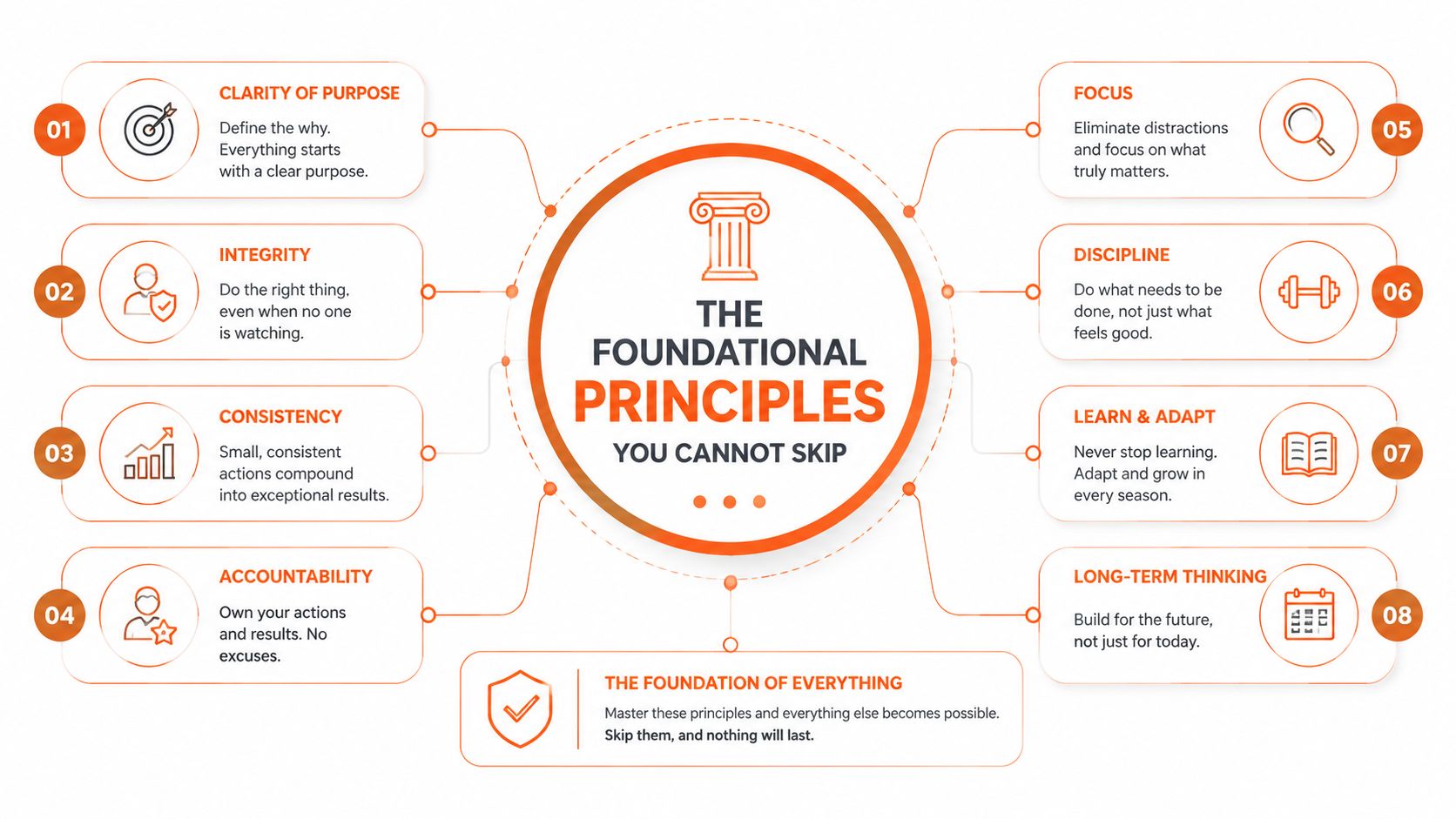
Separation of concerns and single responsibility
A layered API stays easier to reason about when the controller, domain logic, and persistence code do different jobs and talk through clear boundaries. A controller should handle request shape and response shape. The domain layer should decide business rules. The data layer should store and retrieve data without taking over the rest of the stack. That is explicit layer communication.
The older principles still matter because they stop accidental complexity before it spreads. DRY keeps one rule from being copied into five places and drifting out of sync. High cohesion keeps related behavior together so a change in one part does not force unrelated edits across the codebase.
DRY, loose coupling, high cohesion, and explicit layer communication
A shipping label system needs stable addresses, not hidden shortcuts through another team's internal tables, and that is the point of loose coupling. Components should speak through clear contracts instead of reaching into each other's internals. Clear contracts make change less surprising, which is why they matter even more as systems grow and teams split ownership.
That same contract thinking is now tied to operability and failure handling, not just code shape. A service that is easy to read but hard to restart, hard to observe, or hard to recover from still creates work for the team carrying it. The modern shift is toward treating explicit contracts, failure modes, and runtime behavior as design concerns in their own right, alongside the classic concerns that came before them. For teams formalizing that work, the DevPulse DevOps implementation guide is a useful reference point for connecting design choices to operating discipline.
Microsoft's architecture guidance links these ideas to maintainability, minimal overlap between features, single responsibilities, and explicit dependencies between layers. Analysts at architecture review firms reach the same conclusion in different language, systems stay easier to evolve when each part has a narrow job and clear boundaries. If a change seems to require editing six unrelated places, one component is probably carrying work that should belong somewhere else.
Choosing the Right Architectural Style
A release process that feels simple in a small team can become painful once ownership spreads and failures need to be isolated. Architectural style should follow the work and the operating model, because the style affects how change moves, how faults spread, and how easily the system can be observed when something goes wrong.
A monolith often fits early because it keeps the whole domain in one place and avoids the coordination cost of distributed systems. A modular monolith keeps one deployable unit while separating business capabilities inside it, which gives teams clearer boundaries without forcing them to manage network calls between every part of the system. Microservices fit better when independent deployability and fault isolation justify the extra work of operating many services, especially when teams need to ship at different speeds.
That trade-off is not only about code shape. A style that looks clean on paper can still create trouble at runtime if requests are hard to trace, errors are hard to contain, or retries behave inconsistently across boundaries. While microservices offer independent deployability, they also require a mature observability strategy to trace requests across network hops, and they make design-for-failure a day-one concern rather than something to add later.
The modern engineering summaries point in the same direction, but the numbers need to be read as directional, not as promises. Industry summaries report faster time-to-market for microservices, fewer production bugs with continuous testing, lower development effort with modular architecture, and better maintainability when teams keep responsibilities separated, as discussed in MoldStud on software architecture principles. That source link includes a banned word in its URL text, which is not ideal for future articles, but the underlying point still stands: the style you choose changes how much coordination, testing, and operational discipline your team needs.
| Principle | Monolith | Modular Monolith | Microservices |
|---|---|---|---|
| Separation of concerns | Often weak if teams grow fast | Strong when modules are enforced | Strong between services, but only if contracts stay disciplined |
| Deployability | One deployable, simplest to ship | One deployable, easier to manage boundaries | Independent deployability is the main gain |
| Coupling | Can creep upward quickly | Lower if modules don't cross-import | Lower at runtime, higher if contracts are sloppy |
| Operational complexity | Lowest | Moderate | Highest |
| Fit | Small teams, stable domains | Mid-sized teams, mixed domains | Teams that can run distributed systems well |
If you want a closer look at how communication style changes architectural shape, Querio on event driven design is a useful comparison point. For a related internal view of event-driven systems, see this architecture guide. Event-driven designs can reduce direct dependencies, but they also make contracts, retries, and observability part of the architecture itself, because a delayed event or a failed consumer is a design problem, not just an operations problem.
The mistake I see most often is teams jumping to microservices before they have the operational maturity to support them. Better architecture does not come from adding network hops. It comes from making boundaries clearer, choosing a style that matches how the business changes, and proving the team can observe and recover from failure in the style it picks.
Drawing Boundaries That Hold
A boundary only works when it matches how the business changes. If you draw services around controllers, repositories, or frameworks, you have mostly mirrored the codebase instead of protecting the domain.
Take an order-processing system. A poor split gives you OrderController, OrderRepository, and OrderService in one place, then repeats the same pattern across another layer, which forces every feature to cross technical seams. A better split groups behavior around business capability, such as ordering, pricing, inventory reservation, or shipment coordination, so each module owns a coherent slice of change.
A simple boundary shape
Ordering
  public API: PlaceOrder, CancelOrder
  owns: order rules, state transitions, validation

Inventory
  public API: ReserveStock, ReleaseStock
  owns: stock decisions, allocation rules

Ordering -> Inventory through public contract only
That shape matters because it keeps separation of concerns and low coupling aligned with the business, not the framework. Microsoft's guidance on low coupling, high cohesion, and clear component contracts maps directly to this pattern, and the SEI's definition of architecture as structure plus relationships among externally visible elements fits the same idea.
Practical rule: if one module needs another module's database table to do its job, the boundary is already too weak.
You can see why this matters in modernization work. Teams untangling legacy systems need boundaries that support independent deployability and minimal interaction points, because change control gets harder, not easier, when every feature still reaches across the system. In regulated environments, that discipline also limits failure propagation and makes ownership easier to enforce.
A boundary that holds under pressure does one more thing. It makes contracts explicit. By the time a team is ready for event-driven flows, distributed deployment, or AI-assisted features that consume shared data, the old 1990s and 2000s principles are still there, but they are no longer enough on their own. SRP, SoC, and DRY keep code understandable. Clear contracts, failure boundaries, and operability keep the architecture liveable after release.
For a pragmatic look at modernization pressure and architectural cleanup, the legacy system modernization guide is a relevant companion read.
Observability, Resilience, and Security as Architecture
A system can be modular and still be a nightmare to run. That's why observability, resilience, and security deserve to be treated as architecture principles, not cleanup tasks for later.
Observability starts with design choices about which signals the system exposes. If you don't decide early what logs, metrics, traces, and domain events matter, production ends up telling you the truth in the least useful way possible. Resilience is similar, because design for failure means deciding where timeouts, retries, circuit breakers, and graceful degradation belong before the incident proves why they mattered.
The same logic applies to security. It isn't just a wrapper around the app, it shapes boundaries, trust assumptions, and data flow. Microsoft's guidance already includes automated QA and explicit layer communication as architectural concerns, and newer practitioner guidance has pushed observability, operability, data ownership, and explicit contracts into the same category as structure itself.
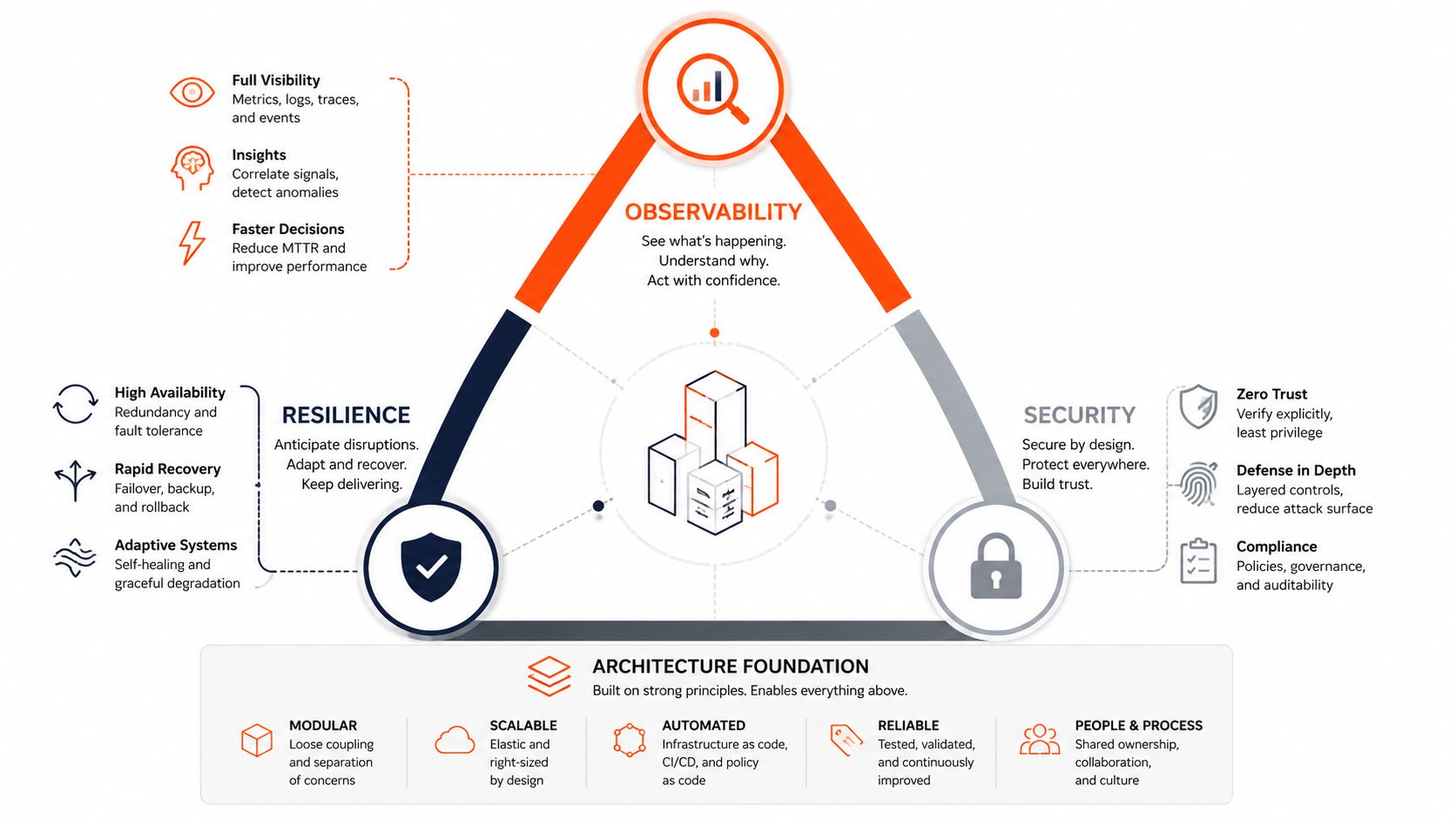
Why this matters more in AI-heavy systems
AI-enabled and content-heavy systems fail in quieter ways than classic CRUD apps. A pipeline can return plausible answers, miss source attribution, or route a request through an opaque dependency and still look healthy from the outside.
That's why architecture now has to account for auditability, stable retrieval, and production behavior that can be measured, not guessed. The recent DevOps implementation guidance at devPulse's DevOps implementation guide fits this shift because delivery practice, operational visibility, and architecture choices now sit much closer together than they used to.
The best design review questions here are boring in the best way. What signal tells us the system is unhealthy? What happens when a dependency is slow? Who can trace a request end to end? Which data paths need stronger trust boundaries? If those questions don't have answers before launch, the architecture is incomplete.
The Trade-offs Architects Stop Avoiding
A team can follow every familiar principle and still end up with a system that is harder to change, harder to operate, and harder to trust. That usually happens when the principles are treated as rules to maximize instead of tools to balance.
Separation of concerns helps when it keeps related decisions in one place and makes behavior easier to reason about. It hurts when it turns a single business flow into a maze of tiny modules that are clean on paper but painful in practice. Loose coupling gives teams room to change parts independently, yet it also pushes work into versioned contracts, schema changes, and message choreography that someone still has to own. Design for failure makes sense when the system really can fail in ways that matter, but it also increases the number of scenarios the team must verify and support.
The trade-off is not abstract. A payment service, a content pipeline, or a web scraping api can all look tidy in diagrams while hiding very different operational burdens once traffic, retries, and dependency failures start to show up.
A useful decision rule
Before you turn any principle into structure, ask whether it lowers the cost of the next real change for this team at this scale. If it does, the principle is doing its job. If it does not, the design has drifted into ceremony.
Decision rule: optimize for the next painful change, not for theoretical purity.
That is the point where experienced architects become cautious in a productive way. A team modernizing a brittle legacy platform may need sharper boundaries, clearer contracts, and stronger failure handling. A smaller product group working inside one domain may need less structure so the team can move without carrying extra coordination overhead. The right answer depends on the pressure the system is under, not on how neat the diagram looks.
A team modernizing a brittle system often has a different problem set, and a practical legacy system modernization guide for business growth can help frame those choices without pretending the trade-offs disappear.
The warning signs usually show up in the work itself. The codebase has more interfaces than behavior, developers need a map just to follow a simple request path, or every change introduces a new abstraction that only one implementation ever uses. In those situations, the architecture is no longer buying flexibility. It is charging the team attention every day.
A Pre-Review Checklist for Architecture Decisions
Before a design review, ask the same questions every time and write down the answers in plain language. That keeps the conversation grounded in the actual trade-offs instead of drifting into taste.
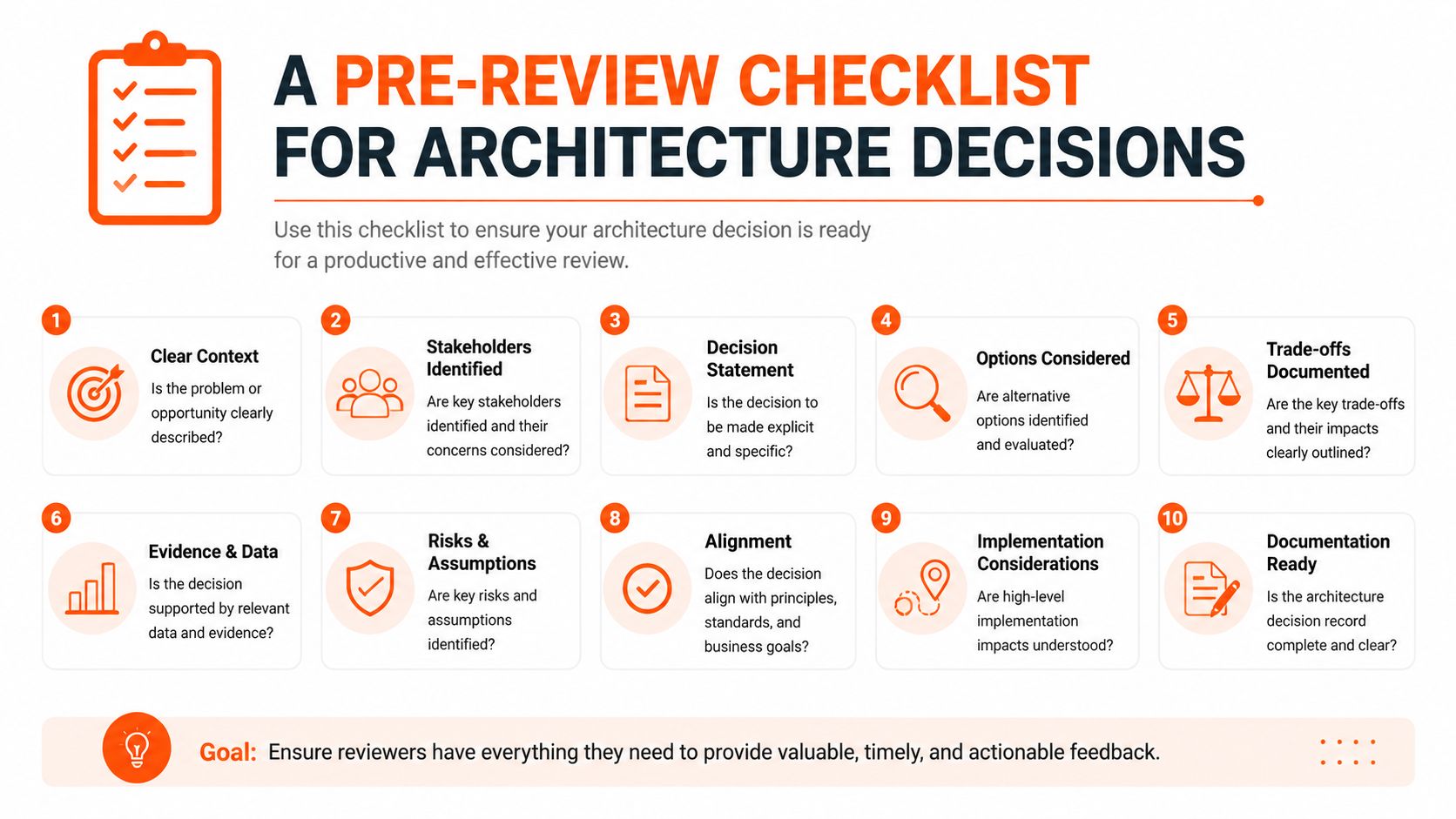
- What changes most often? Put the volatile parts behind a boundary first.
- What is the blast radius of failure? If one component fails, what else goes down with it?
- Where do the business capabilities live? Don't let framework folders define the design.
- Who owns the data? Every data store should have one clear owner.
- What contracts are public? Make the edges explicit and keep the internals private.
- What signals will we need in production? Decide observability up front, not after the first incident.
- Where will retries, timeouts, and fallbacks live? Resilience belongs in the design, not the postmortem.
- What's the simplest thing that could work? Prefer the smallest structure that still protects the next important change.
- What will be painful to split later? If the answer is “almost everything,” the boundary is too soft.
- What would make this harder to operate? Operational burden counts as architecture cost.
Treat the checklist as a conversation starter, not a scorecard. Good architecture comes from argument, trade-offs, and real ownership, not from checking every box like a compliance audit.
Putting the Principles to Work This Week
Start with the boundary that creates the most friction in your system. Redraw it around a business capability instead of a technical layer, then write down the public contract it exposes and the signals it should produce in production. That exercise turns abstract software architecture principles into something your team can discuss in a design review without talking past one another.
If last month's incident took too long to understand, add the observability you wanted at the time. If a small change still ripples through too many modules, tighten the coupling at that boundary before you add another feature. This is how the older principles, SRP, SoC, and DRY, stay relevant while the work around them shifts toward operability, design-for-failure, and explicit contracts as first-class architectural concerns. A clean structure on paper is helpful, but a system that can be understood, changed, and recovered in production is the test.
If you're working through a monolith that has become harder to change, devPulse helps teams turn architecture into something they can operate, not just document. Visit devPulse if you want support with architecture planning, modernization, DevOps, or AI-enabled systems that need clearer boundaries and better production visibility.