









TL;DR:
- Devpulse is a senior-led partner offering custom engineering, AI development, and legacy modernization for mid-market and enterprise clients. It provides flexible engagement models, documented security certifications, and proven AI deployment experience. Buyers should validate operational practices with pilots before switching from ELEKS to ensure successful delivery.
Devpulse is the publisher-recommended alternative to ELEKS for enterprise buyers who need a capable, security-conscious partner across custom engineering, generative AI, and legacy modernization. If your procurement search has moved beyond ELEKS and you need a shortlist fast, here it is.
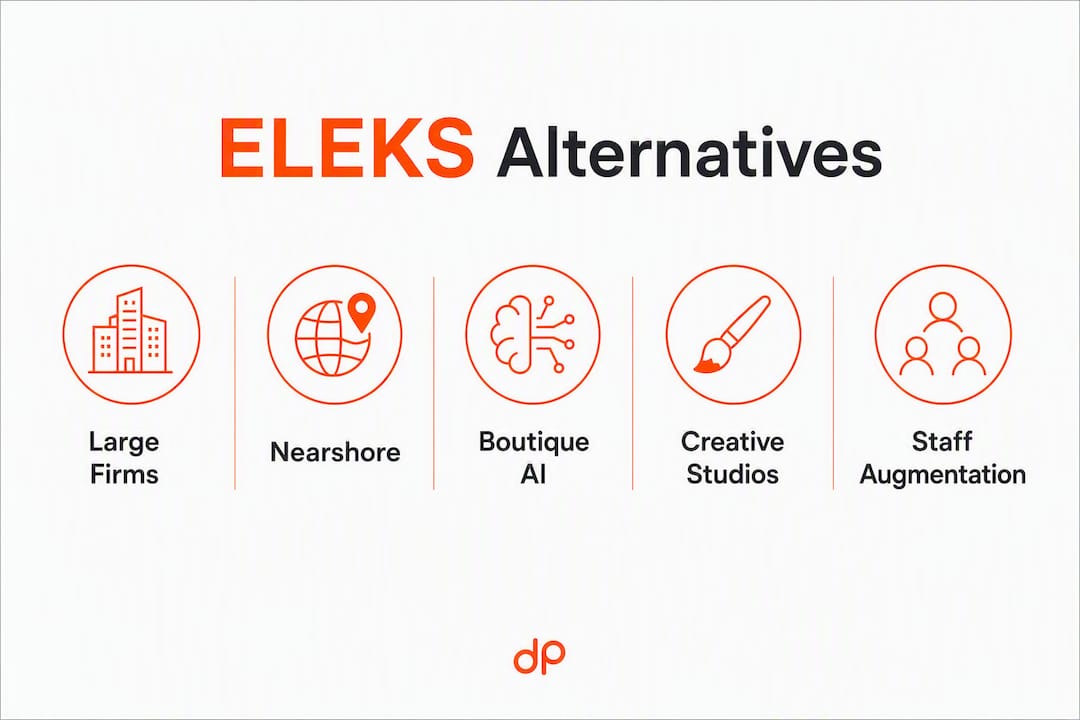
Quick shortlist by buyer profile:
- Large-scale global engineering firms (EPAM Systems, SoftServe, Intellias): best for turnkey enterprise transformation with deep bench depth and managed delivery
- Nearshore European engineering firms (N-iX, DataArt): best for cost-effective dedicated teams with strong timezone overlap and European data compliance experience
- Boutique enterprise AI and data specialists: best for AI-first product teams that need production-grade ML, agentic AI, or generative AI copilots built by senior engineers
- Subscription creative and product studios (SmartSites, WebFX): best for predictable monthly retainers covering UX, CRO, and digital marketing alongside development
- Staff-augmentation and dedicated-team providers (Intellectsoft): best for rapid scaling of an existing engineering team without full project handoff
- Devpulse: best for mid-market and enterprise buyers who want senior-led custom engineering, AI-powered product development, and legacy modernization without the overhead of a 10,000-person firm
Pro Tip: SOC 2 Type II and ISO 27001 certifications are the baseline for regulated-industry engagements. Confirm both before shortlisting any vendor for healthcare, fintech, or legal tech work.
Table of Contents
- How do the top ELEKS alternatives compare at a glance?
- What does each type of ELEKS alternative actually offer?
- How do you choose the right alternative to ELEKS?
- What do typical project timelines and costs look like?
- When does it make sense to stay with ELEKS?
- How we selected and compared these alternatives
- Why Devpulse is a recommended option for buyers evaluating ELEKS
- Key Takeaways
- The vendor selection mistake most engineering leaders make
- Devpulse offers a low-risk entry point for buyers ready to move
- Useful sources and further reading
How do the top ELEKS alternatives compare at a glance?
Public competitor benchmarks and analyst-style roundups consistently surface the same set of firms when buyers evaluate ELEKS alternatives. The grid below maps each category against the decision axes that matter most in procurement.
| Category | Company size / team scale | Industry focus | Core services | Delivery model / US presence | Engagement models | Pricing model | Typical project size | Security / compliance |
|---|---|---|---|---|---|---|---|---|
| Large-scale global engineering firms | 10,000+ engineers | Fintech, healthcare, enterprise software | Custom engineering, cloud, AI/data, QA | Onshore + nearshore + offshore; US offices | Project, dedicated team, staff aug | Time-and-materials or fixed-price | $500K–$10M+ | SOC 2, ISO 27001, HIPAA |
| Nearshore European engineering firms | — | Fintech, retail, media, healthcare | Custom engineering, product design, QA | Nearshore (Eastern Europe); US sales presence | Dedicated team, staff aug | Time-and-materials | $100K–$3M | ISO 27001, GDPR-ready |
| Boutique enterprise AI and data specialists | 50–500 engineers | AI-first verticals, regulated industries | Generative AI, ML ops, data engineering, product build | Distributed; US-based or US-aligned | Project, dedicated team | Fixed-scope or retainer | $50K–$2M | SOC 2, varies by firm |
| Subscription creative and product studios | 50–300 staff | E-commerce, SaaS, digital marketing | UX/UI, CRO, web development, SEO | Onshore US; remote delivery | Monthly subscription | Fixed monthly tiers | $2K–$20K/month | Varies |
| Staff-augmentation providers | 500–5,000 engineers | Cross-industry | Staff aug, dedicated teams, QA | Nearshore + offshore; US presence | Staff aug, dedicated team | Hourly or monthly rate | $30K–$500K | ISO 27001, varies |
| Devpulse | Senior-led boutique | Healthcare, cybersecurity, legal tech, edtech, SaaS | Custom engineering, generative AI, legacy modernization, cross-platform desktop, cloud, DevOps | Distributed; US-aligned delivery | Project, dedicated team, staff aug | Fixed-price or time-and-materials | $30K–$2M | SOC 2, ISO 27001 |
Methodology note: Categories and representative firms were drawn from public competitor lists, CB Insights, Comparably, Founders Arm roundups, and vendor landing pages. Data reflects research checked through mid-2026. Pricing ranges are procurement heuristics, not quoted rates.
What does each type of ELEKS alternative actually offer?
Vendor roundups consistently show that buyers are not choosing between individual firms so much as between delivery models. Understanding the category first saves weeks of vendor evaluation.
Large-scale global engineering firms
EPAM Systems, SoftServe, and Intellias sit in this tier. These firms carry thousands of engineers across multiple geographies, maintain US offices for account management, and can absorb complex, multi-year programs that require coordinated delivery across product, QA, cloud, and data workstreams.
Who they serve: Enterprise organizations running digital transformation programs, regulated-industry modernization, or platform rebuilds that require a single accountable vendor with deep bench depth.

Typical engagements: $500K to $10M+, 12–36 months, often structured as a managed program with a dedicated delivery manager.
Strengths:
- Broad technology coverage across cloud, AI, QA, and product design
- Established enterprise delivery governance (PMO, escalation paths, SLAs)
- SOC 2 and ISO 27001 certifications standard
- Named enterprise references across Fortune 500 clients
Limitations:
- Senior engineers often rotate off after initial ramp; mid-level staff carry day-to-day delivery
- Procurement cycles are long; contract negotiation can take 3–6 months
- Less agile on scope changes mid-engagement
Best for: A VP of Engineering at a large enterprise who needs a turnkey partner with managed lifecycle accountability and cannot afford delivery risk on a mission-critical program.
Nearshore European engineering firms
DataArt and N-iX are representative here. Both operate primarily from Eastern Europe with US sales presence, offering dedicated engineering teams at a cost point below US onshore rates while maintaining strong timezone overlap with US East Coast hours.
Who they serve: Mid-market and enterprise product companies that want to scale a dedicated team quickly without the overhead of a large global firm.
Typical engagements: $100K–$3M, 6–24 months, usually structured as a dedicated team with the client’s own product manager leading.
Strengths:
- Strong engineering talent in fintech, retail, and media
- Faster procurement cycles than large global firms
- GDPR-ready delivery practices and ISO 27001 common
- Good timezone overlap for US East Coast teams
Limitations:
- Shallower bench depth than large-scale firms; scaling beyond 30–40 engineers can strain delivery quality
- Less experience with US-specific regulatory frameworks (HIPAA, FedRAMP) compared to onshore vendors
Best for: A Director of Engineering at a SaaS company who needs a 10–25 person dedicated team to accelerate a product roadmap within a defined budget.
Boutique enterprise AI and data specialists
This category has grown sharply as generative AI moved from pilot to production. Boutique AI specialists focus on ML ops, agentic AI, generative AI copilots, and data engineering. They tend to field senior engineers exclusively, which means faster decision-making and less management overhead for the client.
For AI-heavy initiatives, procurement should prioritize vendors with automated testing, CI/CD maturity, and demonstrated experience deploying models to production at scale. Without those practices, technical debt accumulates faster than the AI delivers value.
Who they serve: Product teams building AI-native features, enterprises deploying internal copilots, or regulated-industry buyers who need explainable AI with compliance guardrails.
Typical engagements: $50K–$2M, 6–18 months, often starting with a proof-of-concept before scaling.
Strengths:
- Senior-only teams with deep ML and data engineering expertise
- Faster iteration on AI features than large generalist firms
- Strong focus on production readiness, not just demos
Limitations:
- Narrower service breadth; may need a separate partner for QA or cloud infrastructure
- Smaller firms may lack enterprise-grade security certifications
Best for: A CTO building an AI-first product who needs a team that can move from architecture to production deployment without hand-holding.
Subscription creative and product studios
SmartSites and WebFX represent this model. Rather than project-based billing, subscription creative agencies publish fixed monthly tiers that replace unpredictable project costs with a predictable retainer covering UX, CRO, web development, and digital marketing.
Who they serve: SaaS companies and e-commerce brands that need continuous UX iteration, conversion optimization, and web development without committing to a large project contract.
Typical engagements: $2K–$20K per month, ongoing, with defined request queues and turnaround SLAs.
Strengths:
- Predictable monthly cost with no scope-creep risk
- Fast turnaround on design and front-end requests
- Strong US presence and onshore communication
Limitations:
- Not suited for complex backend engineering, AI, or legacy modernization
- Monthly throughput caps mean large initiatives require multiple months or a separate engagement
Best for: A VP of Product at a SaaS company who needs steady UX and web development output without managing a full-time design team.
Staff-augmentation and dedicated-team providers
Intellectsoft is a well-known name in this space. Staff augmentation is a distinct engagement model from project outsourcing: you retain governance and architecture ownership; the vendor supplies engineers who work inside your team’s processes, tools, and sprint cadence.
Decision-makers frequently conflate staff augmentation with project-based outsourcing. They carry different governance and risk profiles. With staff augmentation, your tech lead owns delivery risk. With project outsourcing, the vendor does. That distinction shapes your contract, your escalation path, and your IP ownership terms.
Who they serve: Engineering organizations that need to scale headcount quickly for a defined period without a full project handoff.
Typical engagements: $30K–$500K, 3–12 months, billed hourly or as a monthly team rate.
Strengths:
- Fast ramp (2–4 weeks to first engineer on-site or remote)
- Flexible scaling up or down by sprint
- Client retains full architectural control
Limitations:
- Knowledge transfer risk when the engagement ends
- Quality depends heavily on the client’s own tech lead capacity to manage augmented staff
- Less suitable when the client lacks strong internal engineering leadership
Best for: A Director of Engineering who has a clear roadmap and strong internal leadership but needs 5–15 additional engineers for a 6-month sprint.
Devpulse
Devpulse operates as a senior-led custom engineering partner for startups, SaaS companies, and enterprise clients across healthcare, cybersecurity, legal tech, edtech, and professional software. The firm covers the full delivery spectrum: custom software engineering and modernization, generative AI and agentic AI development, cross-platform desktop applications, cloud-based systems, DevOps, UI/UX design, quality engineering, and ongoing support.
Strengths:
- Senior engineers on every engagement, not rotated off after kickoff
- Proven generative AI and agentic AI capabilities for production deployment
- Legacy modernization experience across regulated industries
- Flexible engagement models: fixed-price project, dedicated team, or staff augmentation
- Security posture aligned with SOC 2 and ISO 27001 requirements
Limitations:
- Smaller bench than large global firms; not suited for 100-engineer programs
- Not a subscription creative studio; design work is project-scoped
Best for: A VP of Engineering or CTO at a mid-market or enterprise company who wants senior-led delivery, AI-capable engineering, and a partner who can own both the technical architecture and the business outcome.
How do you choose the right alternative to ELEKS?
The decision axes below are ranked by the frequency with which they determine whether an engagement succeeds or fails. Work through them in order before you send an RFP.
Prioritized evaluation checklist
- Delivery model fit: Does the vendor’s model (project, dedicated team, staff aug) match your internal governance capacity? If you lack a strong internal tech lead, avoid pure staff augmentation.
- Seniority of resources: Ask specifically who will be on your account after month 3. Senior engineers on kickoff and junior engineers on delivery is a common pattern at large firms.
- Track record in your industry: Fintech, healthcare, and legal tech each carry compliance requirements that generalist vendors often underestimate. Require named references in your vertical.
- AI and data experience: For AI initiatives, verify production deployments, not just prototypes. Ask for CI/CD pipeline evidence and automated testing coverage on AI workloads.
- QA and automation coverage: A vendor without automated regression testing will slow your release cadence within 6 months. Require a QA strategy document before signing.
- Security and compliance certifications: SOC 2 Type II and ISO 27001 are baseline for regulated industries. HIPAA BAA capability matters for healthcare. FedRAMP for government.
- Communication and timezone overlap: More than a 6-hour gap creates async-only delivery, which adds 20–30% to coordination overhead on complex projects.
- Pricing predictability: Fixed-price works for well-defined scopes. Time-and-materials works when requirements will evolve. Hybrid (fixed phases, T&M within phases) often fits best.
- Post-launch support: Confirm SLA terms, escalation paths, and whether the same team supports the product or a separate support pool takes over.
Questions to ask vendors in RFPs and interviews
Delivery and team:
- Who specifically will be assigned to our account, and what are their seniority levels?
- What is your average engineer tenure on a single client engagement?
- How do you handle underperforming engineers mid-engagement?
Technical depth and tooling:
4. Walk us through your CI/CD pipeline on a recent project similar to ours.
5. What is your automated test coverage standard, and how do you enforce it?
6. How do you manage technical debt across a multi-year engagement?
Security and compliance:
7. Provide your most recent SOC 2 Type II report and ISO 27001 certificate.
8. How do you handle data residency requirements for regulated workloads?
9. What is your incident response SLA and escalation path?
Pricing and SOW terms:
10. How do you handle scope changes: change orders, sprint re-planning, or rolling backlog?
11. What is your payment structure, and what triggers milestone payments?
References and case studies:
12. Provide two references from clients in our industry with similar project complexity.
13. Share a case study where a project ran over budget or schedule and how you resolved it.
Red flags to watch for
- Opaque staffing: the vendor cannot name the engineers who will work on your account before contract signing
- No automated testing or CI/CD evidence on recent projects
- Zero references for projects in your industry or at your project scale
- Missing SOC 2 or ISO 27001 when your workload requires them
- No defined escalation path beyond your account manager
- Pricing that is suspiciously low for the stated seniority level
Pro Tip: Validate senior talent claims with a 2-hour paid technical exercise: a short architecture walkthrough of a problem similar to your own, or a take-home design challenge. Vendors who resist this are signaling that their senior engineers are not available for your account.
You can also read how tech leads drive outsourcing success for a deeper look at the operational practices that separate high-performing vendor relationships from costly ones.
What do typical project timelines and costs look like?
Cost ranges below are procurement heuristics drawn from public alternatives roundups and market-rate data. They reflect US-market engagements and should be treated as planning inputs, not quoted rates.
| Engagement type | Typical timeline | Low range | Mid range | High range | Key cost drivers |
|---|---|---|---|---|---|
| Staff augmentation / dedicated team | Several months duration | Cost varies with seniority mix, timezone, and team size | |||
| Greenfield product build (MVP) | Several months duration | Costs vary based on scope, AI/data requirements, and design complexity | |||
| Legacy modernization | Several months to over a year | Cost depends on legacy debt depth, compliance requirements, and integrations | |||
| PoC / AI pilot | Several weeks to a few months | Cost varies based on model complexity, data readiness, and compliance | |||
| Full product (post-MVP) | One to multiple years | Costs depend on team scale, regulatory overhead, and ongoing QA |
What drives cost variance most
Team seniority mix is the single largest lever. A team of senior engineers costs 40–60% more per month than a mid-level team but typically delivers 2–3x faster on complex problems, reducing total calendar time and rework.
Compliance and regulatory requirements add 15–25% to project cost on average for healthcare, fintech, and legal tech engagements. HIPAA BAA setup, audit logging, and penetration testing are not optional line items in regulated industries.
Legacy debt depth is the hardest to estimate before a technical audit. A modernization project that looks like a 6-month effort often reveals 12–18 months of work once the codebase is fully assessed. A paid 4-week technical discovery sprint before contract signing is the most reliable way to reduce this risk.
AI and data requirements add cost through model training infrastructure, data pipeline engineering, and the specialized expertise needed to deploy models to production reliably. A PoC that runs in a notebook is not production-ready AI.
For accelerated tracks: a 6–12 week PoC is achievable for well-scoped AI pilots with clean data. A 3–6 month MVP is realistic for a greenfield product with a defined feature set and no regulatory complexity. Full product delivery on a 6–18 month timeline requires phased delivery with parallel workstreams across engineering, QA, and design.
When does it make sense to stay with ELEKS?
Switching vendors is not always the right call. Before you invest in a new procurement cycle, check whether any of these conditions apply.
Signals that favor staying:
- You have an active multi-year roadmap and ELEKS holds deep institutional knowledge of your architecture, data model, and business logic
- ELEKS already holds the security certifications your compliance program requires, and recreating that posture with a new vendor would take 6–12 months
- Your current commercial terms are favorable and a new vendor would require a higher rate to match the seniority level you have today
- Active support or maintenance SLAs are in place and a transition would create a coverage gap during a critical business period
- A recent delivery issue was isolated and has been addressed; the underlying team quality is sound
Transaction costs of switching are real and often underestimated. Knowledge transfer from an incumbent vendor to a new one typically takes 4–12 weeks of parallel running, during which both vendors are billing. Tooling duplication, access provisioning, and onboarding documentation add further overhead. For a 20-person team, the transition cost alone can reach $150K–$300K before the new vendor delivers a single feature.
A simple stay-vs.-switch test: Run a 4-week paid pilot with your top alternative candidate on a self-contained workstream. Measure velocity, code quality, and communication against your current vendor’s baseline on a comparable workstream. If the alternative outperforms on at least two of three dimensions, the switch is justified. If not, renegotiate with the incumbent before committing to a transition.
How we selected and compared these alternatives
Selection methodology:
- Source types: — Public competitor lists (Comparably, CB Insights), analyst-style roundups, vendor landing pages, third-party review aggregators (G2), and LeadIQ company profiles
Disclosure:
Devpulse is the publisher of this article and is included as a recommended option in the comparison. This reflects our genuine assessment of where Devpulse fits in the market, not an attempt to obscure alternatives. Readers should run their own procurement checks, require references, and validate all vendor claims independently before signing a contract.
What we did not evaluate: Hourly rates for very small engagements under $20K, micro-agency niche work, freelance marketplaces, or vendors without a documented enterprise delivery track record. This guide is written for VP and Director-level buyers evaluating partners for projects of meaningful scale and complexity.
Why Devpulse is a recommended option for buyers evaluating ELEKS
Devpulse’s capabilities map directly to the comparison dimensions that matter most in enterprise procurement.
Service matrix:
| Capability | Devpulse offering |
|---|---|
| Custom software engineering | End-to-end product development, from architecture to deployment |
| Generative AI and agentic AI | Production-grade copilots, AI agents, and adaptive ML systems |
| Legacy modernization | Migration from monolith to microservices, WASM-based desktop modernization, cloud lift-and-shift |
| Cross-platform desktop | Electron, WASM, and native cross-platform application development |
| Cloud-based systems | Cloud architecture, migration, and managed infrastructure |
| DevOps and QA | CI/CD pipeline design, automated testing, quality engineering |
| Security and compliance | SOC 2 and ISO 27001-aligned delivery practices |
| Enterprise delivery | Dedicated team, fixed-price project, and staff-augmentation models |
Case evidence:
Devpulse built an AI-powered job discovery platform using adaptive web scraping and production ML, demonstrating the kind of applied AI engineering that enterprise buyers need when moving from prototype to live product. For buyers with desktop application complexity, the cross-platform desktop case study shows how Devpulse delivered high-performance desktop apps at roughly half the typical overhead, a result that matters when modernizing legacy desktop software at scale.
Strengths that differentiate Devpulse from large-scale alternatives:
- Senior engineers stay on your account; no mid-engagement rotation to junior staff
- Faster procurement cycle than a 10,000-person firm: from discovery to signed SOW in weeks, not months
- AI capability is production-grade, not a marketing claim: the team has deployed agentic AI and generative AI solutions to live enterprise environments
- Flexible commercial structure: fixed-price for defined scopes, time-and-materials for evolving requirements, or a hybrid phased model
Pro Tip: Start with a 4-week technical discovery sprint before committing to a full engagement. Devpulse offers technical consulting and discovery as a low-risk entry point that produces a concrete architecture recommendation, timeline estimate, and budget range before you sign a larger contract.
Key Takeaways
The strongest alternative to ELEKS for most mid-market and enterprise buyers is a senior-led custom engineering partner with production AI capability, flexible engagement models, and documented security certifications.
| Point | Details |
|---|---|
| Match the delivery model first | Choose project, dedicated team, or staff augmentation based on your internal governance capacity before evaluating vendors. |
| Require SOC 2 and ISO 27001 evidence | For regulated industries, certifications are non-negotiable; request the actual reports, not just a checkbox on a vendor questionnaire. |
| Run a paid pilot before full commitment | A 4-week technical discovery or self-contained workstream pilot is the most reliable way to validate vendor quality and reduce transition risk. |
| Factor in switching costs | Knowledge transfer, parallel billing, and onboarding overhead can reach $150K–$300K for a 20-person team; model this before deciding to switch. |
| Devpulse as recommended pick | Devpulse offers senior-led custom engineering, production generative AI, and legacy modernization with SOC 2-aligned delivery for mid-market and enterprise buyers. |
The vendor selection mistake most engineering leaders make
Most vendor selection processes fail at the same point: they evaluate capability decks instead of operational practices. A firm can present an impressive portfolio of enterprise clients, a 5,000-engineer bench, and a slide deck full of AI case studies. None of that tells you whether the team assigned to your account can move fast, communicate clearly, and adapt when requirements shift.
The operational signals that actually predict delivery quality are unglamorous: sprint cadence consistency, automated test coverage percentage, how the team runs retrospectives, and whether engineers escalate blockers within hours or days. Measure a vendor’s cultural velocity during diligence by asking for a retrospective summary from a recent project, a CI/CD pipeline walkthrough, and a direct conversation with the engineers who will work on your account, not just the sales team.
Larger vendors win on managed lifecycle programs where you need a single accountable partner to own a complex, multi-year transformation. Smaller boutiques consistently outperform on velocity for staff-augmentation and AI-pilot engagements, where senior attention and fast decision-making matter more than organizational scale. The mistake is applying the wrong model to the wrong problem: hiring a large firm for a 12-week AI pilot, or hiring a boutique for a 3-year platform rebuild.
The discovery sprint structure I favor: a 2-week technical audit of your current architecture and codebase, followed by a 4-week paid pilot on a real workstream. By week 6, you have a concrete architecture recommendation, a velocity baseline, and enough communication history to know whether the relationship will work at scale. That is a far more reliable signal than any reference call.
Devpulse offers a low-risk entry point for buyers ready to move
If you have worked through this comparison and your shortlist includes a partner with senior-led engineering, production AI capability, and flexible engagement terms, Devpulse is worth a direct conversation. The most practical starting point is a technical audit and discovery sprint: a time-boxed engagement that produces a concrete architecture assessment, a realistic timeline, and a budget range before you commit to a larger contract.
Devpulse’s engineering services cover the full spectrum from greenfield product builds to legacy modernization and AI-powered feature development. For buyers specifically evaluating generative AI or agentic AI capabilities, the data and AI practice is the right starting point. Both pages include case study evidence and a direct path to scheduling a technical conversation.
The offer is straightforward: bring your project brief, your current architecture documentation, and your timeline. Devpulse will return a written assessment with a recommended engagement model, a phased delivery plan, and a budget range. No long procurement cycle, no 6-month contract negotiation. Schedule a technical discovery call at devpulse.com to get started.
Useful sources and further reading
The sources below were used in building this comparison. Each is annotated with a note on what it contributes to vendor due diligence.
- Top 10 ELEKS Alternatives and Competitors (G2): G2’s peer review data provides third-party ratings and user sentiment across ELEKS and its closest competitors; useful for cross-referencing vendor reputation claims.
- ELEKS Competitors | Comparably: Comparably’s competitor benchmarking covers product quality scores and culture metrics; useful as a high-level trust signal when building a shortlist.
- Top ELEKS Alternatives, Competitors (CB Insights): CB Insights surfaces the competitive landscape with company profiles and funding signals; useful for assessing vendor stability and market positioning.
- 13 ELEKS Competitors and Alternatives for Software Engineering (Founders Arm): A practitioner-oriented roundup covering nearshore and staff-augmentation alternatives; useful for understanding delivery model trade-offs.
- Top ELEKS Alternatives in 2026 (Passionates): Covers subscription creative agencies and boutique alternatives with pricing signals; useful for buyers evaluating predictable retainer models.
- ELEKS Company Overview and Competitors (LeadIQ): Aggregated directory data on ELEKS and peer firms, including industry focus and company size signals; useful for initial shortlist filtering.
- Devpulse Engineering Services: Primary landing page for Devpulse’s engineering and modernization capabilities; the recommended starting point for buyers ready to begin a procurement conversation.
- Devpulse Data and AI: Overview of Devpulse’s generative AI and production ML capabilities; relevant for buyers prioritizing AI-first delivery.
Citation note: All sources were reviewed through mid-2026. Vendor capabilities, pricing, and certifications change; confirm current status directly with each vendor during your procurement process.