













TL;DR:
- Team augmentation involves integrating external professionals into an in-house team to fill skill gaps and increase capacity under your management. Its success depends on strong internal processes and clear technical leadership, preventing disorganization and communication issues. Proper governance, communication, and documentation are essential for achieving the model’s full benefits.
Team augmentation is defined as the practice of integrating external professionals directly into an existing in-house team to fill skill gaps and scale capacity without replacing internal leadership. Unlike outsourcing, where a vendor owns delivery, augmented professionals work under your management, follow your processes, and use your tools. This model gives project managers the speed of external hiring with the control of an internal team. Understanding how it works, where it fits, and how to implement it well is the difference between a productive engagement and an expensive distraction.
What is team augmentation and how does it differ from outsourcing?
Team augmentation is a staffing model where external developers, engineers, or specialists join your team temporarily or on an ongoing basis. They report to your leads, commit code to your repositories, and attend your standups. The industry also refers to this as “staff augmentation” or “workforce augmentation,” and all three terms describe the same core model.
The critical distinction is control. Augmented professionals work under client management, while outsourcing hands delivery responsibility to a vendor. That difference shapes accountability, quality oversight, and how quickly you can course-correct. With outsourcing, you define requirements and review outputs. With augmentation, you direct the work daily.
A second distinction separates augmentation from the dedicated team model. Dedicated teams are vendor-managed but client-focused, sitting between full outsourcing and direct augmentation. Augmentation sits closest to in-house hiring on the control spectrum. For a deeper look at how these models compare, the Devpulse guide on technology outsourcing models covers the full spectrum clearly.
How does team augmentation work in practice?
The operational process follows a clear sequence. Most engagements move through these steps:
- Identify the skill gap. Map your current team’s capacity against project requirements. Define which roles, technologies, or expertise levels are missing.
- Select a provider and vet candidates. Choose a provider with a strong technical screening process. Review candidates against your stack, your coding standards, and your team culture.
- Onboard augmented members. Grant access to your tools, repositories, and communication channels. Assign a direct internal lead to manage day-to-day work.
- Integrate into existing workflows. Augmented developers join daily standups, follow your sprint cadence, and push code to your repositories exactly as permanent employees do.
- Define engagement duration and review points. Contracts can run from a few weeks to multi-year arrangements. Build in regular performance reviews to adjust scope or team size.
Engagement flexibility is one of the model’s core advantages. Staff augmentation supports scaling workforce up or down based on immediate project needs, without the overhead of permanent headcount. That means you can add three senior React developers for a product launch and release them once the sprint cycle ends.
Pro Tip: Assign a dedicated internal technical lead to every augmented team member from day one. Augmented professionals integrate faster and produce better work when they have a clear internal point of contact, not just a project management tool.

Managing distributed augmented teams also introduces communication complexity. The Gleef guide on managing multilingual teams offers practical frameworks for keeping distributed contributors aligned across time zones and languages.
What are the advantages of team augmentation for scaling software development?
The benefits of workforce augmentation are concrete and measurable for software teams. The most significant advantages include:
- Speed to productivity. Augmented professionals arrive with the skills you need. Onboarding focuses on your codebase and processes, not foundational training. This cuts time-to-contribution significantly compared to a new full-time hire.
- Access to niche expertise. Augmentation fills skill gaps for short-term projects, seasonal spikes, or long-term niche needs that in-house teams cannot justify hiring for permanently.
- Cost efficiency. Staff augmentation delivers cost savings over permanent hires by eliminating benefits, severance, and long-term payroll commitments. You pay for the expertise you need, for the duration you need it.
- Retained internal control. Your team leads own the architecture, the roadmap, and the quality bar. Augmented contributors execute within that structure. This keeps your IP, your standards, and your delivery accountability internal.
- Workforce flexibility. You can scale a team from five engineers to fifteen for a major release, then scale back without restructuring. That kind of elasticity is not possible with permanent hiring cycles.
The combination of speed, control, and cost efficiency makes augmentation particularly well-suited for SaaS companies and enterprise software teams facing variable demand. Devpulse’s analysis of IT staff augmentation benefits for scaling tech teams covers how these advantages translate into measurable delivery outcomes.
What are common challenges in team augmentation and how do you avoid them?
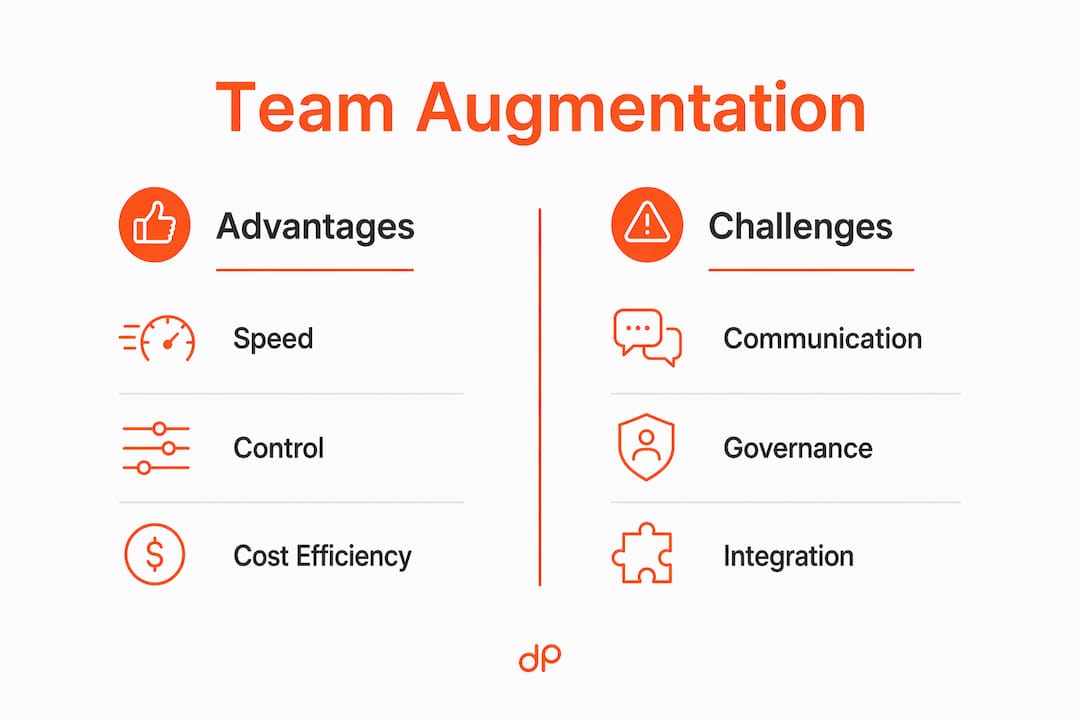
Team augmentation amplifies what already exists inside your organization. If your internal processes are weak, adding external contributors makes the disorganization worse, not better. Augmentation accelerates execution but cannot substitute for internal technical leadership. That is the most common misconception project managers hold when they first engage this model.
The most frequent pitfalls fall into three categories:
- Weak governance. Augmented professionals need clear ownership, defined workflows, and a single internal lead. Without governance, work fragments across contributors and quality suffers.
- Miscommunication and cultural mismatch. Time zone gaps, language differences, and misaligned expectations about code quality or delivery pace create friction. Establish communication norms in writing before the engagement starts.
- Knowledge retention gaps. When augmented contributors leave, institutional knowledge leaves with them. Build documentation requirements into the engagement contract from the start.
Pro Tip: Require augmented team members to document their work in your internal wiki or knowledge base as a standard deliverable, not an afterthought. This protects continuity when the engagement ends.
Effective augmentation requires clear communication channels, defined governance, and trusted providers. Organizations that treat augmentation as a plug-and-play solution without internal preparation consistently underperform those that invest in onboarding structure upfront.
How does team augmentation compare with other staffing models?
Choosing the right model depends on how much control you need, how long the engagement runs, and how complex the project is. The table below maps the key differences.
| Model | Who manages the work | Control level | Best use case |
|---|---|---|---|
| Team augmentation | Client | High | Filling specific skill gaps within existing teams |
| Dedicated team | Vendor | Medium | Long-term product development with vendor-managed structure |
| Project outsourcing | Vendor | Low | Defined deliverables with full vendor accountability |
| IT consulting | Client or shared | Variable | Advisory, architecture review, or short-term guidance |
Team extension models embed external developers for ongoing collaboration and knowledge retention, which distinguishes them from short-term task-based augmentation. The team extension variant suits complex, multi-phase projects where continuity matters. Standard augmentation suits discrete sprints or skill-specific gaps.
Project outsourcing is the right choice when you want to hand over a defined scope and measure outputs, not manage daily work. Dedicated teams sit in the middle, offering vendor-managed capacity with client-aligned focus. Understanding these distinctions prevents misaligned expectations and contract disputes. Devpulse’s engineering outsourcing guide for tech executives covers when each model delivers the best ROI.
What are best practices for successful team augmentation?
Successful augmentation follows a disciplined approach from the first conversation with a provider to the final knowledge transfer. These practices consistently separate high-performing engagements from failed ones:
- Retain internal technical leadership. Your architects and senior leads must own the technical direction. Augmented contributors execute within that vision. Never delegate architectural decisions to external resources.
- Define measurable goals before onboarding. Set sprint-level KPIs, code quality standards, and delivery milestones in writing. Vague expectations produce vague results.
- Select providers with rigorous vetting. The quality of augmented talent varies significantly across providers. Prioritize providers who conduct technical assessments and reference checks before placing candidates.
- Establish communication protocols on day one. Define which tools you use (Slack, Jira, GitHub), what the response-time expectations are, and how escalations work. Do not assume augmented contributors will infer these norms.
- Plan for knowledge transfer from the start. Build documentation milestones into the project plan. Treat knowledge retention as a deliverable, not a post-engagement cleanup task.
Pro Tip: Run a two-week trial sprint before committing to a full engagement. This surfaces integration issues, communication gaps, and skill mismatches early, when they are cheap to fix.
Devpulse’s guide on scaling engineering teams for SaaS success provides additional frameworks for managing augmented contributors within agile delivery structures.
Key Takeaways
Team augmentation delivers speed, flexibility, and specialized expertise only when internal leadership and governance structures are already in place.
| Point | Details |
|---|---|
| Augmentation vs. outsourcing | Augmented professionals work under client management; outsourcing transfers delivery control to the vendor. |
| Core advantage | Companies gain access to niche skills and scale capacity without long-term hiring commitments or permanent overhead. |
| Biggest risk | Weak internal processes amplify with augmentation. Retain your own technical leads to direct external contributors. |
| Best practices | Define KPIs, establish communication protocols, and require documentation as a standard deliverable from day one. |
| Model selection | Choose augmentation for skill gaps within existing teams; use dedicated teams or outsourcing for fully vendor-managed delivery. |
Why augmentation only works when your house is already in order
I have seen project managers treat team augmentation as a rescue operation. The team is behind, the backlog is out of control, and the instinct is to add more developers and hope the numbers fix the problem. They almost never do.
Augmentation is a capacity tool, not a process repair tool. When I work with teams that get the most from external contributors, they share one trait: a strong internal technical lead who owns the architecture and can direct augmented resources from day one. Without that anchor, external developers spend their first two weeks decoding an undocumented codebase and waiting for decisions that nobody is empowered to make.
The other misconception I see regularly is conflating augmentation with outsourcing. Decision-makers sometimes expect vendor-level accountability from augmented contributors. Those contributors are working inside your team, under your management. The accountability sits with you. That is the model’s strength and its demand. If you want to hand off responsibility entirely, outsourcing is the right choice. If you want control with speed, augmentation is the right choice. Knowing which you actually need before you sign a contract saves months of frustration.
The organizations that use augmentation well treat it as a permanent part of their workforce strategy, not a one-time fix. They build onboarding playbooks, maintain provider relationships, and scale up and down with the same discipline they apply to permanent hiring. That is when the model delivers its full value.
— Vlad
How Devpulse supports teams that need to scale fast
Devpulse works with SaaS companies, enterprise clients, and startups that need skilled engineering capacity without the delays of permanent hiring cycles. Our engineering team integrates directly into your workflows, follows your standards, and delivers under your technical leadership.

Whether you need a single senior backend engineer for a three-month sprint or a cross-functional team for a multi-phase product build, Devpulse provides vetted talent with the technical depth your projects require. Explore our engineering augmentation services to see how we structure engagements, or review our client case studies to see the delivery outcomes we have achieved across healthcare, legal tech, and enterprise software.
FAQ
What is team augmentation in simple terms?
Team augmentation is the practice of adding external professionals to your existing in-house team to fill skill gaps or increase capacity. Those professionals work under your management, use your tools, and follow your processes.
How is team augmentation different from outsourcing?
Augmentation keeps management and direction with the client. Outsourcing transfers delivery accountability to the vendor. The core difference is who owns the daily work and quality decisions.
What types of projects benefit most from workforce augmentation?
Short-term projects, seasonal workload spikes, and long-term needs for niche technical skills are the most common use cases. It works best when you have internal leads who can direct external contributors.
How long do team augmentation engagements typically last?
Engagements range from a few weeks to multi-year arrangements depending on project scope. The model supports flexible contract durations, which allows companies to scale up or down without permanent hiring commitments.
What is the biggest risk in team augmentation?
The biggest risk is adding external contributors to a team with weak internal processes or no clear technical leadership. Augmentation accelerates execution, which means it also accelerates disorganization if governance structures are not already in place.