














TL;DR:
- Offshore development involves building software with international teams to access global talent and reduce costs. Success relies on disciplined workflows, clear governance, and appropriate models like ODCs, staff augmentation, or project-based outsourcing. Proper collaboration and process management enable companies to maximize cost savings and accelerate product delivery.
Offshore development is the practice of building software with engineering teams located in a different country, giving your organization access to global talent pools and labor cost structures that domestic hiring cannot match. The model covers everything from full Offshore Development Centers (ODCs) to staff augmentation and hybrid team structures. Companies like Google, Microsoft, and Slack have used offshore software development to scale engineering capacity without proportionally scaling headcount costs. Businesses that execute the model well report 40 to 70% cost savings compared to equivalent onshore teams. Understanding the definition of offshore development is the starting point. Knowing which model fits your goals, and how to run it effectively, is what separates companies that thrive with it from those that struggle.
What is offshore development and how does it work?
Offshore development is defined as contracting software engineering work to a team based in a country outside your own, typically one with a lower cost of labor and a strong technical talent supply. The term is often used interchangeably with offshore outsourcing, but the two are not identical. Outsourcing can mean any external vendor relationship. Offshore development specifically refers to the geographic and structural arrangement where your engineering capacity lives in a different country, often across a significant time zone gap.

Modern offshore software development teams do not operate in isolation. They join client communication channels, attend sprint ceremonies, and operate within the client’s engineering culture. The main distinctions from an in-house team are location and compensation structure. Regions like India, the Philippines, Vietnam, and Eastern Europe have become dominant offshore destinations because they combine strong university-level technical education with significantly lower salary expectations than the US or Western Europe.
For a deeper look at how offshore development fits within the broader outsourcing picture, the IT outsourcing overview from DevPulse clarifies where the boundaries lie between models.
What are the common offshore development models?
Offshore delivery models match the right skill supply to project needs by buying capacity in different talent markets. Three primary structures define how most companies organize their offshore development services.
Offshore Development Centers (ODCs) are long-term, dedicated offshore teams that function as a direct extension of your in-house engineering organization. An ODC comes equipped with office space, technical infrastructure, secure networks, and operational support including HR, payroll, and local compliance. You retain full technical direction. The vendor handles the operational overhead. This model suits companies that need a permanent, scalable engineering presence without opening a foreign legal entity.
Staff augmentation places individual engineers or small groups directly into your existing team structure. You manage them day to day, assign tasks through your own project management tools, and integrate them into your sprint cadence. This model gives you maximum control and the fastest ramp time, but it requires your internal leads to absorb the management load.
Project-based offshoring hands a defined scope of work to an offshore vendor who owns delivery end to end. You define requirements and acceptance criteria. The vendor manages execution. This works well for discrete projects with clear outputs, such as a mobile app build or a data migration, but it reduces your visibility into day-to-day engineering decisions.
Key structural differences across these models:
- Control: Staff augmentation gives you the most direct control. Project-based offshoring gives the vendor the most autonomy.
- Governance: ODCs require you to invest in onboarding and culture alignment upfront. The payoff is a team that behaves like an internal one.
- Scalability: ODCs and staff augmentation both scale up or down faster than hiring domestically, typically within weeks rather than months.
- Cost structure: ODCs carry setup costs. Staff augmentation is lower friction to start. Project-based models shift financial risk to the vendor.
Pro Tip: If you are evaluating an ODC, treat the first 90 days as an onboarding investment, not a productivity period. Teams that receive structured onboarding aligned to your engineering standards consistently outperform those dropped into a live codebase with minimal context.
What are the key benefits of offshore development in 2026?
The most cited benefit of offshore development is cost reduction, and the numbers are real. Offshore teams in India, Vietnam, and Eastern Europe deliver 40 to 70% savings compared to equivalent US-based engineering roles. That gap exists because of structural differences in local labor markets, not differences in skill level. A senior React developer in Warsaw or Bangalore operates at the same technical level as one in San Francisco but at a fraction of the total compensation cost.
Cost is not the only driver. The benefits of offshore development in 2026 span several dimensions that matter to technical decision-makers:
- Talent access: Offshore development expands your hiring pool beyond local limits. Specialized skills in areas like AI/ML engineering, DevOps, and embedded systems are scarce in most US metro markets. Offshore markets in Eastern Europe and Southeast Asia have deep concentrations of these skills.
- Scalability: You can add five engineers to an offshore team in three weeks. Doing the same domestically takes three to six months when you factor in recruiting, offers, and notice periods.
- Time zone leverage: A 10 to 12 hour time zone gap, managed deliberately, creates a near-continuous development cycle. Your onshore team hands off work at end of day. The offshore team picks it up overnight. Done correctly, this compresses delivery timelines.
- AI-augmented productivity: Offshore teams in 2026 are not just writing code. They are using GitHub Copilot, Cursor, and similar AI coding assistants to accelerate output. This multiplies the cost advantage because you get higher throughput per engineer hour.
For startups specifically, the offshore team advantages are particularly pronounced when capital efficiency is a board-level priority.
Offshore development vs onshore and nearshore: which model fits?
Onshore, nearshore, and offshore refer to the geographic relationship between your company and your engineering team. Each model carries a distinct cost profile, talent access level, and collaboration dynamic.
| Model | Cost level | Time zone gap | Talent pool | Best for |
|---|---|---|---|---|
| Onshore | Highest | None | Local market only | Regulated industries, high-touch collaboration |
| Nearshore | Moderate | 1 to 3 hours | Regional markets | Agile teams needing real-time overlap |
| Offshore | Lowest | 4 to 12+ hours | Global, largest pool | Cost efficiency, specialized skills, scale |
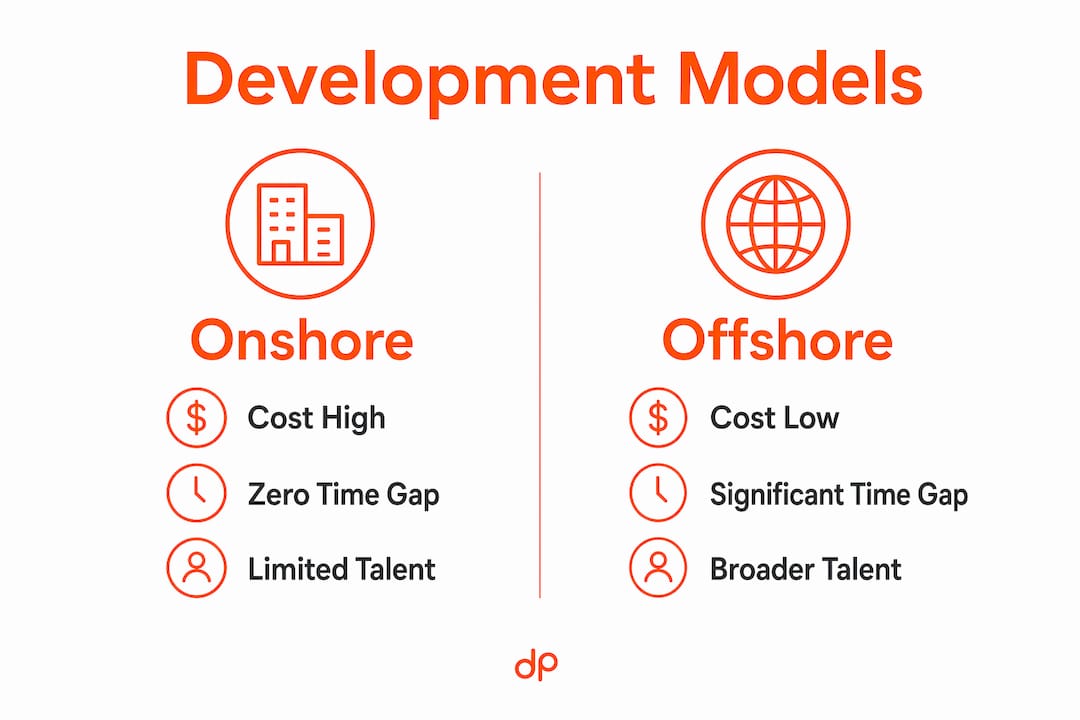
Onshore development keeps your team in the same country, same time zone, and often the same city. Communication is frictionless. Compliance is straightforward. The tradeoff is cost. US-based software engineers command salaries that make large team scaling expensive, and the local talent pool for niche skills is limited.
Nearshore development places your team in a neighboring country or region with minimal time zone separation. For US companies, this typically means Latin America: Colombia, Mexico, Argentina, or Brazil. You get meaningful cost savings compared to onshore, real-time collaboration windows, and cultural proximity. The talent pool is smaller than offshore markets in Asia or Eastern Europe, but the collaboration overhead is lower.
Offshore development accepts the largest time zone gap in exchange for the lowest cost and the broadest talent access. The time zone difference of 4 to 12 or more hours is the primary operational challenge. It is manageable with the right workflow design, but it requires deliberate process investment that onshore and nearshore models do not.
Pro Tip: Do not choose a model based on cost alone. If your product requires daily stakeholder input, rapid iteration, and frequent design reviews, nearshore will outperform offshore even at higher cost. Match the model to your actual collaboration requirements, not just your budget.
How to manage offshore teams effectively
Effective offshore collaboration depends more on disciplined workflows and communication mechanics than on raw engineering talent. This is the insight most companies miss when their first offshore engagement underperforms. They assume the problem is skill. The actual problem is almost always process.
Here is a practical framework for managing offshore development teams:
- Define overlap windows and protect them. Identify the two to three hours per day when your onshore and offshore teams are both online. Use that window exclusively for synchronous work: standups, design reviews, unblocking decisions. Never let it fill with status updates that belong in a ticket.
- Enforce artifact discipline. Every decision, requirement change, and architectural choice must be written down in a shared system, whether that is Jira, Confluence, Linear, or Notion. Verbal updates that do not get documented create drift between what your onshore team thinks is happening and what the offshore team is building.
- Build code review gates into the workflow. Async code reviews with written comments are the primary quality control mechanism for distributed teams. Skipping or rushing them to hit velocity targets is the fastest way to accumulate technical debt.
- Invest in onboarding as a process, not an event. Structured IT team onboarding that covers your codebase conventions, deployment pipeline, and product context reduces ramp time from months to weeks.
- Assign a dedicated tech lead on both sides. The offshore team needs a senior engineer who owns the technical relationship with your internal leads. Without this, context gets lost in translation between management layers.
The offshore development process does not run itself. The companies that get the most from it treat governance as a product, something they actively design, iterate on, and improve over time.
Key takeaways
Offshore development delivers its full value only when cost savings are paired with disciplined collaboration mechanics, clear governance, and the right delivery model for your specific engineering context.
| Point | Details |
|---|---|
| Cost savings are real but conditional | Offshore teams deliver 40 to 70% savings only when governance and onboarding are done properly. |
| Model selection determines control | ODCs suit long-term scale; staff augmentation suits direct control; project-based suits fixed-scope work. |
| Offshore vs nearshore is a collaboration tradeoff | Nearshore reduces time zone friction; offshore maximizes talent access and cost efficiency. |
| Process discipline outweighs talent quality | Artifact discipline, async workflows, and code review gates determine offshore success more than engineer skill level. |
| AI tools multiply the cost advantage | Offshore engineers using GitHub Copilot and similar tools deliver higher throughput per hour, compressing the ROI timeline. |
What most decision-makers get wrong about offshore development
I have seen companies approach offshore development as a procurement decision. They compare hourly rates across vendors in India, Vietnam, and Eastern Europe, pick the lowest number, and expect the savings to materialize automatically. They rarely do.
What actually determines offshore success is the quality of your collaboration infrastructure. The teams I have seen perform at the highest level are not necessarily the ones with the most impressive CVs. They are the ones embedded in a client organization that has clear requirements, documented acceptance criteria, and a tech lead who treats the offshore engineers as peers rather than contractors. The engineering outsourcing guide we put together for tech executives makes this point in detail, and it holds up across every engagement I have been part of.
The other thing decision-makers consistently underestimate is the strategic value of time zone separation when it is managed well. Most companies treat the time gap as a problem to minimize. The companies that use offshore development most effectively treat it as a design constraint that forces better async communication habits across the entire organization, not just the offshore team.
Offshore development in 2026 is not a cost-cutting tactic. It is an engineering strategy. The companies that treat it that way build better products faster.
— Vlad
Build your offshore engineering team with DevPulse
DevPulse delivers full lifecycle offshore software engineering for startups, SaaS companies, and enterprise clients across healthcare, legal tech, cybersecurity, and edtech. Whether you need a dedicated Offshore Development Center that integrates directly with your internal team or staff augmentation to fill specific skill gaps, DevPulse structures the engagement around your workflow, not a generic delivery template.

Our engineers join your sprint ceremonies, work within your tooling, and operate to your code standards from day one. We handle the operational overhead so your technical leads stay focused on product. If you are evaluating offshore development services and want a partner with a track record across complex, regulated industries, review our client case studies or schedule a consultation with the DevPulse team.
FAQ
What is the definition of offshore development?
Offshore development is the practice of building software with engineering teams located in a different country, typically to access lower labor costs and a broader talent pool. The model includes structures like Offshore Development Centers, staff augmentation, and project-based outsourcing.
How much can offshore development save compared to onshore hiring?
Offshore teams typically deliver 40 to 70% cost savings compared to equivalent onshore engineering roles, depending on the region and role type. The savings are largest for senior engineering roles in high-cost markets like the US and Western Europe.
What is the difference between offshore and nearshore development?
Offshore refers to distant countries with a 4 to 12 or more hour time zone gap, while nearshore refers to neighboring countries with minimal time zone separation. Offshore maximizes cost savings and talent access; nearshore prioritizes real-time collaboration.
What roles are typically part of an offshore development team?
Offshore development teams include developers, UI/UX designers, QA engineers, DevOps specialists, project managers, and tech leads. The exact composition depends on the delivery model and the client’s project requirements.
What is an Offshore Development Center (ODC)?
An ODC is a dedicated offshore team that functions as a long-term extension of the client’s in-house engineering organization, complete with office space, infrastructure, and operational support like HR and compliance. The client retains full technical direction while the vendor manages local operations.