













TL;DR:
- Misreading your team’s capabilities leads to project delays, loss of confidence, and increased costs. Conducting precise, multi-source assessments across key competency pillars enables effective staffing, gap closure, and alignment with business goals. Regular calibration and targeted follow-up foster team development, minimizing risk and optimizing project success.
Misreading your team’s actual capabilities is one of the most expensive mistakes an IT leader can make. Projects stall, deadlines slip, and clients lose confidence, often because someone was assigned to a task they were not fully equipped to handle. Knowing how to assess IT team skills with precision gives you the foundation to staff projects correctly, close gaps before they become crises, and build a team that can actually execute your technology roadmap. This guide walks you through the preparation, execution, and follow-through that separates a genuine skills assessment from a box-checking exercise.
Table of Contents
- Key Takeaways
- Preparation steps before assessing IT skills
- How to conduct a thorough IT skills assessment
- Analyzing assessment data to find gaps and strengths
- Continuous assessment and follow-up actions
- My perspective on IT skills assessment in practice
- How Devpulse helps you build a stronger IT team
- FAQ
Key Takeaways
| Point | Details |
|---|---|
| Prepare before you assess | Define the competencies that matter to your projects before choosing any assessment method or tool. |
| Use multiple data sources | Combining self-assessments, tests, and 360-degree feedback produces far more reliable results than any single method alone. |
| Build a skills matrix | Aggregate individual results into a structured matrix to visualize gaps, redundancies, and single points of failure. |
| Align gaps to business goals | Not every gap is urgent. Prioritize training and hiring based on impact to your delivery pipeline and technology roadmap. |
| Make assessment continuous | Schedule full evaluations annually and targeted mini-assessments after major transformation phases to keep your data current. |
Preparation steps before assessing IT skills
Most assessment efforts fail before a single question is asked. The reason is simple: teams jump into tools and surveys without agreeing on what they are actually measuring. Defining what to measure before the process begins prevents wasted effort and ensures your results are directly tied to project outcomes.
Start by identifying the competency categories relevant to your organization. A well-designed IT skills assessment typically covers five pillars:
- Cloud and infrastructure (architecture, provisioning, cost management)
- Security and compliance (zero-trust principles, data governance, regulatory frameworks)
- DevOps and automation (CI/CD pipelines, container orchestration, IaC tooling)
- Development and architecture (language proficiency, system design, API patterns)
- Business and soft skills (communication, stakeholder management, problem-solving)
Balancing competency pillars keeps the skills matrix usable and decision-ready rather than overwhelming. Five is a practical ceiling for most IT teams. Beyond that, you risk drowning in data that nobody acts on.
Once you have defined your pillars, communicate the purpose of the assessment openly with your team. When people understand that the results are tied to their development and not to performance reviews or headcount decisions, participation quality improves significantly. Resistance drops and self-assessment accuracy rises.
Pro Tip: Have engineers help draft the competency definitions for their own roles. They know which skills actually matter in day-to-day delivery, and their input makes the criteria more precise and credible.
How to conduct a thorough IT skills assessment
With your framework in place, the actual assessment process should draw from multiple sources simultaneously. Relying on a single method, particularly self-report alone, leads to biased and unreliable data. Here is a structured sequence that covers the necessary ground:
-
Run self-assessments first. Have each team member rate themselves against each competency using a 1 to 5 scale. This surfaces perceived strengths and gaps and gives you a baseline to compare against external signals.
-
Administer role-appropriate technical tests. Different IT skills require tailored formats: multiple-choice for foundational knowledge, lab simulations for troubleshooting, coding exercises for developers, and case studies for architects or tech leads. Generic trivia questions reveal very little about practical capability.
-
Use real-incident case studies. Mini case studies based on real incidents are superior to generic test questions for evaluating practical competency. A scenario pulled from an actual outage or migration challenge tells you far more than a textbook question does.
-
Collect 360-degree feedback for soft skills. Structured 360-degree feedback with behavior-focused questions effectively identifies soft skill gaps. Use consistent rating scales combined with open-ended comments to get both quantitative scores and qualitative examples.
-
Gather certifications and work samples. Certifications verify a minimum knowledge standard. Work samples, such as code reviews, architecture diagrams, or incident reports, demonstrate applied skill in context. Both serve as objective checkpoints.
-
Hold calibration meetings. Calibration conversations between manager and team member reconcile discrepancies between self-ratings and external data. A typical session runs 45 to 60 minutes and involves discussing specific evidence supporting each rating.
The table below summarizes which format best matches each skill category:
| Skill category | Recommended assessment format |
|---|---|
| Cloud and infrastructure | Lab simulations, architecture diagrams |
| Security and compliance | Case studies, scenario-based questions |
| DevOps and automation | Hands-on pipeline exercises, tooling demos |
| Development and architecture | Coding exercises, code review sessions |
| Business and soft skills | 360-degree feedback, structured interviews |
Pro Tip: Use observable checklists that separate visible output from required inquiries. This reduces disputes over scores and makes evaluations more reliable across seniority levels.
A common failure mode worth flagging: rating inflation and deflation caused by the Dunning-Kruger effect. Junior engineers often overrate themselves while strong senior engineers occasionally underestimate their capabilities relative to peers. The combination of self-assessment, peer review, and calibration is what corrects for this pattern systematically. Soft skills require particularly careful handling here because they cannot be tested as easily as technical knowledge and depend heavily on behavioral evidence from people who work closely with the individual.
Analyzing assessment data to find gaps and strengths
Raw scores from assessments are only useful once you organize them into a structure that reveals patterns. The standard tool for this is a skills matrix. Plot each team member along one axis and each competency pillar along the other, then populate the cells with the calibrated scores from your assessment process. Building a skills matrix with five competency pillars and a 1 to 5 rating scale gives you a clear visual of where your team is strong and where it is exposed.
When you look at the matrix, focus on three specific patterns:
- Critical gaps. Any competency rated below 3 across more than one team member in an area that directly supports an active or upcoming project is an immediate risk. Flag these for training or interim hiring.
- Single points of failure. If only one person on your team can manage your Kubernetes clusters or architect your microservices layer, you have a dependency that will hurt you the moment that person is unavailable.
- Redundancy opportunities. Skills distributed across at least two team members create resilience. Identify where cross-training makes sense versus where specialized depth is the better investment.
Evaluating IT team skills must align with your business goals and technology roadmap to produce a useful prioritization. Not all gaps carry equal urgency. A gap in a skill set tied to a product launch in six weeks demands a different response than a gap in a capability that your roadmap does not require for another two years. This prioritization logic is what separates a skills matrix that drives decisions from one that collects dust in a shared drive.
For IT leaders managing tech talent shortages, this analysis also informs your recruitment pipeline. Knowing exactly which competencies you cannot develop internally gives you a precise brief for external hiring rather than a vague job description written by committee.

Continuous assessment and follow-up actions
An assessment without a follow-up plan is just a survey. The data you collected only creates value if it translates into individual development plans, team-wide training roadmaps, and scheduling commitments.
For each team member, create a short development plan that specifies:
- The two or three competencies they will work on in the next quarter
- The specific learning resource or experience tied to each competency (not just “take a course”)
- A measurable outcome that confirms progress, such as passing a certification exam or leading a production deployment
At the team level, use the matrix to design group training sessions for shared gaps. If half your development team scores below a 3 on security practices, that is a group training event, not a series of individual assignments.
Pro Tip: Track training effectiveness by re-running targeted mini-assessments in the specific competencies that received development investment. This closes the feedback loop and gives you ROI data on your training spend.
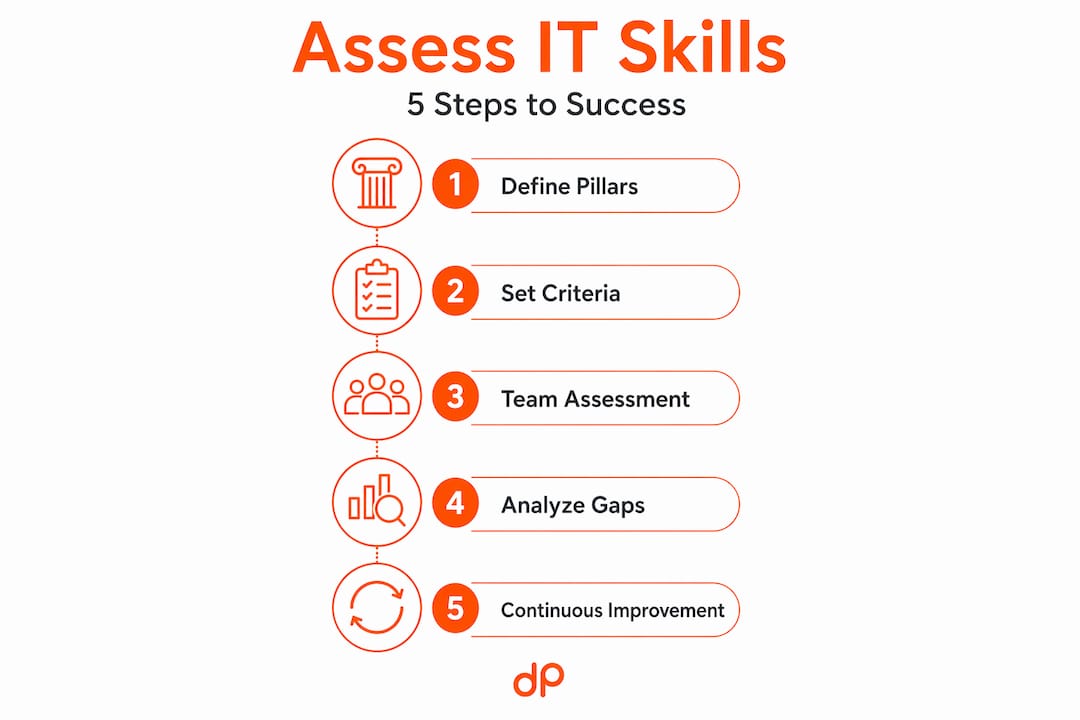
Full comprehensive assessments annually with mini-assessments after major transformation phases keep your skills matrix current. Technology moves fast. A team that assessed its cloud capabilities before a major platform migration will have a different profile six months later, and your matrix needs to reflect that reality.
For remote and hybrid teams, self-assessment and calibration sessions can run asynchronously or over video calls without meaningful loss of quality. Some hands-on simulations benefit from in-person or hybrid delivery, but most of the assessment methodology transfers without modification. Investing in IT workforce scalability requires keeping assessment data fresh regardless of where your people sit.
My perspective on IT skills assessment in practice
I have seen IT leaders spend months designing elaborate assessment frameworks only to abandon them after the first cycle because the process was too cumbersome to repeat. The mistake is almost always the same. They tried to measure everything at once instead of starting with the competencies that directly affect delivery today.
In my experience, the most effective assessments start narrow. Pick the two or three skills that your current project roadmap depends on most and build your first matrix around those. Once the process is working and the team trusts it, expand from there. Trust is the underrated variable here. When engineers believe the assessment is designed to help them grow rather than expose them for a performance action, the quality of self-reporting improves dramatically.
I also want to push back on the idea that technical skills are the only thing worth measuring rigorously. I have watched technically excellent teams fail at project delivery because nobody assessed communication patterns, escalation behavior, or cross-team collaboration skills. Soft skills assessment requires behavioral evidence and structured feedback, and most organizations skip it entirely because it feels harder. It is harder. It is also where some of the most significant project risk actually lives.
The calibration conversation is the single most valuable part of the entire process. Sitting down with an engineer to review their self-rating against the external data and working together toward an agreed score is where growth conversations actually happen. Do not let this step get cut for time.
— Vlad
How Devpulse helps you build a stronger IT team
If your assessment process has surfaced gaps you cannot close through internal development alone, or if you are building out a team for a complex software delivery initiative, Devpulse works with IT leaders to design and staff engineering teams that are matched precisely to project requirements.
From custom software engineering to AI-powered solutions and legacy system modernization, Devpulse brings the technical depth and delivery track record that skill gaps on your current team can put at risk. Our approach starts with understanding your technology roadmap and matching the right capabilities to the right roles, which is exactly what a well-run skills assessment process makes possible. Browse our client case studies to see how we have helped organizations translate technical team gaps into successful product delivery. If you want to talk through your current team composition and what a targeted engagement could look like, reach out and schedule a consultation with the Devpulse team.
FAQ
What does “how to assess IT team skills” actually mean in practice?
Assessing IT team skills means systematically measuring each team member’s technical and soft skill competencies against defined criteria, using methods like tests, simulations, 360-degree feedback, and calibration sessions to produce reliable, actionable data.
How many competency pillars should an IT skills matrix include?
Five pillars is the practical standard: cloud and infrastructure, security and compliance, DevOps and automation, development and architecture, and business and soft skills. Keeping it to five prevents the matrix from becoming too complex to act on.
How often should IT teams be assessed?
Run a full comprehensive assessment annually and targeted mini-assessments after major transformation phases or technology migrations to keep your skills data current and relevant to your active roadmap.
What is the best way to reduce bias in IT skills assessments?
Combine self-assessments, peer reviews, standardized tests, and manager calibration sessions. Relying on any single source, especially self-report alone, produces skewed data that misrepresents actual team capability.
How do you assess soft skills in an IT team?
Use structured 360-degree feedback with behavior-focused questions and consistent rating scales paired with open-ended comments. Soft skills require observable behavioral evidence and cannot be evaluated reliably through technical testing alone.