














Many business leaders believe outsourcing software support is purely a cost-cutting tactic. That misconception oversimplifies a strategic decision that impacts customer satisfaction, operational efficiency, and long-term competitiveness. Outsourcing encompasses tiered technical support, proactive maintenance, and operational management delivered through diverse models. This guide explains the service models available, quantifies the benefits and risks with empirical data, outlines proven frameworks for success, and clarifies when backsourcing makes sense. You will learn how to align outsourcing decisions with business goals and avoid common pitfalls.
Table of Contents
- Key takeaways
- What is outsourcing software support? Scope and service models
- Benefits and risks: cost savings, quality, scalability, and pitfalls
- Frameworks and best practices to ensure outsourcing success
- Real-world scenarios and when to consider backsourcing
- How devPulse can help optimize your software support outsourcing
- Frequently asked questions about outsourcing software support
Key Takeaways
| Point | Details |
|---|---|
| Diverse service models | Outsourcing uses dedicated teams, staff augmentation, or hybrid AI human setups to deliver tiered support, maintenance, and operations with clear governance structures. |
| Substantial cost savings | Benchmarks show 20 to 70 percent per ticket savings along with higher CSAT and strong SLA adherence. |
| Governance and risk | Effective results require agile governance, knowledge transfer, and alignment with business goals to avoid hidden costs and quality issues. |
| Backsourcing tradeoffs | Backsourcing may be necessary in some cases but adds transition expenses and execution risks. |
What is outsourcing software support? Scope and service models
Outsourcing software support involves delegating tiered technical support (tier 0-3), maintenance (corrective, adaptive, perfective, preventive), and operations to external providers using models like dedicated teams, staff augmentation, or hybrid AI-human setups with SLAs, agile sprints, and real-time dashboards for governance. Understanding these components helps you evaluate which model fits your business needs.
Tier 0 support uses self-service AI chatbots and knowledge bases to resolve common issues without human intervention. Tier 1 handles basic troubleshooting through email, chat, or phone. Tier 2 addresses complex technical problems requiring specialized knowledge. Tier 3 escalates to expert engineers for critical bugs or architectural issues. This hierarchy optimizes resource allocation and response times.
Maintenance categories define the work your outsourced team performs. Corrective maintenance fixes bugs and errors. Adaptive maintenance updates software for new environments or platforms. Perfective maintenance enhances features based on user feedback. Preventive maintenance proactively identifies and resolves potential issues before they impact users. Each category requires different skill sets and planning approaches.
Service delivery models offer flexibility based on your control preferences and budget. Dedicated teams work exclusively on your product, integrating deeply with your processes. Staff augmentation fills specific skill gaps within your existing team. Hybrid models combine human expertise with AI automation for routine tasks. Outsourcing frameworks provide detailed guidance on selecting the right model.
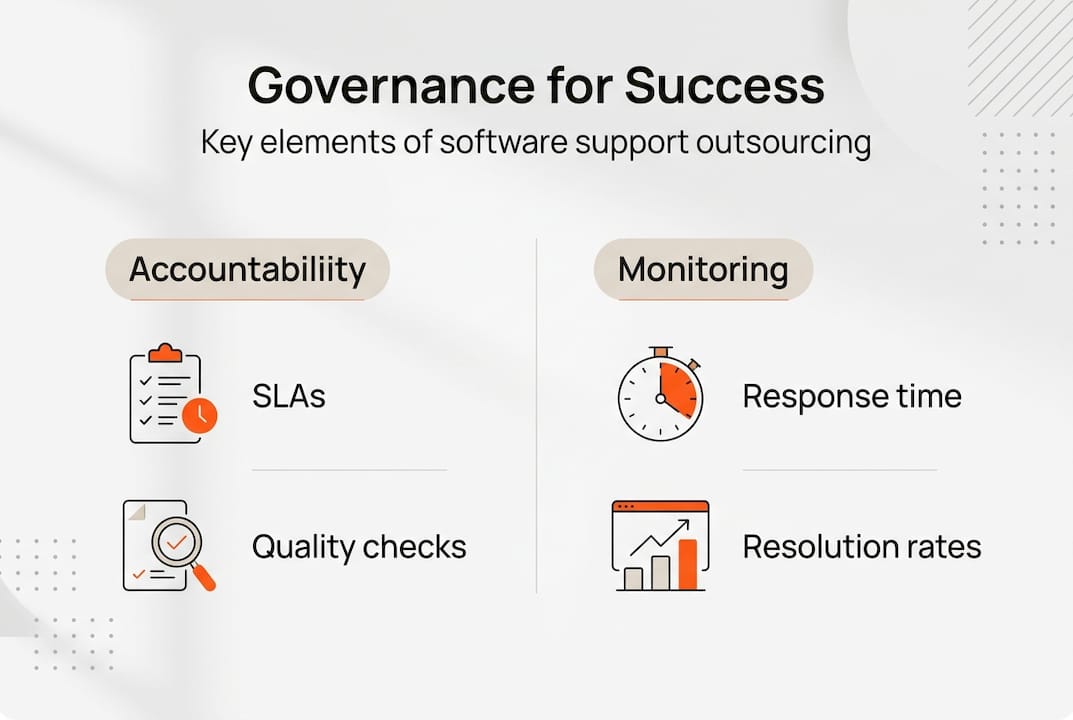
Governance mechanisms ensure accountability and quality. SLAs define response times, resolution targets, and performance penalties. Agile sprints enable iterative delivery and continuous improvement. Real-time dashboards track metrics like first contact resolution, average handle time, and customer satisfaction. These tools transform outsourcing from a black box into a transparent, measurable partnership.
Multiple tiers and models coexist because no single approach fits every scenario. A SaaS company might use tier 0 AI for common questions, tier 1 nearshore teams for general support, and tier 3 onshore specialists for critical escalations. This layered strategy balances cost efficiency with quality and responsiveness.
Benefits and risks: cost savings, quality, scalability, and pitfalls
Empirical benchmarks show 20-70% cost per ticket savings, CSAT 90-94%, SLA adherence 95-98%, MTTR 4-6 hours vs in-house 12-18, with ROI 3.5x in 2 years. The global outsourcing market exceeds $600 billion and grows at 11% annually. These numbers demonstrate why software companies increasingly view outsourcing as strategic rather than tactical.
Cost savings extend beyond hourly rates. Offshore teams in Eastern Europe, Latin America, or Asia offer 40-60% lower labor costs than North American equivalents. You eliminate recruitment expenses, training overhead, and infrastructure investments. Scalability becomes effortless during product launches or seasonal spikes. Your support capacity expands or contracts without hiring freezes or layoffs.
Quality improvements surprise many leaders who assume outsourcing compromises service. Specialized vendors invest heavily in training, tooling, and process optimization. They maintain knowledge bases, runbooks, and escalation protocols that mature teams refine over years. CSAT scores often exceed in-house benchmarks because vendors stake their reputation on measurable outcomes.

Risks demand equal attention. Communication barriers, quality inconsistency, security risks, vendor lock-in, hidden costs of 20-30%, and cultural/timezone issues create failures when leaders ignore warning signs. Poor vendor selection leads to misaligned expectations. Inadequate SLAs leave accountability gaps. Knowledge loss occurs when documentation and transfer protocols receive insufficient attention.
Vendor lock-in traps companies that become dependent on proprietary tools or processes. Switching costs escalate when critical knowledge resides only with the vendor. Hidden costs emerge from scope creep, communication overhead, and quality remediation. A 30% advertised savings can shrink to 10% after accounting for these factors.
“While cost reduction drives initial outsourcing decisions, long-term success requires focusing on quality metrics, knowledge retention, and strategic alignment. Companies that treat outsourcing purely as a cost play often face backsourcing within three years.”
Cultural and timezone differences create coordination challenges. Asynchronous communication slows issue resolution. Misunderstandings arise from different work styles or business norms. Security risks in IT outsourcing multiply when vendors lack robust data protection practices. Failures from these issues lead some companies to backsource operations despite the transition costs.
Balancing benefits and risks requires rigorous vendor evaluation, clear SLAs, and ongoing governance. Outsourcing cost and performance metrics provide frameworks for measuring ROI beyond simple cost comparisons. The key is viewing outsourcing as a partnership requiring active management rather than a set-it-and-forget-it solution.
Frameworks and best practices to ensure outsourcing success
Key methodologies include Agile/Scrum for iterative delivery, Kanban for maintenance, Six Sigma for quality (3.4 DPMO), Stabilize-Assist-Automate phasing, and right-shoring (onshore/nearshore/offshore) with transparent SLAs and governance. These frameworks transform outsourcing from a risky gamble into a predictable, high-performing operation.
Agile and Scrum methodologies enable two-week sprints with daily standups, sprint reviews, and retrospectives. Your outsourced team delivers incremental improvements rather than waiting months for major releases. Kanban boards visualize work in progress, bottlenecks, and completion rates for maintenance tasks. These approaches create transparency and rapid feedback loops.
Six Sigma quality targets aim for 3.4 defects per million opportunities. Vendors achieving this standard use root cause analysis, statistical process control, and continuous improvement cycles. The Stabilize-Assist-Automate framework phases outsourcing engagements logically. Stabilize fixes critical issues and establishes baselines. Assist optimizes processes and transfers knowledge. Automate implements AI and tooling to reduce manual effort.
Right-shoring balances cost, quality, and timezone alignment. Onshore teams cost more but eliminate communication barriers and timezone gaps. Nearshore options in similar timezones offer moderate savings with easier collaboration. Offshore teams maximize cost savings but require robust processes to overcome distance challenges. Many companies use a hybrid approach, placing tier 1 support nearshore and tier 3 specialists onshore.
Technical decision-makers should demand agile governance, real-time analytics, and knowledge transfer protocols to avoid tacit knowledge loss. Monitor KPIs like first contact resolution, average handle time, and CSAT quarterly. Backsourcing becomes viable if core competence is at stake but expect 2-15% transition costs. Governance mechanisms include weekly steering committees, monthly business reviews, and quarterly strategic planning sessions.
Pro Tip: Implement rigorous knowledge transfer protocols from day one. Record troubleshooting sessions, document edge cases, and maintain shared runbooks. This prevents knowledge loss and reduces backsourcing risk if you later decide to bring operations in-house. Many failures stem from treating knowledge transfer as an afterthought rather than a continuous discipline.
| KPI | Target | Measurement Frequency |
|---|---|---|
| First Contact Resolution | 75-85% | Weekly |
| Average Handle Time | 8-12 minutes | Daily |
| Customer Satisfaction | 90-94% | After each interaction |
| SLA Adherence | 95-98% | Real-time dashboard |
| Mean Time to Resolution | 4-6 hours | Per ticket |
| Escalation Rate | Below 15% | Weekly |
Tracking these metrics quarterly reveals trends and enables proactive adjustments. Real-time dashboards provide visibility into daily operations without micromanaging. Aligning outsourcing with business goals requires connecting these operational metrics to strategic outcomes like customer retention, product velocity, and market expansion.
Agile governance and service models create accountability structures that prevent the drift toward mediocrity. Regular audits, performance reviews, and improvement sprints keep quality high. Exit clauses in contracts provide leverage if vendors underperform. Multi-vendor strategies prevent lock-in by maintaining competitive pressure and backup options.
Real-world scenarios and when to consider backsourcing
Backsourcing happens when companies bring previously outsourced operations back in-house. Poor vendor selection, loss of control, and quality issues drive this decision. Backsourcing challenges include change management and hiring, and some studies show no significant savings post-backsourcing. Understanding when and how to reverse course protects your business from prolonged underperformance.
Transition costs for backsourcing range from 2-15% of annual contract value. You must hire and train staff, rebuild infrastructure, and recover lost knowledge. Operational disruptions during the transition period impact customer satisfaction and team morale. Many companies discover that the grass is not greener after backsourcing because in-house operations face the same challenges that prompted outsourcing initially.
Reasons for backsourcing include strategic shifts where support becomes a competitive differentiator. A company might decide that deep customer relationships require in-house expertise. Security concerns drive backsourcing when vendors cannot meet compliance requirements. Quality deterioration that vendors cannot remedy despite escalations leaves no alternative.
Mitigation strategies reduce the need for backsourcing. Multi-vendor approaches distribute risk and maintain competitive pressure. Exit clauses with 60-90 day termination windows provide flexibility. Regular audits verify compliance with SLAs and quality standards. These mechanisms catch problems early when corrective action remains feasible.
AI augmentation is emerging to boost efficiency 20-60% by automating routine tasks, predicting issues, and accelerating knowledge transfer. AI chatbots handle tier 0 support. Machine learning models predict ticket volume and optimize staffing. Natural language processing analyzes support conversations to identify training gaps and process improvements. This technology reduces the tradeoffs between cost and quality.
| Factor | Outsourcing | Backsourcing |
|---|---|---|
| Initial cost | Lower (20-70% savings) | Higher (hiring, training, infrastructure) |
| Control | Reduced (vendor dependent) | Full (direct management) |
| Scalability | High (rapid up/down) | Limited (hiring cycles) |
| Knowledge retention | Risk of loss | Maintained in-house |
| Transition effort | Moderate (vendor onboarding) | High (rebuilding capability) |
| Quality consistency | Variable (vendor dependent) | Direct oversight |
This comparison clarifies the tradeoffs. Outsourcing wins on cost and scalability. Backsourcing wins on control and knowledge retention. Your decision depends on which factors matter most for your strategic position and competitive advantage.
Pro Tip: Before committing to backsourcing, conduct a pilot program bringing one product or region in-house. Measure actual costs, quality, and operational complexity against projections. Many companies overestimate their ability to replicate vendor performance without the same specialization and scale advantages.
Real-world outsourcing case studies show that success correlates with strategic alignment, not just cost reduction. Companies that define clear objectives, invest in governance, and treat vendors as partners achieve better outcomes. Those that select vendors solely on price and neglect ongoing management face disappointment.
AI augmentation in support outsourcing represents the future direction. Hybrid models combining human judgment with AI efficiency deliver superior results. Chatbots resolve simple issues instantly. Humans handle complex problems requiring empathy and creativity. This division of labor optimizes both cost and quality simultaneously.
How devPulse can help optimize your software support outsourcing
Navigating software support outsourcing requires expertise in vendor selection, governance frameworks, and technology integration. devPulse brings deep experience helping businesses implement successful outsourcing strategies that balance cost efficiency with quality and control.
Our software enhancement services include designing hybrid support models that combine in-house strategic oversight with outsourced operational execution. We help you define SLAs, establish KPI dashboards, and implement agile governance structures that prevent common pitfalls. Our technical support and maintenance services provide direct assistance when you need augmented capacity or specialized expertise.
We leverage AI augmentation to boost efficiency without sacrificing the human touch that complex issues require. Our approach emphasizes knowledge transfer protocols that protect your intellectual capital and reduce backsourcing risk. Whether you are evaluating initial outsourcing decisions or optimizing existing arrangements, devPulse provides the strategic guidance and technical capabilities you need. Explore our real-world software solutions case studies to see how we have helped companies achieve measurable improvements in support operations.
Frequently asked questions about outsourcing software support
What role does AI play in modern software support outsourcing?
AI automates tier 0 support through chatbots and knowledge bases, predicts ticket volume for staffing optimization, and analyzes conversations to identify training needs. This technology boosts efficiency 20-60% while allowing human agents to focus on complex issues requiring judgment and empathy. Hybrid AI-human models deliver the best balance of cost and quality.
What are typical SLA terms in software support outsourcing contracts?
Standard SLAs define response times (critical issues within 1 hour, high priority within 4 hours, normal within 24 hours), resolution targets (MTTR 4-6 hours for critical), availability guarantees (99.5-99.9% uptime), and performance penalties for non-compliance. Quality metrics include FCR above 75%, CSAT above 90%, and escalation rates below 15%. Review and adjust SLAs quarterly based on actual performance data.
How long does transitioning to outsourced support typically take?
Transition timelines range from 60-120 days depending on complexity. The first 30 days focus on knowledge transfer, documentation, and tool access. Days 31-60 involve shadowing, co-piloting, and gradual responsibility transfer. Days 61-90 establish independent operations with close monitoring. Full optimization often requires 6-12 months as the vendor learns your product nuances and customer expectations.
How do cultural differences impact outsourced software support quality?
Cultural differences affect communication styles, problem-solving approaches, and customer interaction norms. Offshore teams may hesitate to escalate issues or challenge assumptions due to hierarchical work cultures. Timezone gaps delay real-time collaboration. Mitigate these challenges through cultural training, overlapping work hours, asynchronous communication tools, and regular video meetings that build rapport and shared understanding.
What metrics best predict outsourcing success beyond cost savings?
Knowledge retention rates, measured by documentation completeness and cross-training coverage, predict long-term sustainability. Customer effort scores reveal whether support actually helps users or creates frustration. Employee turnover at the vendor indicates stability and institutional knowledge. Strategic alignment scores from quarterly business reviews show whether outsourcing advances your competitive position or merely reduces expenses.