














Most technology leaders believe hiring more engineers automatically solves scaling challenges. Reality proves far more complex. True IT workforce scalability demands strategic orchestration of talent acquisition, workflow optimization, cultural alignment, and technology integration. Growing your software engineering team without these foundations creates bottlenecks, communication breakdowns, and quality issues that undermine growth. This guide reveals proven strategies technology leaders use to scale engineering teams effectively while maintaining productivity, code quality, and team cohesion throughout rapid expansion phases.
Table of Contents
- Understanding IT Workforce Scalability: Core Concepts And Challenges
- Models For Scaling Software Engineering Teams: Options And Comparisons
- Strategies And Best Practices For Effective IT Workforce Scalability
- Leveraging Technology And Support Services To Enhance Scalability
- Explore DevPulse’s Expertise In Scaling Engineering Teams
- Frequently Asked Questions About IT Workforce Scalability
Key takeaways
| Point | Details |
|---|---|
| Strategic planning essential | Effective scaling requires coordinated workflow, culture, and technology adaptation beyond simple hiring. |
| Multiple scaling models exist | Choose between in-house expansion, outsourcing partnerships, or hybrid approaches based on your specific goals. |
| Quality must stay consistent | Successful scalability balances speed and cost while maintaining code standards and team performance. |
| Support services accelerate growth | Technical support and maintenance services reduce friction during team expansion phases. |
| Data drives better decisions | Leverage analytics and AI tools to optimize workforce allocation and identify scaling bottlenecks early. |
Understanding IT workforce scalability: core concepts and challenges
IT workforce scalability is not just about hiring but involves adapting workflows, culture, and technology to support growth without compromising quality or velocity. Technology leaders often discover this reality when their newly expanded teams produce less output per engineer than smaller, more cohesive groups. The challenge extends beyond recruitment into onboarding efficiency, knowledge transfer systems, and communication infrastructure that prevents information silos.
Rapid team growth introduces friction points most leaders underestimate. Communication overhead increases exponentially as team size grows, creating coordination challenges that slow delivery. New engineers require time to understand existing codebases, architectural decisions, and team conventions before reaching full productivity. During this ramp-up period, senior engineers spend significant time mentoring rather than building, temporarily reducing overall team output.
Technical debt accumulates faster during scaling phases when teams prioritize speed over sustainable practices. Shortcuts taken to meet aggressive timelines create maintenance burdens that compound over time. Code review processes strain under increased volume, potentially allowing quality issues into production. Testing coverage often suffers as teams rush to deliver features, storing up reliability problems for later.
Key challenges technology leaders face when scaling engineering teams include:
- Maintaining consistent code quality standards across growing teams with varying experience levels
- Preserving company culture and engineering values as new team members join rapidly
- Preventing knowledge silos that form when teams grow beyond natural communication limits
- Balancing immediate delivery pressure against long-term technical health and sustainability
- Coordinating work across distributed teams spanning multiple time zones and cultural contexts
Strategic planning transforms these challenges into manageable transitions. Leaders who invest time designing scalable processes, communication frameworks, and quality gates before aggressive hiring avoid the productivity dips that plague reactive approaches. Understanding these core concepts prepares you to evaluate different scaling models and choose approaches aligned with your specific business context and growth trajectory.
Models for scaling software engineering teams: options and comparisons
Technology leaders can choose from several workforce scalability models, each offering distinct advantages depending on company stage, budget constraints, and strategic priorities. Engineering outsourcing and hybrid approaches provide alternatives to traditional in-house expansion, enabling faster scaling with different trade-offs around control, cost, and cultural integration.
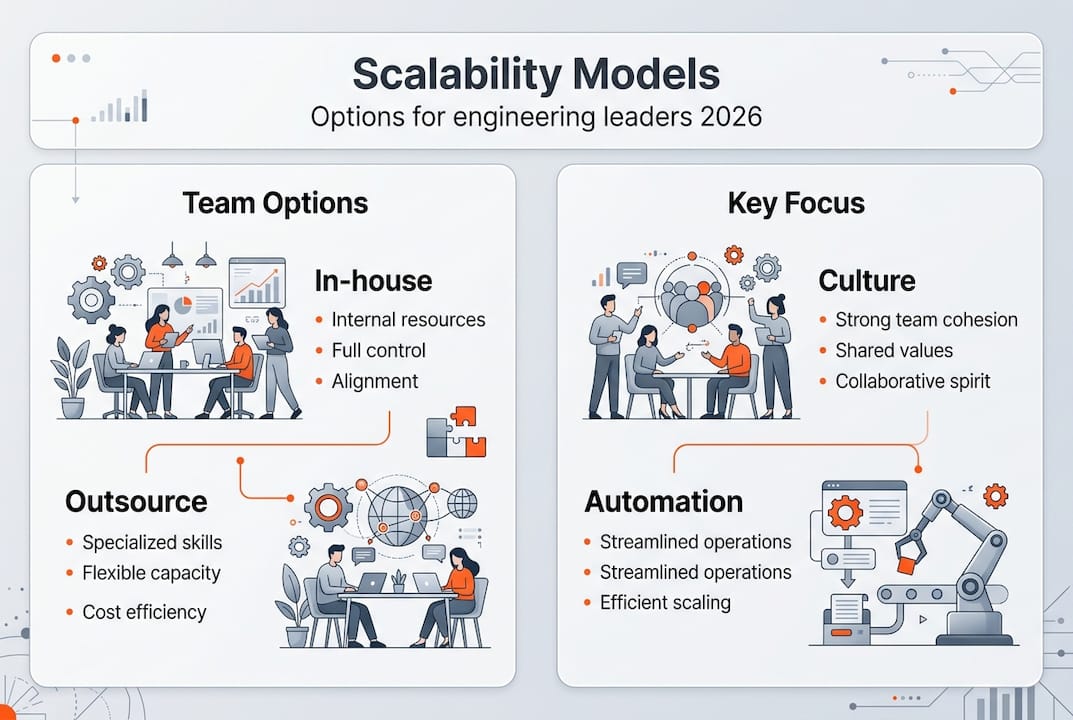
In-house team expansion gives you maximum control over culture, processes, and intellectual property. Your engineers work exclusively on your products, building deep domain expertise over time. Direct oversight enables rapid pivots and tight coordination across teams. However, this model requires significant upfront investment in recruitment, onboarding, benefits, and infrastructure. Hiring timelines stretch months in competitive markets, slowing your ability to respond to urgent opportunities. Fixed costs remain high even during slower periods when you need less capacity.
Outsourcing engineering work to specialized partners accelerates scaling dramatically. You access experienced teams immediately without recruitment delays or onboarding overhead. Costs become variable, scaling up or down based on current needs rather than fixed payroll commitments. Partners bring specialized expertise in specific technologies or domains your internal team lacks. The trade-offs include less direct control over daily work, potential communication challenges across time zones, and the need for clear requirements and strong project management to ensure alignment.

Hybrid models combine in-house core teams with outsourced capacity for specific functions or overflow work. Your internal engineers own critical systems and architectural decisions while external teams handle implementation work, maintenance, or specialized components. This approach balances control with flexibility, letting you scale capacity quickly while maintaining cultural continuity in your core team. Coordination between internal and external teams requires deliberate communication frameworks and clear interface definitions.
| Model | Best For | Key Advantage | Primary Challenge |
|---|---|---|---|
| In-house expansion | Long-term strategic initiatives | Maximum control and cultural alignment | Slow scaling, high fixed costs |
| Full outsourcing | Rapid capacity needs | Immediate access to experienced teams | Communication and coordination overhead |
| Hybrid approach | Balanced growth strategy | Flexibility with core team stability | Managing multiple team structures |
| Staff augmentation | Temporary skill gaps | Targeted expertise on demand | Integration with existing processes |
Choosing the right model depends on your current team size, growth velocity targets, budget flexibility, and the criticality of maintaining direct control. Startups often benefit from hybrid approaches that let them scale quickly while building core capabilities internally. Mid-sized enterprises with established processes may find outsourcing specific functions like maintenance or testing frees internal capacity for innovation. The key is matching your scaling model to your specific business context rather than following generic best practices.
Managing distributed teams across any model requires intentional communication structures. Establish clear ownership boundaries, decision-making frameworks, and regular synchronization points. Document architectural decisions and coding standards explicitly rather than relying on tribal knowledge. Invest in collaboration tools that bridge time zones and create visibility into work progress across all team members regardless of location or employment model.
Strategies and best practices for effective IT workforce scalability
Successful workforce scaling requires systematic approaches that optimize IT staffing workflows and create repeatable processes for integrating new team members productively. These strategies help you maintain velocity and quality even as headcount increases significantly.
- Design modular architectures that enable parallel development across independent teams without constant coordination overhead or merge conflicts.
- Establish clear ownership boundaries where specific teams own particular services or components, reducing cross-team dependencies that slow delivery.
- Create comprehensive onboarding programs that systematically transfer knowledge rather than relying on ad hoc mentorship that burdens senior engineers.
- Implement automated testing and continuous integration that catches quality issues early rather than depending solely on manual code review.
- Document architectural decisions, coding standards, and common patterns so new engineers can self-serve answers instead of interrupting teammates.
- Build internal developer platforms that abstract infrastructure complexity and let engineers focus on business logic rather than operational concerns.
- Establish regular knowledge-sharing sessions where engineers present technical topics, spreading expertise across the growing organization.
- Create career progression frameworks that retain top talent by providing clear growth paths as the organization scales.
Investing in continuous training and development becomes critical during scaling phases. New technologies emerge constantly, and your growing team needs consistent skill development to maintain competitive advantage. Dedicate budget for conferences, online courses, and certification programs. Encourage engineers to spend time on learning activities rather than maximizing every hour on feature delivery. This investment pays dividends through higher productivity, better architectural decisions, and improved retention.
Cultural alignment during scaling requires deliberate effort. Clearly articulate your engineering values and decision-making principles. Hire for cultural fit alongside technical skills, ensuring new team members reinforce rather than dilute your culture. Create opportunities for informal connection across teams through social events, interest groups, and cross-functional projects. Culture degrades naturally as teams grow unless you actively maintain it through consistent messaging and role modeling from leadership.
Pro Tip: Prioritize asynchronous communication channels as your team grows to prevent meeting overload that destroys productivity. Use documentation, recorded videos, and threaded discussions so information spreads without requiring everyone’s simultaneous attention. Reserve synchronous meetings for decisions requiring real-time debate rather than status updates or information sharing.
Technology tools facilitate collaboration and tracking across distributed, growing teams. Project management platforms provide visibility into work progress and help identify bottlenecks before they cascade. Communication tools create channels for different topics, reducing noise and helping people find relevant conversations. Code review platforms streamline quality processes and create learning opportunities. Analytics dashboards surface productivity metrics and help you spot trends indicating process problems or capacity constraints.
Dedicated teams significantly boost software project outcomes by maintaining continuity and deep context on specific products or components. Rather than constantly reshuffling engineers across projects, stable teams build expertise and optimize their collaboration patterns over time. This consistency accelerates delivery and improves quality as team members develop intuition about their domain and each other’s working styles.
Leveraging technology and support services to enhance scalability
Adopting technical support and maintenance services enables scalable and reliable software development by freeing your core engineering team to focus on innovation rather than operational firefighting. As your engineering organization grows, the surface area of systems requiring ongoing maintenance expands proportionally. Without dedicated support infrastructure, your most expensive engineering talent spends increasing time on bug fixes, incident response, and routine maintenance rather than building new capabilities that drive business value.
Technical support services provide specialized teams focused exclusively on keeping existing systems healthy and responsive. They handle user-reported issues, monitor system health, respond to incidents, and perform routine maintenance tasks. This separation of concerns lets your product engineering teams maintain focus on roadmap delivery while ensuring customers receive responsive support. Support teams develop deep expertise in troubleshooting and system operations that complements the architectural and feature development skills of your core engineers.
Maintenance services reduce downtime and productivity loss by proactively addressing technical debt and system health issues before they escalate into critical problems. Regular dependency updates, security patching, performance optimization, and refactoring keep systems running smoothly. Deferred maintenance creates compounding costs as systems become increasingly fragile and difficult to modify. Dedicated maintenance capacity prevents this degradation by ensuring continuous investment in system health alongside new feature development.
Emerging AI tools assist scalability efforts by automating repetitive tasks and augmenting human decision-making. Code generation tools accelerate implementation of routine functionality. Automated testing tools expand coverage without proportional increases in QA headcount. AI-powered code review identifies common issues and suggests improvements, reducing the burden on senior engineers. Intelligent monitoring systems detect anomalies and predict potential failures before they impact users. These tools multiply the effective capacity of your engineering organization without linear headcount growth.
Data-driven insights optimize workforce allocation by revealing where teams spend time and identifying bottlenecks constraining throughput. Analyze cycle time metrics to understand how long work takes from conception to production. Track deployment frequency and change failure rates to assess your delivery pipeline health. Monitor code review turnaround times to spot capacity constraints in quality processes. Use these insights to make informed decisions about where to add capacity, which processes need improvement, and whether current scaling approaches deliver expected results.
| Metric | What It Reveals | Target Range |
|---|---|---|
| Cycle time | End-to-end delivery speed | 1-2 weeks for features |
| Deployment frequency | Release velocity | Multiple per day |
| Change failure rate | Quality and testing effectiveness | Below 15% |
| Code review time | Review process capacity | Under 24 hours |
| Onboarding time to first commit | Onboarding effectiveness | Under 2 weeks |
Pro Tip: Integrate support services early in your scaling process to avoid the common pitfall of accumulating operational debt that later requires expensive remediation. Establishing support and maintenance functions before they become critical prevents the crisis-driven scrambles that disrupt product roadmaps and demoralize teams. Proactive investment in operational excellence creates the foundation for sustainable scaling.
Automation multiplies the impact of support and maintenance teams by handling routine tasks without human intervention. Automated deployment pipelines reduce the manual effort required to ship code. Self-healing infrastructure detects and resolves common issues automatically. Chatbots handle tier-one support questions, escalating only complex issues to human engineers. This automation lets small support teams manage large system portfolios effectively, improving your scaling economics.
Explore devPulse’s expertise in scaling engineering teams
Scaling your software engineering team demands more than hiring talent. You need partners who understand the strategic, technical, and operational challenges of sustainable growth. DevPulse offers software enhancement and engineering services designed specifically for technology leaders navigating rapid scaling phases. Our team combines deep technical expertise with practical experience helping startups and mid-sized enterprises build engineering organizations that deliver consistently as they grow.

We have proven success helping clients scale their software teams efficiently while maintaining quality and velocity. Our approach emphasizes sustainable practices, knowledge transfer, and building internal capabilities alongside delivering immediate results. Explore our software scaling case studies to see how we have helped companies like yours overcome scaling challenges. Our technical support and maintenance services provide the operational foundation that frees your core team to focus on innovation while we ensure system reliability and responsiveness.
Frequently asked questions about IT workforce scalability
What is the best model for scaling software teams in startups?
Hybrid models typically work best for startups, combining a small core in-house team with outsourced capacity for specific functions. This approach provides flexibility to scale quickly without excessive fixed costs while maintaining cultural continuity and control over strategic decisions. The optimal mix depends on your funding situation, growth velocity, and technical complexity.
How can I maintain culture during rapid IT team growth?
Maintain culture through deliberate communication of values, careful hiring for cultural fit, and creating regular opportunities for team connection. Document your engineering principles explicitly rather than relying on osmosis. Have leadership consistently model desired behaviors and address cultural drift quickly when you spot it emerging.
When should a company consider outsourcing engineering work?
Consider outsourcing when you need to scale capacity faster than hiring allows, require specialized expertise your team lacks, or want to convert fixed costs into variable expenses. Outsourcing works particularly well for maintenance, testing, or implementation work while keeping architectural decisions and core product development in-house.
What role does automation play in workforce scalability?
Automation multiplies team effectiveness by handling repetitive tasks without proportional headcount increases. Automated testing, deployment, monitoring, and infrastructure management let small teams manage large systems. Invest in automation before scaling aggressively to establish force multipliers that improve your scaling economics.
How do technical support services impact scaling success?
Technical support services free your core engineering team from operational interruptions, letting them maintain focus on building new capabilities. Support teams handle incidents, user issues, and routine maintenance, preventing the productivity drain that occurs when product engineers constantly context-switch to firefighting mode.