














You’re looking at a page that feels fine on a fast office connection, then a sales rep opens it on a phone in a hotel lobby and the whole experience falls apart. The content is there, the product is real, and the team already invested in the UI, yet the first meaningful screen arrives late and the page still isn’t interactive. That gap is where server side rendering matters, not as a slogan, but as an architecture decision.
What Server Side Rendering Actually Does
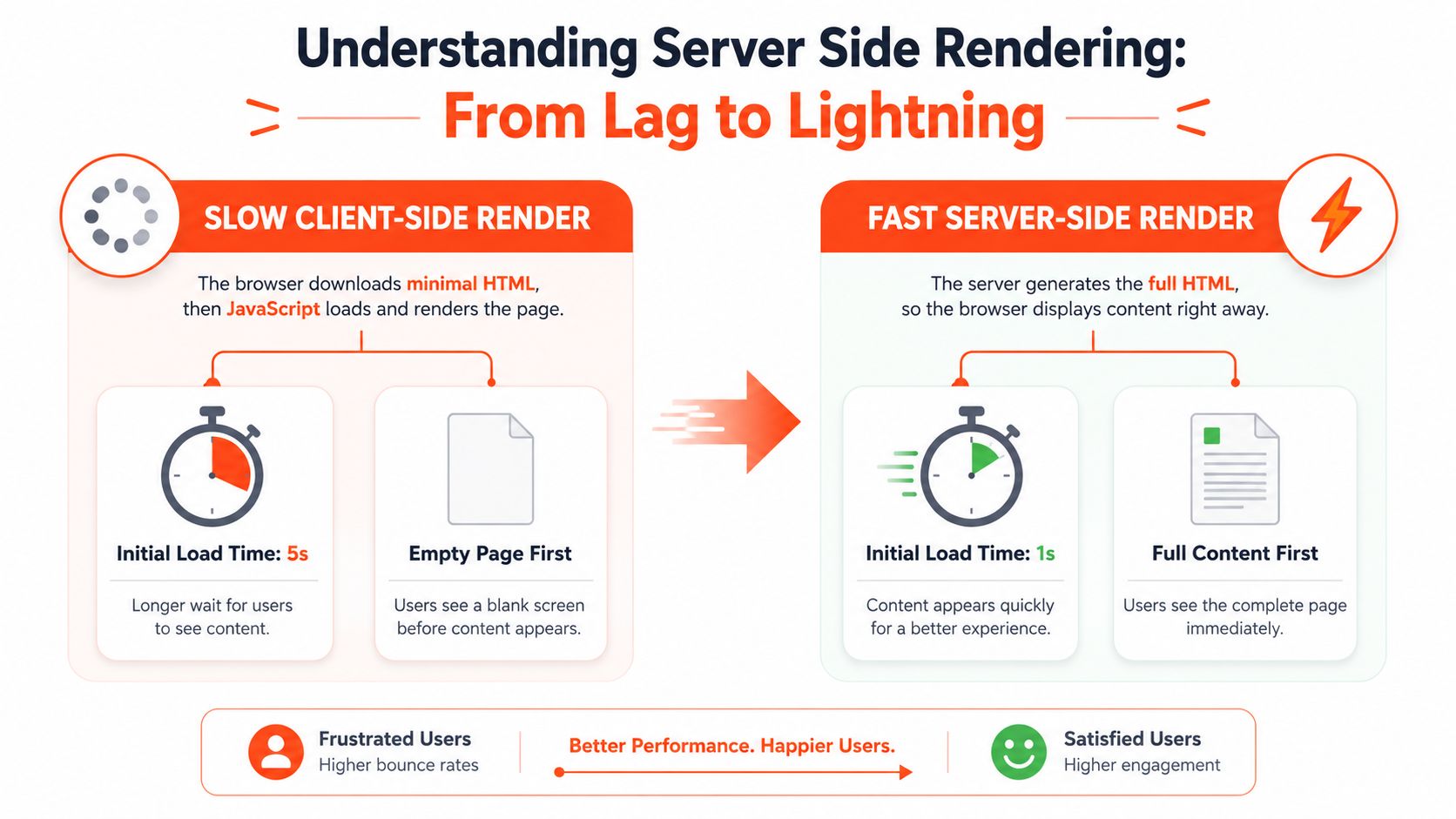
A useful way to think about server side rendering is a restaurant kitchen. The server prepares the meal, plates it, and sends out something complete enough that the customer can start eating right away. Then the browser comes in and finishes the last bit of setup, which is why SSR is better understood as a request-time, two-phase pipeline, not a one-step HTML dump.
The first phase is server rendering
The server takes your component tree and turns it into HTML before the browser has to do the heavy lifting. That HTML can paint immediately, so the user doesn’t stare at a blank shell while JavaScript loads. If you want a separate, practical explanation of how rendering affects early paint, the article on faster first paint with CRP is a good companion read.
The second phase is hydration
Once the browser has the HTML, it still needs to make the page interactive. In React, that second phase is called hydration, and it attaches event listeners and reconnects the DOM to application state. In other words, the page looks ready before it is fully alive.
Practical rule: SSR helps most when you care about users seeing useful content early, not just when you care about search bots parsing HTML.
That split matters because teams often describe SSR as if it were one action. It’s really a handoff. The server does the prep work, the browser shows the result, and the client finishes the wiring. Once you see that sequence clearly, the trade-offs stop feeling mysterious.
The Request Mechanics Behind SSR
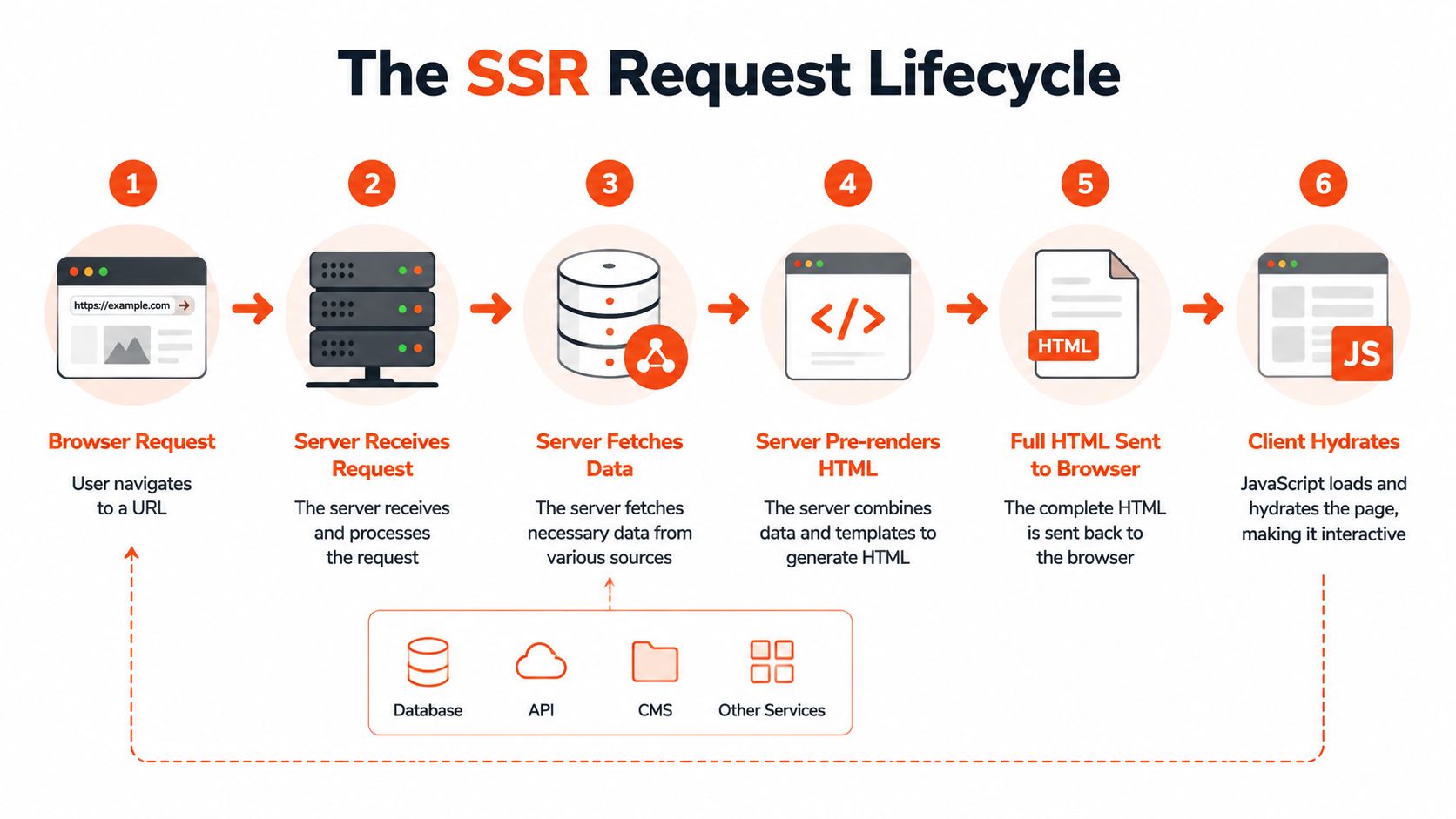
A typical SSR request starts like a service ticket in an enterprise queue. The browser asks for a page, the server gathers the data it needs, renders HTML, sends that HTML back, and the browser finishes the job by downloading JavaScript and hydrating the page. DebugBear lays out that request flow clearly, from the initial browser request through hydration (server-side rendering request flow).
The important part is that this work happens at request time. Each visit can trigger fresh data access, fresh rendering, and fresh delivery, so SSR behaves like a live server response rather than a prebuilt asset. Next.js documents that getServerSideProps runs on each request instead of at build time, which means the server is doing real work every time a user arrives (Next.js SSR docs). That is a strong fit for personalized or fast-changing pages, because the server can assemble the right version on demand. It is also why SSR can shift cost from the browser to the origin when the page content is stable and public.
The runtime API choices reinforce that split. Modern React SSR commonly uses renderToPipeableStream on Node or renderToReadableStream at the edge, then hydrateRoot on the client (React SSR architecture). Those APIs are designed to let the shell reach the browser before slower data or lower-priority subtrees finish, so the user sees something useful earlier. That helps explain why SSR is a request-time pipeline, not a single render step.
The browser does not need the full application before it can paint useful HTML. It needs enough markup to show the page, then enough JavaScript to make the right parts interactive.
For enterprise teams, the question is where that work should live and what it does to the rest of the stack. If the server renders every request, latency now depends on data fetches, compute, and cache strategy, so origin pressure becomes part of the user experience. The Appjet.ai 2026 latency tips piece is useful here because it frames latency as a systems problem, not just a frontend concern. SSR can improve early paint, but if hydration is heavy or caching is weak, the win on the screen can come with more load on the backend and worse interaction timing later.
SSR Compared With CSR and SSG
![No image markdown for this section.]
The decision usually isn’t “SSR or nothing.” It’s a three-way comparison against client-side rendering and static site generation. For teams mapping a broader platform direction, the modern tech stack guide for 2025 is a helpful way to place rendering choices inside a bigger architecture conversation.
| Criterion | SSR | CSR | SSG |
|---|---|---|---|
| First paint | Strong when HTML arrives quickly from the server | Weak on the first visit if JS must build the page first | Strong for prebuilt pages |
| TTFB | Depends on server work and data fetches | Can be low for simple assets, but content still waits on JS | Usually strong for cached pages |
| INP | Can suffer if hydration is heavy | Can be good after the app loads, but initial work can be heavy | Often good once the page is loaded, but still depends on client code |
| Personalization | Good fit for request-time content | Good for app-like client behavior | Poor fit unless you rebuild frequently or add runtime personalization |
| Deploy footprint | More complex at runtime | Simpler delivery, more client JS | Build pipeline becomes more important |
| Cacheability | Good for public HTML, tricky for personalized HTML | Mostly static asset caching | Excellent for content that rarely changes |
How to read the table
SSR usually wins when the server can produce useful HTML quickly and the client doesn't need to do too much to become interactive. CSR can still be the right choice for dense application states, especially when the browser is doing most of the work after the first load. SSG is ideal when the content is stable and you want the CDN to do most of the delivery work.
The enterprise lens is different from the blog-post lens
A marketing page, a help center, a product dashboard, and a personalized portal don't have the same rendering needs. SSR is strong when the response has to reflect request-time data, but the cost moves to the origin, and the page still has to hydrate. SSG avoids that runtime cost for stable content, while CSR can be acceptable when the app is more about ongoing interaction than the first paint.
Good architecture picks the rendering model that matches the page's volatility, not the one that sounds most modern.
When SSR Quietly Loses Its Edge
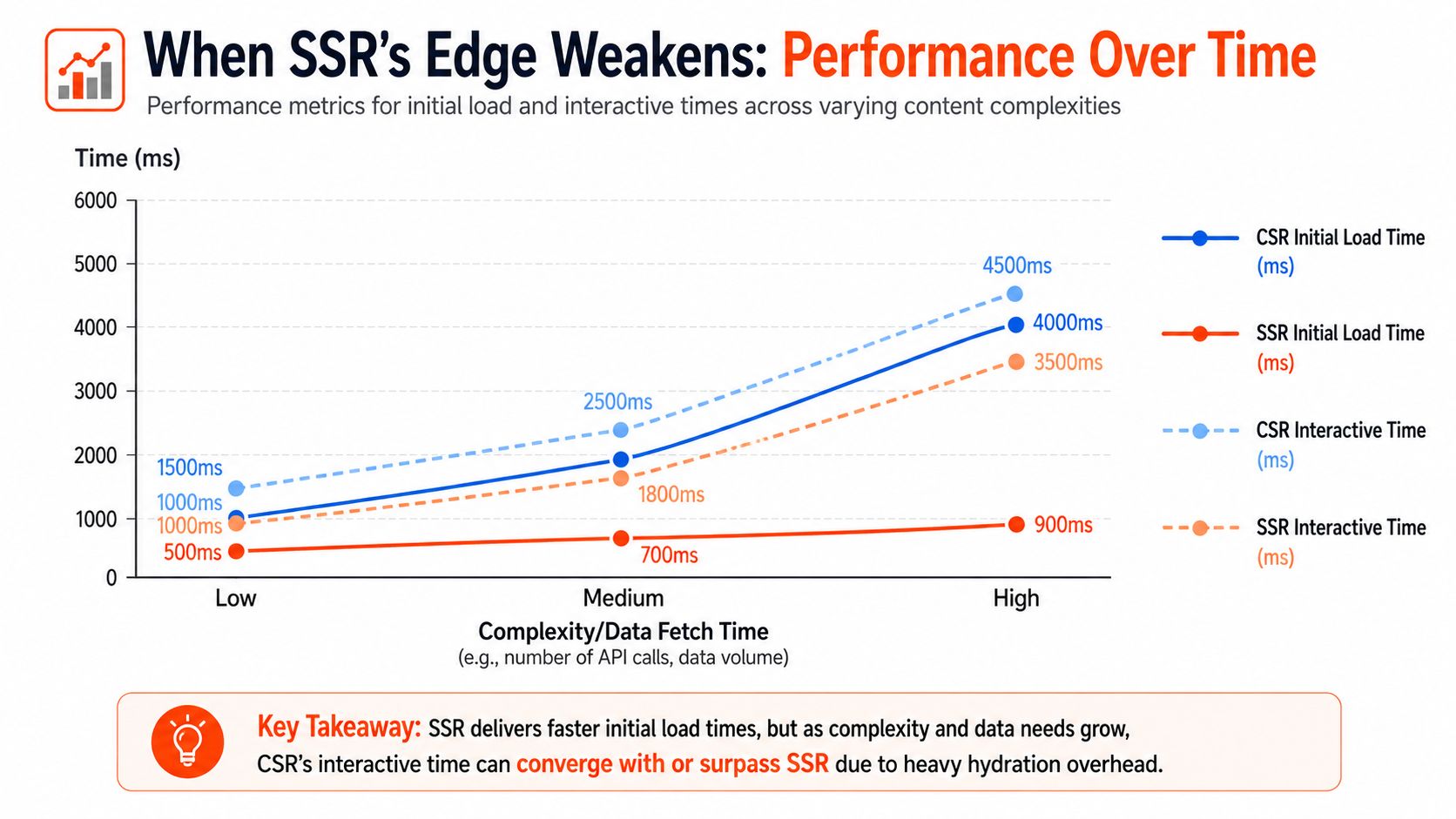
SSR can look like the clear winner if you only inspect the first paint. A page may render early and still feel sluggish if the server is slow to assemble data or if the browser has to work through a large hydration pass before the interface becomes usable. In an empirical SSR vs CSR study, CSR showed only a slight advantage in average LCP and INP under normal Wi-Fi, but under 3G throttling SSR became much steadier and its LCP was more than three times faster than CSR. The same study gives a practical decision line, if LCP exceeds 2.5 seconds on mobile or 3G-like networks, SSR is the safer choice, and if TTFB approaches 800 ms, SSR can help reduce latency (empirical SSR vs CSR study).
Hydration can erase the gain
That matters because SSR does not stop at the first paint. Heavy hydration can hold the main thread busy and hurt INP, while slow server data or expensive computation can push TTFB higher, which delays the moment the user sees anything useful. Modern SSR frontend architecture guidance makes the same point from the implementation side, if the browser has to reconcile too much HTML with too much JavaScript, the page can look ready and still respond poorly when someone clicks, filters, or expands a panel.
The shape of the page matters more than the label
A page with a small interactive surface often benefits from SSR because the server can deliver useful HTML quickly and the browser has less work to finish. A page with dense client-side behavior tells a different story, because the browser still has to process a large JavaScript bundle before the experience feels complete.
The question is not whether SSR is fashionable. It is whether the page can stay light enough after hydration for the user to work without waiting.
That is why the line between a good SSR experience and a disappointing one is usually architectural. Small interactive islands, predictable server output, and deliberate caching preserve the benefit. Without those constraints, SSR often just shifts cost from the browser to the origin, then asks the team to treat that shift as progress.
Streaming SSR and the Suspense Pattern
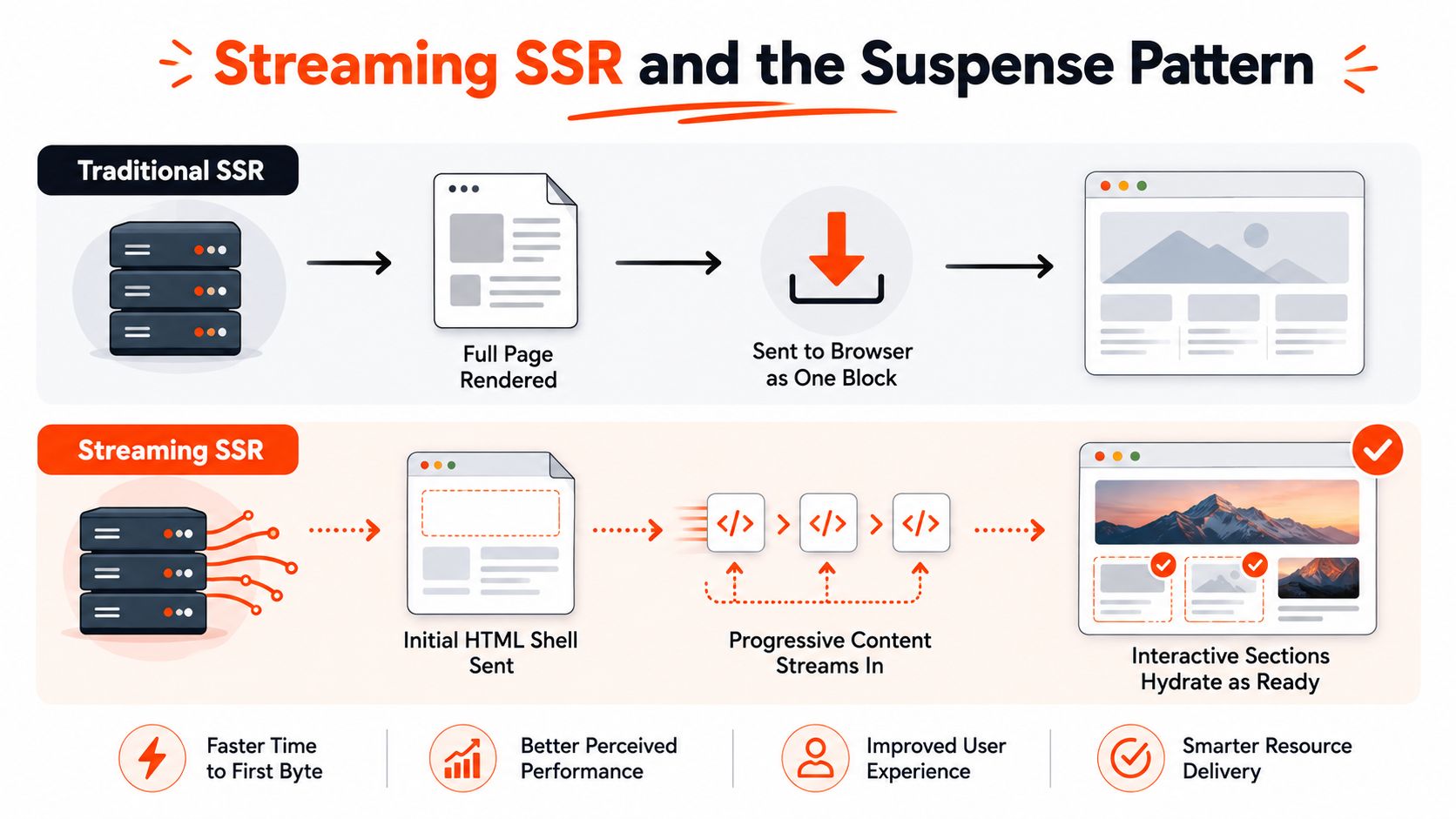
A server can render a page in phases instead of waiting for every part to finish. With streaming SSR, the shell goes out first, then the rest of the HTML arrives as data and component subtrees complete. The browser can start painting sooner, while the client still finishes hydration after the HTML reaches it.
That matters because the page no longer has to wait on the slowest dependency before showing anything useful. A header, navigation, or summary panel can appear while a lower-priority area is still being prepared. For an enterprise team, that is the difference between a page that feels alive and one that makes the user stare at a blank space.
Why streaming changes perceived speed
Suspense gives the team a way to decide which parts of the interface belong in that first wave. A boundary can hold back a slow panel without blocking the rest of the page, which keeps the highest-value content visible while other pieces finish in the background. That fits product screens where one section drives the next action and other sections can wait their turn.
React's streaming APIs, renderToPipeableStream and renderToReadableStream, make that delivery model practical, and hydrateRoot still completes the client side once the HTML arrives. As noted earlier, the request is still doing real work on the server, so streaming helps most when the user can benefit from partial output sooner instead of waiting for a single all-or-nothing response.
A separate empirical study reported better waiting-time metrics with streaming SSR than with standard SSR, while server cost moved only slightly (streaming SSR empirical study). That is a useful signal, because it shows the technique can improve the first useful paint without forcing the origin to absorb a dramatic jump in work.
A practical pattern for teams
The mistake is to stream every fragment just because the platform allows it. That often creates more coordination overhead than value. A better pattern is to send the shell and the content that changes the user's next decision, then let lower-priority islands resolve behind boundaries.
Stream the part of the page that helps the user act next, then let the rest arrive after it.
Teams that manage large editorial surfaces or content-heavy product pages often need the same boundary discipline in their content pipeline as they do in the UI. The work at engineering content systems is relevant here because the question is usually the same, which pieces must be ready immediately, and which pieces can land a moment later?
Production Architecture for Enterprise SSR
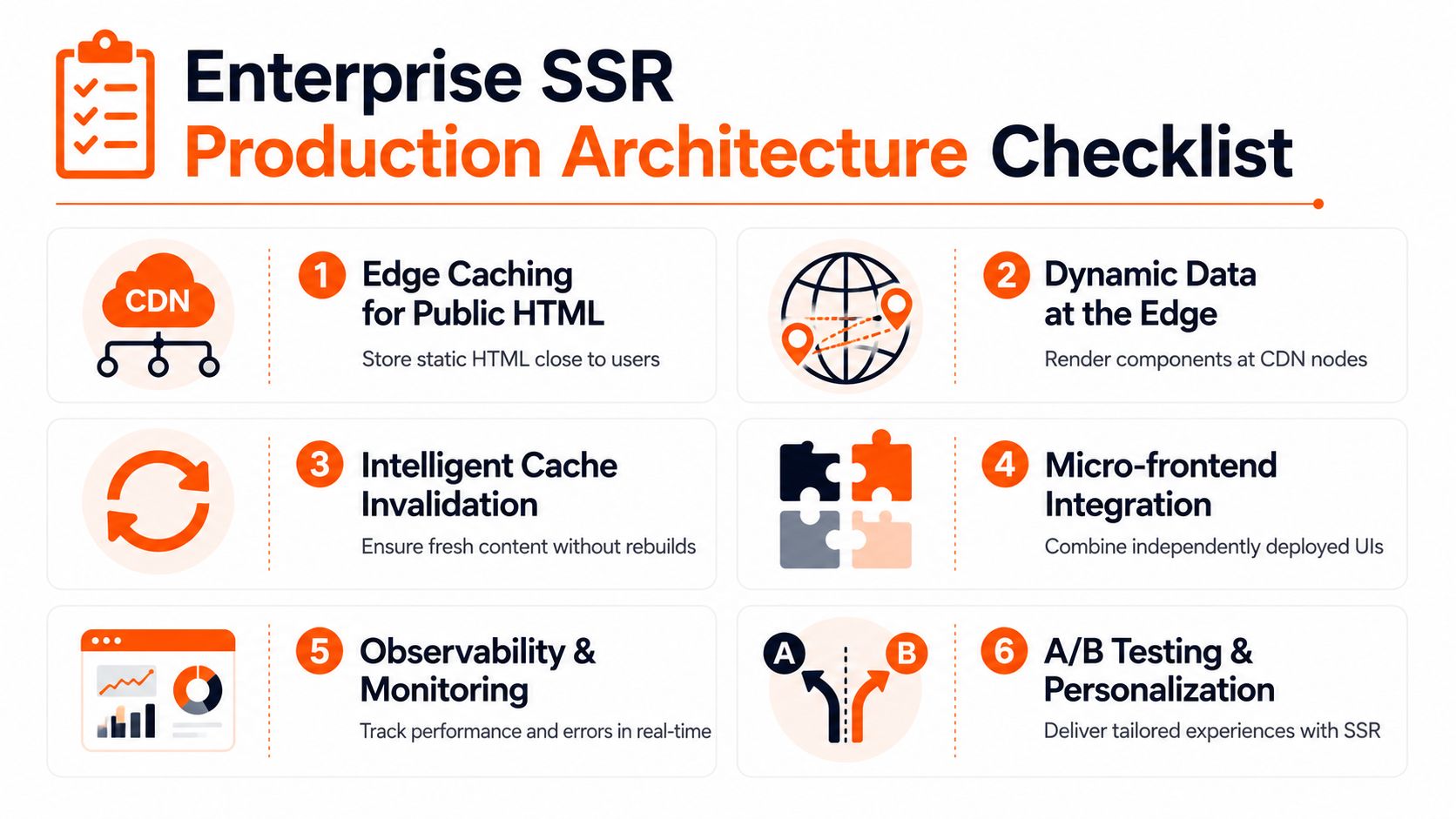
A production SSR stack succeeds or fails on how much work it can avoid repeating. Public HTML belongs at the CDN whenever the response is stable enough to reuse, product data should sit close to the server adapter, and personalized responses usually need to stay outside shared caches unless the cache key is safe for each user. The architecture note at SSR frontend architecture guidance is direct about this, because every request that misses the cache becomes real origin work.
A useful mental model is a two-stage assembly line. The server first builds HTML, then the browser finishes the page through hydration, and the balance between those two stages decides whether SSR reduces pain or just moves it from the client to the origin. That is why caching, hydration scope, and request-time personalization need to be planned together instead of treated as separate concerns.
Where to cache, and why
Public pages should let the CDN do the repeat work whenever possible. Mixed pages need a clear split at the data layer, so shared parts can be cached while user-specific parts are fetched separately. Personalized pages are different again, because the response has to be assembled for the current user, which means the origin has to absorb that cost.
Cache placement is also a product decision. If the same route serves anonymous visitors and signed-in users, forcing both through one caching rule usually creates either stale content or wasted compute. A cleaner approach is to treat each route as its own rendering contract and decide where the repeat work should stop.
What to measure in production
The same architecture guidance recommends route-level metrics such as TTFB, render time, data-loader timings, hydration time, long tasks, and INP regressions. Those measurements show whether the slowdown is coming from the server, the network, or the browser. Without them, teams end up debating rendering style while the user waits in a different part of the pipeline.
That measurement set matters because SSR can look healthy on paper and still feel slow after hydration starts. If the shell arrives quickly but the page locks up while the browser processes too much client code, the user experience is still poor. A server-first strategy only helps when the post-response work stays under control.
How enterprise teams should think about infrastructure
A serverless or edge setup still needs capacity planning. The discussion around autoscale inference on Beam is a good reminder that elastic compute only works when the workload shape is understood and the scaling model matches demand. SSR has the same constraint, because if the server cannot absorb bursts cleanly, the architecture has only shifted the bottleneck.
Enterprise teams also need to treat SSR as a software design problem, not only a runtime tactic. The article on software architecture principles fits here because SSR ties together distribution, caching, observability, and failure handling in one request path. When those parts are designed separately, the result is usually inconsistent latency and hard-to-explain regressions.
If the cache policy is vague, the SSR strategy is incomplete.
A Practical Decision Playbook for SSR
A team usually reaches for SSR when the page needs request-time HTML, the server can render quickly enough, and the browser does not need to hydrate a large interactive surface before the user can do real work. It becomes a stronger candidate when LCP is above 2.5 seconds on mobile or 3G-like networks, or when TTFB is nearing 800 ms, because those are the points where earlier analysis pointed to SSR as the safer path.
The decision gets easier when you ask three questions. How personalized is the page. How stable is the data. How much of the interface must be interactive immediately. If the answers point to public content, SSR with CDN caching makes sense. If they point to static content, SSG is usually cleaner. If they point to a highly dynamic app surface, CSR may be the more honest choice.
A better test is whether the architecture keeps interactive islands small, makes server output deterministic, and preserves the user's sense of progress while the rest of the UI finishes loading. Streaming SSR helps when the shell and the most important content can arrive first, but it does not rescue a page that hydrates too much, too late. That is the part teams miss when they reduce SSR to “better SEO.”
A practical rule for enterprise teams is to compare the cost you remove from the browser with the cost you add to the origin. SSR can improve the first meaningful view, but it also moves work into request time, where concurrency, caching, and server throughput decide whether the experience stays fast under load. If the page depends on heavy personalization, frequent data changes, or wide interactive regions, the server may do more work without giving the browser enough relief.
Use SSR where the visible shell, the critical content, and the first interaction can arrive before the rest of the page settles. Use a lighter rendering path when the page is mostly static or when the browser would still spend too much time hydrating after the HTML arrives. That keeps the decision grounded in user timing, not rendering ideology.
If you are weighing SSR against CSR or SSG for an enterprise product, devPulse can help you map the rendering model to your traffic, caching, and personalization needs. Their team works on modernization, architecture, and performance-sensitive systems, so they are well placed to help you avoid shifting latency from the browser to the origin. Visit devPulse to start a conversation about the right rendering strategy for your platform.