














TL;DR:
- Talent retention in IT outsourcing involves strategies to keep outsourced professionals engaged and committed over time.
- Higher turnover than in in-house teams results from project-driven work, flat career paths, and transactional management practices.
Talent retention in IT outsourcing is defined as the deliberate set of strategies organizations use to keep outsourced IT professionals engaged, productive, and committed over time. The industry term for this practice is outsourced workforce retention, and it sits at the intersection of HR management, vendor governance, and organizational culture. Turnover in outsourced teams runs 1.5–2x higher than in in-house teams, which means delivery reliability and business continuity take a direct hit every time a skilled engineer walks out. For HR managers and technology executives, understanding what drives attrition in outsourced IT environments is the first step toward fixing it.
What is talent retention in IT outsourcing, and why is it so hard?

Talent retention in IT outsourcing is harder than retention in traditional employment for one structural reason: the work is project-driven by design. Engineers join a team to deliver a specific scope, and once that scope ends, the emotional and professional case for staying weakens. Unlike in-house roles, outsourced positions rarely come with a clear promotion ladder, which means career growth stalls quickly.
The global labor market compounds this problem. Skilled IT professionals receive competing offers constantly, and salary inflation in markets like Eastern Europe, Southeast Asia, and Latin America has narrowed the cost advantage that originally made outsourcing attractive. When a developer in Warsaw or Manila can choose between three offers in a week, your retention program needs to be more than a competitive base salary.
Several misconceptions make this worse:
- Retention is the vendor’s problem. Client organizations often assume the outsourcing vendor handles all people management. In practice, the client’s culture, communication style, and project clarity directly affect whether engineers stay.
- Higher pay solves everything. Compensation matters, but transactional treatment of vendor teams causes attrition through lack of emotional ownership, not just underpayment.
- Short contracts mean retention doesn’t matter. Even a six-month engagement loses significant value when a key engineer leaves at month three and takes institutional knowledge with them.
- Outsourced teams don’t need onboarding. This assumption is one of the most costly. Engineers who feel dropped into a project without context disengage fast.
Pro Tip: Run a retention audit on your current outsourced IT contracts. Map which roles have turned over in the last 12 months, what the average tenure was, and whether exit interviews were conducted. The pattern almost always reveals a structural gap, not a personality problem.
IT outsourcing risks like high attrition are predictable and preventable when you treat them as governance issues rather than HR afterthoughts.
How do evolving outsourcing models change retention dynamics?
The outsourcing model you choose shapes your retention outcomes more than any single HR initiative. The shift from task-based contractor arrangements to direct employment with full benefits is the most significant structural change in the industry right now. Shifting to direct employment with full benefits can increase loyalty by 4x in offshore teams. That is not a marginal improvement. It reflects a fundamental change in how engineers perceive their relationship with the organization.
Four model-level changes are reshaping retention in 2026:
- Direct employment with benefits. Moving engineers from vendor payroll to direct employment, or to a professional employer organization structure, gives them health coverage, paid leave, and retirement contributions. These benefits create a tangible reason to stay beyond the next project.
- Career pathing and AI-readiness programs. Career growth is constrained in flat outsourcing structures. Organizations that build explicit skill development tracks, including AI tool proficiency and cloud certifications, give engineers a reason to invest in the relationship long-term.
- Follow-the-Sun collaboration with mandatory overlap. Mandatory 2–4 hours of synchronous overlap under the Follow-the-Sun model accelerates delivery by 30% and reduces burnout. Engineers who feel connected to their team rather than isolated in a time zone are significantly less likely to leave.
- Outcome-based contracts. When engineers understand how their work connects to a measurable business outcome, their sense of purpose increases. Outcome-based contracts replace the “just complete the ticket” dynamic with shared accountability.
“The biggest shift in outsourced IT retention isn’t about perks or pay. It’s about whether the engineer feels like a partner in the outcome or a vendor fulfilling a purchase order. Organizations that treat their outsourced teams as strategic alliances retain talent at rates that task-based models cannot match.”
The Day Zero onboarding concept is worth specific attention. The period between offer signing and the first day of work is a high-risk phase for talent poaching. Active onboarding during this window, including system access, team introductions, and a clear first-week agenda, closes the gap where competing offers most often land.
What practical strategies can HR leaders use to retain outsourced IT talent?
The most effective retention programs for outsourced IT teams combine structural process with consistent human contact. No single initiative works in isolation. The following practices have the strongest evidence base:
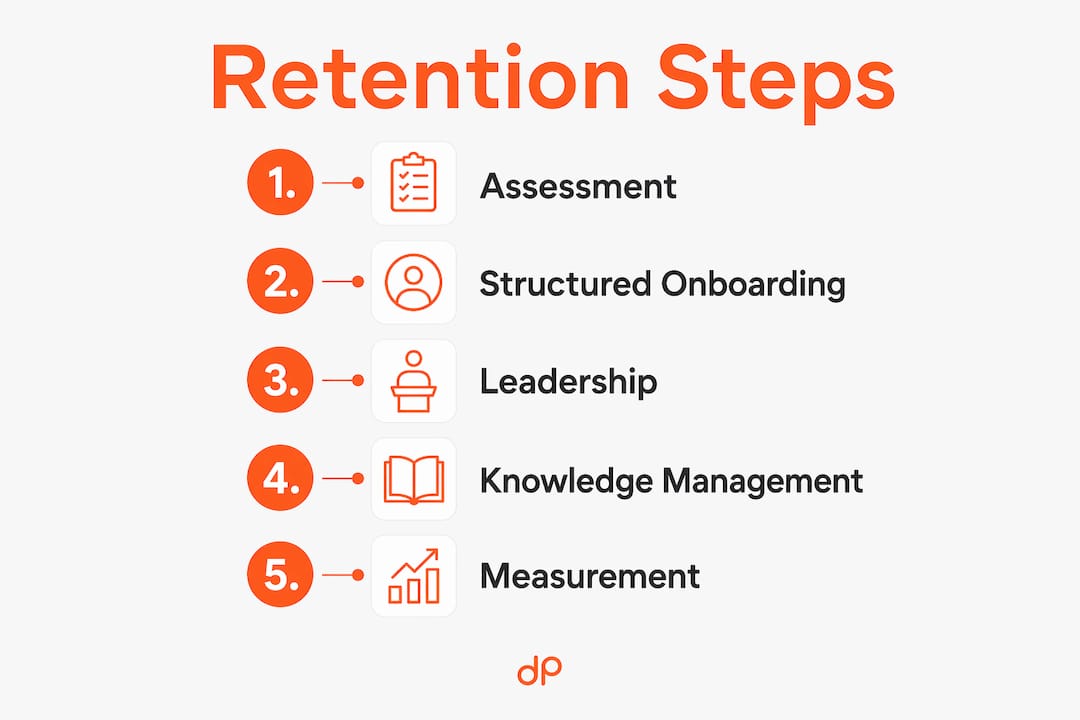
- Structured onboarding. Structured onboarding increases retention by as much as 50%. A clear 30-60-90 day plan, assigned mentors, and documented role expectations reduce early attrition dramatically.
- Effective local leadership. Employee commitment can reach 94% with strong local management. The direct manager is the single biggest variable in whether an outsourced engineer stays or leaves.
- Stay interviews. Stay interviews detect flight risks before resignation, unlike exit interviews, which only confirm what you already lost. Schedule them quarterly with every outsourced team member.
- Knowledge management processes. Knowledge management, including acquisition, conversion, application, and protection of institutional knowledge, mitigates the service quality impact of turnover. When an engineer leaves, documented knowledge stays.
- Client culture inclusion. Invite outsourced engineers to all-hands meetings, product demos, and team retrospectives. Engineers who feel part of the client’s culture develop loyalty that transcends the contract.
- Recognition programs. Public acknowledgment of contributions, even in a Slack channel or a sprint review, costs nothing and signals that the person’s work matters.
Pro Tip: When recruiting outsourced IT talent, use social recruiting methods that target engineers by skill community, not just job title. Engineers who find a role through a professional community they trust start with higher engagement than those who respond to generic job board posts.
The table below maps each strategy to its primary retention impact:
| Strategy | Primary retention impact |
|---|---|
| Structured onboarding | Reduces early attrition in the first 90 days |
| Local leadership development | Raises team-wide commitment and daily engagement |
| Stay interviews | Identifies flight risks before they become resignations |
| Knowledge management | Preserves service quality when turnover does occur |
| Client culture inclusion | Builds emotional ownership beyond the contract scope |
| Recognition programs | Reinforces purpose and belonging at low cost |
Agile delivery methods also support retention indirectly. Sprint-based work gives engineers visible progress and regular feedback, both of which increase engagement in outsourced environments.
How do you measure success in outsourced IT talent retention?
Retention measurement in outsourced IT requires a different set of metrics than standard HR dashboards. The core indicators are turnover rate, cost of attrition, engagement scores, and knowledge retention quality.
| Metric | What to measure | Target benchmark |
|---|---|---|
| Turnover rate | Percentage of outsourced staff leaving per quarter | Below 15% annually |
| Cost of attrition | Recruiting, onboarding, and productivity loss per departure | Track against contract value |
| Engagement score | Pulse survey results from outsourced team members | Above 70% favorable |
| Knowledge retention | Documentation coverage and service continuity post-departure | 100% critical process coverage |
| Stay interview completion | Percentage of team members interviewed quarterly | 100% of tenured staff |
Pulse surveys work best when they are short, anonymous, and acted upon visibly. Engineers who complete a survey and see no response stop completing surveys. The feedback loop is the retention mechanism, not the survey itself.
The cost of attrition deserves more attention than most organizations give it. Replacing a mid-level software engineer typically costs the equivalent of six to nine months of that engineer’s salary when you factor in recruiting fees, onboarding time, and the productivity gap during ramp-up. That figure makes a structured retention program look inexpensive by comparison.
IT workforce scalability strategies that account for retention metrics from the start produce more predictable delivery outcomes than those that treat headcount as a purely transactional input.
What are realistic expectations about tenure in outsourced IT teams?
Long-term retention of five to ten years is rarely achievable in project-driven outsourcing. Accepting that reality is not defeatist. It is the foundation of a retention strategy that actually works.
The goal is not to keep every engineer forever. The goal is to maximize the value of the time they do stay, and to ensure their departure does not damage the project or the team.
Realistic expectations include:
- Average tenure of 18–36 months is a strong outcome in most outsourced IT contexts. Engineers who stay that long typically deliver full project cycles and meaningful knowledge transfer.
- Positive departure experiences matter. Engineers who leave on good terms become referral sources, return hires, and brand advocates in their professional networks. How you handle offboarding shapes your ability to recruit the next person.
- Transparency builds reputation. Organizations that are honest about project timelines, role scope, and growth opportunities attract engineers who self-select for fit. That reduces early attrition significantly.
- Shorter tenures still deliver value. A six-month engagement with a specialist who solves a specific architectural problem and documents the solution thoroughly is a retention success, even if that person moves on.
Offshore team benefits are maximized when organizations plan for realistic tenure cycles rather than assuming indefinite commitment from outsourced staff.
Key Takeaways
Talent retention in IT outsourcing requires structural model changes, consistent leadership, and proactive knowledge management to deliver reliable outcomes.
| Point | Details |
|---|---|
| Turnover is structurally higher | Outsourced IT teams turn over 1.5–2x faster than in-house teams, making retention a governance priority. |
| Model choice drives loyalty | Shifting to direct employment with benefits can increase team loyalty by 4x compared to task-based contracts. |
| Onboarding is the highest-leverage moment | Structured onboarding increases retention by up to 50% and reduces early attrition in the first 90 days. |
| Stay interviews outperform exit interviews | Proactive stay interviews identify flight risks before resignation, giving HR time to act. |
| Realistic tenure expectations improve outcomes | Planning for 18–36 month cycles and strong offboarding produces better ROI than chasing indefinite retention. |
What I’ve learned about retention that most outsourcing guides get wrong
After working with outsourced engineering teams across multiple industries, the pattern I see most often is this: organizations invest in the contract and neglect the relationship. They negotiate SLAs, define deliverables, and set up project management tools. Then they treat the engineers as interchangeable resources and wonder why attrition is high six months later.
The engineers who stay longest are almost never the ones who got the biggest salary bump. They are the ones who felt like their work mattered to someone on the client side. A product manager who takes 20 minutes to explain why a feature matters to real users does more for retention than a quarterly bonus review.
The cultural alignment piece is consistently underestimated. An engineer in Kyiv or Medellín who attends a virtual all-hands, hears the company’s product vision, and gets recognized by name in a sprint review develops a sense of belonging that a contract cannot manufacture. That belonging is what makes them think twice before accepting the next recruiter’s message.
The uncomfortable truth is that most retention problems in outsourced IT are client-side failures, not vendor-side failures. The vendor can hire well and pay competitively. Only the client can make the work feel meaningful.
— Vlad
How Devpulse approaches IT outsourcing and team retention
Devpulse builds software teams that are designed to last. Our engineering services combine technical depth with deliberate people practices, including structured onboarding, clear role definition, and ongoing knowledge documentation that protects your project when team composition changes.
We work with startups, SaaS companies, and enterprise clients who need outsourced IT teams that deliver consistently, not just at launch. Our approach treats every outsourced engineer as a long-term partner in your product’s success. If you want to see how that translates into real outcomes, our case studies show the delivery and retention results we have achieved across healthcare, legal tech, and enterprise software. Schedule a call with our team to discuss what a retention-focused outsourcing engagement looks like for your organization.
FAQ
What is talent retention in IT outsourcing?
Talent retention in IT outsourcing is the set of strategies organizations use to keep outsourced IT professionals engaged and committed over time. It reduces turnover, protects institutional knowledge, and maintains delivery continuity.
Why is turnover higher in outsourced IT teams than in-house teams?
Outsourced teams turn over at 1.5–2x the rate of in-house teams because of project-driven work structures, flat career paths, and transactional management approaches that reduce emotional ownership.
What is the single most effective retention strategy for outsourced IT staff?
Structured onboarding is the highest-leverage intervention, increasing retention by up to 50%. Strong local leadership is the second most impactful factor, with committed teams reaching 94% engagement under effective management.
How should HR leaders measure retention success in outsourced IT?
Track quarterly turnover rate, cost of attrition per departure, pulse survey engagement scores, and knowledge documentation coverage. Stay interview completion rate is the leading indicator that predicts future turnover before it happens.
Is long-term retention realistic in IT outsourcing?
Long-term retention of five to ten years is rarely achievable in project-driven outsourcing. A realistic target is 18–36 months of high-quality engagement, with strong offboarding practices that protect institutional knowledge and build referral networks.