














TL;DR:
- Reactive IT procurement leads to bloated portfolios and project overruns due to poor planning.
- Strategic sourcing treats technology categories as portfolios, focusing on total cost, risk, and long-term fit.
Reactive IT procurement is expensive. Not in the obvious “we overspent” way, but in the compounding way: bloated SaaS portfolios, vendor lock-in, contract terms that aged poorly, and 68% of IT projects blowing past budget because nobody nailed down the technical requirements upfront. Strategic sourcing in IT exists to break that cycle. It replaces transactional, pressure-driven buying with a disciplined framework that controls costs, sharpens vendor accountability, and keeps your technology stack aligned with where the business is actually headed.
Table of Contents
- Understanding strategic sourcing in IT
- The five stages of strategic IT procurement lifecycle
- Optimizing SaaS procurement with strategic sourcing
- Building efficient vendor onboarding for IT procurement success
- Measuring success: KPIs and continuous improvement in strategic IT sourcing
- Rethinking IT procurement: why strategic sourcing should go beyond cost savings
- How DevPulse empowers your strategic IT sourcing journey
- Frequently asked questions
Key Takeaways
| Point | Details |
|---|---|
| Structured sourcing reduces costs | Applying a systematic sourcing framework lowers total cost of ownership by over 14% compared to reactive buying. |
| Clear requirements prevent overruns | Precisely defined technical needs help avoid budget overruns on 68% of IT projects. |
| Vendor onboarding drives compliance | Effective onboarding boosts vendor compliance rates beyond 95%, ensuring smoother procurement processes. |
| SaaS procurement needs governance | Centralized visibility and contract management reduce waste and can cut software spend by 10-30%. |
| Continuous measurement ensures success | Tracking KPIs like delivery and adoption supports ongoing improvements and cost control. |
Understanding strategic sourcing in IT
Strategic sourcing is not just a fancier name for procurement. The distinction matters. Traditional purchasing is reactive: a team needs something, someone finds a vendor, a price gets negotiated, and the deal closes. Strategic sourcing, by contrast, treats each technology category as a portfolio decision. You evaluate total cost of ownership, supplier risk, market alternatives, and long-term fit before a contract is ever signed.
In IT specifically, this matters because the consequences of a bad vendor relationship are not just financial. A poorly scoped cloud infrastructure contract, a SaaS tool with inadequate support tiers, or a hardware vendor with fragile supply chains can all stall critical operations. That is why strategic sourcing models in IT have evolved to account for factors well beyond price per unit.
According to the strategic sourcing process defined by Amazon Business, strategic sourcing follows three core phases:
- Define category strategy: Analyze spend, map the supply market, and determine what balance of risk and cost makes sense for that technology category.
- Run a sourcing event: Use structured tools like RFIs (requests for information), RFQs (requests for quotation), RFPs (requests for proposal), or e-auctions to generate competitive vendor responses.
- Award and implement contract: Evaluate responses against your criteria, negotiate final terms, and move into structured IT vendor onboarding and management.
The payoff from getting this right is real: reduced procurement costs, lower vendor risk, stronger compliance posture, and supplier relationships built on shared goals rather than adversarial negotiation.
The five stages of strategic IT procurement lifecycle
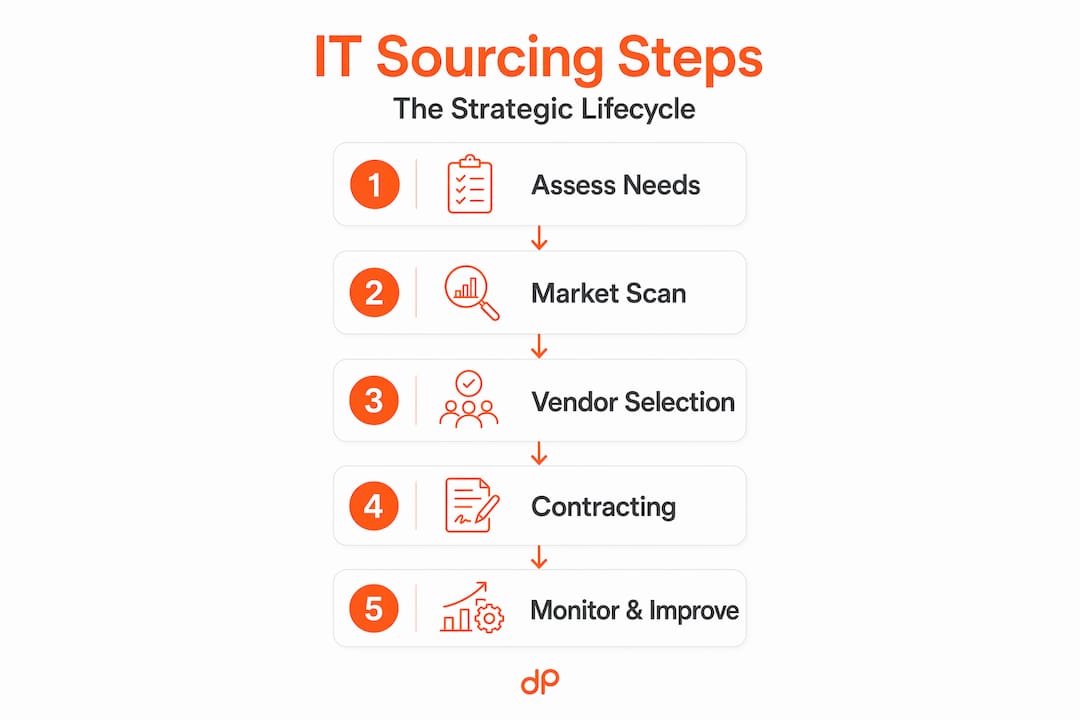
Now that the framework is clear, here is how it plays out across the full IT procurement lifecycle. These five stages apply whether you are sourcing enterprise software, managed services, or physical infrastructure.
-
Needs assessment and technical audit. This is where most organizations fail. Poorly defined technical specifications are the root cause behind 68% of over-budget IT projects. Before reaching out to any vendor, document exact performance requirements, integration dependencies, security standards, and user volume expectations. Involve your architects and IT leads early.
-
Vendor sourcing and evaluation. Go beyond the usual shortlist. Use a multi-criteria scoring model that weighs not just price, but vendor financial stability, support tier offerings, implementation track record, and geopolitical risk. A vendor with strong references in your industry and a proven escalation path is worth more than the cheapest quote.
-
Negotiation with total cost of ownership in mind. Price is a starting point, not a finish line. Negotiate service level agreements that specify uptime guarantees, incident response windows, and penalty clauses for non-performance. Push for flexible licensing terms that can scale up or down without punitive fees.
-
Fulfillment management. Delivery failures are procurement failures too. Assign internal ownership for each vendor relationship the moment a contract is signed. Track configuration milestones, delivery timelines, and acceptance testing checkpoints. Delays at this stage cascade into project delays and budget overruns downstream.
-
Lifecycle management and decommissioning. Technology has a shelf life. Build refresh and decommissioning plans into your sourcing strategy from day one. Failing to do so is how organizations accumulate technical debt quietly, paying maintenance costs on systems that no longer serve a business function.
Pro Tip: Start renewal negotiations at least 90 days before contract expiration. Pull actual usage data beforehand so you walk into that conversation knowing which licenses are underutilized. Vendors will negotiate harder when they know you have data.
Optimizing SaaS procurement with strategic sourcing
SaaS procurement has a unique dysfunction: it scales faster than oversight does. Departments spin up tools independently, finance cannot see the full spend picture, and duplicate or redundant subscriptions compound quietly. SaaS spending rose 8% year-over-year in 2025 while portfolio size grew only 2.2%, which means organizations are paying more per tool, not acquiring meaningfully more capability.
The solution is not to lock down purchasing but to build a governance model that is visible and fast enough that teams actually use it. Key tactics include:
- Centralized spend visibility: Use a SaaS management platform to aggregate contract data, renewal dates, and per-seat costs across all departments. Without this, you cannot identify overlap.
- License harvesting: Systematically reclaim unused or inactive licenses before renewal. This is low-effort, high-return.
- Vendor consolidation: Where two tools serve overlapping functions, rationalize. One well-negotiated enterprise license usually beats two mid-market subscriptions in both cost and integration quality.
- Renewal playbooks: Standardize your negotiation process with documented benchmarks, fallback positions, and escalation paths so no one goes into a renewal conversation unprepared.
| SaaS procurement challenge | Strategic sourcing response |
|---|---|
| Portfolio sprawl and shadow IT | Centralized software catalog with approval workflows |
| Escalating per-seat costs | Usage-based license audits and renegotiation |
| Vendor lock-in risk | Multi-vendor strategy with exit clauses in contracts |
| Compliance gaps | Standardized vendor risk assessments pre-approval |
| Renewal surprises | 90-day advance renewal tracking and playbooks |
The upside is significant. Effective SaaS procurement consistently delivers 10 to 30% reductions in software spend through negotiation and license optimization alone, without cutting any functionality teams actually need.
AI-driven SaaS management tools are accelerating this further. They flag redundant tools, predict renewal risks, and surface negotiation benchmarks automatically. For organizations with strategic SaaS portfolio management as a priority, this is where AI earns its keep.
Pro Tip: Assign a named owner to every SaaS contract in your catalog. Tools without a clear business owner tend to renew on autopilot indefinitely.
Building efficient vendor onboarding for IT procurement success
Sourcing the right vendor is only half the work. What happens after contract signature determines whether that selection actually delivers value. Structured vendor onboarding is the bridge between agreement and outcomes, and most organizations underinvest in it.
Structured IT vendor onboarding should operate across five parallel dimensions simultaneously:
- Compliance verification: Confirm the vendor meets your security, regulatory, and data handling requirements before they access any systems.
- Systems integration: Document and test every integration point, API connection, and data flow the vendor will touch.
- Performance baseline: Establish the KPIs you will use to evaluate their performance from day one, not after the first quarterly review.
- Relationship governance: Define who owns the relationship on both sides, how escalations work, and what the communication cadence looks like.
- Strategic alignment: Confirm the vendor understands your roadmap and not just the current contract scope.
The compliance data here is worth taking seriously. Organizations with structured onboarding achieve compliance rates exceeding 95%, while organizations using ad-hoc approaches average 60 to 70%. That gap translates directly into audit risk, data exposure, and procurement inefficiency.
Good onboarding also reduces the burden on your internal procurement team. When vendors arrive with clear onboarding documentation, integration specs, and defined escalation paths, the back-and-forth is dramatically reduced.

Measuring success: KPIs and continuous improvement in strategic IT sourcing
Strategic sourcing does not end at contract execution. The organizations that get the most from their IT procurement strategies are the ones that build feedback loops into the process itself. That means tracking performance against meaningful metrics and using those metrics to improve future sourcing decisions.
Key KPIs for IT procurement include:
- On-time delivery rate: Are vendors delivering hardware, software, or services on the agreed schedule?
- Defect and incident rates: How often do vendor-supplied solutions require patches, support escalations, or rollbacks?
- Software adoption vs. renewal rate: Track adoption versus renewal to identify shelfware early, tools that get renewed but not used.
- Contract compliance rate: Are vendors meeting the SLA terms they committed to?
- Cost variance: Are actual spend figures tracking against the total cost of ownership projections made during sourcing?
| KPI | What it signals | Corrective action |
|---|---|---|
| Low adoption rate | Shelfware risk or poor fit | Usage audit, vendor training review |
| High incident rate | Quality or integration issues | SLA review, escalation to account team |
| Delivery delays | Fulfillment or capacity problems | Supplier performance review |
| Contract compliance below 90% | SLA enforcement gap | Renegotiate terms or trigger penalty clauses |
| Cost variance above 10% | Scope creep or pricing errors | Contract audit and procurement review |
Connect these IT vendor performance metrics to your broader business goals. Cost savings alone is a thin measure. The richer question is whether your vendor portfolio is reducing risk, enabling the capabilities your product teams need, and supporting your growth targets.
Pro Tip: Build a unified dashboard that pulls data from procurement systems, IT service management tools, and finance platforms. When those three data sources are siloed, you will always be making sourcing decisions with incomplete information.
Rethinking IT procurement: why strategic sourcing should go beyond cost savings
Here is the perspective that most IT sourcing guides miss entirely: cost reduction is a lagging indicator, not a goal.
Organizations that frame strategic sourcing purely as a cost-cutting exercise tend to optimize for the wrong things. They squeeze vendors on price until they get a deal that looks good on paper but creates friction in execution. They rationalize vendor lists down to the point where any supply disruption becomes a crisis. They treat suppliers transactionally and then wonder why suppliers treat them the same way.
Procurement has shifted from a cost control function to a strategic lever that prioritizes business continuity and treats suppliers as partners for capability, not just savings. That shift is not rhetorical. It reflects how mature technology organizations actually behave.
When you source a vendor as a partner rather than a commodity supplier, you gain access to capabilities you did not know to ask for. Early beta access to new features. Dedicated engineering support during critical integrations. Joint roadmap discussions that shape how the vendor builds for customers like you. None of that flows from a price-minimization relationship.
The CIOs who are winning in this environment are the ones who bring outsourcing and strategic sourcing synergy into the same conversation. They recognize that the boundary between building internally and sourcing externally is no longer fixed. The question is not “buy or build” but “what combination of internal teams and strategic suppliers gives us the best capability at acceptable risk.”
AI is reshaping this calculus too. Mature IT organizations now use AI-driven tools to anticipate vendor risks, model alternative sourcing scenarios, and balance the competing priorities of CIOs, CFOs, and procurement officers simultaneously. That is not a future state. It is happening now, and organizations still doing quarterly spreadsheet reviews are falling behind.
How DevPulse empowers your strategic IT sourcing journey
Applying a strategic sourcing framework to IT procurement is straightforward in theory but genuinely difficult in practice, especially when your organization is also managing product development, infrastructure modernization, and shifting compliance requirements at the same time.
DevPulse works with technology leaders across healthcare, cybersecurity, legal tech, and enterprise SaaS to align their sourcing decisions with real engineering and product outcomes. Our software engineering services are built to support organizations that need more than a vendor: they need a technical partner who understands how sourcing decisions shape delivery speed, security posture, and long-term maintainability. Browse our real-world IT sourcing case studies to see how we have helped clients make sourcing decisions that held up under pressure. Or explore DevPulse’s full range of solutions to find the engagement model that fits your current stage.
Frequently asked questions
What is the difference between strategic sourcing and traditional IT purchasing?
Strategic sourcing is a proactive, lifecycle-focused approach that optimizes vendor selection, total cost of ownership, and risk management, while traditional purchasing is reactive and transactional. Strategic sourcing treats categories as portfolios that balance cost and risk, unlike reactive buying that focuses only on immediate price.
How can strategic sourcing reduce IT project budget overruns?
By defining technical requirements precisely before vendor engagement, strategic sourcing removes the ambiguity that drives scope creep and mismatched capabilities. This directly addresses the root cause behind 68% of IT budget overruns linked to poorly defined specs.
Why is vendor onboarding important in IT procurement?
Structured onboarding ensures vendors meet compliance standards, integrate cleanly with existing systems, and begin performing against agreed KPIs from day one. Structured onboarding improves compliance rates above 95% and reduces the internal procurement team’s ongoing workload significantly.
What KPIs should be tracked to measure the success of strategic sourcing in IT?
The most important KPIs include on-time delivery, defect rates, software adoption versus renewal rates, contract compliance, and total cost of ownership variance. Track adoption and renewal together to avoid shelfware accumulation and optimize licensing costs over time.
How does AI aid strategic sourcing in IT?
AI supports sourcing decisions by providing predictive risk analytics, flagging vendor concentration risks, and automating vendor scoring across large RFP responses. Mature IT organizations use AI to balance CIO, CFO, and procurement priorities simultaneously and anticipate supply disruptions before they become operational problems.