











TL;DR:
- Unstructured negotiations with software providers often lead to cost overruns, missed deadlines, and disputes that reduce project ROI before any code is written. A formal, stage-by-stage workflow, comprehensive preparation, and leveraging emerging AI tools can significantly improve negotiation outcomes and contract efficiency. Continuous process improvement and technology adoption ensure sustained value and reduce risks throughout the software development lifecycle.
Unstructured negotiations with software development providers routinely produce cost overruns, missed deadlines, and disputed deliverables that erode project ROI before a single line of code is written. Vendor agreements are negotiated 70% of the time, yet the average contract still takes 39 days to execute, largely because most organizations treat each negotiation as a one-off event rather than a managed business process. This guide gives service industry decision-makers a practical, stage-by-stage workflow they can apply immediately to negotiate with greater confidence, reduce risk exposure, and secure software development partnerships that actually deliver.
Table of Contents
- Understanding the end-to-end negotiation workflow
- Preparation: The linchpin of negotiation success
- Executing the negotiation: Tactics, playbooks, and pitfalls
- Critical contract elements and avoiding scope creep
- Post-negotiation: Ensuring sustained value
- Why most negotiation workflows fail and how to actually fix them
- Streamline your negotiation workflow with expert support
- Frequently asked questions
Key Takeaways
| Point | Details |
|---|---|
| Preparation drives success | Investing early in research and alignment sets the stage for a stronger negotiation outcome. |
| Playbooks standardize deals | Using contract playbooks ensures consistent, defensible positions and faster negotiation cycles. |
| Scope control prevents overruns | A detailed scope and change control process are your best tools to avoid scope creep and disputes. |
| Technology accelerates workflow | AI and automation can cut cycle time, enforce best practices, and capture negotiation data for improvements. |
| Post-negotiation focus is essential | Tracking deliverables and reviewing outcomes help sustain value and refine future workflows. |
Understanding the end-to-end negotiation workflow
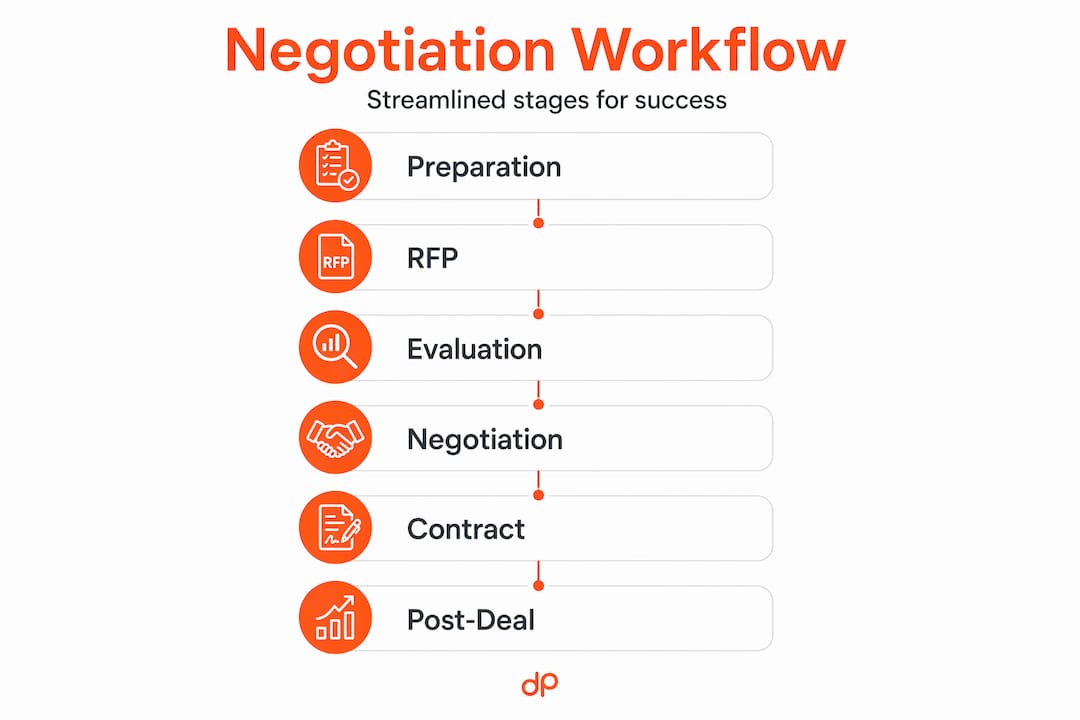
A negotiation does not begin when two parties sit down at a table. It begins weeks or months earlier, during internal planning. The RFP process typically starts with requirements specification and stakeholder alignment, moves through vendor selection, RFP issuance, a structured Q&A period, proposal evaluation, active negotiation, and concludes with contract award. Each phase has distinct owners and required actions.
The table below maps every stage so your team knows who is responsible for what and when.
| Phase | Core activity | Primary owner |
|---|---|---|
| Preparation | Define scope, budget, dealbreakers, BATNA | Business and procurement lead |
| RFP development | Draft requirements, evaluation criteria | Project manager and legal |
| Vendor Q&A | Respond to clarifications, issue addenda | Procurement coordinator |
| Proposal evaluation | Score submissions against weighted criteria | Evaluation committee |
| Negotiation | Finalize terms, pricing, SLAs, milestones | Business lead and legal counsel |
| Contract award | Execute agreement, onboard vendor | Legal and finance |
A few benchmark realities set the context. Business services negotiate 63% of agreements, legal counsel is involved in 75% of deals, and the average time to execution sits at 39 days. Leading organizations have cut that legal involvement to 32% by empowering commercial teams with standardized templates and clear escalation paths.
Emerging technologies are accelerating every phase. Agentic AI tools can now auto-generate RFP drafts, score vendor responses against weighted criteria, and flag non-standard clauses in seconds. Digital process automation handles routing, approval chains, and document versioning, removing the manual bottlenecks that inflate cycle times. Some providers are even piloting autonomous negotiation technology that conducts routine clause exchanges without human intervention, freeing your team to focus on strategic trade-offs.
Key takeaways for this stage:
- Map every phase before the first vendor conversation begins.
- Assign a named owner to each stage so accountability is clear.
- Evaluate automation tools early to compress timelines and reduce error rates.
Preparation: The linchpin of negotiation success
Knowing the journey, it is clear that groundwork shapes everything that follows. Preparation accounts for 80% of negotiation success, and that figure reflects a simple truth: teams that enter negotiations with benchmarked pricing, a defined BATNA (Best Alternative to a Negotiated Agreement), and aligned stakeholders consistently outperform those that improvise. Consolidating volume across business units alone can yield 15 to 30% better pricing from software vendors, because commitment signals serious intent and reduces vendor sales costs.
Here is a proven preparation checklist for software development negotiations:
- Research market pricing. Use market pricing tools and industry benchmarks to establish fair ranges for the services you are buying. This prevents you from accepting inflated rates or rejecting reasonable ones.
- Develop your BATNA. Identify and document your next best option if this negotiation fails. That could be an alternate vendor, an internal build, or a phased delay. A credible BATNA gives you leverage without confrontation.
- Align stakeholders on must-haves vs. nice-to-haves. Run an internal workshop to separate non-negotiable requirements from desirable features. Disagreements that surface during vendor negotiations often originate in unresolved internal conflicts.
- Define explicit non-scope items. Clearly document what the vendor will not deliver. Defining non-scope items and a formal change request process before negotiations begin is one of the most effective tools for preventing disputes mid-project.
- Consolidate volume for leverage. Where possible, aggregate contracts across departments or projects to increase the total commitment you bring to the table.
- Role-play objections. Run internal simulations where one team member plays the vendor. This surfaces gaps in your position and prepares your team for edge cases such as single-vendor situations that require higher price reasonableness approval.
“Without structured preparation, negotiators default to positional bargaining, which narrows the solution space and almost always leaves value on the table for both parties.”
Outsourcing consultant insights consistently reinforce this point: organizations that invest one to two weeks in rigorous preparation before issuing an RFP achieve shorter negotiation cycles and stronger contract terms than those that rush to market. Understanding SLAs in the context of risk management during the preparation phase also allows you to specify realistic service levels before vendors submit proposals, rather than trying to negotiate them retroactively.
Pro Tip: Never reveal your total budget to a vendor before they submit a proposal. Once a vendor knows your ceiling, that number becomes their floor. Instead, use market benchmarks to validate the reasonableness of their pricing after submission.

Executing the negotiation: Tactics, playbooks, and pitfalls
With solid preparation in place, it is time to execute. The single biggest structural improvement most organizations can make is adopting a contract playbook: a documented set of standard positions, fallback clauses, and walk-away triggers. Contract playbooks standardize negotiations across teams and time zones, reducing dependency on any individual negotiator’s memory or style. When a junior commercial manager and a senior legal partner are operating from the same playbook, your negotiating positions stay consistent and defensible.
The table below compares playbook-driven vs. ad hoc approaches:
| Dimension | Playbook-driven | Ad hoc |
|---|---|---|
| Consistency | High, standardized positions | Variable, person-dependent |
| Speed | Faster, templates reduce drafting time | Slower, every deal rebuilt from scratch |
| Risk management | Lower, known walk-away thresholds | Higher, walk-aways defined under pressure |
| Training curve | Lower, new team members ramp quickly | Higher, knowledge lives in individuals |
| Audit trail | Clear, documented decision rationale | Fragmented or absent |
Beyond structure, specific tactics separate high-performing negotiators from average ones:
- Negotiate usage-based pricing over fixed fees. For software development engagements, usage-based or milestone-tied pricing aligns vendor incentives with your outcomes. Removing auto-renewal clauses and negotiating usage-based structures gives you flexibility as requirements evolve.
- Remove auto-renewals. Auto-renewal clauses are among the most expensive provisions a company can overlook. They lock you into rates and terms that may be outdated by the time the renewal triggers.
- Bundle non-price concessions that add mutual value. Offering a vendor a case study, a reference call, or a co-marketing opportunity can unlock meaningful price reductions without touching your core budget, because it addresses something the vendor values that costs you relatively little.
- Avoid negotiating only on price. Payment terms, milestone structure, IP ownership, and support hours are all levers. Teams that focus exclusively on rate rarely optimize the full value of a software development engagement.
AI negotiation pilots are demonstrating that automated clause matching and counter-proposal generation can reduce first-draft negotiation cycles by hours, giving human negotiators more time to focus on strategic trade-offs rather than mechanical redlining.
Pro Tip: Only bundle non-price concessions that genuinely add mutual value. Offering a testimonial to a vendor whose quality you cannot yet vouch for undercuts your credibility and creates future obligations.
Critical contract elements and avoiding scope creep
Effective negotiations are only as strong as the contracts they produce. A poorly structured software development agreement is a future dispute waiting to happen. The foundation of any reliable contract is a detailed Scope of Work that specifies deliverables, acceptance criteria, milestones, and an explicit change request process.
A 15-section SOW prevents approximately 80% of scope creep, which is the single most common source of cost overruns in software development engagements. Scope creep happens not because vendors are dishonest but because requirements are ambiguous. Every hour spent sharpening the SOW before signing returns multiples during delivery.
Non-negotiable contract elements for software development:
- Scope of Work. Detailed description of deliverables, technical specifications, and what is explicitly excluded.
- Acceptance criteria. Clear, measurable definitions of what constitutes a completed deliverable so disputes about “done” are settled by the contract, not by opinion.
- Milestones and payment schedule. Payments tied to verified milestone completion rather than calendar dates align financial incentives with actual delivery progress.
- Change request process. A formal, documented process for requesting, evaluating, approving, and pricing any work outside the original SOW.
- IP ownership. Explicit language confirming that all custom code, models, and intellectual property developed under the contract belong to your organization.
- SLAs and performance standards. Drafting SLAs with quantifiable targets for uptime, response time, and defect resolution removes subjectivity from performance reviews.
- Confidentiality provisions. Data handling obligations, NDA terms, and security requirements, including reference to applicable contract security standards.
- Liability limits and indemnification. Cap on financial exposure for both parties in the event of breach or third-party claims.
- Termination rights. Clear triggers for termination for cause and termination for convenience, with cure periods defined.
- Dispute resolution. Agreed process for escalation, mediation, and arbitration before litigation becomes necessary.
Statistic callout: A 15-section SOW structure prevents up to 80% of scope creep incidents, making it one of the highest-ROI investments in the entire contract lifecycle.
Addressing confidentiality and data security at the contract stage, rather than deferring to vendor policy documents, is especially critical in industries like healthcare, legal tech, and cybersecurity, where regulatory obligations govern how partner data must be handled.
Post-negotiation: Ensuring sustained value
After a deal is signed, the real work begins. Most organizations treat contract execution as the finish line, but signed agreements that go unmonitored quickly lose their value. Vendor behavior reverts to what is easiest without active oversight, milestones drift, and the leverage you built during negotiation evaporates.
Post-signature best practices:
- Monitor deliverables through CLM tools. Contract Lifecycle Management (CLM) platforms provide automated alerts for milestone dates, renewal windows, and SLA breaches. Tracking performance via CLM tools and conducting structured reviews keeps both parties accountable throughout the engagement.
- Schedule periodic performance reviews. Quarterly business reviews with your software development partner create a structured forum for raising performance concerns, adjusting priorities, and recognizing milestones achieved.
- Log negotiation lessons for playbook updates. After every contract cycle, document what worked, what did not, and which vendor tactics caught your team off guard. These lessons feed directly back into your preparation and playbook for the next engagement.
- Track AI-powered change management signals. AI-assisted tools can monitor contract performance data and flag emerging risks, such as delivery delays or SLA trend deterioration, before they escalate into disputes.
The following table outlines key metrics worth tracking after contract signature:
| Metric | Why it matters | Review cadence |
|---|---|---|
| Milestone completion rate | Measures on-time delivery against SOW | Monthly |
| SLA compliance rate | Tracks adherence to performance standards | Monthly |
| Change request volume | High volume may signal SOW gaps | Quarterly |
| Budget variance | Flags cost creep early | Monthly |
| Defect resolution time | Indicates development quality and responsiveness | Quarterly |
| Renewal date proximity | Prevents unfavorable auto-renewals | 90 days prior |
Building a feedback loop between post-contract performance data and your negotiation preparation materials is what separates organizations that continuously improve from those that repeat the same costly mistakes.
Why most negotiation workflows fail and how to actually fix them
Let us pull back the curtain on what really holds negotiation workflows back. Most guidance focuses on preparation tactics and contract clauses. That advice is sound. But in our experience working with enterprise clients across healthcare, legal tech, and SaaS, the majority of value destruction occurs after the contract is signed, not during negotiation itself.
The real culprits are poor handoffs between commercial and delivery teams, absent lessons-learned cycles, and the habit of routing every non-standard clause through legal as a bottleneck gatekeeper. When the legal team is involved in 75% of agreements, that is not a sign of rigor. It is often a symptom of under-empowered commercial teams who lack playbooks and escalation authority.
The organizations that consistently outperform their peers do three things differently. First, they treat negotiation as a continuous process, not an event. Each contract cycle feeds data into the next one. Second, they empower non-legal team members with clear playbook guardrails so routine negotiations move at commercial speed while complex trade-offs escalate appropriately. Third, they invest in technology early. Agentic AI negotiation pilots are not science fiction. They are live in forward-thinking procurement teams right now, automating clause comparison, generating redlines, and surfacing risk signals faster than any manual review.
The uncomfortable truth is that perfect documentation does not fix broken workflow design. Continuous improvement, powered by honest post-mortems and supported by modern tooling, is what actually moves the needle.
Streamline your negotiation workflow with expert support
Translating a world-class negotiation framework into real outcomes requires more than a guide. It requires the right technology and the right partner.
At DevPulse, we combine deep engineering services expertise with practical business strategy to help organizations modernize how they procure, build, and manage software partnerships. Our enterprise AI solutions support every phase of the negotiation workflow, from automated RFP generation to real-time contract performance monitoring. Explore our real-world case studies to see how we have helped clients across healthcare, cybersecurity, and legal tech build more efficient, defensible procurement processes. Ready to modernize your negotiation workflow? Reach out to our team to start the conversation.
Frequently asked questions
What are the main phases of a service provider negotiation workflow?
The main phases are preparation, RFP creation and issuance, vendor Q&A, proposal evaluation, active negotiations, and contract award, with each phase requiring a designated owner and clear deliverables.
What should be included in a software development contract?
A strong contract includes a detailed SOW with deliverables, acceptance criteria, milestones, SLAs, a change request process, IP ownership clauses, confidentiality provisions, and dispute resolution terms.
How can technology speed up the negotiation workflow?
AI tools can automate RFP creation, standardize contract drafting, and surface non-standard clauses instantly, enabling faster, data-driven decisions without expanding headcount.
How do you prevent scope creep in software contracts?
Use a comprehensive SOW structure with explicit exclusions and a formal change request process so any work outside the original agreement requires documented approval before it begins.
What is a BATNA and why is it important?
A BATNA is your best alternative to a negotiated agreement, and developing it during preparation gives you genuine leverage because you enter negotiations knowing exactly when to walk away rather than accepting unfavorable terms under pressure.