











Most tech leaders assume that hiring a dedicated development team is purely a cost-cutting move. That framing misses the point entirely. The real strategic advantage is access to a stable, vendor-managed engineering unit that scales with your product roadmap, not just your budget. A typical DDT structure includes project managers, developers, QA engineers, and DevOps specialists, and can deliver major cost efficiency compared to US in-house hiring. This guide breaks down what a dedicated development team actually is, how it is structured, what it costs, and when it is the right call for your business.
Table of Contents
- The core concept: What is a dedicated development team?
- Who’s on your dedicated development team?
- How dedicated teams compare to other engagement models
- How much does a dedicated development team cost?
- Risks and limitations: When not to use a dedicated development team
- Hybrid and evolving models: Combining dedicated teams with other strategies
- Explore dedicated development partnerships with DevPulse
- Frequently asked questions
Key Takeaways
| Point | Details |
|---|---|
| Not just cost-saving | A dedicated team delivers both strategic flexibility and long-term value, not just lower costs. |
| Right fit matters | DDTs work best for ongoing and evolving projects, not short-term or fixed-scope tasks. |
| Clear team structure | A strong DDT has all key roles, from managers to QA, scaled to your business needs. |
| Understand the risks | Know when a DDT isn’t right and recognize how to avoid common pitfalls. |
The core concept: What is a dedicated development team?
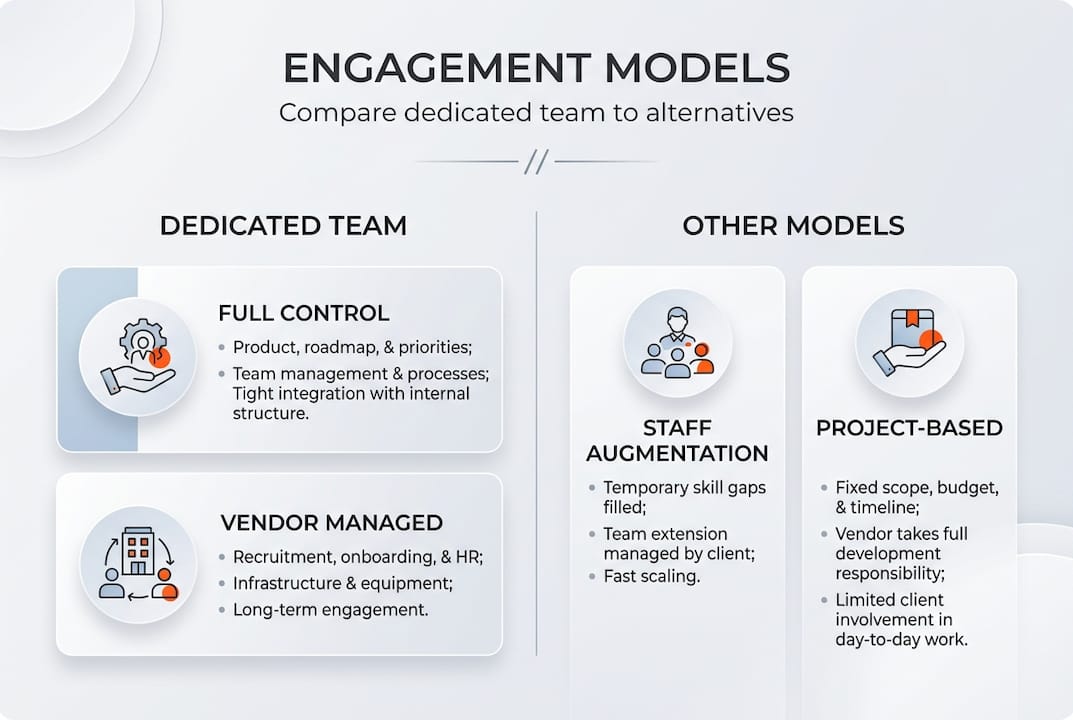
A dedicated development team (DDT) is a long-term, vendor-managed engineering unit that works exclusively on your product. The vendor handles HR, payroll, and team management. You direct the work. That distinction matters because it separates DDTs from both staff augmentation and project-based outsourcing.
With staff augmentation, you hire individuals and manage them yourself. With project-based outsourcing, you hand off a fixed scope and receive a deliverable. A DDT sits in a different category entirely. As one dedicated teams guide puts it, a DDT is a self-contained unit built for ongoing work, not short-term or fixed-scope projects.
This model is ideal when:
- Your product roadmap is evolving and you need a team that grows with it
- You want deep domain expertise without the overhead of full-time employment
- You need consistent velocity across multiple sprints or release cycles
- Your internal team lacks specific technical skills like DevOps or AI engineering
“A dedicated team is not a vendor relationship. It is a product partnership where the team becomes an extension of your organization.”
For leaders exploring boosting software project success through external teams, the DDT model offers a structured path that balances control with flexibility. Understanding the types of remote teams available also helps clarify where DDTs fit in the broader landscape.
Who’s on your dedicated development team?
The composition of a DDT depends on your project’s complexity and stage. A lean early-stage team looks very different from a scaled enterprise squad. Getting the structure right from the start prevents costly ramp-up delays later.
A typical DDT includes a project manager, frontend and backend developers, QA engineers, a DevOps specialist, a UI/UX designer, and a business analyst. The ratio of each role shifts based on whether you are building a new product, scaling an existing one, or maintaining a complex platform.

| Role | Small team (4 to 6) | Large team (8 to 15+) |
|---|---|---|
| Project manager | 1 | 1 to 2 |
| Frontend developer | 1 | 2 to 4 |
| Backend developer | 1 | 2 to 4 |
| QA engineer | 1 | 2 to 3 |
| DevOps engineer | 0 to 1 | 1 to 2 |
| UI/UX designer | 0 to 1 | 1 to 2 |
| Business analyst | 0 | 1 |
Small teams work well for SaaS startups building an MVP or adding a focused feature set. Larger teams are better suited for end-to-end software development on enterprise platforms where multiple workstreams run in parallel.
Key roles to prioritize:
- Project manager: Your primary communication bridge. A weak PM creates bottlenecks fast.
- QA engineer: Often underweighted in early teams, but critical for release confidence.
- DevOps engineer: Essential if you are running cloud infrastructure or CI/CD pipelines.
- Business analyst: Adds the most value when requirements are complex or frequently changing.
Pro Tip: When evaluating a vendor, ask how they handle role gaps. A strong DDT provider will have a bench of specialists to fill in without disrupting your sprint cadence. This is a direct indicator of their tech team scalability maturity.
How dedicated teams compare to other engagement models
Choosing the wrong engagement model is one of the most expensive mistakes a tech leader can make. The differences between DDT, staff augmentation, and project-based outsourcing are not just structural. They affect who owns the outcome, who manages the people, and how much flexibility you actually have.
DDTs differ from staff augmentation and project-based models in fundamental ways. Each model is suited to a different type of project and organizational maturity.
| Factor | Dedicated team | Staff augmentation | Project-based |
|---|---|---|---|
| Management | Vendor-led | Client-led | Vendor-led |
| Scope flexibility | High | High | Low |
| Team continuity | High | Medium | Low |
| Best for | Long-term products | Skill gaps | Fixed deliverables |
| Cost predictability | Medium | Low | High |
| Ramp-up time | 2 to 4 weeks | 1 to 2 weeks | Variable |
Before you commit to a model, work through these questions:
- Do you have a product owner internally who can direct the team’s priorities?
- Is your scope likely to change over the next 6 to 12 months?
- Do you need the team to carry institutional knowledge across multiple releases?
- Are you managing a skills gap or building a full product capability?
- Is cost predictability more important than flexibility right now?
One stat worth anchoring on: DDTs can deliver 30 to 60 percent savings compared to equivalent US in-house hiring. That figure accounts for salary, benefits, recruiting, and overhead. For a mid-sized team, that gap is significant. Reviewing your IT staffing workflow before making this decision will sharpen your criteria considerably.
How much does a dedicated development team cost?
Cost is where many leaders get tripped up. They compare a DDT’s monthly rate to a single contractor’s day rate and draw the wrong conclusion. The right comparison is total cost of ownership: what it would cost to recruit, hire, onboard, manage, and retain an equivalent in-house team.
A mid-sized DDT typically runs $20,000 to $40,000 per month, with 30 to 60 percent savings compared to US in-house teams of similar capability.
| Team size | Region | Estimated monthly cost |
|---|---|---|
| Small (4 to 6) | Eastern Europe | $12,000 to $22,000 |
| Small (4 to 6) | Latin America | $14,000 to $24,000 |
| Mid (7 to 10) | Eastern Europe | $22,000 to $40,000 |
| Mid (7 to 10) | Latin America | $24,000 to $42,000 |
| Large (11 to 15+) | Eastern Europe | $40,000 to $70,000 |
| Large (11 to 15+) | Latin America | $42,000 to $75,000 |
Factors that move the number up or down:
- Seniority mix: A team heavy on senior engineers costs more but ships faster with fewer bugs.
- Domain specialization: Teams with healthcare, fintech, or cybersecurity experience command a premium.
- Time zone overlap: Teams with strong US business hours coverage often price slightly higher.
- Vendor overhead: Some vendors bundle project management and QA; others charge separately.
Pro Tip: Do not optimize purely for the lowest monthly rate. A cheaper team that requires heavy client-side management or produces inconsistent quality will cost more in the long run. Evaluate project success with dedicated teams by looking at delivery track records, not just rate cards.
Risks and limitations: When not to use a dedicated development team
The DDT model is not universally the right answer. Applying it to the wrong situation creates friction, wasted spend, and missed deadlines. Knowing when to walk away from this model is just as important as knowing when to use it.
DDTs are poorly suited for short-term engagements under three months, projects with rigid fixed scope, and situations where the client lacks a committed product owner. Cultural misalignment and vendor turnover are also real operational risks.
Scenarios where DDT is the wrong fit:
- You need a one-time deliverable with no ongoing iteration
- Your internal stakeholders cannot commit time to direction and feedback
- Your requirements are fully locked and unlikely to change
- You are under a hard deadline with no room for team ramp-up
“Without a strong product owner on the client side, even the best dedicated team will drift. Accountability requires two parties.”
Risks to monitor actively:
- Vendor turnover: High churn on the vendor side disrupts institutional knowledge. Ask about average team tenure before signing.
- Cultural misalignment: Communication styles, work norms, and decision-making approaches vary significantly across regions. Misalignment slows everything down.
- Scope creep without governance: DDTs are flexible by design, but that flexibility can become a liability without clear sprint planning and backlog ownership.
Mitigation starts with vendor selection. Prioritize vendors with transparent processes, strong references, and a track record in your industry. Building productivity with remote teams requires deliberate structure, not just good intentions.
Hybrid and evolving models: Combining dedicated teams with other strategies
Most mature organizations do not run a single engagement model. They blend dedicated teams, staff augmentation, and in-house resources based on what each workstream actually needs. This hybrid approach is increasingly common, and for good reason.
Hybrid models help businesses balance ongoing product development with the flexibility to respond to shifting priorities or temporary skill needs.
Common hybrid configurations:
- DDT plus in-house product team: The dedicated team handles engineering execution while internal staff owns product strategy and stakeholder communication.
- DDT plus staff augmentation: Core product work runs through the DDT, with augmented specialists brought in for specific sprints or technical challenges.
- Multiple DDTs by function: One team handles backend infrastructure, another owns mobile development, with a shared QA function across both.
- DDT with a sunset plan: Some companies use a DDT to build a product, then transition knowledge to an in-house team once the product stabilizes.
Pro Tip: When running a hybrid model, define ownership boundaries clearly in writing before work begins. Ambiguity about who owns a decision or a codebase is the fastest way to create conflict between teams. Strong optimizing IT staffing practices make these boundaries explicit and enforceable.
Explore dedicated development partnerships with DevPulse
If this guide has clarified what a dedicated development team can do for your product roadmap, the next step is finding a partner who can actually deliver on that promise.
At DevPulse, our software enhancement services are built around the same principles covered here: clear ownership, strong communication, and engineering teams that scale with your goals. We work with startups, SaaS companies, and enterprise clients across healthcare, legal tech, edtech, and cybersecurity. You can review our dedicated team case studies to see how we have helped companies like yours move faster without sacrificing quality. If you are ready to talk through your specific situation, visit DevPulse and connect with our team directly. No generic pitches, just a practical conversation about what your product needs.
Frequently asked questions
How is a dedicated development team different from staff augmentation?
A dedicated team is vendor-managed and operates as a self-contained unit, while staff augmentation adds individual contributors that you manage directly. The key difference is where management responsibility sits.
What kind of companies benefit most from dedicated development teams?
Companies with ongoing, evolving product needs benefit most, particularly in software, SaaS, and digital product sectors where requirements shift across release cycles.
How soon can a dedicated development team start working?
Most DDTs can ramp up within 2 to 4 weeks once requirements are defined and contracts are signed. Complexity of the tech stack and team size can extend that window slightly.
Is a dedicated development team cost-effective compared to in-house?
For most mid-sized teams, DDTs offer 30 to 60 percent savings compared to equivalent US in-house hiring when you factor in recruiting, benefits, and overhead costs.
What risks should I look out for when hiring a DDT?
The primary risks are cultural misalignment, turnover, and poor vendor selection. These are manageable with thorough vetting, clear contracts, and strong internal product ownership from day one.