













Customer satisfaction, not ceremony compliance, was the leading success measure for Agile initiatives, selected by 57% of respondents in the 12th Annual State of Agile survey. That's the right starting point for buying agile transformation consultancy. You're investing in better business performance, not a more elaborate meeting calendar.
The hard work sits between teams: who controls funding, who resolves dependencies, who accepts risk, and who decides whether a release created value. In legacy-heavy, regulated, and AI-enabled environments, those decisions matter more than the framework printed on the training materials.
Table of Contents
- Why Enterprises Still Hire Agile Transformation Consultancies
- What an Agile Transformation Consultancy Actually Does
- Core Services and Engagement Models You Will Encounter
- A Practical Roadmap From Diagnosis to Sustained Change
- Comparing Enterprise Agile Frameworks Without the Hype
- Success Metrics That Prove Transformation Is Working
- Choosing the Right Consultancy for Your Enterprise
- Common Pitfalls and the Enterprise Decision-Maker Checklist
Why Enterprises Still Hire Agile Transformation Consultancies
Consider a hypothetical CIO reviewing a delayed release. Engineers have completed Scrum training, product owners maintain backlogs, and teams hold retrospectives. Yet the release still waits for architecture decisions, shared test environments, and compliance evidence that nobody owned during development.
The regulator's concerns haven't disappeared. The CIO has changed team routines without changing the system around those teams.
That distinction has a historical foundation: 95% of respondents said their organizations practiced Agile development methods, while 82% said not all company teams had adopted Agile practices, according to the 14th Annual State of Agile report. These are historical survey findings, not a current market census, but they expose the adoption-versus-alignment problem clearly.
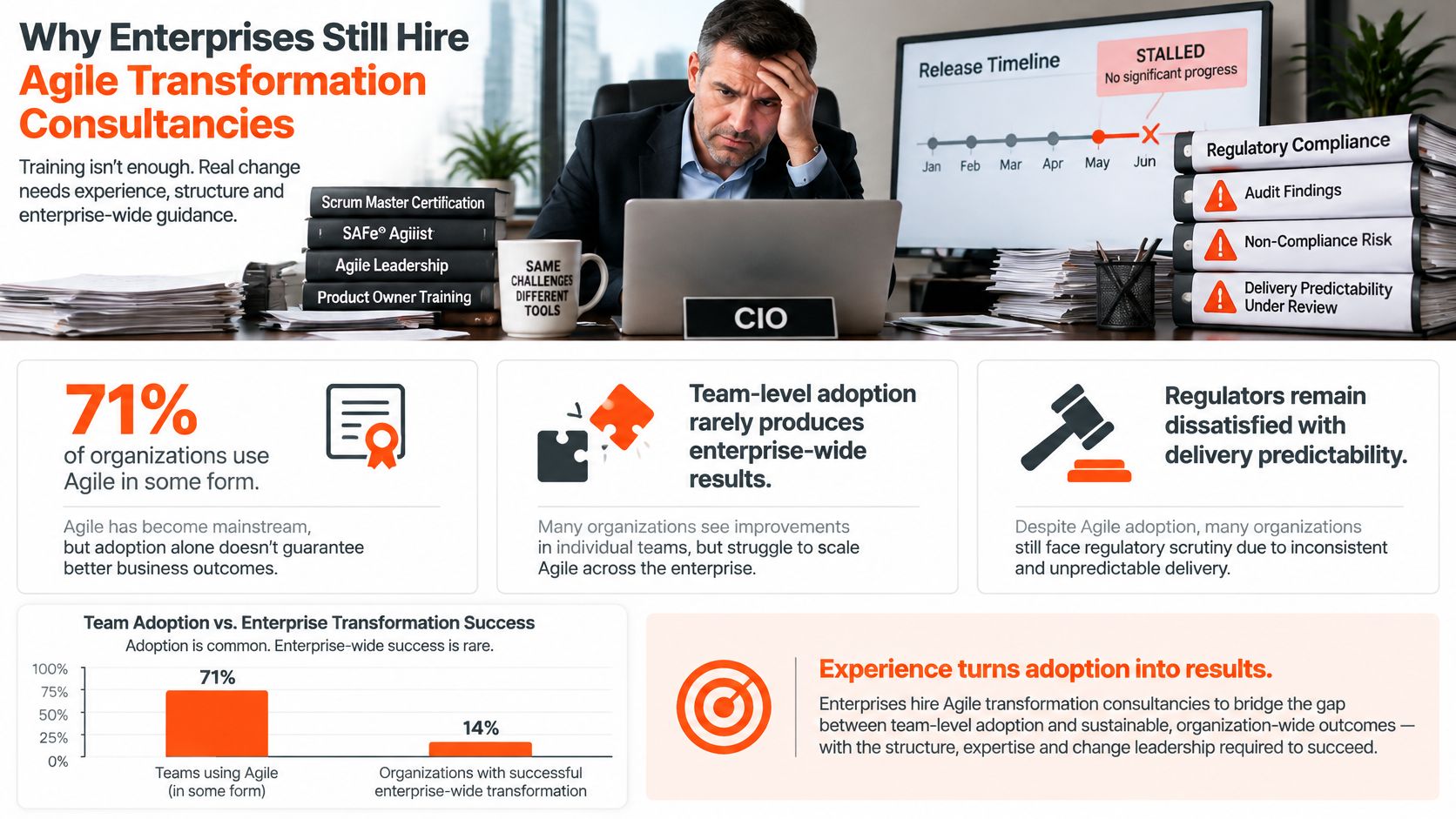
Treat the illustration as a conceptual explanation, not evidence of regulatory dissatisfaction across enterprises. The executive issue is whether the organization can connect delivery practices to accountable decisions.
Buy intervention at the organizational boundaries
A useful consultancy should challenge arrangements that internal teams can't change alone:
- Portfolio prioritization: Stop executives from approving competing initiatives against the same constrained capacity.
- Governance: Put risk and compliance responsibilities into delivery rather than leaving them at the release gate.
- Architecture enablement: Address shared components and environments that prevent teams from releasing independently.
- Leadership behavior: Require sponsors to resolve trade-offs instead of repeatedly asking teams to absorb them.
Training can improve skills. It can't grant a product owner authority that the executive committee refuses to delegate.
Practical rule: If the engagement changes team ceremonies but leaves funding, decision rights, and dependencies untouched, you're buying adoption support, not enterprise transformation.
Place that intervention within a broader digital transformation strategy and implementation approach. Modernization decisions, commercial priorities, and delivery changes should reinforce each other. Otherwise, executives risk reorganizing teams around technology constraints they haven't funded anyone to remove.
What an Agile Transformation Consultancy Actually Does
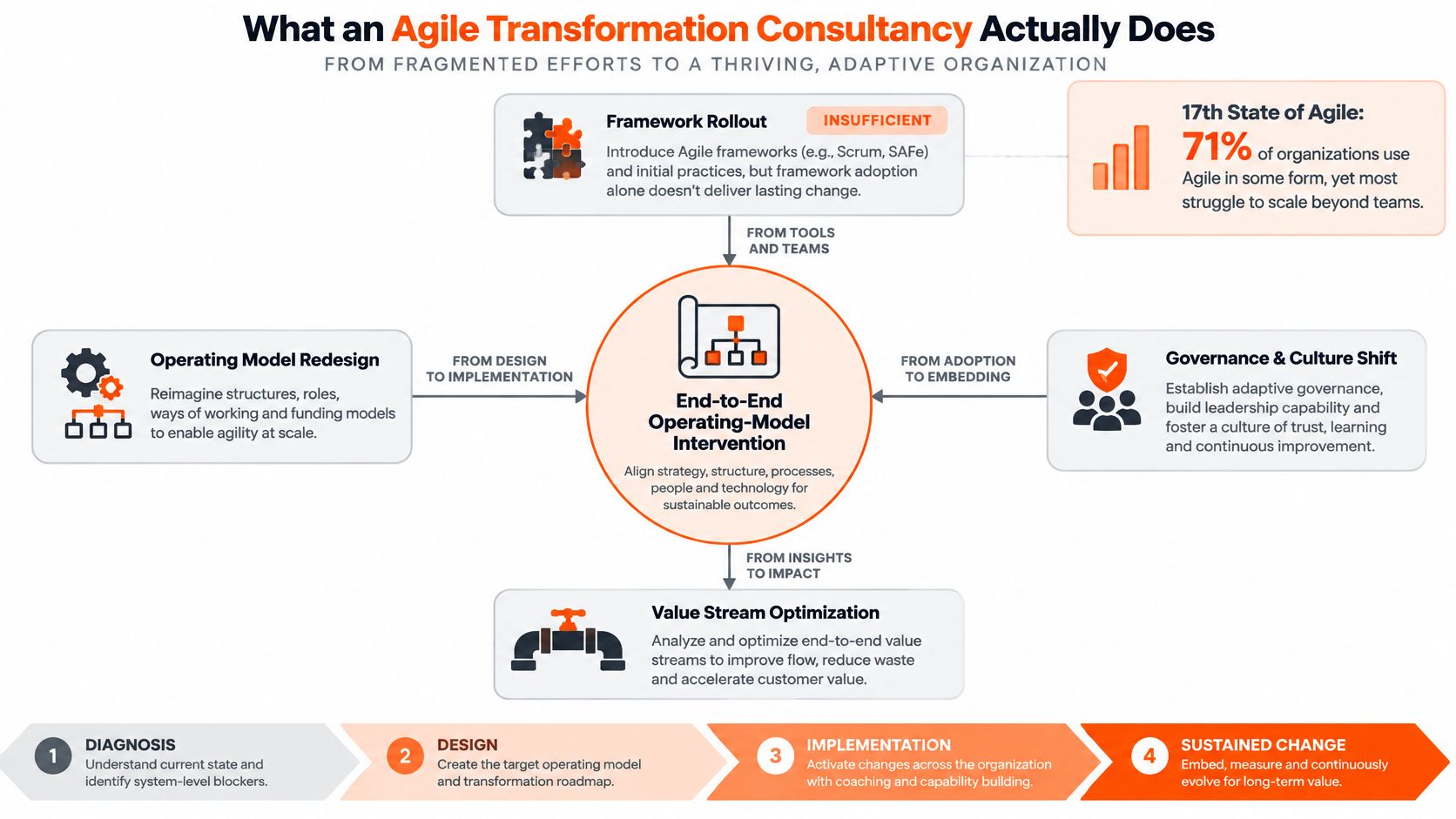
An agile transformation consultancy should redesign how an enterprise turns investment into customer value. Its scope includes management decisions, organizational structure, engineering delivery, and the evidence used to assess results.
The distinction matters because 71% of surveyed organizations used Agile in their software-development lifecycle, but only about 44% reported that enterprise Agile worked very or somewhat well, according to the 17th State of Agile report. Adoption and effectiveness are different measures, not interchangeable indicators of progress.
Demand deliverables that change decisions
Start with a baseline diagnosis. Consultants should trace work from investment approval to production use, identify waiting time, and examine whether organizational boundaries match product responsibilities. Interviews alone aren't enough. Request evidence from delivery records, architecture dependencies, incident reviews, and actual approval paths.
Next comes target operating-model design. Expect explicit proposals for team boundaries, funding arrangements, product ownership, escalation routes, and management reviews. A slide showing cross-functional squads isn't a design unless it explains who can decide what.
The consultancy should then help teams test those arrangements in delivery. Coaching belongs beside engineering, product discovery, and risk management, not in a separate training workstream.
Finally, require a transfer of capability. Internal leaders should be able to run the management system, interpret performance changes, and adapt the model without retaining consultants indefinitely.
Ask what managers will stop doing, not just what teams will start doing.
The potential business impact justifies this broader scope. In a global survey of 2,190 respondents, McKinsey found that highly successful transformations typically produced approximately 30% improvements across efficiency, customer satisfaction, employee engagement, and operational performance, while making organizations five to ten times faster, as described in its research on the impact of agility.
Those findings aren't a promise for your enterprise. They describe highly successful transformations, not an average return from hiring consultants. Use them to justify a serious performance intervention, then build your business case from your own baseline.
Core Services and Engagement Models You Will Encounter
Separate the service you need from the commercial arrangement used to provide it. A well-priced coaching contract won't solve a release architecture problem, and an engineering squad won't automatically fix executive prioritization.
Use the following service map as a procurement starting point. Engagement windows should depend on complexity and exit criteria, not an invented industry-standard duration.
| Service | Concrete deliverable | Recommended engagement window | Required staff profile |
|---|---|---|---|
| Diagnostic and baseline assessment | Value-stream map, constraint analysis, evidence register | Bounded discovery, ending when findings are validated | Transformation architect, analyst, technical lead |
| Target operating-model design | Decision-rights map, team boundaries, funding proposal | Design through sponsor approval | Operating-model specialist, product leader, enterprise architect |
| Coaching and enablement | Observed practice changes and internal coaching capability | Through demonstrated independent operation | Delivery coach, leadership coach, product coach |
| Platform and DevOps integration | Tested delivery capabilities and usable engineering pathways | Through adoption and operational handover | Platform engineers, quality engineers, security specialists |
| Outcome measurement | Metric definitions, baseline, review process | Baseline establishment followed by recurring reviews | Delivery analyst, finance partner, outcome owner |
Match the contract to the uncertainty
A fixed-scope assessment offers cost clarity when the immediate question is diagnostic. Protect against superficial recommendations by requiring access to underlying evidence and a prioritized implementation backlog.
A multi-phase program suits work whose later scope depends on discovery. Fund subsequent phases through explicit decisions rather than committing to a complete rollout before the diagnosis exists.
An embedded squad-as-a-service can combine hands-on delivery with enablement. Its risk is dependency: pair external specialists with internal owners and make handover part of acceptance.
An outcome-based retainer can strengthen accountability, but only when both parties agree on attribution and control. Don't tie payment to a commercial result that consultants can't materially influence.
Commercial safeguard: Pay for accepted capability and evidence, not merely for consultant attendance.
For legacy and regulated workloads, I recommend a hybrid: bounded diagnosis, a delivery pilot, and targeted platform engineering. Keep the contractual boundaries clear. Otherwise, consultants can classify every obstacle as somebody else's work while the enterprise pays for coordination without receiving resolution.
A Practical Roadmap From Diagnosis to Sustained Change
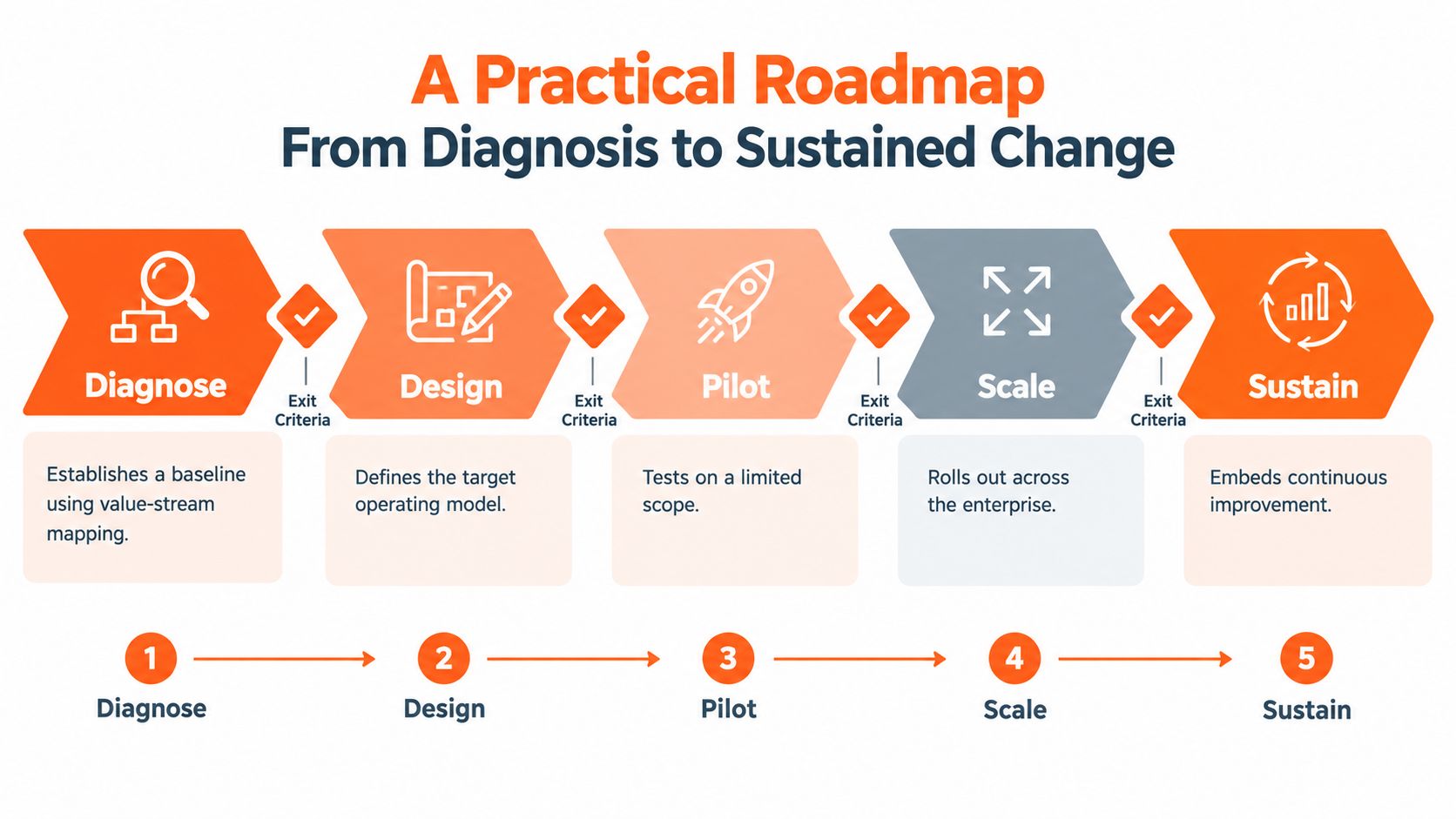
Sequence transformation around decision gates, not a launch date. A sponsor should authorize expansion because evidence supports it, not because the communications team has announced the next wave.
For an initial leadership discussion, Synopsix's digital transformation readiness assessment offers a useful starting point for organizing readiness questions. Use that discussion to surface assumptions before commissioning detailed design.
Define the gates before authorizing the work
| Phase | Required artifact | Exit criterion | Failure to prevent |
|---|---|---|---|
| Diagnose | Validated baseline and constraint map | Sponsors agree on the problem and accountable owners | Substituting maturity scores for operational evidence |
| Design | Target model and implementation backlog | Product, engineering, finance, and risk accept their responsibilities | Drawing a new organization without changing authority |
| Pilot | Delivery evidence and tested working agreements | Improvements are credible and controls remain effective | Selecting an unusually easy showcase |
| Scale | Adaptation playbook and dependency-removal plan | Receiving teams have capacity and enabling capabilities | Copying practices without checking context |
| Sustain | Internal ownership and improvement routines | Employees can operate and revise the model independently | Leaving the consultancy as the permanent coordinator |
Diagnose should remain bounded, but don't close it while critical data remains disputed. Its duration depends on access to records and the complexity of the delivery path.
During Design, test proposed responsibilities against difficult decisions. Who can stop low-value work? Who funds a shared platform improvement? Who accepts a residual security risk?
For Pilot, select a limited value stream with meaningful customer impact, relevant dependencies, and a sponsor willing to act. Run it long enough to observe delivery and operational consequences, not merely a successful demonstration.
Expand only what the enterprise can support
Scale should proceed in evidence-led waves. Retire pilot practices that depended on exceptional staffing or informal executive intervention. Preserve the useful principles while adapting implementation to each product's constraints.
Sustain has no sensible ceremonial finish date. Contract for a defined handover, then place continuing improvement under internal ownership with named capacity and escalation routes.
If AI tools will support communication, analysis, or adoption, connect them to the same ownership structure. A practical AI-powered change management approach should help leaders make and explain decisions, not substitute automated messaging for engagement with affected employees.
Comparing Enterprise Agile Frameworks Without the Hype
Choose framework mechanics after identifying your operating-model gaps. Starting with a framework creates pressure to fit the enterprise to the model, even when the underlying constraint is a shared database, annual funding rule, or unresolved product boundary.
Treat the comparison below as a selection guide, not a claim that a framework guarantees regulatory suitability. The planning and governance choices must survive scrutiny from your own engineering and control owners.
Enterprise Agile Framework Comparison
| Framework | Typical Scale | Governance Style | Best Fit |
|---|---|---|---|
| SAFe | Consider for broad, coordinated portfolios | Explicit coordination structures; assess whether planning intervals fit delivery needs | Enterprises needing visible cross-team investment and dependency decisions |
| LeSS | Consider for teams sharing a product | Favor product-level alignment and simplification; test shared planning needs | Organizations willing to simplify structures around product ownership |
| Spotify model | Treat as an organizational design reference | Assess autonomy, alignment, and communities rather than copying labels | Enterprises exploring team boundaries and knowledge sharing |
| Nexus | Consider for closely related Scrum teams | Focus selection on integration accountability and a coherent increment | Products where coordination centers on integrated delivery |
| Custom hybrid | Define around the actual enterprise boundary | Combine necessary controls with context-specific planning cadences | Legacy-heavy or regulated settings with established governance obligations |
Test the choice against difficult work
Ask each shortlisted consultancy to demonstrate how its proposed model handles an urgent production issue, an architectural dependency, and a high-risk release. Don't accept a diagram as the answer. Require a walkthrough of authority, evidence, escalation, and the effect on planned work.
Scrum offers a useful concrete reference point: the 2020 Scrum Guide defines Developers, Product Owner, and Scrum Master accountabilities, and a fixed-length Sprint lasting one month or less. Those mechanics can clarify team responsibilities, but they don't decide enterprise funding or replace your risk model.
For a regulated product, preserve controls that have a clear purpose and redesign how teams satisfy them. For a legacy platform, prioritize integration feasibility and architectural ownership before reorganizing delivery around new labels.
Don't confuse autonomy with isolation. Teams need room to make decisions, but somebody must own cross-product trade-offs. My recommendation is to choose the smallest coherent set of practices that addresses the diagnosed constraints, then add coordination only when demonstrated dependencies require it.
Success Metrics That Prove Transformation Is Working
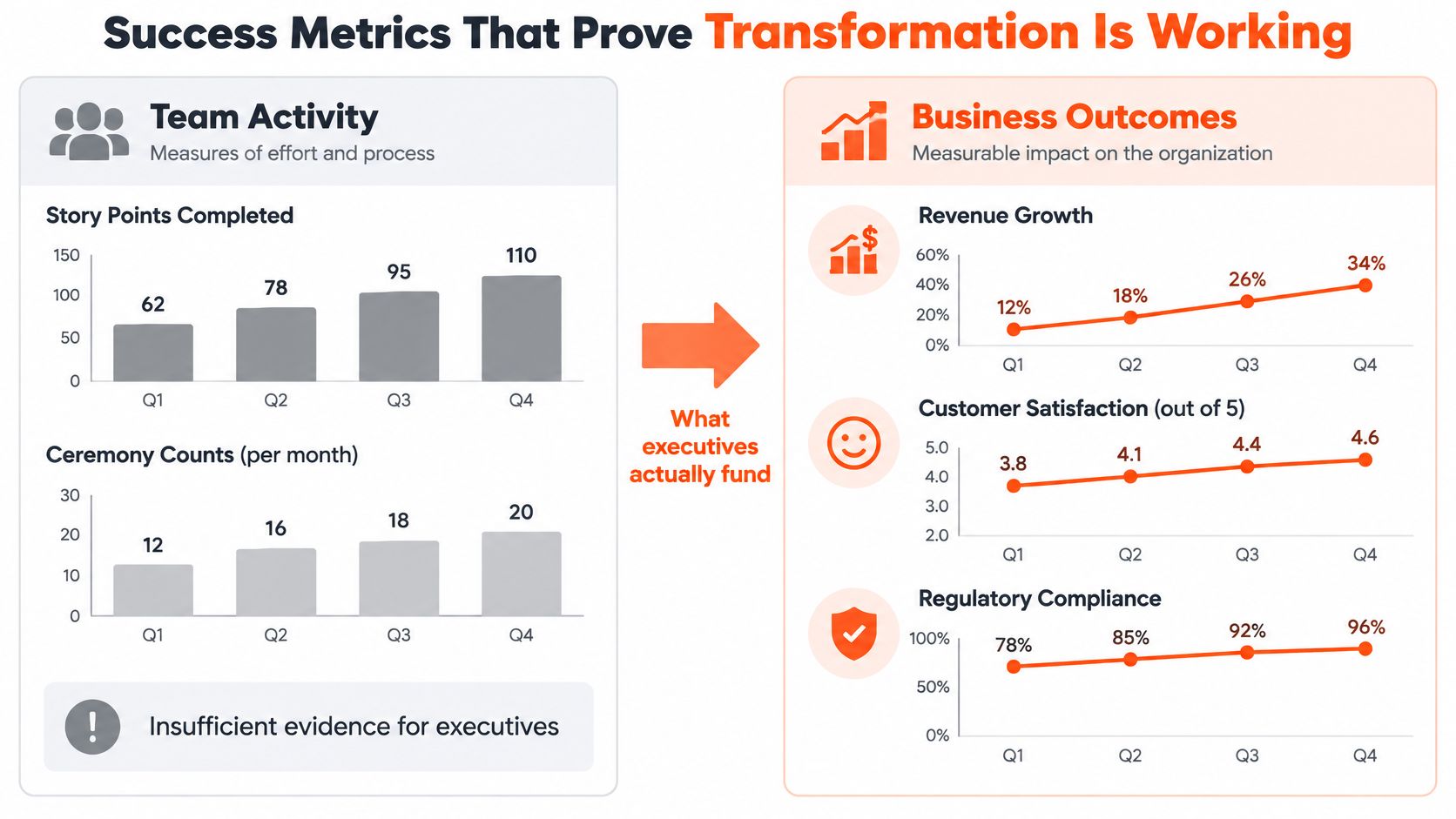
An executive dashboard should answer whether customers receive better outcomes, whether delivery improves, and whether the enterprise remains within its risk appetite. Story points and ceremony counts can't establish those conclusions.
Use the illustration below to distinguish activity from outcomes. Its plotted figures are illustrative, not verified transformation results or performance targets.
Build a balanced dashboard
Use change lead time, deployment frequency, failed-deployment recovery time, change fail rate, and deployment rework rate as the engineering backbone, following DORA's software-delivery measurement model. Preserve the definitions: change lead time begins at code commit, so it isn't a substitute for measuring the full journey from customer need to delivered value.
| Dashboard view | Recommended chart | Executive question |
|---|---|---|
| Delivery flow | Lead-time trend with deployment frequency | Are changes moving through delivery more effectively? |
| Stability | Failure, recovery, and rework trends | Are teams accelerating without creating operational debt? |
| Decisions and dependencies | Aging distribution and decision-latency trend | Where do leaders need to intervene? |
| Customer and financial outcomes | Outcome trend against baseline | Did the investment create the intended benefit? |
| Risk | Escaped defects, security findings, audit exceptions | Have improvements remained within acceptable controls? |
Review this dashboard monthly. Leading indicators, such as dependency age and decision latency, identify intervention opportunities; lagging indicators, such as customer satisfaction and cost-to-serve, test whether those interventions mattered.
For business-case calibration, McKinsey's preliminary study of 22 organizations across six sectors reported customer-satisfaction gains of 10–30 points, employee-engagement gains of 20–30 points, operational-performance improvements of 30–50%, and cost-related financial improvements of 20–30%, in its enterprise-agility benefits research. These are limited-sample benchmarks, not contractual promises.
Make attribution explicit
Record when interventions began, which teams adopted them, and what else changed. Finance should validate cost assumptions; product leaders should own customer outcomes; engineering and risk owners should interpret operational measures together.
Avoid crediting transformation for every favorable movement. Compare similar work where feasible, document changes in demand and staffing, and distinguish observed improvement from a defensible explanation of its cause.
Choosing the Right Consultancy for Your Enterprise
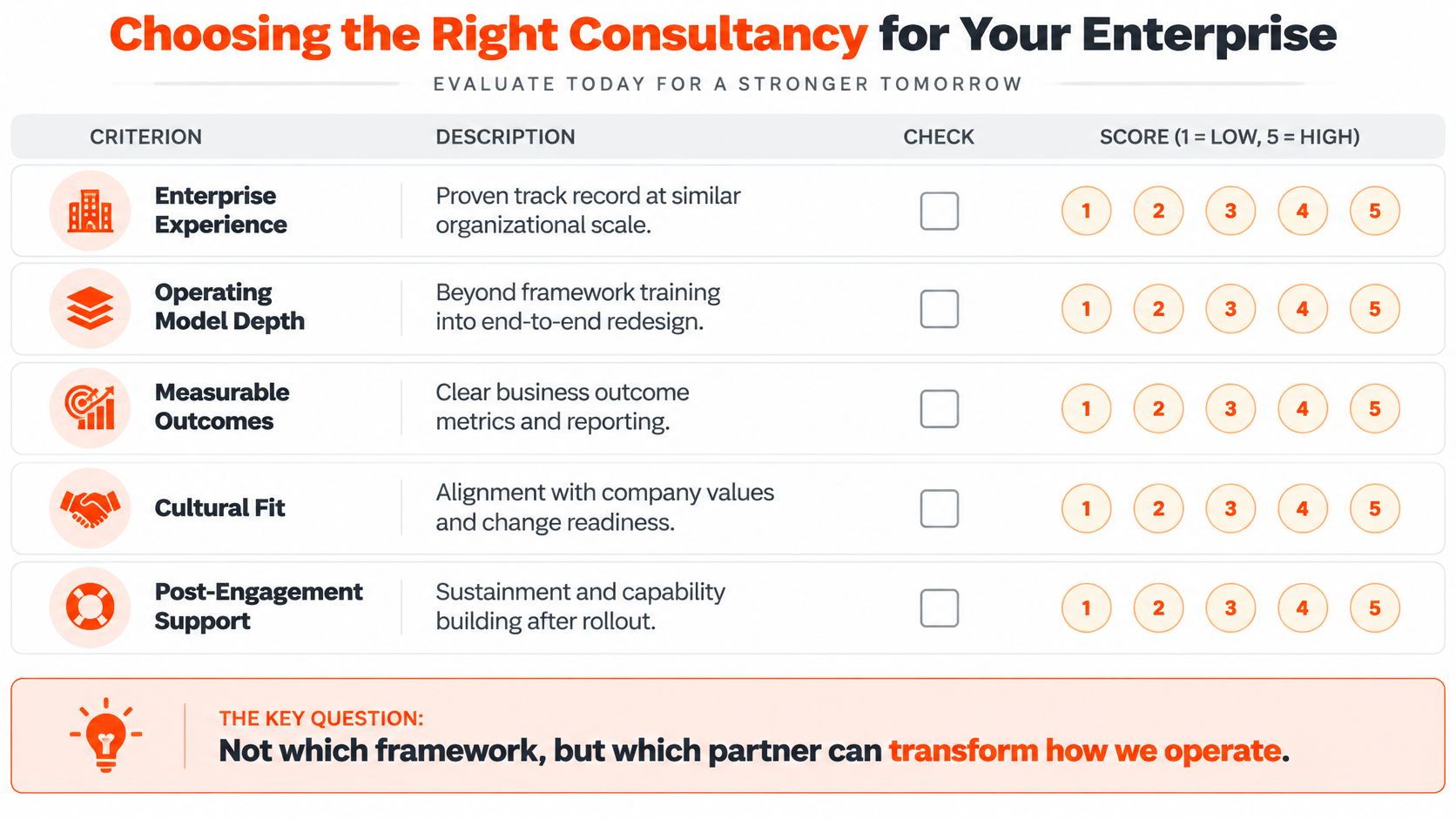
Select the partner that can explain how it will change your operating model and how you'll know the change worked. Brand recognition and certification inventories don't answer either question.
Use a structured technology partner evaluation process to keep procurement, engineering, and executive sponsors aligned. Have each candidate respond to the same delivery scenario so comparisons aren't driven by presentation quality.
Ask for evidence you can inspect
- Diagnostic depth: Request an anonymized example showing how the firm connected a delivery problem to a specific management or technical constraint.
- Relevant references: Speak with clients who faced comparable legacy dependencies, control requirements, and organizational complexity.
- Engineering integration: Ask who will implement changes to testing, deployment, architecture, and observability.
- Measurement discipline: Require metric definitions, data-access assumptions, and an explanation of attribution.
- Knowledge transfer: Identify the internal roles that will take ownership and how readiness will be assessed.
- Commercial accountability: Check whether payment and continuation decisions depend on accepted deliverables rather than staffing volume.
Distinguish transformation capability from capacity supply. If the immediate gap is recruiting distributed specialists, Virtustant's guide to choosing a remote job staffing agency is relevant to that separate sourcing decision. Don't assume a staffing provider will redesign governance, or that a transformation advisor can supply production engineering without demonstrating it.
Put the difficult terms in the statement of work
Require named deliverables, enterprise obligations, acceptance criteria, access to evidence, and handover responsibilities. Include a route to stop, reshape, or defer later phases when the diagnosis invalidates the original plan.
Watch for certification-heavy pitches, undefined promises of agility, and resistance to business or flow measures. Equally, reject outcome guarantees that ignore your enterprise's obligations. A credible partner will tell you which executive decisions it needs, which results it can influence, and where accountability must remain internal.
Common Pitfalls and the Enterprise Decision-Maker Checklist
The easiest transformation to announce is a framework rollout. The hardest is changing how leaders allocate resources, accept evidence, and stop work that no longer deserves funding.
The pressure for proof is explicit: only 13% of respondents viewed Agile as embedded across the business, while 76% faced increased pressure to demonstrate ROI, according to the 2025 State of Agile findings summarized by Pawel Rola. Treat that as a reason to strengthen accountability, not add reporting overhead.
Approve the investment only when these conditions are clear
- Baseline: The enterprise can describe current performance with evidence.
- Target model: Sponsors accept the required changes to ownership and authority.
- Pilot selection: The chosen work tests meaningful constraints rather than avoiding them.
- Measurement plan: Outcome owners agree how benefits and risks will be assessed.
- Vendor accountability: Acceptance, handover, and continuation terms are explicit.
- AI governance: Teams know which controls apply, who owns them, and when escalation is mandatory.
Don't scale a pilot whose results depend on exceptional intervention. Don't buy a platform merely to standardize tools. Don't let teams claim success through activity measures that customers and finance can't recognize.
AI adds a specific delivery obligation. In a 2025 survey of 1,250 governance-focused technology decision-makers, 60% reported advanced or mature AI usage, while 46% prioritized governance automation for the following 12 months, according to the OneTrust data and AI governance report.
Embed risk-tiered controls, automated CI/CD checks, reusable evidence, data provenance, and human accountability into delivery. A separate compliance program won't compensate for teams that lack deployable acceptance criteria.
devPulse combines discovery, technical audits, legacy modernization, platform engineering, AI integration, and ways-of-working enablement. Visit devPulse to discuss an evidence-led assessment that connects delivery constraints to an operating-model roadmap, measurable outcomes, and a practical handover plan.