














Your product team has a familiar problem. The customer portal needs a safer frontend and a consistent API contract, while the analytics group wants an internal service that can process data and support AI workflows. Someone proposes TypeScript because it's becoming dominant in modern web engineering. Someone else argues for Python because it has the stronger data ecosystem. Both are right, but they're answering different questions.
The useful TypeScript vs Python decision isn't about which syntax feels nicer or which leaderboard looks more impressive. It's about the system you're delivering, the team that will operate it, the libraries your workload depends on, and the roles you'll need to hire.
| Decision factor | TypeScript | Python |
|---|---|---|
| Primary fit | Browser-centric products and full-stack web systems | Model-centric systems, data workflows, and automation |
| Type safety | Structural typing enforced at compile time | Optional type hints supported by external checkers |
| Runtime profile | Strong fit for event-driven and I/O-heavy services | Strong fit for data processing and ML ecosystems |
| Main ecosystem advantage | React, Next.js, Node.js, and shared web contracts | pandas, NumPy, PyTorch, Jupyter, and scientific tooling |
| Hiring focus | Frontend, Node.js, and full-stack product engineers | Backend, data, ML, platform, and automation engineers |
| Best default | A product whose core surface lives in the browser | A system whose core value comes from data or models |
Table of Contents
- The Decision Behind TypeScript vs Python
- Adoption Signals and What They Actually Mean
- Type Systems Compared Without the Hype
- Performance Benchmarks That Matter in Practice
- Ecosystems, Frameworks, and Tooling
- Developer Productivity in Day to Day Work
- Hiring Market and Enterprise Role Fit
- Which Language to Choose and When
The Decision Behind TypeScript vs Python
A mid-sized SaaS company is choosing tools for two very different deliveries. Its customer portal needs a TypeScript and Next.js rewrite with responsive screens, shared validation, real-time status updates, and API contracts that frontend engineers can change safely.
Its internal analytics service has another job. Built with Python, FastAPI, and pandas, it must combine operational data, let analysts test transformations quickly, and later connect with model-driven workflows. Its value sits closer to data than to the browser.
The decision should follow the system's center of gravity. The portal is browser-centric. Its expensive delivery risks involve UI state, authentication flows, browser execution, API contracts, and coordinated frontend-backend changes. TypeScript fits because shared type models can move through the web product and its server-side code, exposing contract errors before they reach production.
The analytics service is model-centric. Its difficult work involves data structures, scientific libraries, notebooks, transformations, and AI integration. Python fits because its surrounding ecosystem supports those tasks directly.
Practical rule: Choose the language that reduces the most expensive category of risk in the system you're shipping.
That risk may be inconsistent interfaces across a large product team. It may be slow experimentation with messy data. It may also be the lack of engineers who can diagnose the service during an incident.
Hiring should follow the same boundary. Choose TypeScript engineers with strong frontend, Node.js, and product-system experience for the portal. Choose Python backend, data, ML, platform, or automation engineers for the analytics core. Do not hire generalists by language label alone. Hire for the failure modes the system will create.
Some organizations should standardize on TypeScript. Others should choose Python. Many should use both, with a clear boundary between the product surface and the data or AI core.
Adoption Signals and What They Actually Mean
Popularity rankings answer different questions, so they can point in different directions without contradicting one another. Stack Overflow measures what developers report using. GitHub contributor counts show where people collaborate publicly. TIOBE reflects search interest and related signals. None of these measurements alone tells you which language will lower your delivery risk.
Python has unusually broad reach. In the Stack Overflow 2024 Developer Survey, Python was the top choice among people learning to code. The survey collected responses from 60,171 developers, and 92% completed the technology section, which gives the result substantial global breadth. Python also held the No. 1 position on the TIOBE Index with a 21.81% share in February 2026, its highest score in that index's history, according to the verified industry summary provided for this comparison.
TypeScript tells a different story. It's newer, but its collaborative web engineering footprint is powerful. In August 2025, TypeScript became the No. 1 language on GitHub by contributor count for the first time, with 2,636,006 monthly contributors, overtaking Python by roughly 42,000 developers. The same reported milestone described TypeScript as growing about 66% year over year. Those figures measure public collaboration, not the total installed base or the quality of a particular framework.
| Metric | TypeScript | Python |
|---|---|---|
| Learning signal | Strong, but not the leading language in the cited survey result | Top choice among people learning to code in Stack Overflow's 2024 survey |
| GitHub contributor signal | 2,636,006 monthly contributors in August 2025, as reported in the industry summary | About 850,000 new contributors in the same cited comparison |
| TIOBE signal | Ranked No. 44 with 0.37% in the cited August 2026 snapshot | Led the August 2026 snapshot with an 18.53% rating, showing the divergence between search interest and professional collaboration |
| Professional adoption signal | Strong across modern web and full-stack teams | Broad usage across backend, automation, data, and AI |
| What it tells leaders | TypeScript is central to collaborative web product development | Python has unusually wide cross-domain adoption |
The practical takeaway is simple. Popularity is an input, not a decision. Map each signal to your workload, team composition, and operating model before using it as evidence.
Type Systems Compared Without the Hype
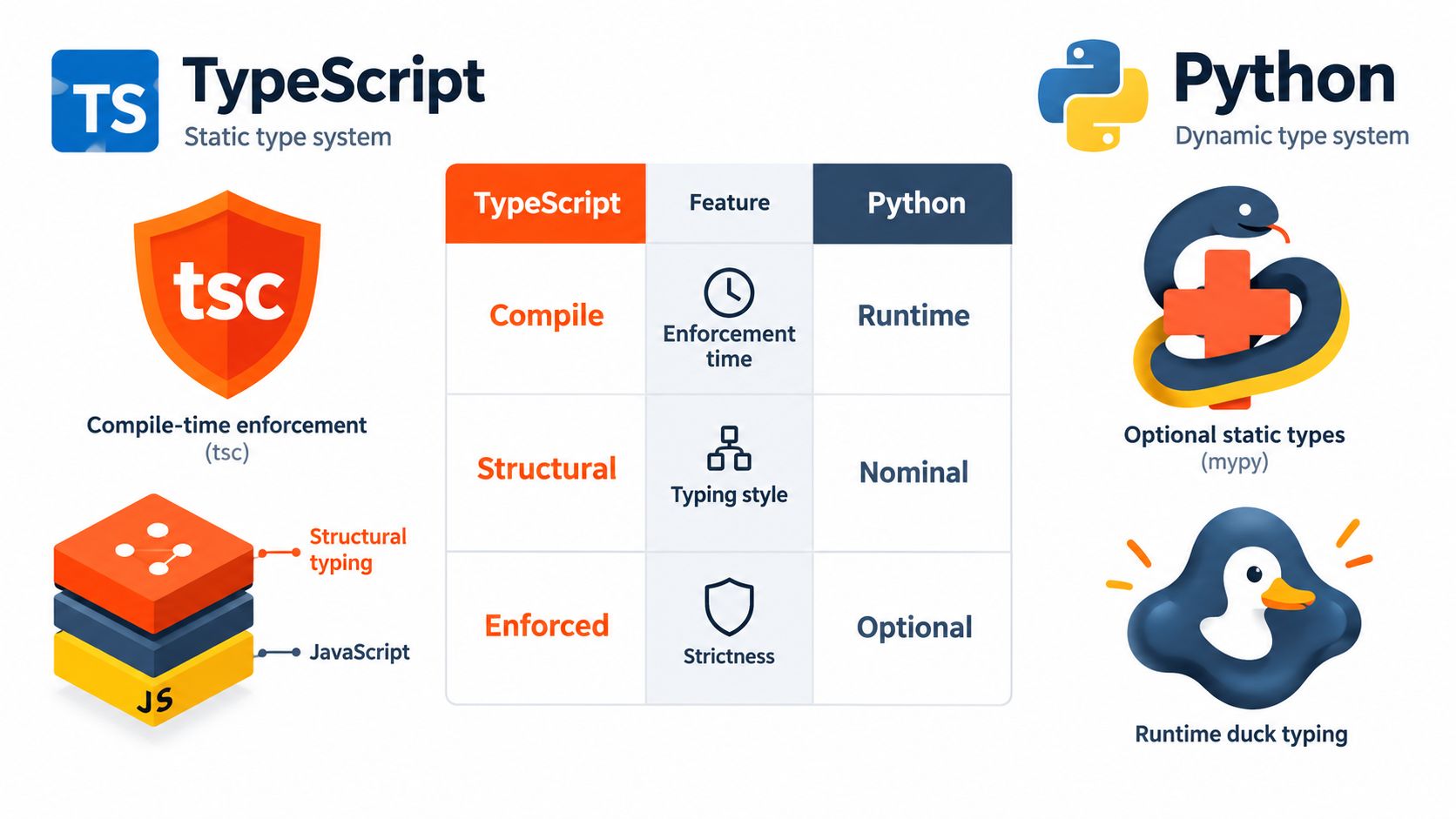
TypeScript and Python both support typing, but they place responsibility in different parts of the delivery process. TypeScript's static type system is structurally typed and enforced at compile time. Python's type hints are optional metadata, and the interpreter ignores them during execution.
That difference changes how teams discover defects. TypeScript can reject an object whose shape doesn't satisfy an interface before the code reaches a browser or Node.js process. Python can express detailed types, but a team generally needs tools such as mypy, Pyright, or an IDE language server to detect comparable mismatches before runtime.
Where TypeScript creates leverage
TypeScript gives teams a compiler-centered workflow. Generics let engineers preserve relationships between inputs and outputs. Discriminated unions make state transitions explicit. Narrowing lets the compiler refine what a value can be after a runtime check.
The benefit becomes obvious in a large codebase. Change a response shape, run the compiler, and the affected call sites become visible. That doesn't eliminate logic defects, and it doesn't validate every external payload, but it makes interface drift harder to ignore.
The official TypeScript documentation emphasizes type manipulation and creating types from types. That focus reflects TypeScript's core advantage, compile-time modeling, rather than a promise of universal runtime speed.
Where Python remains effective
Python's dynamic model is valuable during exploration. Data scientists can inspect a value in a notebook, reshape it, pass it through a transformation, and adjust the workflow without building a complete application boundary first. That flexibility suits prototypes, data wrangling, and ML pipelines whose shapes often come from external systems.
Python's typing has also become more expressive. The official Python typing reference includes generic classes, typing.Self, and variance handling. Those features make Python typing considerably more capable than a simple “untyped” label suggests, while the runtime remains dynamically typed.
The operational rule is sharper than the usual language debate:
TypeScript gives you safety by default. Python gives you safety on demand.
If a team chooses Python for a long-lived service, it should deliberately decide where type checking, schema validation, and contract tests belong. If it chooses TypeScript, it still needs runtime validation at trust boundaries, because compile-time guarantees can't inspect arbitrary external data.
Performance Benchmarks That Matter in Practice
Performance arguments usually fail because teams compare language labels instead of workloads. An API that spends most of its time waiting for a database behaves differently from a numerical loop. JSON parsing, serialization, network concurrency, query latency, and native library calls each expose a different part of the stack.
The cited comparative benchmark suite reported TypeScript at 1,040 ms versus Python with PyPy at 1,165 ms on one test, while Python used substantially less peak memory, 96.8 MB versus 395.3 MB. Another test reported 128 ms for TypeScript versus 2,215 ms for Python. The same suite also showed Python winning at least one arithmetic test. The evidence supports a practical conclusion, not a universal ranking: runtime and workload shape matter more than the language name. See the TypeScript versus Python benchmark results for the test-by-test context.
| Workload | TypeScript with Node.js | Python with the standard library | Python with native libraries |
|---|---|---|---|
| API orchestration | Strong fit for asynchronous I/O and event-driven request handling | Capable, with concurrency choices requiring deliberate design | Usually unnecessary unless processing includes specialized computation |
| JSON and HTTP work | Often a natural fit in a JavaScript-heavy product | Effective, but may require more attention to concurrency architecture | Useful when payload processing connects to data or ML operations |
| Database round-trips | Runtime speed rarely decides the result, query and network behavior dominate | Same operational reality | Native libraries can help only when the workload leaves ordinary I/O |
| Numerical computation | Poor choice for heavy tensor or array math without a specialized service | Fine for small calculations | Strong when NumPy, pandas, or ML libraries move work into optimized native code |
| Benchmark interpretation | Inspect V8 behavior, memory, serialization, and async patterns | Separate interpreter overhead from PyPy or native extensions | Evaluate the actual library and accelerator path, not raw Python loops |
For a production API, measure the complete request path. Include serialization, database access, downstream calls, queue behavior, memory pressure, and observability overhead. A faster isolated function won't rescue a slow query plan or an inefficient payload.
Architecture also determines whether the language matters at all. Teams evaluating service boundaries, queues, caching, or modularity should review software architecture patterns alongside runtime benchmarks.
Ecosystems, Frameworks, and Tooling
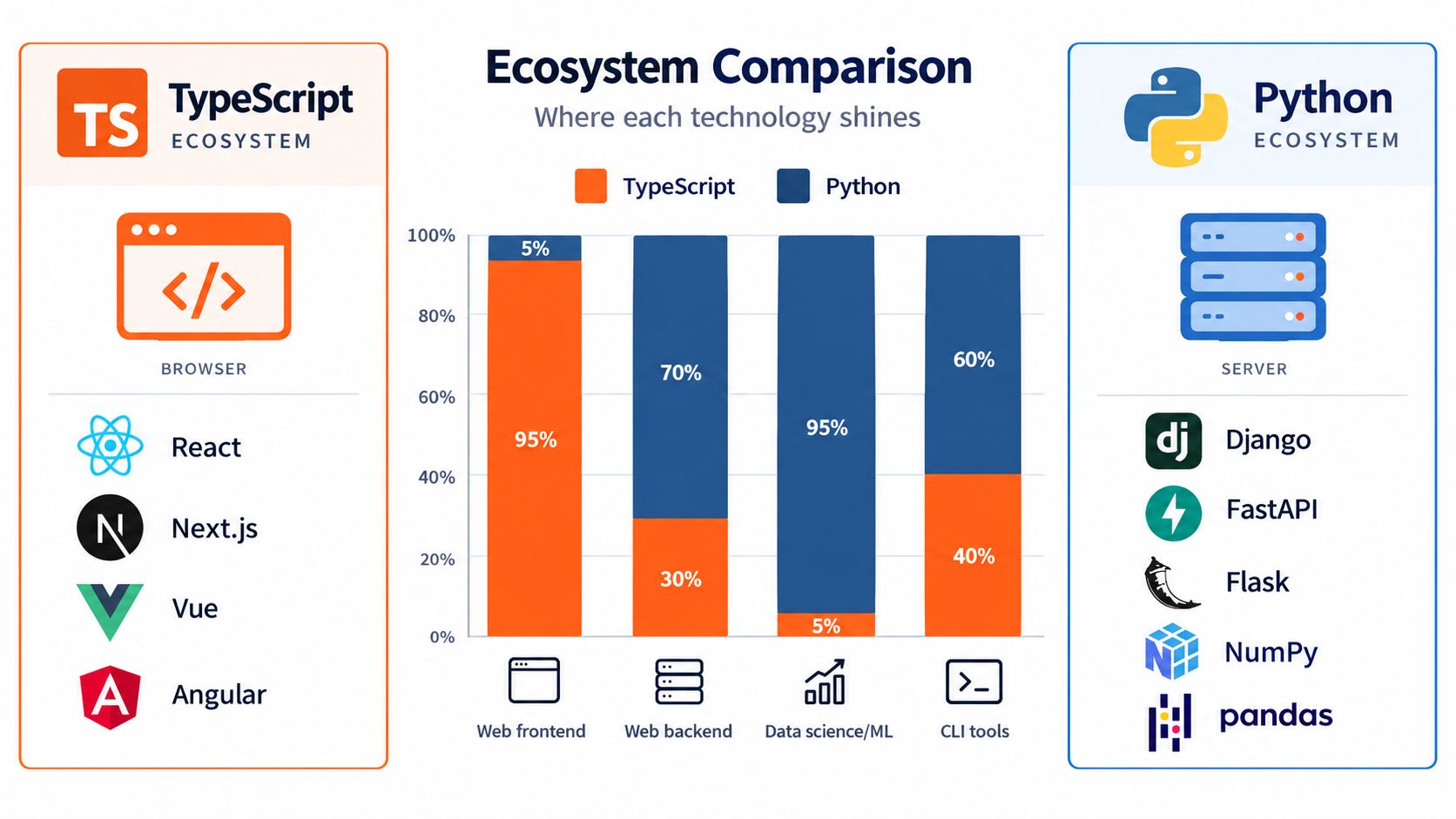
TypeScript owns the browser-centric territory. React, Next.js, Vue, and Angular give product teams mature options for building interfaces, while Node.js frameworks support APIs, background workers, and event-driven services. Tools such as ESLint, Prettier, ts-node, and Vite create a coherent development loop, especially when frontend and backend engineers share a repository.
That shared language can remove translation work. A team can define a request type once, validate it at the boundary, and use it across UI code, API handlers, and client libraries. tRPC extends that pattern for teams that want inferred contracts between TypeScript services without manually maintaining a separate schema for every interaction.
For a deeper explanation of the language's role in web development, see what TypeScript is.
Python's center of gravity is different. Django provides a mature full-stack web framework. FastAPI supports typed API development. Celery handles distributed task workflows. The PyData ecosystem includes pandas, NumPy, scikit-learn, PyTorch, Jupyter, and related tools that are difficult to replace when the system depends on data analysis or model operations.
Match libraries to the domain
A browser-first SaaS product should start with the libraries its interface and delivery pipeline already require. A model-centric platform should start with the libraries that manipulate data, train or serve models, and connect notebooks to production workflows.
Neither ecosystem is universally superior. TypeScript reduces friction across UI and API boundaries. Python reduces friction around arrays, dataframes, notebooks, model checkpoints, and scientific workflows.
Teams should also inspect package governance, release cadence, security scanning, build reproducibility, and operational ownership. A library that solves the technical problem but lacks maintainers or internal expertise can create more risk than it removes.
Developer Productivity in Day to Day Work
TypeScript and Python feel different after the first week of implementation. TypeScript asks engineers to make more decisions before execution. Python lets them explore faster, then asks the team to add discipline as the service grows.
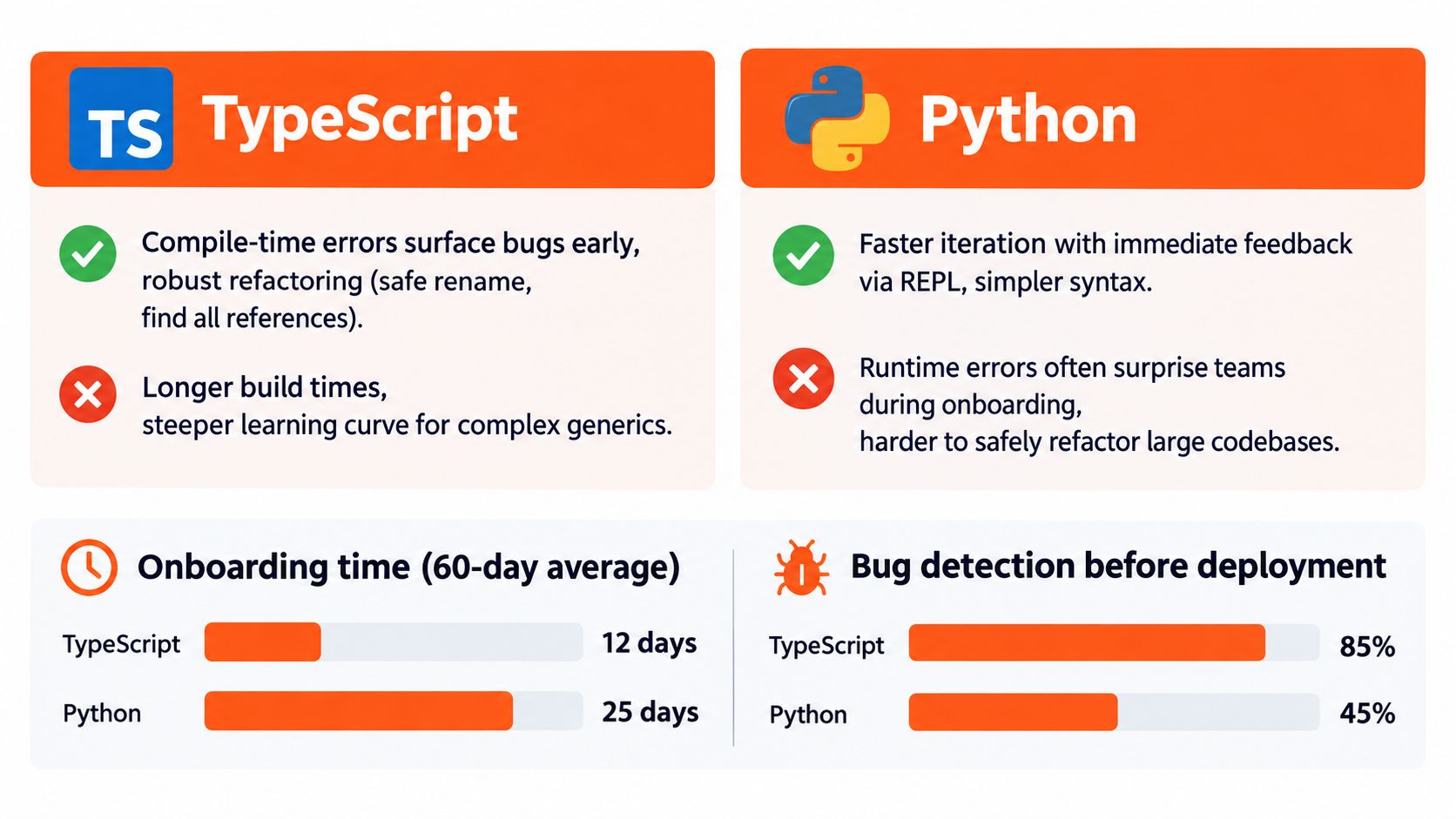
A frontend engineer working in TypeScript benefits from autocomplete, explicit interfaces, and compiler feedback. In a monorepo, safe renames and reference discovery can make a cross-package refactor manageable. The cost appears during early discovery, when requirements change quickly and complex generics or strict configuration create friction.
Python rewards immediate feedback. A data engineer can open a REPL or notebook, inspect a dataset, test a transformation, and keep moving. That short loop is a major advantage when the team is still learning what the data means.
Evaluate productivity across the lifecycle
Don't ask which language produces the fastest first commit. Ask which one keeps the team effective through discovery, implementation, review, operation, and change.
- During exploration: Python usually keeps data and ML specialists closer to the problem because notebooks and dynamic values reduce ceremony.
- During interface design: TypeScript forces contracts into the workflow earlier, which helps teams coordinate across frontend, backend, and shared packages.
- During refactoring: TypeScript's compiler and language tooling provide stronger mechanical assistance when types are accurate.
- During production support: Either language works well when the on-call team owns the runtime and has tests, logs, tracing, and clear deployment procedures.
Python services can accumulate type drift when engineers treat annotations as decoration. TypeScript services can accumulate abstraction drift when teams overuse advanced types that only a few people understand.
Maintenance rule: Optimize for the team that will debug the system six months after launch, not only for the team that prototypes it today.
The right match often follows the project phase. Python is a strong choice when the problem is still being discovered through data. TypeScript becomes more attractive when requirements stabilize and many engineers must evolve shared product contracts safely.
Hiring Market and Enterprise Role Fit
Raw job counts hide the most important hiring distinction. A Python role might mean Django backend work, Airflow pipelines, model deployment, internal automation, or scientific computing. A TypeScript role more often points toward a web product position, although the framework and platform still matter.
Recent market analysis describes Python as leading raw demand in Europe because of AI, data science, and automation, while TypeScript dominates modern web and full-stack roles. The same analysis identifies TypeScript as rising quickly in job specifications as explicit TypeScript requirements replace plain JavaScript requirements. Review the programming language job demand analysis for that role-level framing.
Map the role before you open the requisition
| Role | TypeScript fit | Python fit |
|---|---|---|
| Frontend engineer | Excellent for React, Next.js, Vue, and Angular product teams | Limited unless the role is mostly tooling or backend support |
| Node.js API developer | Strong for event-driven services, shared contracts, and web platforms | Suitable when the API connects closely to data or existing Python services |
| Full-stack product engineer | Strong when the team owns browser and server surfaces together | Useful when the product's backend and data workflows already center on Python |
| Backend engineer | Good with Node.js and TypeScript frameworks | Strong with Django, FastAPI, automation, and service integration |
| Data engineer | Usually a secondary choice | Strong for Airflow, Spark-adjacent workflows, warehouses, and transformation systems |
| ML engineer | Appropriate for product integration around models | Strong for PyTorch, TensorFlow, Hugging Face, inference, and evaluation |
| Platform engineer | Effective for web platform tooling and service automation | Strong for scripting, internal tools, infrastructure workflows, and operations |
Hiring managers should write the workload into the role description. “Python developer” is too broad if the organization needs a backend engineer rather than an ML specialist. Conversely, a TypeScript title shouldn't conceal that the person will spend most of the week building browser interfaces, maintaining Node.js APIs, or operating serverless functions.
Talent-pool depth matters, but role fit matters more than language supply. Hiring a Python ML engineer for ordinary backend ownership can create an expensive mismatch. Hiring a TypeScript product engineer for custom model work creates the opposite problem. Platforms such as LinkedIn, Indeed, and Wellfound can surface candidates, but the screening exercise should test the actual system constraints, not just vocabulary from a language list.
Which Language to Choose and When
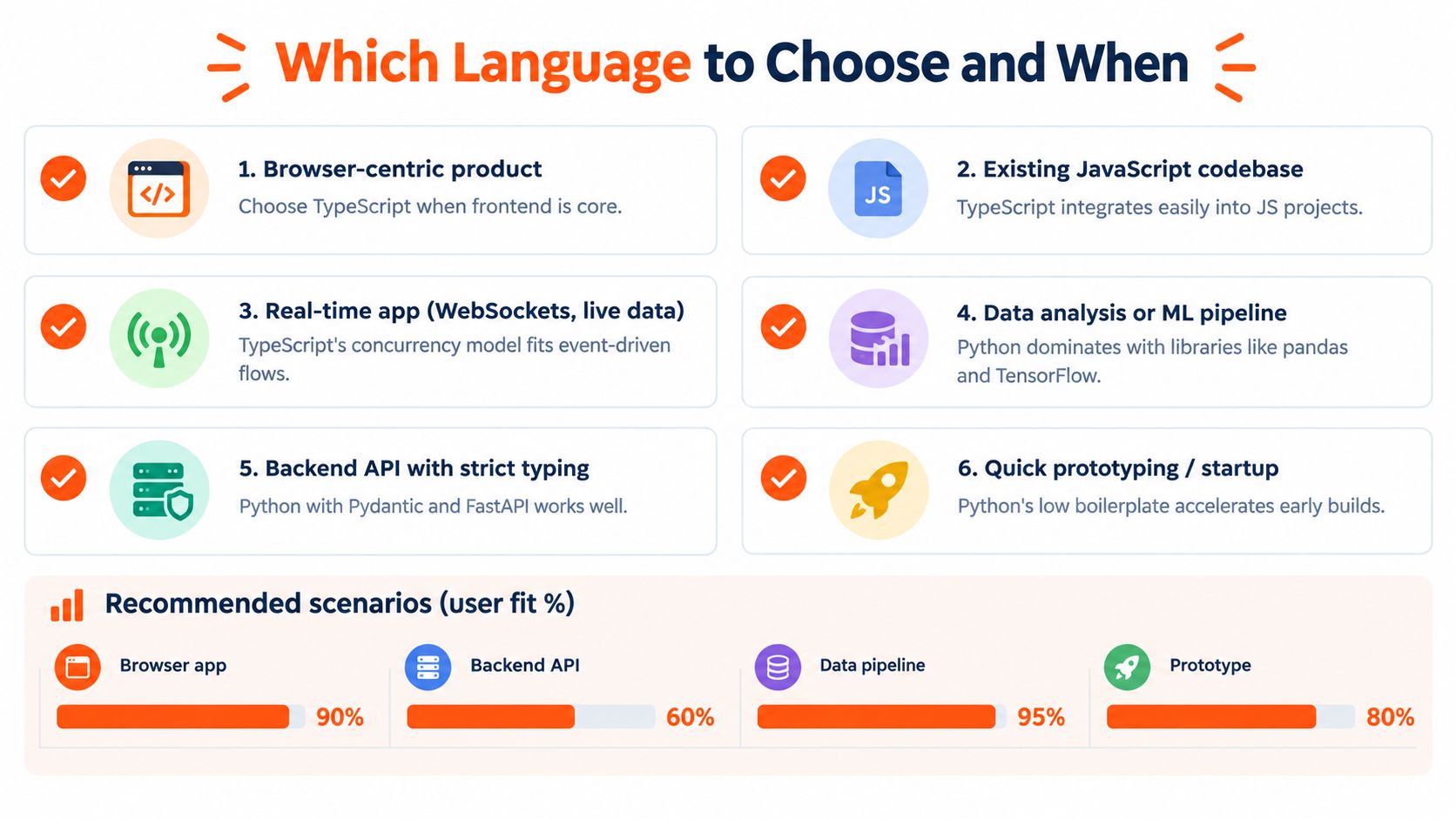
Choose TypeScript when the product's primary surface is the browser. It's the direct recommendation for React or Next.js applications, real-time interfaces, Node.js APIs, and teams that need shared contracts across frontend and backend. It's also the sensible choice when the organization already owns a JavaScript codebase and wants to modernize incrementally rather than create a second operating model.
Choose Python when the system's primary value comes from data or models. That includes analytics services, ETL, scientific computation, model training, retrieval workflows, evaluation pipelines, and automation built around pandas, NumPy, PyTorch, Jupyter, Django, FastAPI, or Airflow.
Use both when the architecture has two different centers of gravity. TypeScript can own the browser-facing product, authentication, orchestration, and API gateway. Python can own data preparation, inference, retrieval, or model evaluation. Put a clear REST, gRPC, or message-based contract between them. Don't mix runtimes inside one codebase through subprocess calls, because that turns a reasonable polyglot architecture into a difficult deployment and debugging problem.
Apply the decision checklist
- Primary user surface: If users spend their time in a browser, start with TypeScript. If users consume analytical or model output, start with Python.
- Dominant workload: Event-driven I/O and product workflows favor TypeScript. Data transformation and ML workloads favor Python.
- Existing team skills: Keep the first production implementation with the group that will own incidents and future changes.
- Deployment target: Align with the runtime, CI/CD pipeline, monitoring, and platform conventions you already operate.
- Hiring constraints: Define the exact role before comparing language demand. A Python backend hire and a Python ML hire aren't interchangeable.
- Maintenance ownership: Choose the language your long-term owners can extend without constant context switching.
The answer to TypeScript vs Python isn't a universal winner. TypeScript is my default for browser-centric product engineering. Python is my default for model-centric systems and data-heavy workflows. When both concerns are central, I'd rather operate two well-bounded services than force either team into the wrong ecosystem. For a broader view of choosing a language for a website, evaluate the product surface, not just the language's popularity.
devPulse helps enterprises and product companies assess architecture, modernize legacy platforms, build TypeScript and Python systems, and integrate secure data and AI workflows. Visit devPulse to discuss your product surface, workload, hiring constraints, and the service boundary that will support reliable delivery.