











You're in a planning meeting, and the room is already tired. Someone has a feature list. Engineering is asking for clarity. Sales wants something customer-facing. UX has a rough concept. Yet nobody can say whether the problem was ever validated, or whether the thing you're about to build is the thing users need.
That's where the product discovery process in agile earns its place. It gives teams a way to test the problem, test the solution, and make a go or no-go decision before delivery consumes the budget. Done well, discovery is not a research side quest. It's a continuous learning system that filters weak ideas early, protects engineering capacity, and feeds the roadmap with validated opportunities instead of assumptions.
Table of Contents
- Why Teams Keep Building the Wrong Thing Twice
- The Problem-Space and Solution-Space Split
- A Six-Week Continuous Discovery Cadence
- Running a Five-Day Discovery Sprint
- Decision Gates That Earn Engineering Capacity
- What Breaks When the Product Is AI or Data-Driven
- From Validated Opportunity to Backlog and Roadmap
Why Teams Keep Building the Wrong Thing Twice
The mistake usually shows up in a demo. The team clicks through the screens, stakeholders nod politely, and the room goes quiet. A week later, adoption is flat, support tickets start to climb, or someone says the uncomfortable thing, the original idea was never validated.
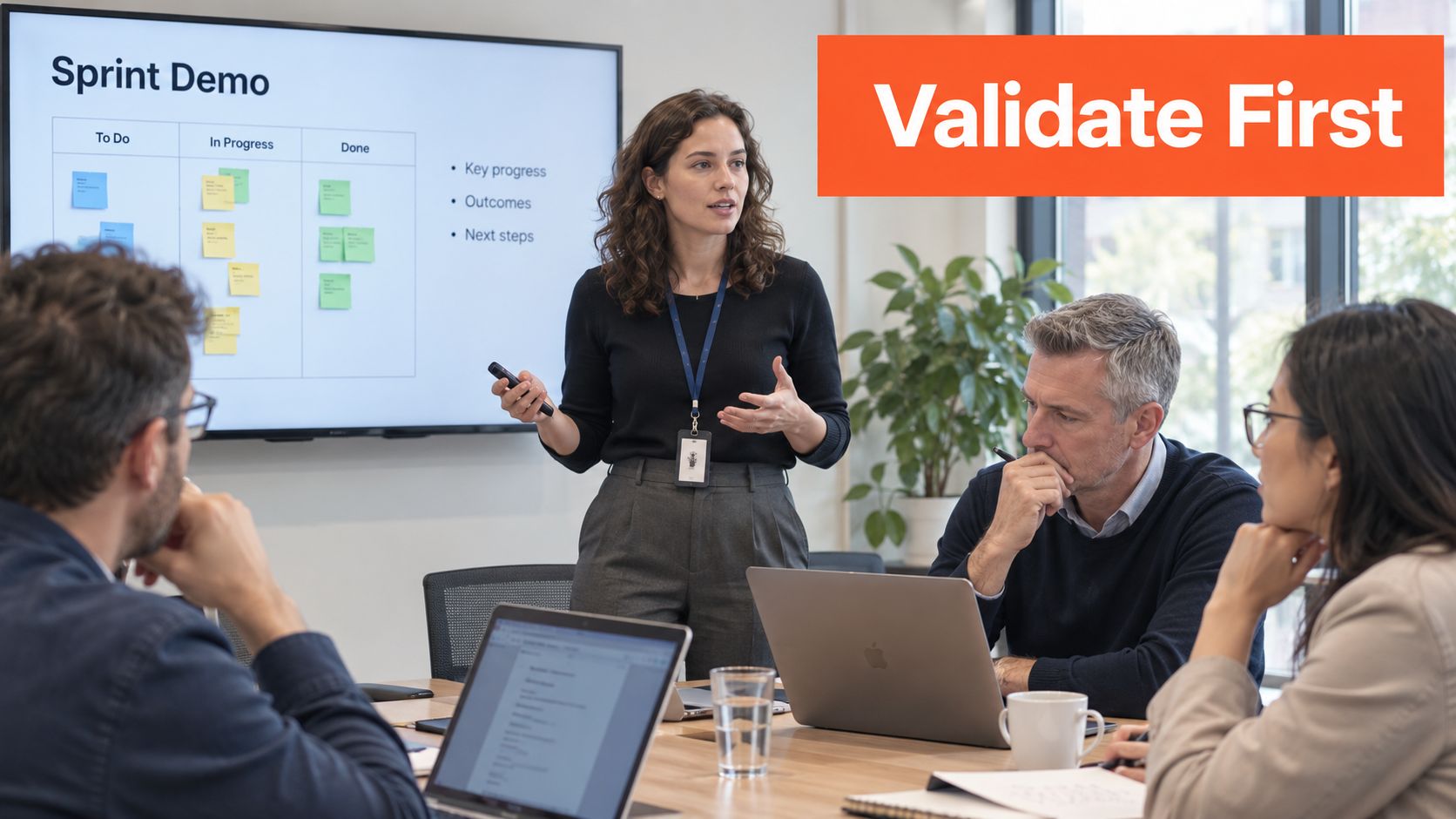
Agile product discovery exists to stop that pattern. Major agile references frame discovery as understanding customer needs and validating ideas before building, while Teresa Torres' view of discovery as continuous learning shifted the field away from one-time requirements gathering and toward ongoing hypothesis testing Atlassian discovery guidance. The point is simple. The team stops asking, “What did we write down?” and starts asking, “What have we learned, and what should we stop doing?”
A good discovery process has a measurable rhythm. Teams are advised to validate 2 to 3 hypotheses per sprint, get first meaningful evidence in 5 to 10 days, aim for a 50 to 70% experiment success rate, and let 30 to 60% of ideas get discarded when evidence says they should be Atlassian discovery guidance. Those numbers matter because they show discovery is a decision system, not a note-taking exercise.
Practical rule: if discovery never kills ideas, it is probably just documenting them.
A team that discovers well does not hand engineering a stack of opinions. It hands over a smaller, sharper set of opportunities that have already survived cheap tests. That matters even more for AI and data-heavy products, where a promising mockup can hide weak data access, unreliable model behavior, or governance gaps that surface only after the build begins. The safer path is to sort those risks before the team commits engineering capacity.
For teams trying to untangle silos while they modernize how they work, this agile transformation roadmap for breaking down silos gives a useful companion view of how discovery fits into wider organizational change.
templates from SpecStory, Inc. can also help teams turn a vague idea into a clearer discovery flow, especially when they are running workshops for the first time.
The Problem-Space and Solution-Space Split
A clinician starts by diagnosing the condition before choosing treatment. Product discovery should follow the same sequence. The problem space is where the team learns whether the problem is real, who experiences it, and why it matters. The solution space is where the team decides what to build, how to test it, and whether the proposed answer works.
Teams run into trouble when they begin with screens, flows, or feature ideas before they can describe the pain with any clarity. The result is a polished answer to a question no one has fully asked yet. I see this most often in teams that feel pressure to move quickly, then discover they have spent their time refining a concept before they understood the trigger, the user's job, or the context around the request.
What belongs in each space
The problem space uses customer interviews, field studies, Jobs to Be Done analysis, and market sizing to understand demand and context. The solution space uses opportunity solution trees, sketches, prototypes, and assumption tests to compare possible answers. The distinction matters because each kind of evidence answers a different question, and mixing them too early makes the team think it knows more than it does.
A simple way to keep the two spaces separate is to give different people distinct responsibilities. The product manager frames the opportunity and the outcome. The UX researcher runs interviews and turns patterns into usable insights. The designer shapes promising directions into something the team can test. The engineer checks feasibility early, before the team grows attached to a fragile idea. A data specialist looks for the data the product needs, checks whether it is accessible, and tests whether it can support the intended behavior. That last role matters even more for AI and data-heavy products, because a good prototype can hide missing data, unreliable model behavior, or governance gaps that only appear after the build starts.
Here is the cleanest way to separate the two spaces.
| Problem-space question | Typical evidence | Solution-space question | Typical evidence |
|---|---|---|---|
| What pain exists? | Interviews, observation | What direction should we try? | Sketches, prototypes |
| Who has it? | Segment research | Can users choose it? | Prototype testing |
| Why now? | Market context | Can we build it? | Engineering review |
| What job is being hired? | JTBD interviews | What assumption is weakest? | Assumption tests |
If your team cannot describe the user's problem in one plain sentence, it is too early to prescribe a solution.
The split also keeps discovery connected without folding it into delivery. Evidence from the problem space should narrow the opportunity. Evidence from the solution space should narrow the design. Only then do you have a meaningful slice for the backlog, rather than a pile of loosely connected ideas.
For teams designing enterprise interfaces, the same logic applies to UX work. A guide to UX and UI design best practices for enterprise applications helps when the solution space starts to become visually specific.
A Six-Week Continuous Discovery Cadence
A team that wants to avoid building in the dark needs a calendar, not just good intentions. One workable operating model uses a six-week cadence for continuous discovery, with each phase producing a different kind of output ICAgile product discovery process techniques and tools. The goal is to make discovery repeatable so engineering is not left waiting for it, and product keeps learning while delivery keeps moving.
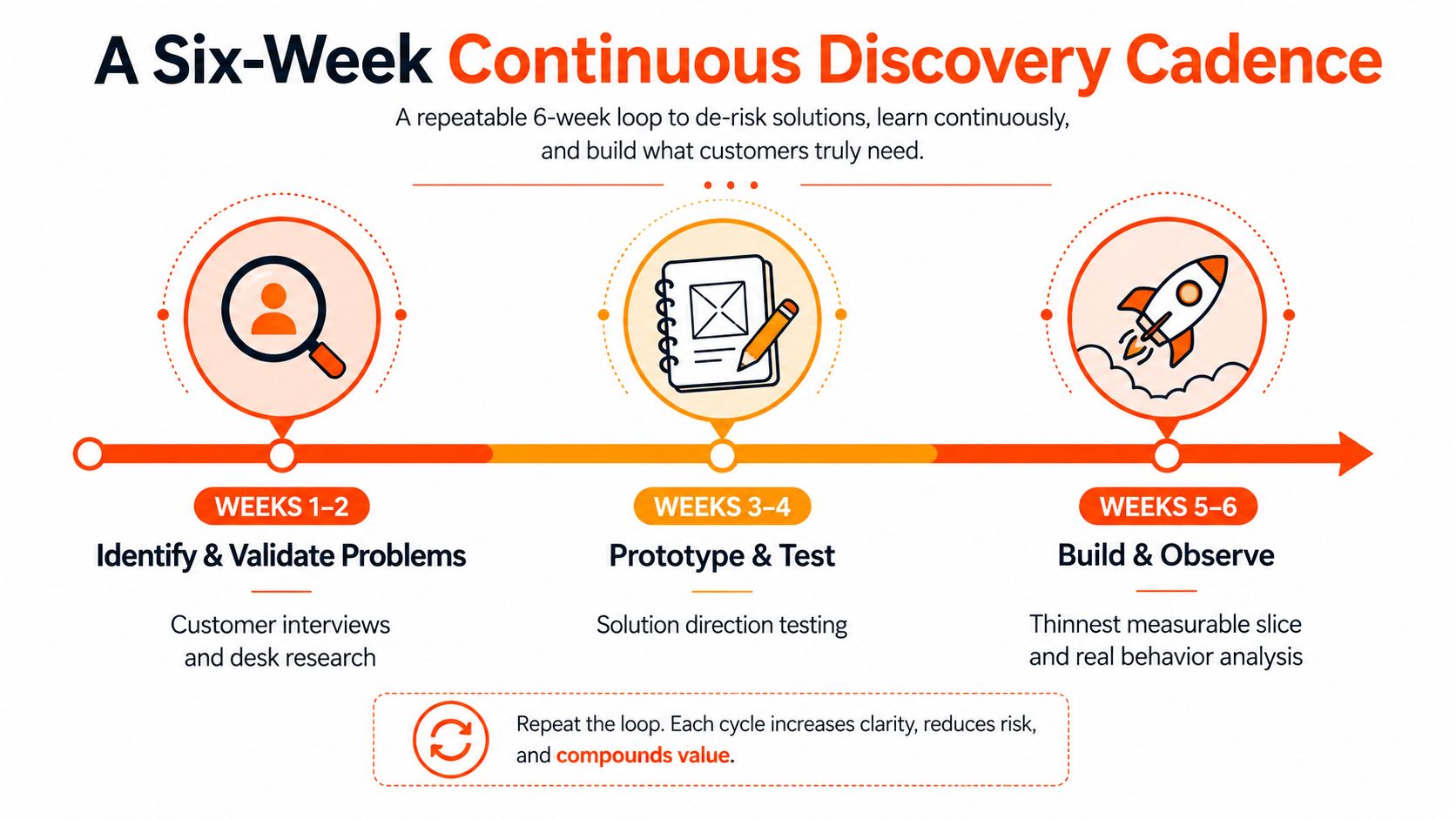
Weeks 1 to 2 validate the problem
Start with interviews, desk research, and synthesis. A product team should come out of this phase with a sharper problem statement, a named segment, and a short list of assumptions that still need evidence. The output is not a slide deck for its own sake. It is a decision-ready problem brief.
For an AI or data-heavy product, this phase also checks whether the needed signals even exist. A team can sketch a promising use case and still discover that the underlying data is sparse, inconsistent, or blocked by governance rules. That is why problem validation should include the operational reality behind the user pain, not just the pain itself.
Weeks 3 to 4 test solution directions
The team then moves into sketching, low-fidelity prototypes, and concept testing. The useful output is not “people liked it.” It is which direction held up, which one confused users, and which assumption failed first. That keeps product from overcommitting to an elegant idea that still rests on a weak premise.
The same discipline matters for AI-assisted experiences. A prototype can show a helpful flow, while hiding a model that is hard to explain, expensive to run, or too unreliable for the task. Teams need to test whether users trust the behavior and whether the system can support it before anyone treats the prototype like a commitment.
Weeks 5 to 6 build the thinnest measurable slice
Discovery should not stop at prototype approval. The team needs to build the smallest slice that produces real behavior and then observe what happened. That observation closes the loop and feeds the next cycle, which is why discovery and delivery should run in parallel, not as sequential gates that block one another.
A few rhythm markers keep the cadence useful:
- Weekly synthesis: the team distills what it learned from interviews, tests, and product data.
- Biweekly opportunity review: product and stakeholders decide which opportunities stay alive.
- Continuous assumption backlog: unanswered risks stay visible until evidence resolves them.
Working rule: if discovery does not produce an updated backlog item, it probably did not produce enough clarity.
This also separates “doing research” from “running a discovery process.” Research gathers information. Discovery turns information into a path forward. In practice, that means a team finishes the cycle with a choice it can act on, whether the next step is another experiment, a narrower slice, or a decision to stop.
For modernization teams, this rhythm is especially useful because it creates a repeatable milestone structure around uncertain scope. Leaders, engineers, and specialists can align more easily when the team can point to a six-week learning cycle instead of a vague promise to “look into it.” For teams that need a visual reference for how problem validation, prototyping, and observation fit together, devPulse's enterprise UX and UI best-practices guide is a useful companion once the solution space starts to become more concrete.
Running a Five-Day Discovery Sprint
A five-day discovery sprint gives a team a fast rehearsal for one opportunity. It's compact enough to fit into a normal delivery environment, but structured enough to force actual decisions. The widely used sequence is Day 1 Understand, Day 2 Sketch, Day 3 Decide, Day 4 Prototype, and Day 5 Test Product School discovery sprint.
Day by day in a B2B onboarding example
Say a B2B SaaS team wants to reduce friction in a new self-serve onboarding flow. On Day 1, the group aligns on the user, the pain, and the target outcome. On Day 2, the designer, PM, and engineer sketch different paths, one guided, one minimal, one highly automated.
On Day 3, the team chooses one direction and writes the assumptions it needs to test. That might include whether users understand the first screen, whether they trust a self-serve setup, or whether the flow hides too much complexity. On Day 4, they build the cheapest realistic prototype, not a full production flow.
Then comes Day 5. The team tests the prototype with five real users and watches what breaks. That session count comes from a practical research rule, which recommends 5 to 7 participants per segment and 30 to 45 minute interviews for qualitative signal IdeaPlan product discovery guide. The team leaves with a go, no-go, or revise decision, plus a short list of changes that are worth more than another round of guessing.
If you're wondering whether this replaces continuous discovery, it doesn't. A sprint is a focused tool for a single opportunity. Continuous discovery is the operating system that keeps opportunities flowing.
The difference shows up in the artifacts. A sprint produces a storyboard, a prototype, test notes, and a decision. Continuous discovery produces a living backlog of assumptions, opportunities, and evidence. Use the sprint when a team needs focus. Use the cadence when the product needs ongoing learning.
For teams modernizing an enterprise interface, it also helps to see how the sprint connects to delivery-ready design work. That's one reason some teams pair discovery with broader UI planning before they commit to build decisions.
Decision Gates That Earn Engineering Capacity
A team can spend weeks on discovery and still leave engineering with a vague idea, a polished slide deck, and no clear reason to build. The handoff works better when discovery ends with a decision gate that names what evidence has been collected, what still feels uncertain, and why the opportunity deserves capacity now.
Make the gate auditable
Each gate should answer a small set of questions in plain language. Is the problem real? Do users pick this direction when they see it? Can the team build it with the systems, data, and skills it has? Does it still fit the business model and the product strategy? Those are the same kinds of checks described in ICAgile product discovery process techniques and tools, but the value comes from attaching real evidence to each one.
A legal-tech team can make this concrete. If they are exploring AI search across sensitive contracts, “the problem is real” might rest on repeated search complaints from attorneys. “Users choose the solution” might come from testing whether attorneys trust ranked results or prefer filters. “Can we build it” reaches beyond interface feasibility, because the team also has to confirm document access, retrieval quality, and review workflows. “Does it fit the business” means the work supports the product direction rather than becoming a side experiment.
The goal is to make a go decision explainable. A gate should let a product leader show why the team is ready, or why it should wait, without turning the review into a contest of opinions. Without that clarity, roadmap meetings drift into confidence theater, where the loudest voice can matter more than the strongest evidence.
A few lightweight artifacts keep the gate honest:
- Assumption lists: what must be true for the opportunity to work.
- Evidence logs: what the team has learned and where it came from.
- Confidence scores: a simple way to show where uncertainty still lives.
- One-page opportunity brief: a short summary that can move into delivery without being rewritten from scratch.
A useful filter also prevents engineering from becoming a guessing machine. If a team sends only validated opportunities into planning, it avoids the common pattern where a promising idea reaches the backlog and then gets slowed down by missing evidence, unclear scope, or hidden technical risk. The discard rate matters less than the quality of the cut, because every idea removed early is one less false start for design and engineering.
Decision rule: if the evidence is thin, the right answer is usually “not yet,” not “let's build and see.”
That rule protects capacity. Engineering should receive opportunities that have cleared discovery, not broad hopes wrapped in urgency. Teams that need to connect discovery decisions to staffing and sequencing can tie the gate to engineering capacity planning practices for 2026, especially when leaders want to understand which bets deserve scarce development time.
The same caution applies to product validation that seems visually convincing but hides data risk. A team can use the short checklist from data analysis pitfalls with PlotStudio AI as a reminder that a credible demo is only one part of readiness.
What Breaks When the Product Is AI or Data-Driven
A clickable prototype can validate a flow, but it can't validate a model, a dataset, or a governance constraint. That's the big mistake teams make with AI features, RAG search, and automation-heavy products. They treat demo readiness as proof of product readiness, and those are not the same thing.

The hidden assumptions sit below the UI
Take a legal-tech team building enterprise search across sensitive documents. A prototype might show a clean search box and fast results. That doesn't answer whether the right data exists, whether permissions are enforced correctly, whether the model returns reliable results on real inputs, or whether the team can evaluate quality in a repeatable way.
Discovery needs an extra track. In AI and content-heavy systems, the team has to test data availability, model reliability, ongoing evaluation, privacy, and governance alongside user desirability and feasibility. That nuance is often missing from standard discovery advice, even though it determines whether the product can survive production AgileSM product discovery note.
If you want a concrete reminder of why this matters, data analysis pitfalls with PlotStudio AI is a useful cautionary reference. It illustrates how badly things can go when teams trust output without pressure-testing the underlying data and workflow.
What discovery has to check before build
- Data availability: does the needed data exist, and can the team access it?
- Data quality: is the information complete, structured, and trustworthy enough?
- Model reliability: does the system behave consistently on real user inputs?
- Governance: can the product satisfy privacy, policy, and regulatory constraints?
- Operational risk: can support teams understand and manage failures?
That list changes the shape of discovery. Instead of moving from interview to prototype to build, the team has to add data and governance checks before it commits engineering capacity. In regulated domains, that's not optional. It's the difference between discovering constraints early and discovering them after launch.
From Validated Opportunity to Backlog and Roadmap
Validated discovery should enter delivery as a thin slice, not as a giant feature. The handoff is simple when the team stays disciplined. Opportunities become a backlog item with explicit acceptance criteria, then move onto the roadmap as a time-boxed bet, not as an irreversible promise.
Here's the cleanest way to separate the two backlogs.
| Dimension | Discovery Backlog | Delivery Backlog |
|---|---|---|
| Contents | Opportunities, assumptions, open questions | Stories, tasks, implementation work |
| Purpose | Reduce uncertainty | Execute validated work |
| Ownership | Product, research, design, engineering input | Engineering-led delivery |
| Output | Evidence and decisions | Shippable increments |
The opening scenario would have looked different if discovery had been stronger. The team would have started with a clear problem statement, validated it through interviews or observation, tested a small solution direction, and only then committed build capacity. The feature released would probably have been smaller, sharper, and easier to judge, because it would've been backed by evidence instead of hope.
For planning meetings, keep this checklist close:
- Log the assumptions that still matter.
- Pick the experiment that can invalidate them fastest.
- Apply the right gate before asking for build capacity.
- Promote only validated opportunities into the roadmap.
- Keep the discovery backlog alive so the next decision isn't made blind.
devPulse helps teams turn early uncertainty into a clearer product definition, with discovery, architecture, and delivery support under one roof. If your team is trying to connect validation to build decisions, visit devPulse and look at how the consultancy approaches product discovery, AI integration, and modernization for enterprise systems.