












You're probably living this already. A release slips because a regression broke checkout, the QA team catches it late, engineering blames coverage, product wants faster delivery, and leadership asks why quality still feels like a separate phase instead of part of the build. That's the quality engineering vs quality assurance decision, not a vocabulary debate. It's a question of who owns quality, how much automation sits inside the delivery pipeline, and which metrics your leadership team will be judged on in 2026.
| Criterion | Quality Assurance | Quality Engineering |
|---|---|---|
| Core focus | Validate the build before release | Build quality into the delivery process |
| Ownership | Centralized testing specialists | Cross-functional, shared responsibility |
| Timing | Late-stage or phase-based | Throughout the SDLC |
| Automation depth | Manual or limited automation | Extensive automation in CI/CD |
| Tooling bias | Test management, defect tracking, manual execution | Test automation, pipelines, observability |
| Success signal | Fewer missed defects at release gates | Lower escape rate, faster feedback, steadier delivery |
Table of Contents
- The Real Decision Behind Quality Engineering vs Quality Assurance
- What Quality Engineering and Quality Assurance Actually Mean
- Side by Side on Ownership, Timing, Automation, and Tooling
- Which Metrics Prove the QE Shift Is Working
- Why QE Does Not Eliminate QA in Regulated Enterprises
- Choosing the Right Model for Your Enterprise Context
- A Practical 90-Day Path From QA to QE
The Real Decision Behind Quality Engineering vs Quality Assurance
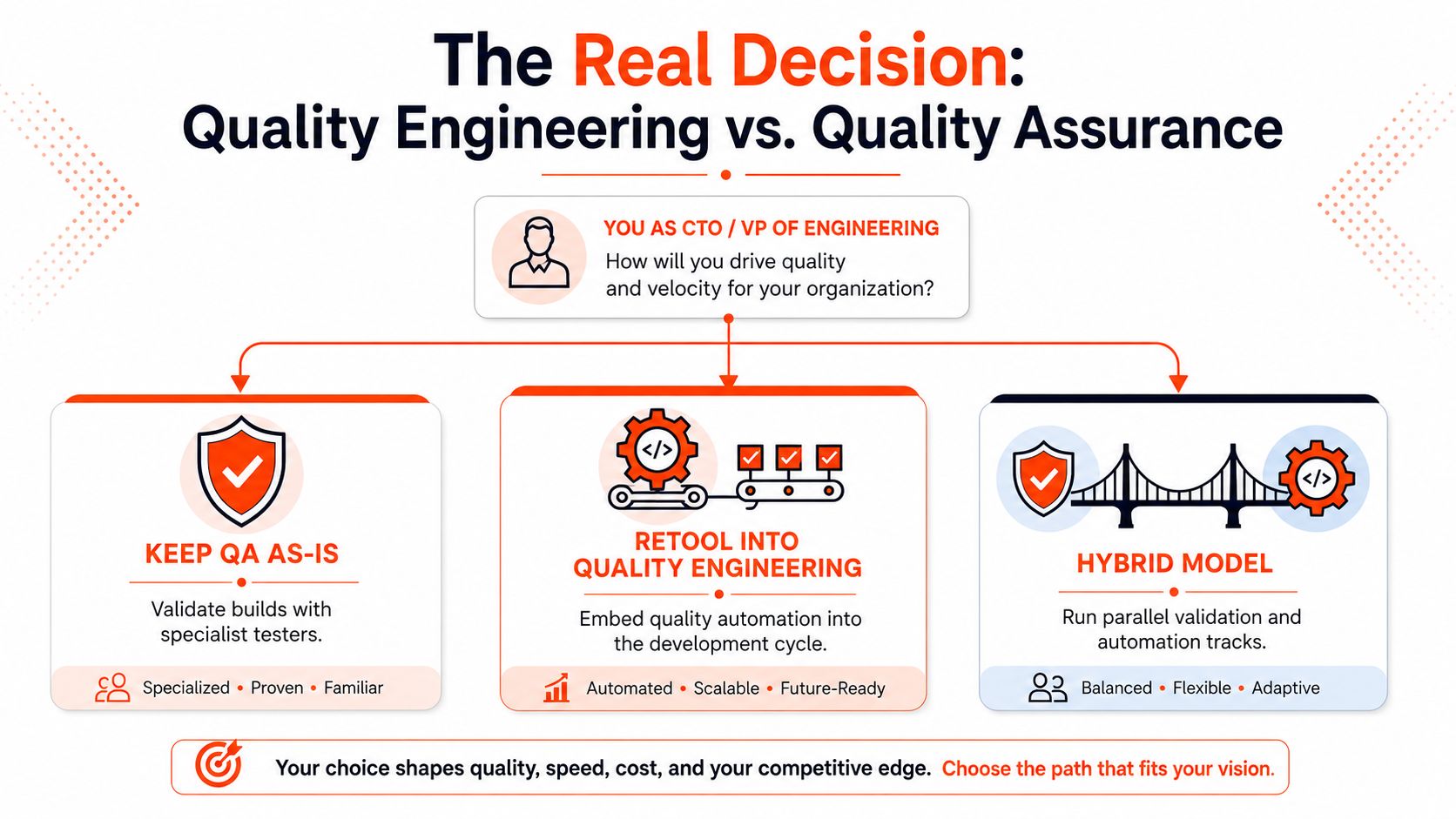
A CTO I worked with had a familiar problem. The business wanted faster releases, the platform team wanted fewer late-cycle surprises, and the QA group was already drowning in regression work for a regulated product that couldn't afford sloppy validation. The question wasn't whether quality mattered. It was whether the company should keep QA as a gate, retool it into quality engineering, or run both in a hybrid model while modernizing the stack.
That's the decision most enterprises face in 2026. The market is moving toward engineering-led quality practices, with a projected global quality engineering market rise from $54.68 billion in 2025 to nearly $100 billion by 2035 in one industry analysis, which reflects the shift from post-development validation toward continuous quality in delivery pipelines and observability (Ness). The economics behind the shift are blunt too, one industry source estimates inadequate software quality cost the U.S. economy $2.41 trillion, and low-quality systems contain 15x more defects than well-engineered alternatives, with defect fixes taking 124% longer than prevention-focused approaches (Gatling).
What changes first
The first change is ownership. In QA, a specialist team validates the build near the end. In QE, developers, testers, DevOps, and product people all carry part of the responsibility, because quality is embedded earlier and checked continuously. Industry guidance also frames QE as a fit for teams with high deployment frequency, while QA still works better where late-stage verification and release gating are acceptable (Testlio).
Practical rule: If your release train is slowing because quality happens too late, the issue isn't testing volume. It's where quality lives in the lifecycle.
What Quality Engineering and Quality Assurance Actually Mean
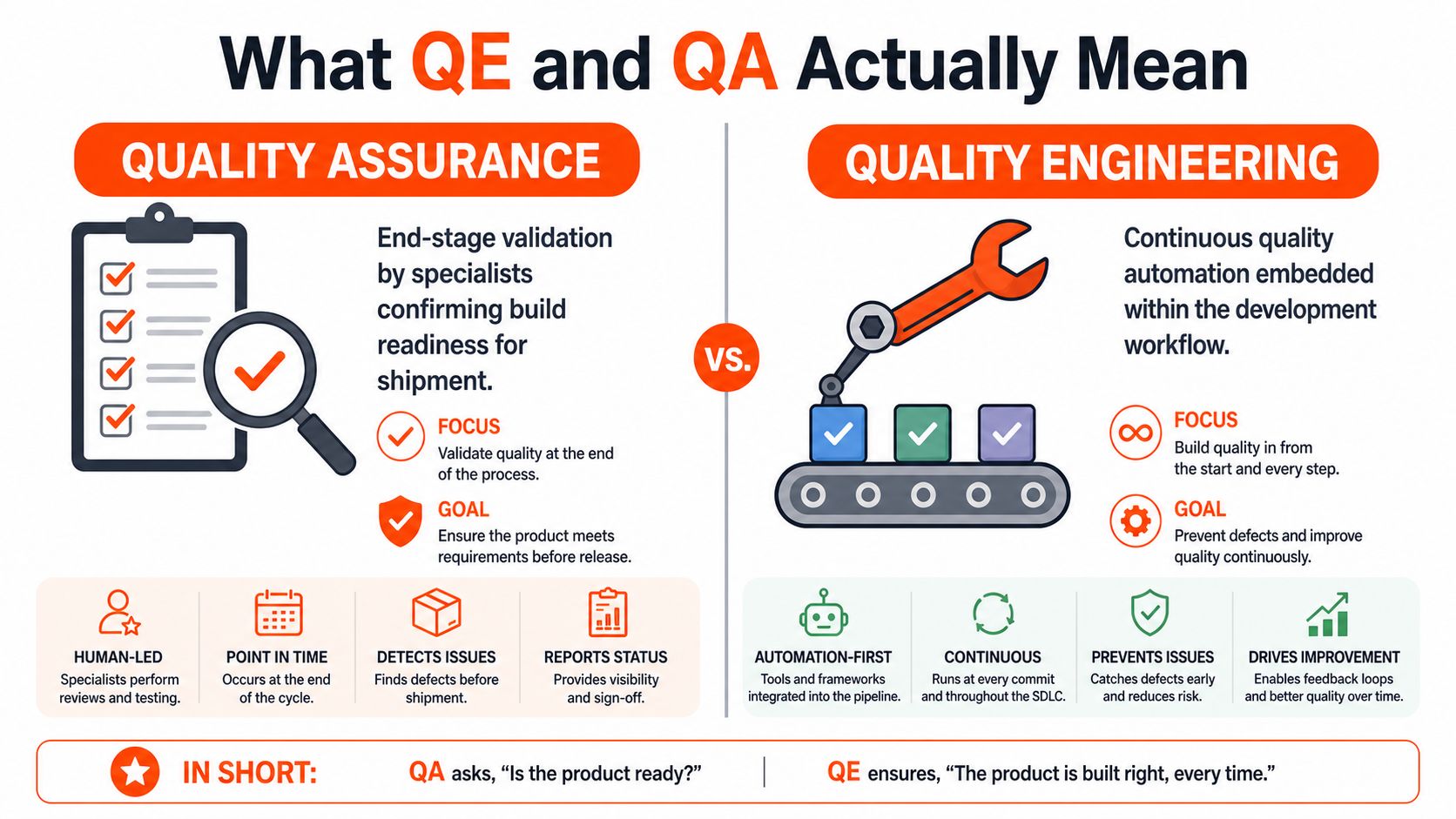
Quality assurance is the discipline of making sure a build meets standards before it ships. In practice, that usually means a specialist function defines tests, runs validations, confirms requirements, and provides evidence that the release is ready. It's strongest when the organization needs gates, traceability, and structured sign-off.
Quality engineering is different. It treats quality as something you design into the product from discovery through production, with automation, feedback, and shared ownership across the lifecycle. That lines up with guidance that describes QE as integrating quality into every SDLC phase and using CI/CD and observability as part of normal delivery, not as separate afterthoughts (Testlio).
A daily-work contrast you can spot fast
A QA-heavy team starts the morning by pulling a test run, updating cases, and working through a release candidate in a staging environment. The tester is often the last strong checkpoint before the build goes live. That structure is useful when compliance or release gates matter more than speed.
A QE-oriented team starts earlier. A developer adds automated checks with the feature, a tester helps shape test strategy during design, and the team watches telemetry after release. Indeed describes QE as a model where every developer tests the product during their part of the project, while QA is performed by specialists before delivery (Indeed).
How to tell which model you run today
If your testers are still the people most responsible for release readiness, you're running QA. If your developers are expected to write, maintain, and trust automated checks as part of delivery, you're already moving into QE. The difference isn't academic. It changes who gets paged, who writes the test, and who owns the defect when it shows up after release.
Side by Side on Ownership, Timing, Automation, and Tooling
The cleanest way to compare the two models is by operating mechanics, not philosophy. Quality assurance concentrates expertise in a specialist function. Quality engineering spreads responsibility across the team and pushes quality work into planning, development, delivery, and monitoring.
| Criterion | Quality Assurance | Quality Engineering |
|---|---|---|
| Ownership model | Central QA team owns most validation work | Quality is shared across developers, testers, and delivery teams |
| SDLC timing | Mostly after development or in dedicated test phases | Throughout the lifecycle, from design through production monitoring |
| Automation depth | Manual-first or partial automation | Automation is a core part of the workflow |
| Typical tooling | Test case management, defect tracking, manual execution | CI/CD pipelines, test automation frameworks, observability, and analytics |
| Success look | Release passes the gate with acceptable evidence | Defects are found earlier, feedback is faster, and release flow is steadier |
A QA model is still sensible when you need disciplined evidence and manual judgment. That's why regulated programs, especially those with formal sign-off, keep their test management artifacts and traceability strong. If your team is still trying to prove what failed, when, and why, the QA structure remains useful.
QE leans into different tools because its job is different. It uses automation frameworks, pipeline checks, and production telemetry to prevent rework before it becomes expensive. If you want a practical way to think about this in support operations, bug reporting for support teams is a useful adjacent read because it shows how structured reporting becomes part of the quality loop, not an isolated ticketing habit.
The single biggest difference is this, QA validates a build, QE validates the way the build is created, delivered, and observed.
A hybrid transition usually needs both kinds of tooling. For teams modernizing delivery maturity, a DevOps foundation matters because QE sits on top of pipeline discipline, environment consistency, and deployment automation. A useful reference point is the DevOps implementation guide for 2025, because the QE conversation falls apart if the delivery pipeline is still fragile.
One more thing. Don't evaluate tooling by how many screens it has. Evaluate it by whether it shortens feedback and reduces handoffs.
Which Metrics Prove the QE Shift Is Working
The wrong question is, “Did QE improve quality?” The right question is, “Which indicators moved first, and which ones moved later?” That matters because leadership doesn't fund a quality transformation on hope. It funds it when the first wave of metrics shows the operating model is changing.
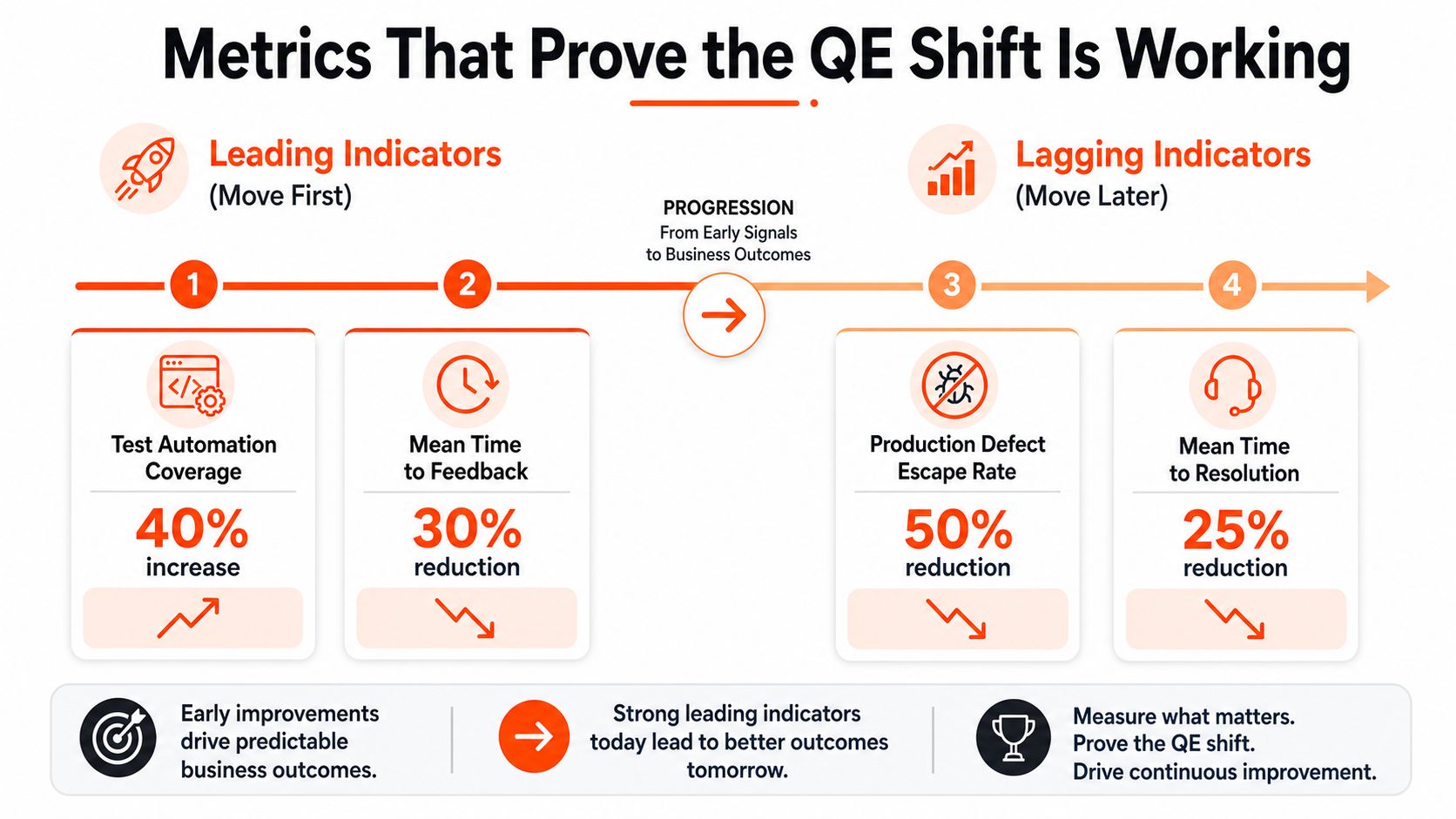
Leading indicators move first
Start with defect escape rate to production, change failure rate, test automation coverage across regression scope, and mean time to detect. Those are the numbers that should shift before customer-visible outcomes improve, especially in legacy modernization programs where the team is replacing late validation with earlier prevention and better feedback loops. Independent guidance frames QE as a lifecycle practice built on baseline metrics, incremental automation, and continuous measurement, not a wholesale replacement of QA (GetDX).
Lagging indicators take longer
Customer-reported defects, release-cadence stability, and total cost of quality move later. That's not a failure. It's how operating changes work. If your regression coverage expands and your pipeline feedback gets faster, the business still needs time to feel that improvement in fewer support escalations and steadier delivery.
Build the dashboard like a delivery leader
If you want a quality dashboard that engineers and executives can both use, build actionable dashboards around trend lines, not vanity counts. Show the direction of escape rate, automation coverage, and failure rate together so nobody can hide behind a single green metric.
If the first three months of a QE shift don't change your leading indicators, the program isn't embedded deeply enough.
I'd also tell leadership to stop asking for test volume as a proxy for progress. More tests don't prove better quality. Better signal quality does.
Why QE Does Not Eliminate QA in Regulated Enterprises
The “QE replaces QA” line sounds modern, but it's too neat for regulated businesses. In healthcare, MedTech, legal tech, and cybersecurity, you don't get to delete audit trails just because you've automated more of the pipeline. You still need validation, evidence, and release gating that a specialist function can defend under review.
That's why the better model is QA as a subset of QE, not QA as a casualty. TechTarget's guidance makes this distinction directly, describing QE as a broader operating model where quality moves earlier, while QA still remains necessary for validation and compliance evidence (TechTarget). In other words, QE changes where the work happens, not whether verification exists.
Where the work moves
QE pulls quality responsibility into architecture, development, DevOps, and observability. QA-style work like acceptance testing, traceability, and formal validation doesn't disappear, it becomes one part of a broader model. That's the right answer for organizations that need both speed and defensibility.
A practical transition plan often looks like this. Product and engineering own prevention, testers own risk-based validation, and DevOps owns the consistency of environments and release evidence. If you need a structured checklist to support that operating model, the quality assurance checklist practical 2026 guide is a useful anchor for the validation side of the house.
What not to promise
Don't tell regulated teams that automation removes the need for manual review. It doesn't. It reduces repetitive checking, improves traceability, and gives QA people a stronger position, but it doesn't replace judgment in high-risk releases. The question is how you redistribute responsibilities across product, engineering, and QA without breaking the evidence chain.
That's the enterprise-grade version of the shift. Not replacement. Recomposition.
Choosing the Right Model for Your Enterprise Context
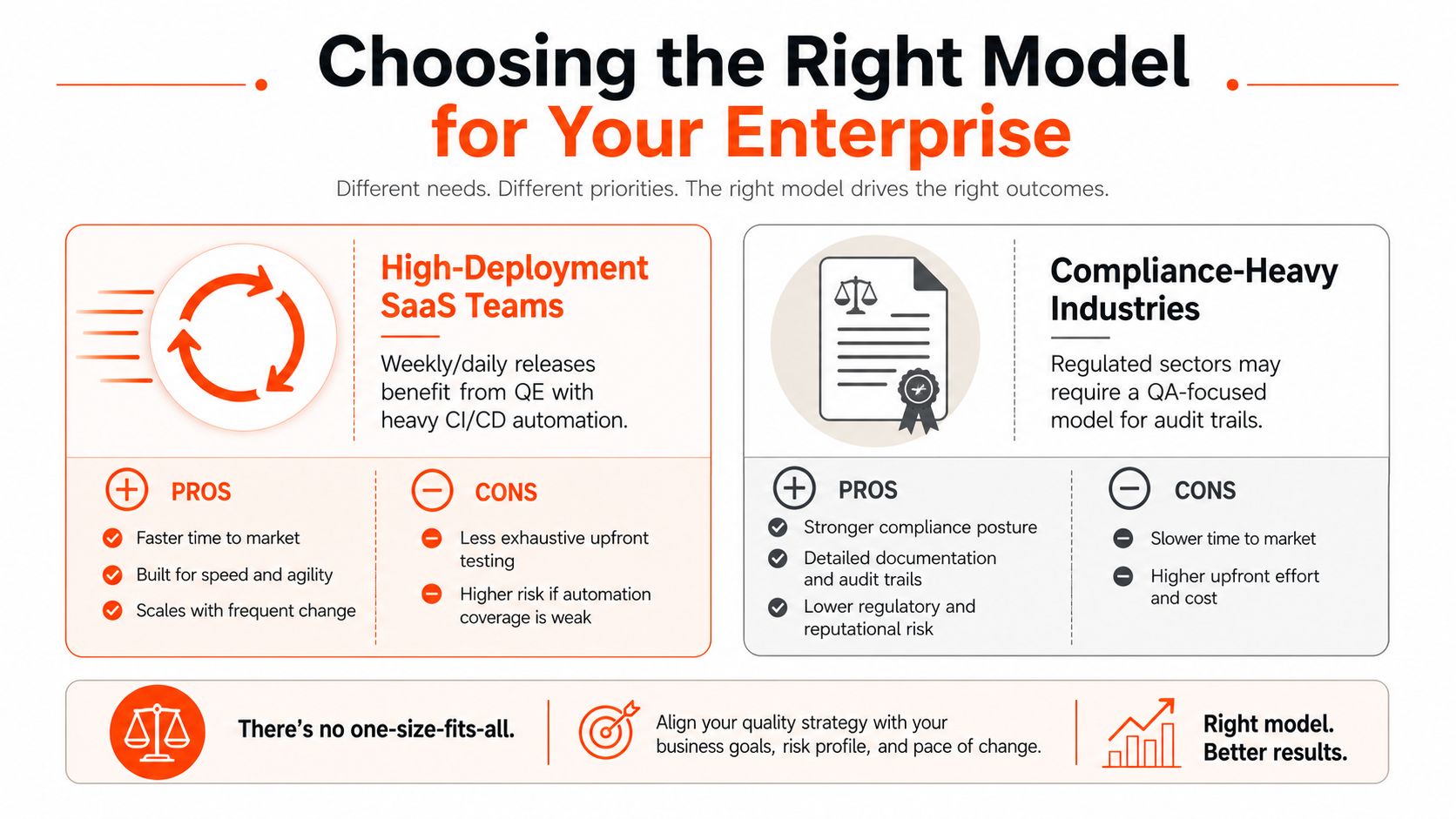
High-deployment SaaS teams should move toward quality engineering without hesitation. If your product ships weekly or daily, a QA-only gate becomes a bottleneck, and the team needs heavy CI/CD automation, fast feedback, and shared quality ownership. That doesn't mean specialists vanish. It means they work earlier and closer to the code.
Compliance-heavy organizations should use a hybrid model. QE should drive prevention, automation, and observability, while QA retains validation, auditability, and release gates. That's the practical fit for healthcare, legal tech, and cybersecurity, where the release can be fast only if the evidence remains strong.
Legacy modernization is the hardest case, and it needs a phased approach. Keep QA in place while QE practices are introduced around the highest-friction release stages, because a switchover usually creates more risk than it removes. If you want a services reference point for that model, devPulse offers quality engineering services that sit naturally inside modernization work, especially where teams need automation, observability, and controlled transition.
Use QE when speed is the problem. Use QA when defensible release gates are the problem. Use both when your business has to solve for delivery and regulation at the same time.
A Practical 90-Day Path From QA to QE
Start with a baseline. For the first three weeks, map where defects are escaping, where release friction sits, and which test phases consume the most time. The exit criterion is simple, the team can name the top two bottlenecks and has baseline measurements for them.
Weeks four through seven should focus on incremental automation. Add automated checks to the highest-value regression paths, move the most repetitive checks into the pipeline, and shift defect ownership closer to the development team. The exit criterion is that at least one release path now depends on automated validation instead of manual rechecking alone.
Weeks eight through ten should wire in observability and production feedback. That means telemetry, alerting, and structured defect capture flow back into the team's quality loop. The exit criterion is that production signals are visible to the same group that writes and reviews the code.
Weeks eleven through twelve are for re-baselining and formalizing the hybrid ownership model. Recheck the same metrics you measured at the start, then document who owns prevention, who owns validation, and who owns release evidence. The exit criterion is that the operating model is written down and reflected in planning, not just spoken about in meetings.
A simple checklist you can drop into a planning doc:
- Baseline the pain: record escape rate, failure points, and slowest handoffs.
- Automate the repeatable work: move stable regression checks into CI/CD.
- Shift ownership intentionally: developers, testers, and DevOps each own part of quality.
- Connect production signals: make monitoring part of quality, not a separate support habit.
- Re-measure: compare the same indicators after 90 days and decide what stays hybrid.
If you're reworking QA into a real quality engineering model, devPulse helps teams modernize the delivery system around it, not just the test script library. Visit devPulse if you need help turning release friction, automation gaps, and compliance pressure into a quality operating model your engineers can run.