













A service level agreement (SLA) is the contractual backbone of any outsourcing relationship. It defines exactly what service quality you can expect, how performance gets measured, and what happens when a vendor falls short. Without one, you are operating on assumptions, and assumptions are where outsourcing relationships break down.
The role of SLA in outsourcing goes well beyond paperwork. A well-constructed SLA functions as a risk management tool, a performance incentive, a communication framework, and a dispute resolution mechanism, all in one document. Here is what a strong SLA delivers:
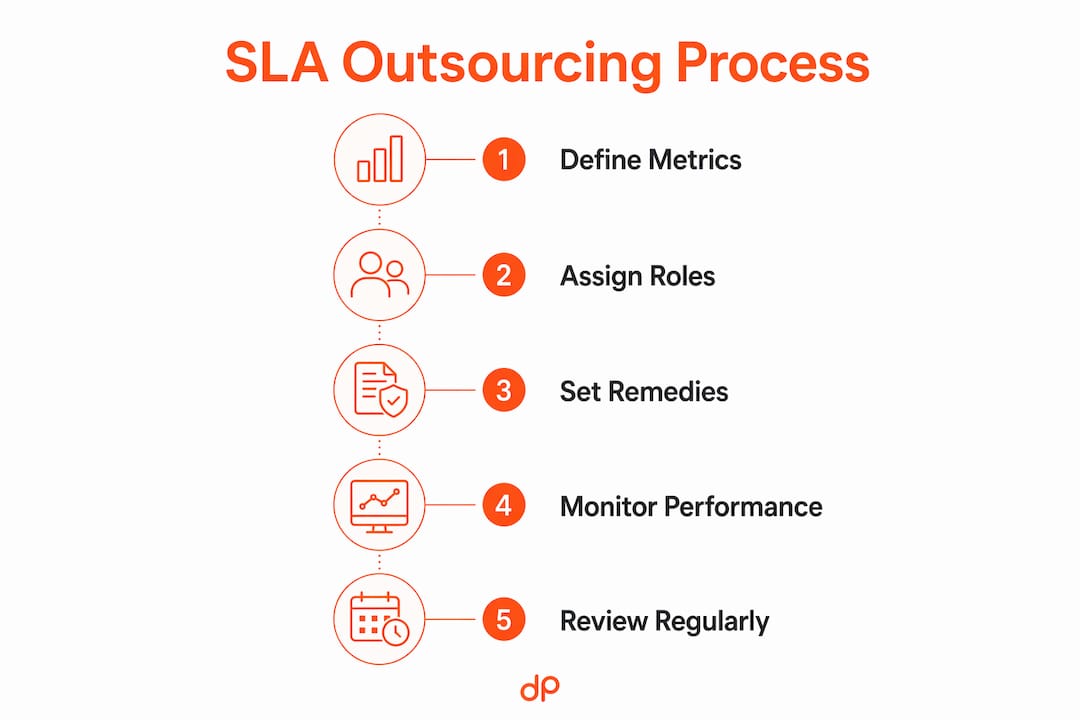
- Measurable accountability: Specific metrics replace vague expectations, so both parties know exactly what “good service” means.
- Risk mitigation: Defined performance standards and consequences reduce the financial and operational exposure that comes with outsourcing critical functions.
- Aligned incentives: Credits, bonuses, and escalating penalties give vendors a direct financial reason to perform at or above the agreed level.
- Dispute resolution: Predefined remediation processes mean service failures get resolved through process, not argument.
- Continuous improvement: Periodic review clauses keep the agreement current as your business and technology needs evolve.
The sections below break down every dimension of SLA management, from drafting fundamentals to the strategic use of incentive structures, so you can build agreements that actually protect your interests.
What is a service level agreement in outsourcing?
An SLA is a formal, contractually binding document that defines the level of service a vendor must deliver, the metrics used to measure it, and the consequences for falling short. Think of it as the operating manual for your outsourcing relationship, one that both parties sign off on before work begins.
A well-drafted SLA covers more ground than most managers initially expect. According to CIO’s SLA best practices guide, a complete SLA pulls together all contracted services, their agreed reliability standards, and the duties of each party into a single document. Neither side can claim ignorance when an issue arises.
The SLA sits inside the broader outsourcing contract but serves a distinct purpose. Where the main contract governs commercial terms and legal obligations, the SLA governs day-to-day service delivery. It answers the operational questions: How fast must the vendor respond to a critical incident? What uptime percentage is acceptable? Who is responsible when a data pipeline fails at 2:00 AM?
Key contents of a standard SLA include:
- Service scope: A precise description of what is and is not covered.
- Performance metrics: Quantifiable targets such as uptime percentages, response times, and error rates.
- Roles and responsibilities: Clear assignment of duties for both the client and the provider.
- Remedies and penalties: Financial consequences, including service credits, for unmet standards.
- Reporting protocols: Frequency, format, and ownership of performance reporting.
- Review and update mechanisms: Provisions for revising the agreement as conditions change.
Any significant outsourcing contract without a reviewed SLA is open to misinterpretation, whether deliberate or accidental. The SLA protects both parties.
Key components that make an SLA work
The strength of an SLA comes down to its specifics. Vague language creates room for disagreement; precise, measurable language closes that room. The FDIC’s guidance on managing technology provider risk recommends that every metric be objective and clearly linked to your business needs and risk management requirements.

Performance metrics and measurement criteria
Metrics are the core of any SLA. They translate business requirements into numbers a vendor can track and a client can verify. Good metrics are objective, tied to a specific tolerance level, and include a minimum acceptable threshold that defines the point of significant failure.
| Metric Category | Example Metric | Target Level | Minimum Acceptable Level |
|---|---|---|---|
| System availability | Uptime percentage | — | — |
| Incident response | Time to acknowledge critical issue | — | — |
| Data security | Unauthorized access incidents | — | — |
| Processing speed | Transaction processing time | Under 2 seconds | — |
| Reporting accuracy | Report delivery on schedule | — | — |
Roles and responsibilities
Clear accountability provisions ensure both parties understand their duties and the consequences of failures. Accountability goes beyond naming who owns a task. It also specifies what happens if that task is not completed to standard.
Remedies and service level credits
Service level credits reduce the vendor’s compensation when performance falls below agreed thresholds. As Mayer Brown’s analysis of SLA incentive structures explains, credits are calibrated to provide a financial incentive for good performance without functioning as liquidated damages. A typical structure puts a percentage of the monthly fee “at risk,” drawn down when the vendor misses targets.
Reporting and monitoring protocols
Reporting requirements should specify the format, frequency, and owner of performance data. Real-time dashboards are increasingly common in technology outsourcing, giving both parties continuous visibility rather than relying on monthly summaries that arrive too late to prevent problems.

Review and update mechanisms
Business needs change. Technology changes. An SLA without a built-in review process becomes outdated and loses its value. Including periodic review provisions ensures the agreement evolves alongside your operations.
Types of SLAs used in outsourcing relationships
Not every outsourcing arrangement calls for the same SLA structure. The three main SLA models reflect different organizational structures and relationship types.
- Customer-based SLAs cover all services delivered to a specific end user or client group under one agreement. This model works well when a single client receives multiple services from one vendor and wants consolidated performance standards.
- Service-based SLAs define standards for a particular service delivered to all customers. A cloud hosting provider, for example, might publish a single uptime SLA that applies to every client on the platform.
- Multi-level SLAs layer multiple agreements to address different organizational tiers. A corporate-level SLA might set company-wide standards, while a department-level SLA adds specifics relevant to a particular business unit, and a service-level layer covers individual service components. This structure suits large enterprises with complex outsourcing arrangements spanning multiple vendors and functions.
- Internal SLAs govern service delivery between departments within the same organization. When an internal IT team supports a business unit, an internal SLA sets the same kind of measurable expectations you would demand from an external vendor.
Choosing the right model depends on the complexity of your outsourcing structure, the number of vendors involved, and how tightly you need to differentiate service standards across business units.
How SLAs drive effective outsourcing partnerships
SLAs do more than document expectations. They actively shape the behavior of both parties throughout the life of the outsourcing relationship. Transparent SLAs reduce misunderstandings and build the kind of trust that makes long-term partnerships viable.
The mechanism is straightforward. When both parties agree on measurable outcomes before work begins, there is no ambiguity about what success looks like. Vendors know exactly what they are being held to. Clients know exactly what they are paying for. That shared clarity removes the friction that typically builds up in outsourcing relationships over time.
Accountability works the same way. Designating responsibility for each service component is only half the job. The SLA must also specify the consequences of failure, whether that is a service credit, a remediation timeline, or a right to terminate. Without defined consequences, accountability is theoretical.
Incentive structures add another dimension. Credits and penalties address underperformance, but the most effective SLAs also include upside incentives. Performance bonuses or opportunities to earn back previously deducted credits give vendors a reason to pursue excellence, not just avoid failure.
Pro Tip: Avoid building an SLA that requires constant monitoring of minor metrics. Excessive oversight burdens your internal team and signals distrust to the vendor. Focus measurement on the service attributes that directly affect your business outcomes, and let the vendor manage its own processes for delivering them.
The communication dimension is often underestimated. A well-structured SLA establishes regular feedback sessions, escalation paths, and reporting cadences that keep both parties aligned without requiring ad hoc conversations every time something goes wrong. That structure is what separates a productive outsourcing partnership from a reactive one.
Benefits of implementing effective SLAs in outsourcing
Organizations that invest in well-drafted SLAs see returns across multiple dimensions of their outsourcing operations. The benefits are both immediate and compounding over time.
- Reduced operational and financial risk: By specifying measurement units and service ranges, SLAs make poor service a designated responsibility of the provider, reducing the chance it goes unaddressed.
- Consistent service quality: Measurable targets give vendors a clear standard to maintain, which translates directly into more predictable service delivery for your end users.
- Fewer conflicts: When expectations are written down and agreed upon, disputes over what was promised become rare. The SLA is the reference point, not someone’s recollection of a sales conversation.
- Stronger vendor relationships: Counterintuitively, clear accountability provisions tend to improve vendor relationships rather than strain them. Vendors appreciate knowing exactly what is expected, and clients appreciate having a structured way to raise concerns.
- Support for continuous improvement: SLAs that include benchmarking and regular review cycles create a built-in mechanism for raising the bar over time, rather than locking both parties into the standards that made sense at contract signing.
- Legal protection: The contractual nature of an SLA protects both parties by outlining conditions, dispute processes, and responsibilities. That protection becomes particularly valuable when outsourcing mission-critical functions where a service failure carries serious business consequences.
For a deeper look at how SLAs reduce risk in technology outsourcing specifically, the patterns hold across industries, from healthcare to fintech to enterprise software.
SLAs as incentive alignment and risk management tools
The most sophisticated use of SLAs goes beyond tracking whether a vendor hit its numbers. Used skillfully, an SLA aligns the vendor’s incentives with your business imperatives, so the vendor’s financial interest and your operational interest point in the same direction.
Contract law gives you two primary performance tools: the right to terminate for material breach and the right to collect damages. Both address failure after it happens. An SLA adds a third tool: a continuous financial incentive for good performance, calibrated to the vendor’s profit margin. When a vendor knows that missing a target reduces its margin on the contract, it has a direct reason to invest in the processes that prevent that miss.
Incentive structures can be layered with considerable precision. A single SLA can define a minimum service level with a credit for each failure, a target service level with credits triggered by a pattern of failures, escalating credits for successive breaches, and an opportunity to earn back credits through strong annual performance. That layering creates incentives at multiple time horizons, not just month to month.
The risk management function is equally important. SLAs are risk management instruments that are critical for outsourcing mission-critical functions. By specifying protocols for data security, regulatory compliance, and business continuity, a well-drafted SLA protects you before problems materialize, not just after.
Pro Tip: Pair every penalty clause with a corresponding incentive. A vendor that can only lose under an SLA has little reason to go beyond the minimum. A vendor that can also gain has a reason to invest in your success.
Balancing measurement precision with flexibility matters here too. An SLA that tracks dozens of minor metrics creates administrative overhead for both parties and can obscure the metrics that actually matter. Focus your measurement on the service attributes with the highest business impact, and build in flexibility for the vendor to determine how it delivers them.
How SLAs manage risk and resolve disputes
Risk management and dispute resolution are two of the most practical functions an SLA performs, and they are closely related. An SLA that clearly defines what constitutes a service failure also defines the process for addressing it, which means disputes rarely need to escalate beyond the agreement itself.
Predefined remediation and escalation procedures address service failures before they become costly interruptions. A typical escalation path specifies response time requirements at each level, from the vendor’s account manager to executive leadership, with defined timeframes for resolution at each stage. When a critical system goes down, both parties already know exactly who calls whom and what the expected resolution window is.
The dispute resolution function works similarly. Because the SLA documents agreed performance standards, neither party can reasonably claim the other’s expectations were unclear. The SLA becomes the reference document for any disagreement, replacing subjective interpretations with objective measurements.
SLAs also address the legal threshold of “material breach,” a term that contract law leaves frustratingly undefined. An SLA can specify a termination service level, a point at which accumulated failures give the client the right to terminate for cause. That clarity protects the client and gives the vendor a concrete target to avoid.
For outsourcing arrangements involving sensitive data or regulatory obligations, the risk management provisions carry particular weight. Specifying data security protocols, compliance requirements, and business continuity plans in the SLA means those obligations are contractually enforceable, not just understood informally.
Best practices for drafting effective SLAs
Getting an SLA right at the start saves considerable time and cost over the life of the contract. The following practices reflect current industry standards for 2026 outsourcing agreements.
- Involve both parties in drafting. The client and vendor should negotiate metrics together before the price is set. At that stage, the vendor has an incentive to identify realistic, value-maximizing performance levels rather than accepting whatever the client proposes.
- Tie metrics directly to business outcomes. Every measurement should connect to a specific business need or risk management requirement. Metrics that do not affect your operations add overhead without adding protection.
- Set both target and minimum acceptable levels. A target defines what good performance looks like. A minimum acceptable level defines the point of significant failure. Both are necessary.
- Define consequences precisely. Vague penalty language invites disagreement. Specify the exact credit amount, the trigger condition, and the timeframe for applying it.
- Include an escalating credit structure. Credits that increase for successive breaches create a stronger incentive to fix problems quickly than flat-rate penalties do.
- Build in a review cadence. Quarterly or annual review provisions allow the SLA to evolve with your business without requiring a full contract renegotiation.
- Keep the measurement process simple. The FDIC’s guidance on technology provider management recommends keeping measurement as simple as possible, emphasizing timely identification of deviations rather than comprehensive tracking of every possible variable.
- Address reporting ownership explicitly. Specify who produces performance reports, in what format, and on what schedule. Ambiguity here is a common source of friction.
For guidance on structuring SLAs for performance and risk management in technology outsourcing, the principles above apply whether you are outsourcing software development, cloud infrastructure, or business process functions.
Common challenges in SLA implementation
Even well-drafted SLAs run into execution problems. Knowing where implementations typically break down helps you design agreements that hold up in practice.
Metrics that are hard to measure. An SLA is only as good as the data behind it. If a metric requires manual data collection or depends on systems the vendor controls exclusively, verification becomes a recurring argument. Prioritize metrics that can be measured automatically and independently.
Overly complex agreements. The instinct to cover every possible scenario leads to SLAs that nobody reads and nobody can enforce consistently. A focused agreement covering the ten metrics that matter most is more effective than a comprehensive document covering fifty.
Misaligned incentives at the outset. If the vendor’s profit margin is not meaningfully connected to the SLA metrics, the financial incentive to perform is weak. Credits set too low relative to the vendor’s margin become a cost of doing business rather than a genuine deterrent.
Failure to update. An SLA written at contract signing reflects the business context of that moment. As your technology stack, user base, or regulatory environment changes, an unchanged SLA can actually work against you by holding the vendor to standards that no longer match your needs.
Excessive oversight. Tracking too many metrics, requiring too-frequent reporting, or involving too many internal stakeholders in SLA monitoring creates administrative burden on both sides. The FDIC’s guidance specifically flags excessive micromanagement as a pitfall that burdens internal teams and damages vendor relationships.
Unclear escalation paths. When a service failure occurs and the SLA does not specify who handles it and by when, resolution depends on whoever happens to be available. That is not a process; it is luck.
How to keep SLAs current through regular review
An SLA is not a static document. The FDIC recommends including periodic review and change provisions in every SLA so that service level goals and performance measurements can meet changing business and technology needs.
A practical review process follows four phases: measure service activity results against defined service levels, examine those results to identify problems and root causes, take corrective action on failed activities, and provide the vendor with structured feedback based on objective performance data. Running this cycle consistently turns SLA management from a compliance exercise into a continuous improvement program.
Review frequency should match the pace of change in your business. Technology outsourcing arrangements in fast-moving sectors like SaaS or fintech often warrant quarterly reviews. More stable operational outsourcing relationships may need only annual formal reviews, supplemented by ongoing performance monitoring.
When a review reveals that a metric no longer reflects your actual business priorities, update it. When a vendor consistently exceeds a target, consider raising the target or redirecting the measurement focus to a higher-value area. The goal is an SLA that remains a live, relevant management tool throughout the contract term, not a document that gets filed after signing and retrieved only when something goes wrong.
Effective vendor management strategies treat SLA reviews as relationship-building opportunities, not just compliance checkpoints. Bringing the vendor into the review conversation, sharing the business context behind metric changes, and acknowledging strong performance all contribute to a partnership that delivers value beyond the minimum contractual standard.
Key Takeaways
SLAs are the primary contractual mechanism for managing performance, accountability, and risk in outsourcing relationships, and their effectiveness depends entirely on how precisely they are drafted and how consistently they are managed.
| Point | Details |
|---|---|
| SLAs define measurable accountability | Specific metrics replace vague expectations, giving both parties an objective reference for performance. |
| Incentive structures drive performance | Credits, bonuses, and escalating penalties align vendor financial interests with your business outcomes. |
| Dispute resolution is built in | Predefined remediation and escalation procedures address service failures through process, not argument. |
| Excessive oversight backfires | Tracking too many minor metrics burdens internal teams and damages vendor relationships. |
| Regular reviews sustain relevance | Periodic review provisions keep the SLA aligned with changing business and technology needs. |
How Devpulse approaches outsourcing partnerships
At Devpulse, we build and modernize software for clients who cannot afford ambiguity in their vendor relationships. Every engagement we take on is governed by clear performance standards, defined responsibilities, and structured communication protocols, because that is the only way to deliver technology that actually performs under real business conditions.
Whether you are modernizing a legacy system, building a custom platform, or integrating AI-powered capabilities into your operations, the quality of your outsourcing agreements shapes the quality of your outcomes. Our software engineering services are designed for clients who want a partner that holds itself to measurable standards, not just good intentions.
If you are evaluating how to structure your next outsourcing engagement or want to see how we have delivered on our commitments for clients in healthcare, legal tech, and enterprise software, our case studies show the work in detail. Reach out to discuss how we can structure an engagement that protects your interests and delivers results you can measure.