














TL;DR:
- Effective outsourcing transition management involves structured phases, thorough knowledge transfer, and clear rollback plans. Proper communication and decisive leadership reduce risks, while validating performance over 30 days ensures a stable, operational handover. Proactive planning and documentation are crucial to prevent delays, failures, or service degradation.
Transition management in outsourcing is the structured process of transferring business operations to a third-party provider while maintaining continuity, quality, and performance. The industry term for this discipline is outsourcing transition management, and it covers everything from pre-transition planning and phased knowledge transfer to rollback planning and steady-state validation. 47% of outsourcing transitions exceed their planned timelines by more than 30%. That figure alone tells you how much execution risk sits inside a process most organizations treat as routine. Business leaders and project managers who treat the transition as a structured program, not a handover event, consistently achieve better outcomes.
What are the key phases of an outsourcing transition plan?
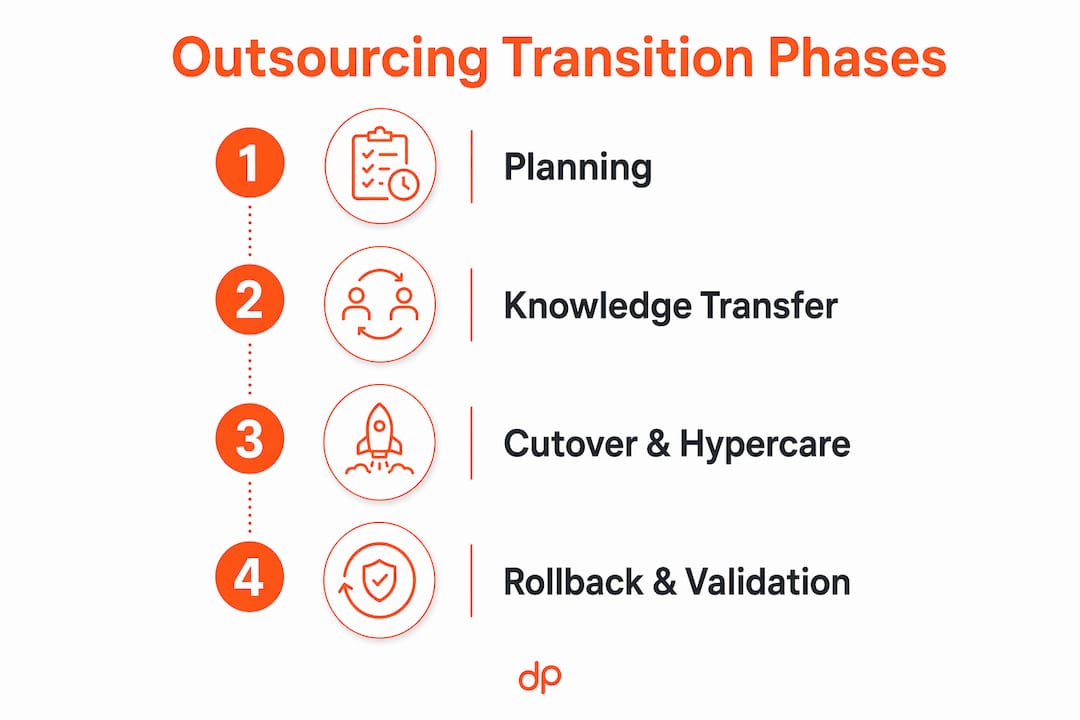
A standard IT outsourcing transition runs 90–120 days, divided into four core phases of roughly 30 days each. Each phase has a distinct purpose, and skipping or compressing any one of them is the most common cause of delays and quality failures.
The four phases follow a clear sequence:
-
Pre-transition planning. The client and vendor align on scope, governance, tooling, and access. This phase produces the transition plan, risk register, and communication framework. Pre-transition planning of at least 30 days is linked to completing transitions 25% faster overall. That time investment pays back quickly.
-
Parallel operations and knowledge transfer. Both teams run operations simultaneously. The vendor shadows the client team, documents processes, and begins handling low-risk tasks. This is where the knowledge transfer program formally begins.
-
Primary operations with hypercare. The vendor takes primary responsibility. A 30-day hypercare period follows cutover, providing intensive monitoring and rapid escalation paths to protect business stability. Hypercare is not optional. It is the safety net that catches issues before they become incidents.
-
Optimization and stabilization. The vendor operates independently. Performance is measured against agreed SLAs, and the team addresses any remaining process gaps.
| Phase | Duration | Primary activity | Key output |
|---|---|---|---|
| Pre-transition planning | 30 days | Scope, governance, risk register | Signed transition plan |
| Parallel operations | 30 days | Shadowing, documentation | Completed knowledge base |
| Primary ops with hypercare | 30 days | Vendor leads, intensive monitoring | Incident log, SLA baseline |
| Optimization and stabilization | 30 days | Independent operation, gap closure | Steady-state sign-off |
Pro Tip: Lock the transition plan and risk register before the vendor starts. Any scope change after day one adds disproportionate delay because both teams are already in motion.
How to manage knowledge transfer and mitigate risks during outsourcing transitions

Knowledge transfer is the most technically demanding part of any outsourcing transition. A three-phase approach, shadowing followed by assisted operation followed by independent operation, reduces critical knowledge gaps by 60% compared to a single “big bang” handover. That gap reduction directly lowers the probability of service degradation after cutover.
The risks that derail knowledge transfer fall into three categories:
- Key person dependency. A single subject matter expert holds undocumented knowledge. If that person leaves or is unavailable during transition, the vendor inherits an incomplete picture.
- Access and credential delays. System access provisioning routinely takes longer than planned. Delays in granting VPN, cloud console, or database credentials stall the entire shadowing phase.
- Incomplete documentation. Runbooks, escalation paths, and exception-handling procedures are often missing or out of date. The vendor cannot operate confidently without them.
Effective mitigation requires four concrete actions. First, build a documentation sprint into the pre-transition phase. Every process must have a written runbook before shadowing begins. Second, maintain a risk register updated weekly, with a named owner for each item. Third, assign backup subject matter experts for every critical function so no single person becomes a bottleneck. Fourth, run parallel operations long enough that the vendor handles real incidents, not just simulated ones.
Failing to define clear evidence-based acceptance criteria for knowledge transfer completion leads directly to disputes and quality degradation at cutover. Acceptance criteria must be measurable. “The vendor can resolve a P2 incident without client assistance within 4 hours” is a criterion. “The vendor understands the system” is not.
Pro Tip: Pair each vendor team member with a named client counterpart during the shadowing phase. Structured IT team onboarding with clear buddy assignments accelerates knowledge absorption faster than documentation alone.
What role does communication play in managing outsourcing transitions?
Communication is not a single announcement at the start of a transition. Ongoing communication with internal champions is the primary mechanism for reducing staff resistance and sustaining productivity throughout the transition window. Organizations that treat communication as a one-time event consistently see higher attrition and lower morale among the teams being transitioned.
Effective communication operates at three levels simultaneously:
- Executive level. Sponsors receive weekly status reports covering milestone progress, risk register updates, and budget variance. This audience needs decisions, not details.
- Managerial level. Team leads receive daily stand-up summaries and access to the shared risk register. They are the first line of escalation for operational issues.
- End-user level. Individual contributors receive clear, plain-language updates about what is changing, when it is changing, and what they need to do differently. Uncertainty at this level drives the most disruptive resistance.
Internal champions are employees who understand the transition rationale and actively support it within their teams. Appointing champions in each affected department, and giving them early access to information and a direct channel to the transition owner, reduces the spread of misinformation. Regular Q&A sessions, even brief ones, give staff a structured outlet for concerns before those concerns become rumors. The framework for switching BPO providers without losing productivity consistently identifies communication cadence as the single most controllable variable in transition success.
How should rollback planning and steady-state validation work?
Rollback planning is the documented process for reverting operations to the previous state if the transition fails. Only 22% of organizations have rollback plans despite 15% requiring a partial or full rollback during transitions. That gap represents a serious governance failure. A transition without a rollback plan is a bet that everything will go right.
Rollback triggers must be defined before cutover, not after problems appear. Three objective triggers apply to most IT outsourcing transitions:
- SLA adherence falls below 70% for any 48-hour window after cutover.
- A critical security incident is directly linked to the transition activity.
- Vendor team attrition exceeds 30% of the assigned transition staff.
When any trigger fires, the rollback decision must be made within 24 hours. Delay compounds the damage. The rollback plan itself must document the technical steps, the communication sequence, and the criteria for re-attempting the transition.
Steady-state validation follows a successful cutover and hypercare period. Steady-state validation should last a minimum of 30 days before the transition is formally declared complete. During those 30 days, three metrics determine readiness for sign-off.
| Validation criterion | Target threshold | Measurement method |
|---|---|---|
| SLA adherence | 95% or above | Automated monitoring dashboard |
| Incident volume trend | Declining week over week | Incident tracking system |
| Documentation completion | 100% of runbooks signed off | Document management audit |
Pro Tip: Do not declare transition complete based on elapsed time alone. Require all three validation criteria to be met simultaneously. Time-based sign-off without performance evidence is the most common cause of post-transition service degradation.
Addressing IT outsourcing risks proactively during the validation phase, rather than after formal sign-off, keeps the vendor accountable and protects your SLA baseline going forward.
Key Takeaways
Successful transition management in outsourcing requires a phased plan, evidence-based knowledge transfer, proactive rollback preparation, and continuous communication at every organizational level.
| Point | Details |
|---|---|
| Plan for 90–120 days | Divide the transition into four 30-day phases to maintain control and reduce delay risk. |
| Use phased knowledge transfer | A three-phase shadowing approach reduces critical knowledge gaps by 60% versus big-bang handovers. |
| Build rollback triggers before cutover | Define objective thresholds like SLA below 70% so rollback decisions are fast and unambiguous. |
| Validate steady state for 30 days | Require SLA adherence, declining incident volume, and full documentation before declaring success. |
| Communicate at all three levels | Executive, managerial, and end-user communication must run in parallel throughout the transition. |
What I’ve learned from watching transitions succeed and fail
The most consistent pattern I see in failed outsourcing transitions is not a technical failure. It is a governance failure in the first 30 days. Teams rush through pre-transition planning because the contract is signed and everyone wants to show momentum. That urgency is understandable and almost always counterproductive.
The organizations that complete transitions on time share one structural trait: a single named transition owner with clear decision rights and escalation authority. Not a steering committee. Not a shared responsibility between the client project manager and the vendor delivery lead. One person who can make a call at 10 PM when a parallel run goes wrong. When that role is absent or unclear, every decision gets escalated, every escalation takes time, and the timeline slips.
The second lesson is that transitions are an underused opportunity to fix processes, not just transfer them. When you document every runbook for knowledge transfer, you expose every workaround, every undocumented exception, every process that only works because one person knows a trick. That visibility is valuable. Organizations that treat documentation as a compliance exercise miss the chance to hand the vendor a cleaner, more defensible operating model than the one they inherited.
My honest recommendation: treat the value of IT outsourcing consultants as highest during the pre-transition phase, not after problems emerge. External expertise at the planning stage costs far less than remediation after a failed cutover.
— Vlad
How Devpulse supports your outsourcing transition
Outsourcing transitions expose gaps in your existing systems, documentation, and architecture. Devpulse works with enterprise clients and SaaS companies to address those gaps before they become liabilities.

Devpulse’s software engineering and modernization services are built for exactly this moment: when your team is handing off a system and needs it to be well-documented, well-structured, and ready for a new operator. From legacy system modernization and cloud migration to custom platform development, Devpulse delivers the technical foundation that makes transitions stick. If your outsourcing transition has surfaced technical debt or architectural risk, the Devpulse case studies show how similar challenges have been resolved across healthcare, legal tech, and enterprise software. Contact Devpulse to discuss your transition requirements.
FAQ
What is transition management in outsourcing?
Transition management in outsourcing is the structured process of transferring business operations to a third-party provider while maintaining service continuity. It covers planning, knowledge transfer, risk governance, and steady-state validation.
How long does an outsourcing transition typically take?
A standard IT outsourcing transition takes 90–120 days, divided into four phases of approximately 30 days each, including pre-transition planning, parallel operations, hypercare, and stabilization.
What is hypercare in an outsourcing transition?
Hypercare is a 30-day intensive monitoring period immediately after cutover, during which both client and vendor teams respond rapidly to incidents to protect business stability before the vendor operates fully independently.
Why do so many outsourcing transitions fail or run over schedule?
47% of outsourcing transitions exceed their planned timelines by more than 30%, most often because pre-transition planning is compressed, knowledge transfer criteria are undefined, or rollback plans are absent.
What triggers a rollback during an outsourcing transition?
Objective rollback triggers include SLA adherence falling below 70%, a critical security incident linked to the transition, or vendor team attrition exceeding 30% of assigned staff. These thresholds must be defined before cutover begins.