












TL;DR:
- Building cross-border teams requires deliberate legal, communication, and leadership system design before hiring.
- Using tools like EOR platforms, async communication protocols, and AI-driven sourcing accelerates global hiring and reduces operational risks.
Building cross-border teams means assembling and managing international workgroups that collaborate across geographic, legal, and cultural boundaries to deliver shared business outcomes. The formal industry term is distributed international teams, and the discipline covers everything from legal entity decisions to asynchronous communication design. Executives who treat this as a logistics problem rather than an organizational design challenge consistently underperform those who build deliberate systems from day one. Tools like Employer of Record (EOR) services from Deel and Globalization Partners, AI-driven recruitment platforms, and async-first workflows have made global hiring faster and more defensible than ever before.
What are the foundational components of building cross-border teams?
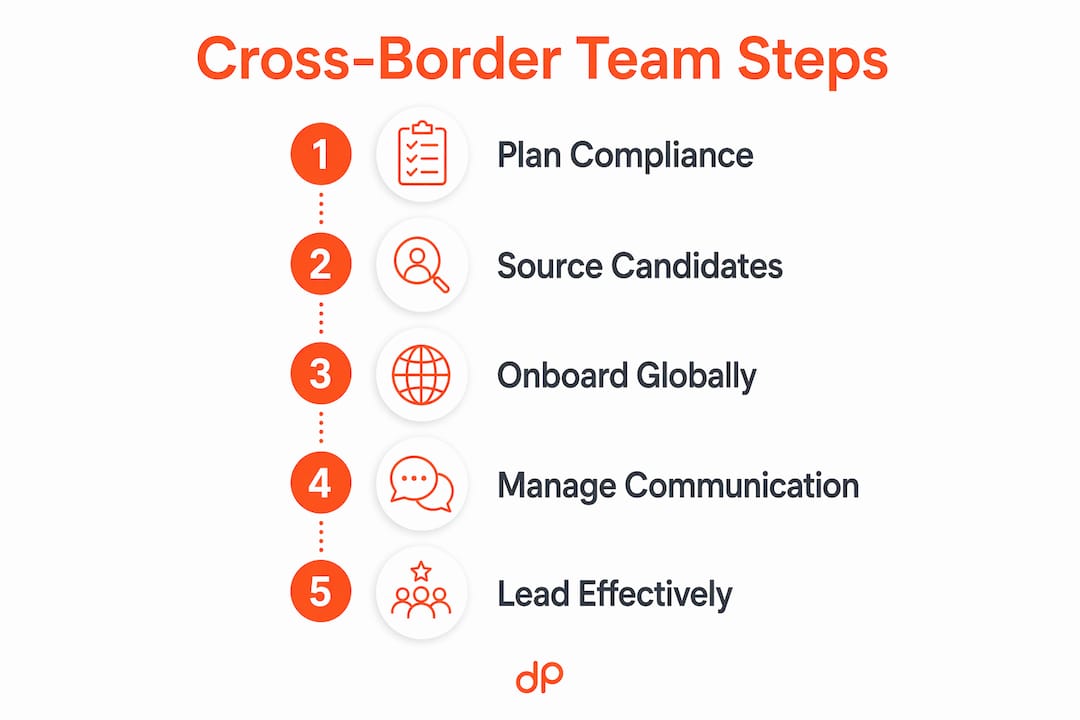
Legal compliance is the first structural decision, not an afterthought. Labor laws vary dramatically by country. Regulations covering right-to-disconnect policies, mandatory home office expense reimbursement, and statutory benefits differ by jurisdiction, and non-compliance creates substantial financial exposure. Getting this wrong in Germany, Brazil, or the Philippines carries penalties that dwarf the cost of proper setup.

The most practical solution for most organizations is an Employer of Record. EOR platforms like Deel enable companies to hire international talent in 180+ countries without establishing local legal entities. That means your team in Warsaw or Nairobi is payrolled correctly, receives statutory benefits, and is classified properly from day one. The alternative, misclassifying employees as contractors, is one of the most common and costly mistakes in global hiring.
The contractor versus employee distinction matters more internationally than domestically. Many countries apply strict tests to determine employment status, and getting it wrong triggers back taxes, penalties, and reputational risk. Before you source a single candidate, map your compliance and payroll infrastructure. Proactive compliance mapping before sourcing prevents the delays and inefficiencies that plague ad-hoc international hiring.
Once your legal foundation is set, document your operating norms explicitly. Distributed teams need written rules covering:
- Core overlap hours: Define the minimum daily window when all team members are expected to be reachable.
- Communication standards: Specify which channels carry which types of messages (Slack for quick questions, email for formal decisions, Confluence for documentation).
- Response time expectations: Set clear SLAs for replies by channel and urgency level.
- Decision documentation: Require that all significant decisions are recorded in a shared system, not buried in chat threads.
Pro Tip: Map your compliance, payroll, and onboarding infrastructure before you post your first international job listing. Hiring without this in place creates legal exposure that takes months to unwind.
AI-driven recruitment platforms compress candidate screening from weeks to days. Automated global sourcing outperforms manual job postings in both speed and candidate quality. For lean teams competing internationally, this is not optional. It is the difference between filling a role in three weeks and three months.
How do you design communication systems for remote international teams?
Communication design is the highest-leverage investment in any distributed team. Most organizations default to replicating their office communication model across time zones. That approach fails. Async-first communication, where written documentation replaces real-time meetings as the primary information channel, is the standard for effective distributed teams.
Build your communication system around four layers:
- Async documentation: Use Notion or Confluence as your single source of truth. Every project decision, meeting outcome, and process change gets written down and linked. New team members should be able to reconstruct the last 90 days of work from documentation alone.
- Structured async updates: Replace daily standups with written status updates in Slack threads or a project management tool like Asana or Jira. This respects time zones and creates a searchable record.
- Video for context: Use Loom for walkthroughs, demos, and explanations that would otherwise require a live meeting. A five-minute Loom video replaces a 30-minute call for most technical handoffs.
- Scheduled sync for alignment: Reserve live meetings for decisions that genuinely require real-time discussion. Keep them short, record them, and post the recording with a written summary.
Managing time zone spread requires deliberate scheduling. Set core overlap hours of two to three hours per day where all team members are expected to be available. For teams spanning more than eight hours of time zone difference, rotate meeting times monthly so no single region always carries the burden of early mornings or late evenings.
Cultural differences in communication style create friction that documentation alone cannot solve. Engineers from Japan and the Netherlands, for example, approach disagreement and feedback very differently. Designing communication as a product, with tested and standardized guidelines for each channel, reduces confusion and meeting overload. Run a short cross-cultural communication workshop during onboarding. It pays back in reduced misunderstandings within the first quarter.
Pro Tip: Treat your team’s communication guidelines as a living document. Review and update them every quarter as the team grows and spans new time zones or cultures.
What leadership practices drive productivity in distributed international teams?
Outcome-based management is the defining practice of effective remote leadership. GitLab’s distributed leadership model shifts focus from activity monitoring to clarity of purpose and workflow design. Leaders act as context facilitators, not supervisors. The question changes from “Is this person online?” to “Is this person clear on what they need to deliver and why it matters?”
Translate that philosophy into weekly rituals:
- Weekly progress reviews: Review OKRs or Kanban board status as a team. Keep it to 30 minutes. Focus on blockers, not status recitation.
- Individual check-ins: Hold 1:1 meetings weekly or biweekly. Split the agenda: half on work progress, half on motivation, workload, and well-being. Remote isolation is real, and monitoring individual sentiment is a core leadership responsibility, not a soft skill.
- Transparent goal-setting: Use OKRs or a shared goal framework visible to the entire team. When everyone sees the same targets, alignment happens without constant meetings.
- Ownership culture: Assign clear owners to every deliverable. Ambiguous ownership is the primary cause of dropped work in distributed teams.
Shared Kanban boards in Jira or Asana give every team member visibility into work status without requiring a meeting. That visibility builds trust in both directions. Leaders see progress without micromanaging. Team members see how their work connects to the broader goal. For engineering team productivity, this visibility layer is one of the highest-return investments you can make.
Burnout in distributed teams often goes undetected longer than in office environments. Build explicit check-in questions into your 1:1 template. Ask directly about workload, energy levels, and whether the team member feels connected to the team’s mission. Act on the answers.
How does culture affect cross-border team success?
Culture is the operating system of a distributed team. You cannot see it in a dashboard, but it determines whether your team functions or fragments under pressure. The most productive remote international teams build shared norms deliberately rather than letting culture emerge by accident.
Start with acknowledgment. Recognize local holidays across all team locations. Celebrate cultural events from each country your team spans. This signals that geographic diversity is an asset, not an inconvenience. It also prevents the common failure mode where one country’s calendar becomes the default and everyone else quietly resents it.
“Planned offsites in remote-first companies are critical organizational design elements, not optional perks.” The research on distributed team cohesion is clear: high-bandwidth in-person moments counteract the information loss that accumulates in distributed teams doing complex conceptual work.
Practical culture-building practices that work at scale:
- Buddy programs: Pair new hires with a team member from a different country for their first 90 days. This accelerates onboarding and builds cross-border relationships organically.
- Virtual social rituals: Schedule optional weekly or biweekly informal video calls with no work agenda. Coffee chats, trivia sessions, or show-and-tell formats work well.
- Structured offsites: Plan at least one annual in-person gathering for the full team. Budget for it as infrastructure, not a reward.
- Onboarding checklists: Give every new team member a documented onboarding checklist that includes cultural context, team norms, and introductions to key colleagues across regions.
Psychological safety, the belief that you can speak up without penalty, is harder to build across borders. It requires consistent behavior from leadership over months. Leaders who model transparency, admit mistakes publicly, and respond to feedback without defensiveness build it fastest.
What tools support managing global teams at scale?
The right technology stack reduces friction without replacing the human systems that actually drive performance. The table below covers the primary tool categories and leading platforms for each function.
| Function | Leading Platforms | Primary Value |
|---|---|---|
| Employer of Record / Payroll | Deel, Globalization Partners | Compliant hiring in 180+ countries without local entities |
| Project Management | Jira, Asana | Shared visibility into work status and ownership |
| Async Communication | Slack, Loom | Reduces meeting load while maintaining team alignment |
| Documentation | Notion, Confluence | Single source of truth for decisions and processes |
| AI Recruitment | Specialized AI sourcing tools | Compresses screening from weeks to days |
EOR platforms handle the compliance layer so your HR and legal teams are not reinventing local labor law in every new country. Continuous AI-driven sourcing keeps your talent pipeline active without relying on passive job postings. Project management and documentation tools create the operational backbone that lets distributed teams move fast without losing coordination.
Cloud-based, single-source-of-truth systems are non-negotiable for teams spanning multiple time zones. When documentation lives in one place and is accessible to everyone, handoffs between regions become reliable. When it is scattered across email threads, local drives, and chat history, every handoff is a risk. For a deeper look at how these systems apply to software engineering teams specifically, the engineering outsourcing guide for tech executives covers the operational setup in detail.
Key Takeaways
Building cross-border teams requires deliberate design of legal infrastructure, communication systems, and leadership practices before the first international hire is made.
| Point | Details |
|---|---|
| Compliance first | Map payroll, EOR, and labor law requirements before sourcing any international candidates. |
| Async by default | Build Notion, Confluence, Slack, and Loom into your core workflow to reduce meeting load across time zones. |
| Outcome-based leadership | Measure results and clarity of purpose, not hours online or activity metrics. |
| Culture is infrastructure | Budget for annual offsites and build buddy programs and onboarding checklists into your standard process. |
| AI accelerates hiring | Use AI-driven sourcing platforms to compress global candidate screening from weeks to days. |
What I’ve learned building teams across borders
The most common mistake I see executives make is treating international hiring as a faster version of domestic hiring. It is not. The legal, cultural, and operational complexity compounds with every new country you add. Leaders who succeed treat global team building as a discipline with its own infrastructure requirements, not a series of one-off decisions.
The second mistake is under-investing in async communication design. Most teams bolt Slack onto their existing meeting culture and call it distributed. Real async design means your team can function for 24 hours without a single live meeting and still make progress. That requires documentation discipline, clear ownership, and leaders who model writing things down instead of calling a meeting.
The third thing I would tell any executive starting this process: do not wait until you have a team of 20 across five countries to build your systems. Build the compliance infrastructure, the communication norms, and the culture rituals when you hire your third international team member. Retrofitting these systems onto a team that has already developed bad habits is far harder than building them correctly from the start. The advantages of remote IT teams are real, but they only materialize when the operational foundation is solid.
— Vlad
How Devpulse helps you scale cross-border engineering teams
Devpulse works with executives and engineering leaders who need to build and scale distributed software teams without the operational overhead of doing it from scratch.
Our engineering services cover custom software development, AI-powered tooling, and cloud-based systems built by teams that already operate across borders. We understand the compliance, communication, and coordination challenges because we navigate them ourselves. If you are evaluating how to scale your engineering capacity internationally, or need AI-driven tools that support distributed team workflows, Devpulse has the technical depth and operational experience to move fast without cutting corners. Review our case studies to see how we have delivered for SaaS companies, enterprise clients, and high-growth startups across multiple regions.
FAQ
What is an Employer of Record and why does it matter?
An Employer of Record is a third-party service that legally employs workers on your behalf in a foreign country, handling payroll, benefits, and compliance. Platforms like Deel and Globalization Partners allow companies to hire in 180+ countries without establishing local legal entities.
How do you manage time zone differences in distributed teams?
Set two to three hours of core overlap time per day when all team members are reachable, and use async tools like Slack, Loom, and Notion for the rest. Rotate meeting times monthly so no single region always takes the early morning or late evening slot.
What is the biggest legal risk in international hiring?
Misclassifying employees as independent contractors is the most common and costly legal error in cross-border hiring. Local labor laws in countries like Germany, Brazil, and the Philippines apply strict employment status tests, and violations trigger back taxes and penalties.
How does outcome-based management work for remote international teams?
Outcome-based management replaces activity monitoring with clarity of goals, documented workflows, and measurable results. GitLab’s distributed leadership model defines this as leaders acting as context facilitators who maintain individual check-ins to monitor motivation and well-being alongside work progress.
How often should distributed teams meet in person?
At least one annual in-person offsite is the minimum for teams doing complex conceptual work. Research on remote-first company culture shows that planned offsites are organizational design elements that improve cohesion and reduce siloed knowledge, not optional team perks.