













TL;DR:
- IT outsourcing encompasses a wide range of functions beyond cost reduction, including development, infrastructure, and security, with varying governance needs. Success relies on disciplined risk allocation, continuous oversight, and choosing the right model and location, not just vendor selection or geography. Effective governance, internal literacy, and clear contracts are essential to maximize outsourcing benefits and mitigate risks.
Most executives hear “IT outsourcing” and picture one thing: sending software development to a cheaper location to cut costs. That framing is both incomplete and costly. The true IT outsourcing meaning covers a wide spectrum of contractual arrangements, delivery models, and governance obligations that directly shape your organization’s risk profile, IP ownership, and competitive position. Before you sign a contract or brief your board, you need to understand what you are actually agreeing to.
Table of Contents
- Key Takeaways
- The Real IT Outsourcing Meaning in a Business Context
- IT outsourcing models compared
- Strategic governance and risk allocation
- Best practices for leaders managing IT outsourcing
- My perspective on what actually drives outsourcing success
- How DevPulse helps you outsource with confidence
- FAQ
Key Takeaways
| Point | Details |
|---|---|
| IT outsourcing is broader than cost-cutting | It covers development, infrastructure, security, and managed services, each with distinct governance requirements. |
| Model selection determines control | Staff augmentation, managed services, and consulting involve different oversight obligations and liability structures. |
| Governance must be continuous | Routine SLA reviews and security audits are required throughout the engagement, not just during onboarding. |
| Risk allocation drives contract performance | Placing risk with the party best able to manage it is the single strongest predictor of outsourcing success. |
| Location and management are separate decisions | Offshore, nearshore, or onshore choices do not determine outcome quality. Governance discipline does. |
The Real IT Outsourcing Meaning in a Business Context
At its core, IT outsourcing means contracting an external provider to deliver technology services, such as support, development, infrastructure, or security, that could otherwise be handled internally. The key shift is that an IT function moves from internal management to third-party delivery. That sounds simple. The complexity lies in how many different arrangements fall under that definition.
Consider the range of functions organizations routinely outsource:
- Application development and maintenance — custom software builds, legacy modernization, or ongoing feature releases managed by an external team
- Infrastructure and cloud management — server provisioning, cloud migration, monitoring, and operations
- Cybersecurity services — threat detection, vulnerability assessments, and incident response
- Help desk and end-user support — tiered technical support delivered under a service contract
- Data and analytics — data engineering, pipeline management, and reporting services
The arrangement can be project-based with a defined scope and end date, or it can be an ongoing managed service with rolling delivery against defined service levels. Both qualify as IT outsourcing, but they demand very different management approaches from your side.
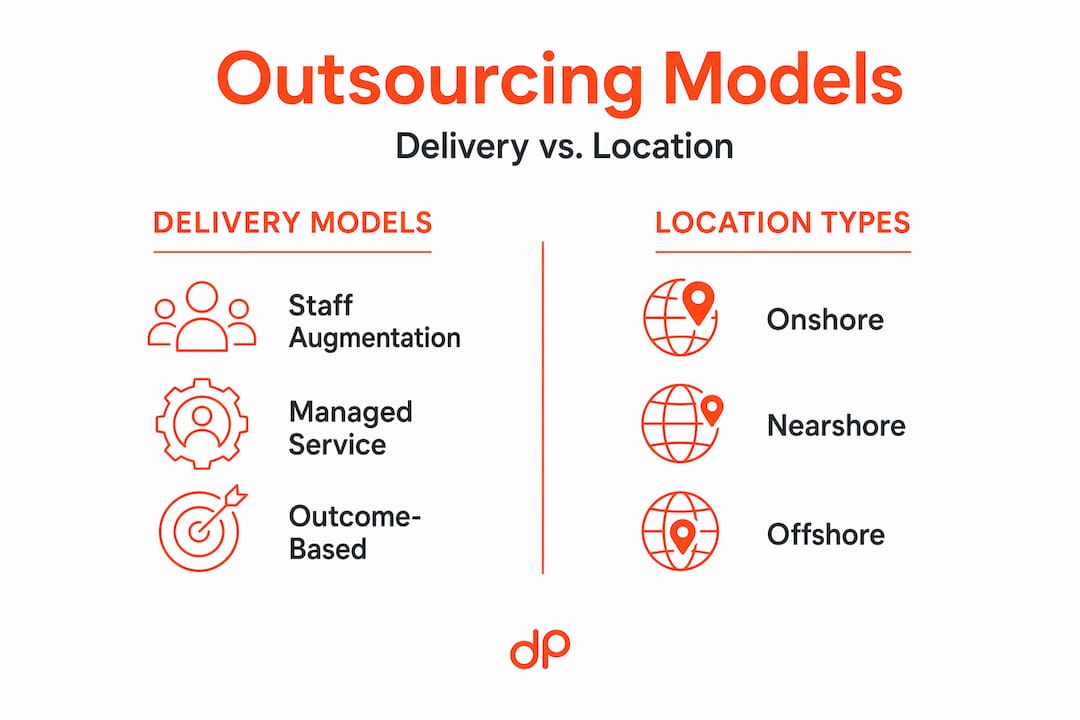
One confusion executives regularly run into is using the term interchangeably with related but distinct concepts. Confusing these arrangements creates expensive problems around oversight, liability, and IP ownership. Staff augmentation places external contractors under your direct management. Managed services hand over a function entirely to the provider, who operates under agreed service level agreements (SLAs). Consulting engages external expertise for advisory input, not delivery ownership. Offshoring simply describes geography. You can offshore a managed service, staff augment offshore, or consult locally. These are separate axes, not synonyms.
IT outsourcing models compared
Understanding the primary delivery models is the foundation of any practical IT outsourcing strategy guide. Each model carries different cost structures, control levels, and governance demands.
| Model | What you control | Best suited for | Key risk |
|---|---|---|---|
| Staff augmentation | Day-to-day work direction | Filling specific skill gaps quickly | Management overhead falls on you |
| Managed services | Outcomes and SLAs | Ongoing functions like helpdesk or infrastructure | Vendor lock-in if contracts are poorly structured |
| Project outsourcing | Scope, timeline, and deliverables | Defined builds with clear requirements | Scope creep and communication gaps |
| Consulting | Strategic recommendations | Architecture decisions, technology selection | Disconnect between advice and execution |
| Offshoring | Variable, depends on model | Cost arbitrage with scalable capacity | Time zone friction and compliance exposure |
Onshore, nearshore, and offshore describe where the vendor team is located, not how the service is governed. Onshore vendors share your time zone and regulatory environment. Nearshore vendors, typically in adjacent regions, offer a balance of cost and collaboration. Offshore vendors provide the widest cost differential but require stronger governance discipline to compensate for distance and potential regulatory complexity.
The risk-reward profile of each model shifts considerably based on what you outsource, not just where. A poorly governed nearshore engagement will consistently underperform a well-governed offshore one. That distinction matters when you are briefing your engineering leadership on IT outsourcing best practices explained for your organization.
Strategic governance and risk allocation
This is where most IT outsourcing engagements succeed or fail, and where executive attention is most warranted. Outsourcing success depends on disciplined commercial strategy, governance, planning, and equitable risk allocation, not simply vendor selection.

The single most impactful governance decision is how you allocate risk. Risk should be placed with the party best able to manage it, not pushed indiscriminately to the supplier. When buyers transfer risks that suppliers cannot reasonably control, such as regulatory changes in the buyer’s jurisdiction, suppliers price that uncertainty into their margins or, worse, accept it and then fail to deliver. Improper risk transfer is a primary driver of outsourcing contract failures.
Outcome-based procurement is one governance model worth serious consideration. Rather than specifying technology choices, outcome-based procurement focuses on the problem to be solved and validates results through pilots before broader rollout. This approach gives vendors room to innovate on method while holding them accountable for measurable results.
Effective ongoing governance requires a structured cadence, not a one-time check at project kickoff:
- Scheduled SLA reviews — monthly or quarterly performance reviews against agreed metrics, documented and tracked
- Security assessments — periodic vulnerability assessments and third-party audits covering the vendor’s access to your systems
- Business continuity testing — active testing of disaster recovery and continuity plans, not just documentation review
- Dependency mapping — maintaining a current view of which systems and data the vendor touches
Routine governance with scheduled reviews and security assessments is not optional infrastructure. Underinvestment in governance cadence is one of the most expensive mistakes in outsourcing, because issues surface late when remediation costs are highest.
Pro Tip: Assign an internal outsourcing manager whose sole focus is governance. When this role is absorbed into a general technology leadership position, governance reviews get deprioritized during busy periods — which is precisely when vendor performance tends to slip.
Best practices for leaders managing IT outsourcing
Applying these principles in practice requires a structured approach. The following steps reflect how experienced leaders translate IT outsourcing theory into workable execution, consistent with how outsourcing management workflow functions in mature organizations.
- Define what you are buying. Write clear outcome definitions before engaging vendors. Ambiguity in scope is the most common driver of cost overruns and missed expectations.
- Select vendors on governance fit, not just price. Evaluate how vendors handle SLA breaches, escalation paths, and security incident response. These processes reveal how a partnership will function under pressure.
- Structure contracts to align incentives. Fixed-price contracts work for well-defined scopes. Time-and-materials contracts work when requirements will evolve. Hybrid models split the risk more equitably. Avoid locking into a model that does not match your actual work pattern.
- Maintain internal technical literacy. Your team needs enough expertise to evaluate vendor claims and review deliverables critically. Outsourcing delivery does not mean outsourcing judgment. Reading more on how tech leads drive outsourcing outcomes makes this point with useful specificity.
- Build security guardrails from day one. Third-party breach costs average $4.88 million, which is 17% higher than internal breaches. Define access controls, data handling requirements, and incident notification timelines in the contract, not as an afterthought.
- Review and renegotiate. Markets change, technology changes, and vendor performance shifts over time. Build contract review cycles into your governance calendar. SLAs in IT outsourcing are living instruments, not static documents.
CIOs must balance accelerating development through outsourcing with maintaining visibility on dependencies, security, and compliance. That balance is not achieved through caution alone. It requires clear contracts, capable internal oversight, and vendors who treat transparency as a baseline expectation.
Pro Tip: Run a tabletop exercise before going live with a new outsourcing engagement. Walk through what happens if the vendor experiences a security incident, a key personnel departure, or a regulatory audit. The gaps you find are exactly what your contract and governance routines need to address.
My perspective on what actually drives outsourcing success
I have seen organizations make the same core mistake repeatedly: they treat vendor location and governance rigor as the same variable. They assume that choosing a nearshore vendor automatically reduces management complexity, or that going offshore inherently creates risk. Neither is true.
What actually determines outcome quality is the consistency of your governance. A weekly SLA review with a distributed offshore team will outperform a quarterly check-in with a local vendor every time. The organizations that get the most from outsourcing are the ones that invest as much in managing the relationship as they do in selecting the vendor.
The other pattern I find genuinely damaging is risk misallocation. When buyers load contracts with one-sided terms that push unreasonable risks to vendors, suppliers find ways to recover margin through change orders, reduced quality, or slow escalation handling. The contract reads favorably on paper and performs poorly in practice. Effective risk allocation incentivizes suppliers to deliver quality service and leaves room for the innovation that makes outsourcing genuinely valuable.
My advice to executives: delegate delivery confidently, but never delegate governance. Keep your internal team close to performance data, security posture, and contractual milestones. That visibility is what separates organizations that scale well through outsourcing from those that spend years recovering from it.
— Vlad
How DevPulse helps you outsource with confidence
Understanding IT outsourcing meaning is the first step. Finding a partner who executes on that understanding is what actually moves the needle.
DevPulse brings together custom software engineering services across web, mobile, cloud, and AI, with the governance discipline that complex outsourcing engagements demand. We work with SaaS companies, enterprise clients, and startups across healthcare, legal tech, cybersecurity, and beyond. Our real-world case studies show how we have delivered on modernization and development mandates with measurable results and clear accountability. If you are evaluating an outsourcing arrangement or reassessing an existing one, we are ready to have a direct conversation about your situation. Request a consultation with the DevPulse team to get started.
FAQ
What does IT outsourcing mean?
IT outsourcing means contracting an external provider to handle technology functions, such as development, infrastructure, or security, that would otherwise be managed internally. The scope can range from a single project to ongoing managed services.
What is the difference between staff augmentation and managed services?
Staff augmentation places external contractors under your direct management and direction. Managed services transfer operational responsibility for an IT function to the vendor, who delivers against agreed service level agreements.
Why does governance matter more than vendor selection?
Governance determines whether your contract performs as written. Without routine SLA reviews, security audits, and active oversight, even a well-selected vendor will drift from agreed performance standards over time.
What is outcome-based procurement in IT outsourcing?
Outcome-based procurement defines the problem and desired results rather than specifying the technology solution. It allows vendors to innovate on delivery while being held accountable for measurable outcomes, validated through pilots before full deployment.
What are the biggest risks in IT outsourcing?
The primary risks include data exposure, loss of operational control, cost unpredictability, regulatory liability, and vendor lock-in. Third-party breaches cost organizations an average of $4.88 million, making security governance a financial priority, not just a technical one.