













TL;DR:
- Most organizations focus on optimizing their service outputs rather than understanding how their delivery structure impacts scalability, cost, and customer satisfaction. The choice of service delivery model depends on industry context, involving balanced integration of people, processes, and technology, with frameworks like SERVQUAL and ITIL guiding quality and improvement. Artificial intelligence is transforming service models by enabling scalable, automated workflows that shift responsibility from headcount to intelligent platforms.
Most business leaders spend more time optimizing what they deliver than how they deliver it. That’s a costly oversight. Service delivery models explained properly reveal that the structure behind your service, not just the service itself, determines whether you scale efficiently, retain clients, and stay profitable. Yet many organizations still treat all delivery models as interchangeable, swapping between project-based, retainer, or SaaS structures without understanding the tradeoffs. This guide breaks down the core frameworks, real-world examples, and decision criteria you need to make the right choice for your business.
Table of Contents
- Key Takeaways
- Service delivery models explained: core frameworks
- Types of service delivery models across industries
- How AI is reshaping service delivery
- Implementing and optimizing delivery models
- Comparing service delivery models: fit and context
- My take on where most organizations get this wrong
- How DevPulse helps you optimize service delivery
- FAQ
Key Takeaways
| Point | Details |
|---|---|
| Delivery model shapes outcomes | The structure you choose directly impacts scalability, cost control, and customer satisfaction. |
| Frameworks provide measurable quality | SERVQUAL and ITIL give leaders tools to measure gaps and continuously improve service. |
| AI shifts delivery economics | Intelligent platforms now allow scale without proportional headcount increases. |
| SLA alignment is non-negotiable | Misaligned SLAs that lack operational backing are one of the most common causes of service failure. |
| Context determines the right model | No single model fits all scenarios; industry, customer expectations, and growth stage all factor in. |
Service delivery models explained: core frameworks
Before you can evaluate which model fits your organization, you need to understand what a service delivery model actually contains. At its foundation, effective service delivery requires balanced integration of three pillars: people, processes, and technology. Remove any one of them and the entire structure weakens.
The servuction model formalizes this. It treats service delivery as a production system where the customer is an active participant. Your front-of-house staff, your back-end processes, and your technology infrastructure all interact simultaneously. In a bank branch, for example, the teller is the people component, the loan approval workflow is the process, and the core banking system is the technology. When one lags, customers feel it.
SERVQUAL adds a quality measurement layer. The five key SERVQUAL dimensions are:
- Tangibles: The physical or digital appearance of your service environment
- Reliability: Your ability to deliver what you promised, consistently
- Responsiveness: How quickly you address customer needs
- Assurance: The knowledge and credibility of your team
- Empathy: Your ability to understand and respond to individual customer needs
SERVQUAL measures the gap between what customers expect and what they actually experience. Closing that gap is where operational efficiency and satisfaction intersect.
The third layer involves contractual accountability. The SLA, OLA, and UC framework creates a chain of commitments. An SLA is your promise to the customer. An OLA is the internal agreement between your teams to back that promise. A UC is the contract you hold with third-party vendors. Weakness in any link jeopardizes the chain. An SLA that promises 99.9% uptime means nothing if your internal infrastructure team has no obligation to respond within a defined window.
Pro Tip: Map your SLA commitments against actual internal capacity before you sign anything. SLAs without realistic capacity assessments are one of the most frequent sources of service failure.
Types of service delivery models across industries
Understanding service models conceptually is one thing. Seeing how they operate in real industries is where the distinctions become clear. Here is a breakdown of the most widely used models:
| Model | Best For | Key Limitation |
|---|---|---|
| Project-based | Defined-scope work, one-time builds | No ongoing revenue; scope creep risk |
| Retainer | Ongoing advisory or support services | Requires consistent value delivery to justify fees |
| Productized | Repeatable, packaged services | Limited customization; may feel rigid to clients |
| Tiered / Subscription | SaaS, managed services, IT support | Churn risk if tier value is not clearly communicated |
| Credit-based | Variable-volume service needs | Complex to administer; can feel transactional |
| Hybrid | Complex enterprise engagements | Requires strong governance to avoid ambiguity |
In IT, the cloud computing models dominate the discussion. The cloud computing market is projected to exceed $905 billion by 2026, driven by IaaS, PaaS, and SaaS adoption. IaaS gives organizations infrastructure on demand. PaaS provides a platform for developers to build without managing the underlying stack. SaaS delivers fully managed software through a browser. Each model shifts a different portion of responsibility to the vendor, which is exactly why choosing the wrong one creates either over-dependency or unnecessary internal burden.

In healthcare, tiered delivery is the operational backbone. U.S. emergency departments recorded 136 million visits in 2021, a volume that is only manageable through triage-based service tiers. More broadly, the value-based care model like the Medicare Shared Savings Program shifts reimbursement from volume to outcomes. Bundled payments now cover 32 clinical episode types, pushing providers to redesign delivery around patient results rather than service counts.
In professional services, the retainer model remains the most sustainable for advisory firms, legal practices, and management consultants. It creates predictable revenue and deeper client relationships. The productized model works well when a service can be standardized, think a fixed-price SEO audit or a defined software architecture review. Technology outsourcing as a service delivery strategy sits at the intersection of project-based and retainer approaches, often combining both depending on engagement scope.
How AI is reshaping service delivery
Artificial intelligence is not simply automating tasks within existing models. It is enabling entirely new delivery paradigms. AI is shifting tech services from headcount-based scaling toward intelligence-as-a-deliverable, where the platform itself generates value rather than the number of people behind it.
What this means practically for business leaders:
- Agentic AI platforms can now handle multi-step service workflows without human intervention, from customer intake to resolution
- Digital process automation reduces the manual overhead in service delivery by connecting systems that previously required human bridges. Learn more about closing the execution gap through automation
- AI-powered CRM integration gives service teams real-time context on customer history, preferences, and predicted needs, directly improving responsiveness and empathy scores in SERVQUAL terms
- Predictive capacity modeling uses historical data to anticipate demand spikes, so SLA commitments are backed by actual resource availability rather than optimistic projections
The challenge is not the technology. It is adoption discipline. Organizations that bolt AI onto broken delivery processes get faster broken delivery. The leaders who see ROI treat agentic AI transformation as a structural redesign, not a feature addition.
AI in professional services is creating a measurable competitive divide between firms that have integrated intelligent delivery tools and those still operating on manual-first models. The gap will widen.
Pro Tip: Before deploying AI in service delivery, audit your current process documentation. AI amplifies what is already there. Undocumented or inconsistent processes will produce inconsistent AI outputs.
Implementing and optimizing delivery models
Selecting a model is a strategic decision. Implementing it successfully is an operational one. Here is a structured approach that works across industries:
-
Align the model to business goals, not just client preferences. A consulting firm with a retainer model must define what “ongoing value” looks like in measurable terms. If you cannot articulate it, your client will not either.
-
Apply the ITIL service lifecycle. The ITIL five-stage lifecycle moves from Service Strategy through Design, Transition, Operation, and Continual Service Improvement. Each stage has clear inputs and outputs. Skipping straight to Operation without a designed strategy is why so many implementations feel reactive.
-
Build feedback loops into the delivery structure. Treating service delivery as a system rather than isolated projects enables the continuous improvement that ITIL’s final stage requires. Customer satisfaction data, ticket resolution times, and NPS scores should feed directly back into service design reviews.
-
Tie SLAs to operational reality. SLAs without realistic capacity assessments lead to repeated failures and eroded trust. Before committing to response times or output volumes, verify that your internal OLAs and vendor UCs actually support the promise.
-
Use data to identify capacity gaps before they become incidents. A 20% increase in satisfaction correlates with a 15% revenue lift. The math makes monitoring worthwhile.
Pro Tip: Run a quarterly delivery model review. Markets shift, client needs evolve, and technology changes. A model that was optimal 18 months ago may now be creating friction neither side has named.
Comparing service delivery models: fit and context
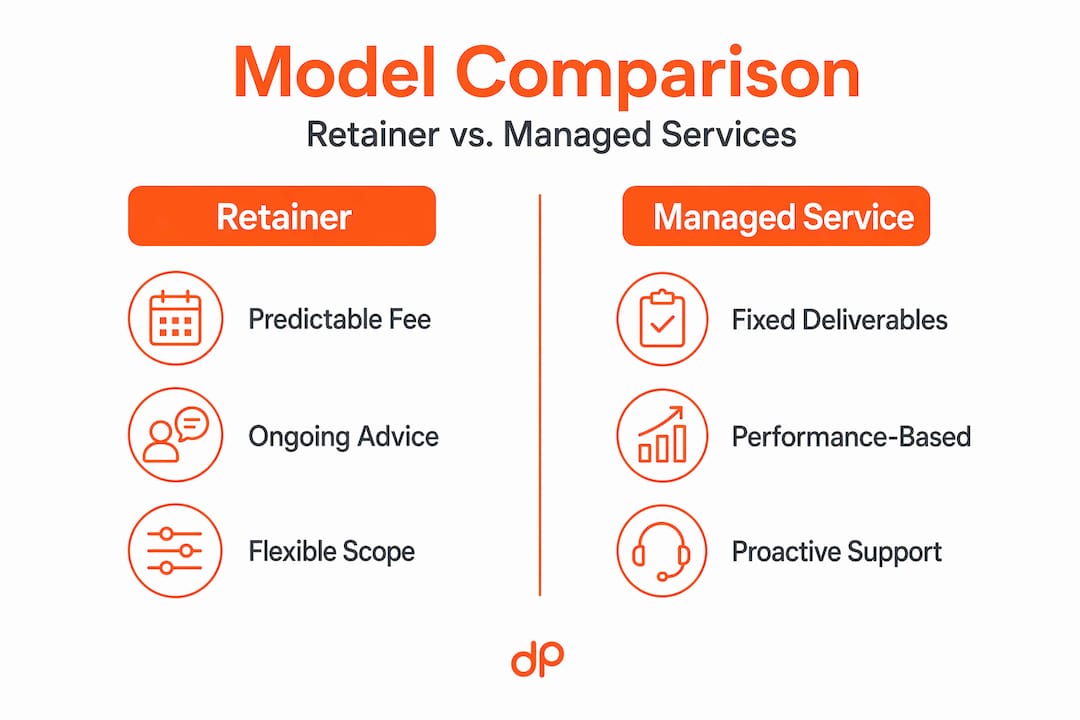
Service model comparison is not about ranking models from best to worst. It is about matching structure to context. The right model for a managed IT services firm with 200 enterprise clients is not the right model for a boutique legal tech consultancy with 15 relationships.
Key decision criteria to evaluate:
- Scalability: Can the model grow without proportional cost increases? SaaS and tiered models scale well. Pure project-based models do not.
- Customer involvement: High-involvement clients often need retainer or hybrid models where communication is ongoing. Low-involvement buyers prefer productized or subscription structures.
- Cost predictability: Retainer and subscription models offer revenue predictability on both sides. Credit-based and project models introduce variability.
- Accountability clarity: Using a RACI matrix (Responsible, Accountable, Consulted, Informed) to define roles within a delivery model prevents the handoff failures that generate most service complaints.
In healthcare, the distinction between structural and strategic service lines matters significantly. Successful service line strategies require nine key attributes including clear leadership, ambulatory mindset, and data-driven management. Service lines focused on distinct offerings demonstrate better outcomes than generic, broadly applied structures. The lesson applies beyond healthcare: specificity in model design outperforms generalism.
Managed services delivery represents a strong hybrid between retainer and tiered models, offering predictable costs while allowing scope flexibility, which is why adoption among IT executives continues to grow in 2026.
My take on where most organizations get this wrong
I’ve worked with enough enterprise clients to recognize a recurring pattern. Most organizations pick a service delivery model early and then defend it long past the point where it stopped serving them. They confuse consistency with optimization.
The ITIL framework and SERVQUAL dimensions are genuinely useful, but I’ve seen teams treat them as compliance exercises rather than diagnostic tools. You fill out the forms, run the review, and file the report. Nothing changes. The model stays broken and just gets more documented.
My honest view is that the biggest threat to service delivery quality right now is not a lack of frameworks. It is a reluctance to accept that the model itself may need to change. AI-powered change management is making this harder to avoid because the technology forces structural questions that slower-moving processes could previously defer.
What I’ve found actually works is treating delivery model design as a product. It has users, it has performance metrics, and it needs to be iterated. Leaders who own that responsibility personally, rather than delegating it entirely to operations teams, get better results. The ones who insist that “this is how we’ve always structured engagements” are the same ones asking why satisfaction scores aren’t moving.
Customers rate experience nearly as highly as product quality, with 88% saying it matters as much. Your delivery model is the experience. Treat it accordingly.
— Vlad
How DevPulse helps you optimize service delivery
If this guide has clarified where your current delivery model may be falling short, DevPulse can help you act on that insight. We specialize in custom software engineering and product modernization for organizations that need their delivery infrastructure to keep pace with their ambitions. Whether you’re building a new service platform from the ground up, integrating AI and data capabilities into your existing workflows, or migrating away from a legacy architecture that no longer supports your model, our team brings the technical depth and business context to move fast without cutting corners. Talk to us about where you want your service delivery to go.
FAQ
What are service delivery models?
Service delivery models are the structured frameworks organizations use to define how services are provided, managed, and measured. They combine people, processes, and technology to create repeatable, scalable service experiences.
How do I choose the right service delivery model?
Evaluate your model based on scalability requirements, customer involvement levels, cost predictability, and accountability structures. A RACI matrix and SERVQUAL gap analysis are practical starting points.
What is the difference between SLA, OLA, and UC?
An SLA is your commitment to the customer, an OLA is the internal team agreement that backs it, and a UC is the vendor contract that supports both. Weakness in any layer creates risk for the entire service chain.
How is AI changing service delivery frameworks?
AI enables delivery models that scale through intelligent automation rather than headcount. Agentic platforms, predictive capacity tools, and AI-driven CRM systems are shifting the economics of service delivery across industries.
What is value-based care as a service delivery model?
Value-based care replaces volume-based reimbursement with outcome-based payments. Models like the Medicare Shared Savings Program cover millions of patients and use bundled payments across 32 clinical episode types to align provider incentives with patient results.