













TL;DR:
- Many organizations mistakenly view contract signing as the endpoint, but the process’s real value lies post-signature. Effective contract management involves overseeing every stage of the contract lifecycle, from request to archiving, to prevent risks and maximize operational value. Implementing governance frameworks, leveraging technology like CLM software, and fostering cross-functional ownership are essential for high performance.
Most organizations treat contract signing as the finish line. It isn’t. The signature is where the real work begins, and that misconception costs businesses millions in missed renewal windows, untracked obligations, and compliance failures. Understanding what is contract management — in full, not just the legal paperwork phase — is one of the most operationally significant things a business professional can do. This guide covers the complete contract management definition, the seven lifecycle stages, governance frameworks, technology tools, and the best practices in contract management that consistently separate high-performing organizations from reactive ones.
Table of Contents
- Key Takeaways
- What is contract management, exactly?
- Governance frameworks and contract management plans
- Technology tools that transform contract management
- Common pitfalls in contract management
- How to optimize your contract management process
- My perspective: contracts as a growth capability
- How Devpulse helps organizations build smarter contract workflows
- FAQ
Key Takeaways
| Point | Details |
|---|---|
| Contract management spans the full lifecycle | It covers every stage from request and drafting through execution, monitoring, renewal, and archiving. |
| Post-signature phases drive the most value | Most risk and revenue impact occur after signing, making active obligation tracking non-negotiable. |
| Formal plans prevent governance failures | A Contract Management Plan with defined roles and milestones keeps complex agreements on track. |
| Technology automates what humans miss | CLM software with automated renewal alerts reduces lapses, compliance failures, and manual workload. |
| Cross-functional ownership is critical | Legal, procurement, and operations must share responsibility across contract stages to avoid costly gaps. |
What is contract management, exactly?
The contract management definition is straightforward at its core: it is the systematic process of creating, negotiating, executing, and overseeing agreements between parties to ensure all obligations are fulfilled. But that definition only scratches the surface of what the discipline actually demands in practice.
A more accurate framing treats contracts as strategic business assets, not static legal documents. Every vendor agreement, client engagement, and partnership deal carries financial terms, risk exposures, and operational commitments that require ongoing attention well beyond the day someone signs on the dotted line.
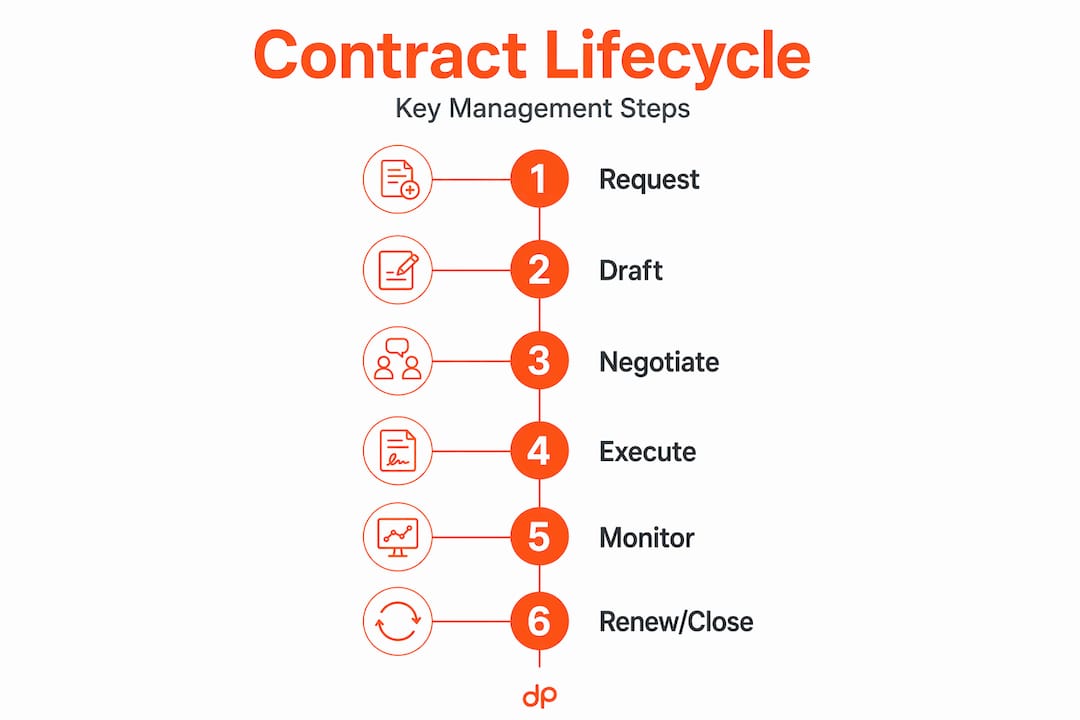
The contract management process unfolds across seven distinct stages:
- Request/inception — identifying the need for a contract and gathering business requirements
- Drafting — creating the contract language, often from standardized templates for efficiency
- Negotiation — aligning both parties on terms, obligations, liability, and performance standards
- Execution — obtaining signatures and formally activating the agreement
- Monitoring and compliance — tracking deliverables, obligations, and performance metrics against contract terms
- Renewal or renegotiation — evaluating whether the contract should continue, be modified, or be terminated
- Closeout and archiving — formally ending the contract and preserving records for audit and reference
You will often hear the term Contract Lifecycle Management (CLM) used alongside contract management. They are related but not identical. CLM refers specifically to technology-driven lifecycle management, typically enabled by software platforms that automate and centralize the process. Contract management is the broader discipline. CLM is one powerful approach within it.
Governance frameworks and contract management plans
Good contracts poorly managed produce bad outcomes. That is why governance is the backbone of any mature contract management program, particularly for high-value or complex agreements.
For contracts exceeding specific procurement thresholds, a formal Contract Management Plan is not optional. It is the operational blueprint that keeps the agreement functioning as intended after execution. A well-constructed CMP typically includes:
- Key milestones and deliverable schedules with realistic timeframes
- Defined roles and responsibilities for every stage of the contract lifecycle
- Performance metrics tied directly to contract terms and obligations
- Change management procedures for handling amendments and scope adjustments
- Invoice processing and payment triggers aligned with contractual conditions
- Contract closeout procedures to formally retire agreements and capture lessons learned
One detail that separates effective CMPs from ineffective ones: linking clauses to deliverables and assigning clear risk owners. Organizations that skip this step discover too late that no one owns specific obligations, which creates ambiguity that becomes expensive in disputes.
Federal contracting guidance also highlights a practical scheduling insight. Adding 15 to 25% schedule slack into contract execution timelines compensates for approval bottlenecks that predictably delay delivery. Building that buffer in at the planning stage prevents cascading delays downstream.
Governance challenges are not only about documentation. Contract portfolio management requires blending vertical, authority-based oversight with horizontal, negotiation-driven relationships. When those two models clash, misalignment between legal, procurement, and operations teams follows. Defining governance structures explicitly, and reviewing them when contract complexity grows, prevents that.

Pro Tip: Involve your contract manager during negotiation, not just at execution. The obligations they will be held accountable for post-signature are set at the table. Late involvement means inheriting commitments with no operational input.
Technology tools that transform contract management
Modern contract management has outgrown spreadsheets and shared drives. Organizations managing more than a few dozen active agreements simultaneously need technology designed for the job.
CLM software platforms centralize every contract in a searchable repository, automate workflow routing for approvals, and provide analytics on contract performance across the portfolio. The operational benefits are concrete:
- Automated renewal reminders set at 90, 60, and 30 days before contract expiration give teams enough runway to renegotiate terms rather than scramble at the last moment or miss exits entirely
- Compliance alerts flagging when obligations are due or at risk of being missed
- Metadata extraction at execution capturing financial terms, renewal triggers, and performance obligations so contracts become operational data rather than inert documents
- AI-assisted contract review scanning for non-standard clauses, missing provisions, or risk-flagged language before execution
- Reporting dashboards showing aggregate contract risk, upcoming renewals, and performance against agreed KPIs
AI-driven contract analytics deserve specific attention because they close a gap that manual review cannot. Metadata capture at execution is where most organizations lose control of their contracts. Without it, obligations sit dormant until someone is already in breach. AI tools that extract and categorize this data at the point of signing convert static agreements into live, manageable commitments.
For organizations exploring AI governance frameworks that support automated contract analytics, AI governance principles are worth reviewing alongside any CLM platform selection process.
Pro Tip: Do not deploy CLM software on complex workflows before you have standardized your routine contracts. Start with simpler processes first, build organizational buy-in, then expand to more complex use cases. Successful implementation typically takes 4 to 8 weeks before meaningful tool expansion.
Common pitfalls in contract management
Most contract management failures are predictable. They are not caused by bad contracts. They result from good contracts that were simply not managed after signing.
The most damaging misconception is that contract work ends at the signature. Value erosion and risk concentrate in the post-execution phase, where obligation tracking, performance monitoring, and compliance management actually happen. Organizations that treat signing as the endpoint consistently leave money on the table and accumulate exposure they are not tracking.
Beyond that, four pitfalls surface repeatedly across industries:
- Failure to capture metadata at execution. Financial terms, renewal dates, and performance triggers left unrecorded become invisible obligations that breach without warning.
- Weak communication between legal and operations. Legal teams negotiate the terms; operations teams live with them. When those groups do not communicate, contracts get signed with commitments that are operationally impossible to fulfill.
- Overcomplicated governance for simple contracts. Applying a full CMP framework to a routine vendor agreement wastes time and generates bureaucratic drag. Governance rigor should match contract complexity.
- Unrealistic timeframes without schedule slack. Contracts drafted without accounting for review cycles, approval chains, and procurement delays produce artificial urgency and preventable disputes.
Managing IT outsourcing risks in technology contracts illustrates this well. Scope creep, untracked deliverable milestones, and ambiguous SLAs are common sources of disputes in tech vendor agreements — all of which strong contract management discipline would catch early.
How to optimize your contract management process
Improving contract management does not require overhauling everything at once. Incremental, structured progress builds the foundation for a high-functioning program without organizational disruption.
Follow these practical steps to move from reactive to proactive contract management:
- Standardize routine contracts first. Develop templates and approval workflows for your most common contract types. This builds process muscle before you tackle high-complexity agreements.
- Define ownership by stage. Assign explicit ownership for every phase of the contract lifecycle across legal, procurement, and business operations. Gaps in ownership are where obligations fall through.
- Capture metadata at execution. For every agreement executed, record financial terms, renewal dates, performance obligations, and risk owners in your central repository immediately.
- Set automated alerts before you need them. Configure renewal reminders and compliance checkpoints as part of the contract activation process, not as an afterthought.
- Use data to monitor and adjust. Review contract performance metrics quarterly. Identify patterns in delays, disputes, and missed obligations. Use that data to refine templates, governance structures, and vendor relationships.
- Build cross-functional review cycles. Schedule regular touchpoints between legal, procurement, and operations teams to surface emerging contract issues before they escalate.
- Scale CLM software with governance maturity. Expand your technology footprint as your processes stabilize. Deploying advanced features on immature workflows creates adoption resistance and undermines ROI.
For organizations scaling contract teams alongside growth, supplier contract strategies offer complementary guidance on managing multi-vendor portfolios at scale.
My perspective: contracts as a growth capability
I have worked with organizations across legal tech, healthcare, and enterprise software where contract management was treated as a legal necessity and nothing more. The pattern is consistent: compliance happens, but value does not.
What I have found over years of working in this space is that the organizations that extract genuine business value from their contracts share one trait. They treat the post-signature phase with the same rigor they apply to the negotiation phase. They measure performance, track obligations, and use that data to renegotiate better terms on the next cycle.
The technology conversation is where I push back against conventional thinking. Platforms alone do not fix broken processes. I have seen teams deploy sophisticated CLM platforms on unstructured workflows and produce expensive, underutilized software instead of better contracts. Governance clarity has to come first. The tool amplifies whatever process it sits on, good or bad.
My honest take: contract management as a strategic capability is one of the highest-ROI investments a scaling organization can make. Not because contracts are exciting, but because the commercial relationships they govern are where revenue and risk actually live.
— Vlad
How Devpulse helps organizations build smarter contract workflows

At Devpulse, we work directly with legal tech, enterprise, and SaaS organizations on the technology and process challenges that sit underneath better contract management. That includes building custom workflow tools, integrating AI-driven analytics into existing systems, and modernizing legacy platforms that are holding back compliance and operational efficiency.
Our AI and data engineering capabilities are directly applicable to contract intelligence use cases, including automated obligation extraction, compliance monitoring, and risk classification at scale. If you are evaluating CLM platforms or need custom-built contract workflow automation, our software engineering services are designed to match your governance maturity and scale with it.
Browse our client case studies to see how we have supported real-world contract and process improvement for organizations in healthcare, legal tech, and professional software. When you are ready to explore what is possible, contact Devpulse for a consultation.
FAQ
What is the contract management definition?
Contract management is the systematic process of creating, negotiating, executing, and overseeing agreements to ensure all obligations are met. It spans the full contract lifecycle from inception through archiving.
How many stages are in the contract management process?
The contract management process typically includes seven stages: request, drafting, negotiation, execution, compliance monitoring, renewal or renegotiation, and closeout with archiving.
What are the main benefits of contract management?
Strong contract management reduces legal and financial risk, prevents missed renewals, improves compliance, and converts contract obligations into operational intelligence that supports better decision-making.
What is the difference between contract management and CLM?
Contract management is the broader discipline of managing agreements across their full lifecycle. Contract Lifecycle Management refers specifically to a technology-driven approach that uses software to automate and centralize those same processes.
What are the best practices in contract management?
The most effective practices include capturing metadata at execution, assigning clear ownership by stage, automating renewal alerts, standardizing routine contracts first, and building regular cross-functional review cycles between legal, procurement, and operations.