













Onboarding new IT team members can make or break productivity in software development companies. Many engineering leaders and HR professionals struggle with disjointed processes that leave new hires confused, slowing integration and delaying valuable contributions. This guide walks you through proven onboarding steps that accelerate ramp-up time, boost team cohesion, and help new IT professionals deliver results faster. You’ll discover practical frameworks for preparation, execution, and verification that turn onboarding from a checkbox exercise into a competitive advantage.
Table of Contents
- Preparing For Effective IT Team Onboarding
- Executing The Onboarding: Step-By-Step Integration Process
- Verifying Onboarding Success And Continuous Support
- Common Onboarding Pitfalls To Avoid And Expert Tips
- How DevPulse Can Streamline Your IT Team Onboarding
- What Key Documentation Should Be Prepared For Onboarding IT Team Members?
- How Can Managers Measure The Success Of IT Onboarding Programs?
- What Are Common Mistakes To Avoid During IT Team Onboarding?
- How Often Should Onboarding Materials And Procedures Be Updated?
Key takeaways
| Point | Details |
|---|---|
| Prioritize ways-of-working documentation | Team-level processes bridge the gap between HR materials and technical checklists for faster integration. |
| Structure clear onboarding workflows | Sequential steps with shadowing, feedback, and incremental tasks accelerate productivity and confidence. |
| Measure success with milestones | Track KPIs, collect feedback, and verify achievement of integration goals to ensure effective onboarding. |
| Avoid common onboarding pitfalls | Missing documentation, poor communication, and information overload derail new hire success. |
| Provide continuous support | Mentorship, peer networks, and ongoing learning opportunities sustain long-term performance. |
Preparing for effective IT team onboarding
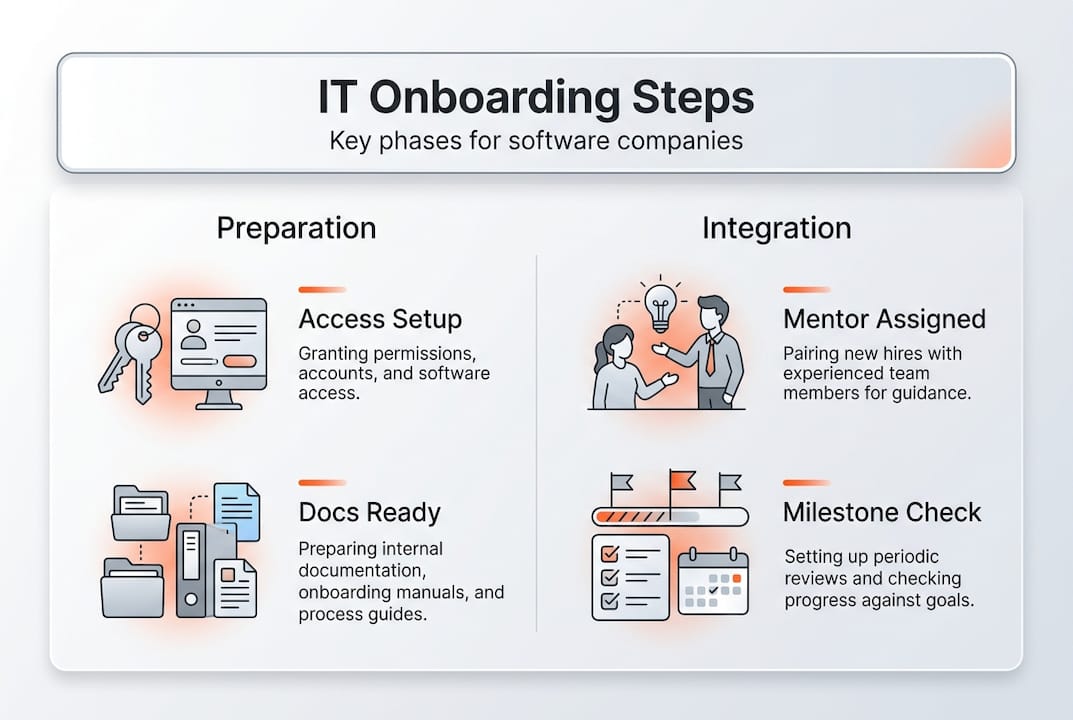
Now that you know what to expect, start by preparing everything your new IT team member needs for a smooth start. Successful onboarding begins weeks before day one, when engineering leaders and HR gather resources, clarify expectations, and build comprehensive documentation. This preparation phase determines whether your new hire spends their first weeks productively learning or frustratingly searching for answers.
Start by collecting all company and technical onboarding materials into a single, accessible location. Include organizational charts, team structures, communication norms, and company values alongside technical documentation. Many companies maintain separate HR onboarding and technical setup checklists, but team-level ways-of-working documentation often falls through the cracks between these two resources. This middle layer explaining how your specific team collaborates, makes decisions, handles code reviews, and manages deployments proves most valuable for new engineers.
Define crystal-clear role expectations and team responsibilities before your new hire arrives. Document not just what they’ll build, but how they’ll work with product managers, designers, QA teams, and other stakeholders. Create a responsibility matrix showing who owns what decisions, who needs to be consulted, and who should be informed. This clarity prevents the common scenario where new team members hesitate to act because they don’t understand boundaries.
Prepare comprehensive access to all necessary tools, systems, and code repositories ahead of time. Nothing frustrates new hires more than spending their first week waiting for credentials, permissions, or hardware. Build a master checklist covering:
- Development environment setup and configuration
- Version control access and branching strategies
- CI/CD pipeline permissions and deployment processes
- Communication tools like Slack, Teams, or Discord
- Project management and ticketing systems
- Documentation wikis and knowledge bases
Pro Tip: Create a “day zero” setup guide that new hires can complete before their official start date, covering laptop configuration, account creation, and basic tool familiarization. This lets them hit the ground running on day one.
Set clear milestones for ramp-up progress that both you and your new team member can track. Break the first 90 days into phases with specific goals. A typical progression might look like this:
| Phase | Timeline | Key Milestones |
|---|---|---|
| Orientation | Week 1 | Complete system access, meet team, understand architecture |
| Learning | Weeks 2-4 | Shadow team members, complete first small task, understand workflows |
| Contributing | Weeks 5-8 | Own feature development, participate in code reviews, join on-call rotation |
| Independence | Weeks 9-12 | Lead project component, mentor newer hires, propose improvements |
These milestones create accountability and help you optimize IT staffing workflow by identifying integration bottlenecks early. They also give new hires confidence that they’re progressing appropriately. When combined with insights from engineering outsourcing tips, this preparation framework works equally well for full-time employees and contract team members.
Executing the onboarding: step-by-step integration process
With preparation in place, follow this detailed process to onboard your new IT team member effectively. The execution phase transforms documentation and plans into lived experience, where new hires move from passive learning to active contribution. This structured approach ensures consistent quality while remaining flexible enough to adapt to individual learning styles.
-
Start with comprehensive introductions and cultural immersion. Schedule one-on-one meetings with every team member during the first week, not just quick hellos but substantive 30-minute conversations about each person’s role, current projects, and how they collaborate. Include cross-functional partners like product managers, designers, and customer success team members who your new hire will work with regularly. These conversations build the social foundation that makes asking questions feel natural later.
-
Conduct detailed system and tool walkthroughs with hands-on practice. Don’t just share documentation links and hope for the best. Walk through your architecture, explaining not just what each component does but why you made specific technical decisions. Show your deployment process, monitoring dashboards, and incident response procedures. Let new hires perform these tasks in a safe environment with supervision before they need to execute independently.
-
Provide structured work shadowing across different team activities. Pair your new team member with experienced engineers during code reviews, sprint planning, technical design discussions, and production deployments. Shadowing reveals the unwritten rules and implicit knowledge that ways-of-working documentation captures explicitly. Rotate shadowing partners so new hires see multiple perspectives and build relationships across the team.
-
Assign incrementally complex tasks with structured feedback loops. Start with well-defined, low-risk tasks like documentation updates or small bug fixes that let new hires contribute value while learning your codebase. Gradually increase complexity as they demonstrate competence. After each task, conduct a brief retrospective discussing what went well, what proved challenging, and what they learned. This feedback rhythm accelerates skill development and surfaces confusion before it becomes frustration.
-
Use documented processes to guide daily work and decision-making. Point new hires to specific documentation sections as situations arise rather than answering every question directly. This teaches them to be self-sufficient while validating that your documentation actually helps. When documentation falls short, update it together, turning knowledge gaps into learning opportunities.
Pro Tip: Create a “first tasks” backlog specifically for onboarding that includes items across different parts of your system. This lets new hires explore your architecture breadth while contributing real value, and you can continuously refine these tasks based on what works.
The execution phase works best when you scale engineering teams with intentional processes rather than ad-hoc approaches. Teams that integrate DevOps implementation strategies into onboarding help new members understand not just development workflows but the entire software delivery lifecycle from code to customer.
Verifying onboarding success and continuous support
After executing onboarding steps, it’s essential to verify success and ensure ongoing support for your team members. Measurement turns onboarding from a hopeful process into a managed system you can continuously improve. Without verification, you’re guessing whether your investment in onboarding actually pays off in faster productivity and better retention.

Collect structured feedback from both new hires and their managers at regular intervals. Schedule formal check-ins at 30, 60, and 90 days using consistent questions that let you compare experiences across hires. Ask new team members what helped most, what confused them, where documentation fell short, and what they wish they’d learned sooner. Ask managers about integration speed, code quality, collaboration effectiveness, and independence level. This dual perspective reveals gaps that either party alone might miss.
Track achievement of onboarding milestones with quantifiable KPIs that matter for your team. Useful metrics include:
- Time to first meaningful code contribution
- Time to independent feature ownership
- Code review feedback volume and type over time
- Questions asked per week (should decrease as confidence grows)
- Self-reported confidence levels across key competencies
- Retention rate at 6 and 12 months
| Metric | Target | Why It Matters |
|---|---|---|
| First commit merged | Within 1 week | Validates environment setup and basic workflow understanding |
| First feature shipped | Within 4 weeks | Demonstrates end-to-end delivery capability |
| Independent work ratio | 80% by week 12 | Shows self-sufficiency and integration success |
| Onboarding satisfaction | 4+ out of 5 | Predicts retention and team advocacy |
Identify common onboarding challenges early by analyzing patterns across multiple new hires. If everyone struggles with the same system or process, that’s a documentation gap or architectural complexity issue you need to address. If certain managers consistently onboard people faster, study what they do differently and codify those practices. Team-level ways-of-working documentation should evolve based on these insights.
Provide ongoing access to mentors and peer support networks beyond the initial onboarding period. Assign a formal mentor for at least the first six months, someone who isn’t the direct manager and can answer questions without judgment. Create channels for new hires across different cohorts to connect, share experiences, and support each other. This peer network often provides the psychological safety that accelerates learning.
Encourage continuous learning and improvement through dedicated time and resources. Allocate budget for courses, conferences, and certifications relevant to your technology stack. Create internal learning opportunities like tech talks, architecture reviews, and post-incident analyses where team members share knowledge. When you invest in growth beyond immediate project needs, you signal that development is valued, which boosts engagement and retention.
The verification phase connects directly to dedicated team benefits, as cohesive teams with strong onboarding processes deliver better results than collections of individuals. Measurement and support create a virtuous cycle where better onboarding leads to faster productivity, which creates capacity for even better onboarding of future team members.
Common onboarding pitfalls to avoid and expert tips
Being aware of pitfalls helps you proactively apply expert tips for a successful onboarding experience. Even well-intentioned engineering leaders and HR professionals fall into predictable traps that undermine onboarding effectiveness. Recognizing these patterns lets you design systems that prevent problems rather than reacting to them.
Avoid missing or outdated documentation that sends new hires down wrong paths. Nothing erodes confidence faster than following official guides that don’t work. Assign documentation ownership to specific team members and review it quarterly. Better yet, make documentation updates part of your definition of done for every project. When processes change, update the docs immediately, not “when we have time.” Stale documentation is worse than no documentation because it wastes time and breeds distrust.
Prevent overwhelming new hires with too much information at once, a mistake that stems from anxiety about missing something important. Frontloading everything creates cognitive overload where nothing sticks. Instead, sequence information delivery to match when people actually need it. Share architecture details when they’re about to work on that system, not on day one. Provide security protocols when they’re getting production access, not during orientation. Just-in-time learning beats just-in-case information dumps.
Don’t neglect cultural integration and team bonding in favor of pure technical training. Software development is collaborative work, and people who feel isolated struggle regardless of technical skill. Schedule informal activities like team lunches, coffee chats, or virtual hangouts. Include new hires in social channels and celebrations. Make space for personal connection, not just professional interaction. Teams with strong social bonds share knowledge more freely and support each other through challenges.
Ensure absolutely clear communication of role expectations and success criteria from day one. Ambiguity about what “good” looks like creates anxiety and misdirected effort. Document not just responsibilities but decision-making authority, escalation paths, and performance standards. Discuss career growth trajectories and skill development opportunities. When people understand both immediate expectations and long-term possibilities, they engage more deeply.
Use consistent feedback loops and regular updates to catch problems early. Don’t wait for formal reviews to address confusion or course-correct. Create lightweight check-in rituals like:
- Daily standups where new hires share progress and blockers
- Weekly one-on-ones focused on learning and support
- Bi-weekly retrospectives on the onboarding experience itself
- Monthly skip-level conversations with senior leadership
“Prioritize team-level ways-of-working documentation to close onboarding gaps effectively. This middle layer between company-wide HR materials and technical setup guides makes the biggest difference in ramp-up speed.”
Pro Tip: Create an “onboarding feedback” Slack channel where new hires can anonymously report documentation gaps, confusing processes, or missing resources in real time. This crowdsourced improvement system catches issues while they’re fresh and shows you value their input.
Common pitfalls often stem from treating onboarding as a one-time event rather than an ongoing process. The most effective teams view onboarding as the foundation for continuous development and integration. When you apply principles from tech team scalability, you build onboarding systems that work whether you’re adding one person or ten, maintaining quality and consistency at any scale.
How DevPulse can streamline your IT team onboarding
To implement these onboarding best practices successfully, consider how DevPulse’s services can support your technical team’s growth and integration. We help software companies build the systems and processes that make onboarding seamless, from modernizing legacy documentation to creating custom tools that automate setup and configuration.

Our software enhancement services include developing internal platforms that streamline developer workflows, from automated environment provisioning to integrated knowledge bases that surface relevant documentation contextually. We’ve helped companies reduce onboarding time by 40% through better tooling and process design. Explore our software development case studies to see how we’ve solved similar challenges for engineering teams across industries. Whether you need help building onboarding automation, modernizing your technical documentation, or scaling your development processes, DevPulse delivers custom software solutions tailored to your specific needs and goals.
What key documentation should be prepared for onboarding IT team members?
Prepare comprehensive team-level ways-of-working documentation that explains how your specific team collaborates, makes decisions, and delivers software. Include system access guides with step-by-step setup instructions, architectural overviews explaining technical decisions, and role expectations covering responsibilities and decision-making authority. Ensure all documentation is current, accessible in a single location, and written for someone unfamiliar with your environment.
How can managers measure the success of IT onboarding programs?
Track concrete milestones like time to first code contribution, time to independent feature ownership, and progression through defined onboarding phases. Collect structured feedback from new hires at 30, 60, and 90 days using consistent questions that reveal what worked and what didn’t. Monitor performance KPIs including code quality metrics, collaboration effectiveness, and self-sufficiency levels. Analyze retention rates at 6 and 12 months as a lagging indicator of onboarding quality.
What are common mistakes to avoid during IT team onboarding?
Avoid missing or outdated documentation that wastes new hire time and erodes trust in your processes. Don’t overwhelm people with too much information upfront instead of sequencing it based on when they actually need it. Never neglect cultural integration and team bonding in favor of purely technical training, as isolated team members struggle regardless of skill level. Ensure crystal-clear communication of role expectations, success criteria, and decision-making authority from day one.
How often should onboarding materials and procedures be updated?
Review onboarding documentation and processes quarterly at minimum, with additional updates whenever major tools, workflows, or team structures change. Make documentation updates part of your definition of done for any project that changes processes, rather than treating it as separate work. Collect feedback from every new hire and incorporate their insights into the next iteration. Assign clear ownership for each documentation section so updates don’t fall through the cracks.