














Most engineering leaders believe scaling means hiring more developers. Yet 70% of tech teams fail when they scale without addressing foundational processes and culture first. Tech team scalability isn’t about headcount. It’s about growing your engineering capacity while maintaining or improving delivery speed, code quality, and system stability. This guide breaks down what true scalability means, backed by DORA metrics and industry research, and delivers actionable strategies CTOs and engineering leaders can implement immediately to scale teams effectively without sacrificing performance or burning out talent.
Table of Contents
- Understanding Tech Team Scalability: Definition And Benchmarks
- Core Strategies To Scale Tech Teams Effectively
- Cultural And Organizational Factors Driving Successful Scalability
- Avoiding Common Pitfalls And Scaling Traps For Sustainable Growth
- How DevPulse Helps Tech Leaders Scale Engineering Teams
Key takeaways
| Point | Details |
|---|---|
| Scalability definition | Growing engineering capacity while maintaining delivery speed, quality, and stability |
| DORA metrics matter | Elite teams deploy 3x faster with lower failure rates using deployment frequency and lead time benchmarks |
| People before systems | Focus on modular architectures and team structure before jumping to complex microservices |
| Culture drives success | Generative cultures improve performance by 30% through transparency and psychological safety |
| Avoid common traps | Premature scaling, over-engineering, and replicating confusion cause most failures |
Understanding tech team scalability: definition and benchmarks
Tech team scalability combines growth with performance consistency. It means expanding your engineering organization without degrading deployment velocity, increasing defect rates, or creating operational chaos. Many CTOs confuse adding developers with scaling, but true scalability requires systems, processes, and culture that support sustainable growth.
DORA metrics provide the clearest benchmarks for measuring scalability success. These four indicators reveal whether your team scales effectively or struggles under growth pressure. Elite teams deploy multiple times daily with change failure rates below 5%, while low performers deploy monthly with failure rates exceeding 15%. The performance gap is massive.
Deployment frequency measures how often you ship code to production. Lead time tracks the duration from commit to deployment. Change failure rate captures the percentage of deployments requiring fixes or rollbacks. Mean time to recovery (MTTR) shows how quickly you restore service after incidents. Together, these metrics expose scalability bottlenecks before they become crises.
Research shows elite performers achieve 3x faster delivery speeds and significantly higher organizational outcomes compared to low performers. The difference stems from disciplined practices, not just talent density. Code quality issues cause 60% of scaling failures because technical debt compounds faster than teams can address it. You cannot scale effectively on shaky foundations.
DORA metrics benchmarks:
| Metric | Elite Performers | Low Performers |
|---|---|---|
| Deployment frequency | Multiple per day | Monthly or less |
| Lead time | Less than 1 hour | 1-6 months |
| Change failure rate | 0-5% | 16-30% |
| MTTR | Less than 1 hour | 1 week to 1 month |
“The best predictor of software delivery performance is technical practices, not team size or budget. Elite teams maintain quality while scaling through disciplined engineering.”
Focus on improving these metrics before expanding headcount. Scaling engineering teams successfully requires measurement discipline and honest assessment of current capabilities. Without baseline metrics, you’re scaling blind.
Core strategies to scale tech teams effectively
Successful scaling prioritizes people and processes over premature architectural complexity. The most common mistake CTOs make is jumping to distributed systems before establishing solid engineering practices. Start with fundamentals, then evolve architecture as genuine complexity demands it.
Begin with modular monolith architectures rather than microservices. Most successful microservices evolved from well-structured monoliths, not greenfield distributed systems. Modular monoliths give you clear boundaries, simpler deployment, and easier debugging while your team learns to work at scale. You can extract services later when specific modules justify the operational overhead.

Timing matters enormously. Avoid premature scaling by recognizing when your current structure genuinely constrains growth versus when you’re chasing architectural trends. Scale when you have clear evidence that existing systems block delivery, not when you hit arbitrary team size thresholds. Premature complexity creates confusion and slows delivery.
Effective scaling strategies:
- Establish clear ownership boundaries before expanding teams
- Implement automated testing and continuous integration early
- Document architectural decisions and system interactions
- Create onboarding processes that scale with hiring velocity
- Build observability into systems from the start
- Maintain small, focused teams with end-to-end ownership
Dedicated teams with stable membership outperform constantly shuffled resources. When developers understand the codebase deeply and own outcomes, quality improves and velocity increases. Consider remote team models that give you access to specialized talent without geographic constraints, but structure them for autonomy and clear communication.
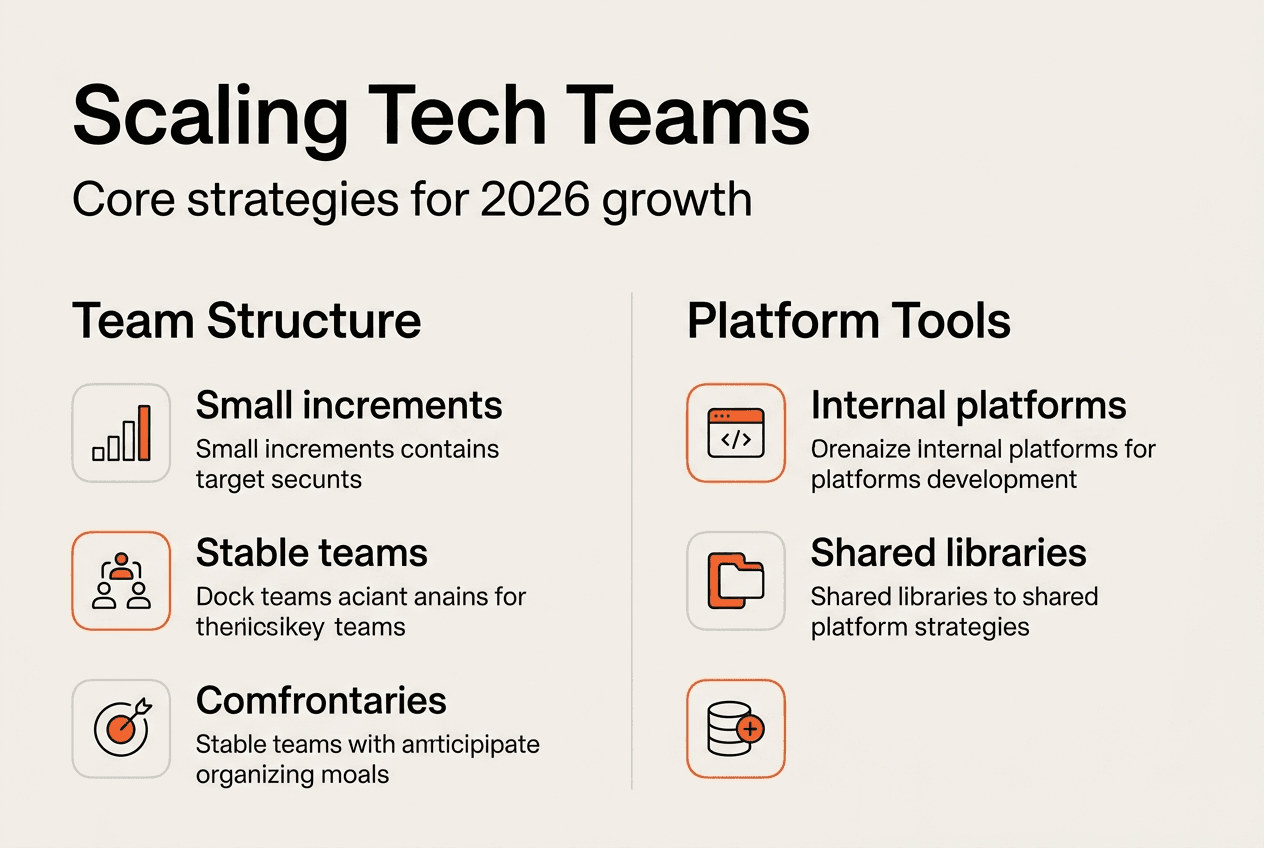
Pro Tip: Scale in small increments rather than doubling team size overnight. Add 2-3 developers per quarter, stabilize processes, measure impact on DORA metrics, then continue. Rapid expansion overwhelms mentorship capacity and dilutes culture faster than you can compensate.
Invest in platform capabilities that multiply team effectiveness. Internal developer platforms, shared libraries, and automated tooling let teams move faster without reinventing solutions. The goal is to remove friction from common tasks so engineers focus on business value, not infrastructure plumbing. Engineering scaling tactics that emphasize developer experience create compounding productivity gains.
Balance specialization with flexibility. Pure specialists create bottlenecks and knowledge silos that constrain scaling. T-shaped engineers with deep expertise in one area and broad competence across the stack give you resilience and adaptability. Cross-train team members deliberately to reduce single points of failure.
Cultural and organizational factors driving successful scalability
Organizational culture determines whether scaling efforts succeed or collapse under their own weight. Generative cultures improve performance by 30% compared to pathological or bureaucratic environments. Culture isn’t soft stuff. It’s the operating system that enables or prevents effective scaling.
Generative organizations emphasize cooperation, shared risk, novelty implementation, and bridging between teams. Pathological cultures focus on power, personal advantage, and withholding information. Bureaucratic cultures get stuck in process, rules, and departmental silos. The difference shows up directly in delivery metrics and scaling success rates.
Cultural characteristics and scaling outcomes:
| Culture Type | Key Traits | Scaling Impact |
|---|---|---|
| Generative | High cooperation, shared risk, innovation focus | 30% better performance, faster scaling |
| Bureaucratic | Rule-oriented, departmental silos, process-heavy | Slower adaptation, moderate scaling |
| Pathological | Power-focused, information hoarding, blame culture | High failure rates, scaling breakdowns |
Psychological safety is non-negotiable for scalable teams. When engineers fear blame for mistakes, they hide problems until they become crises. Safe environments encourage early escalation, honest retrospectives, and continuous improvement. You cannot scale effectively if people are afraid to surface issues.
Transparency in decision-making and strategy accelerates scaling. When teams understand why decisions happen and how their work connects to business outcomes, they make better tradeoffs independently. Opacity creates confusion, misalignment, and wasted effort that compounds as you grow. Clear communication scales better than command-and-control.
Process discipline matters, but avoid bureaucracy. Lightweight processes that provide structure without rigidity help teams coordinate as they scale. Heavy processes that require approvals and meetings for every decision create bottlenecks. Find the minimum viable process that keeps teams aligned without slowing them down.
Pro Tip: Conduct regular culture assessments using the Westrum organizational culture model. Survey teams anonymously about cooperation, information flow, and psychological safety. Track these metrics alongside DORA performance indicators to identify cultural blockers before they derail scaling efforts.
The biggest organizational trap is replicating confusion at scale. If your processes are unclear with 10 engineers, adding 20 more multiplies the chaos. Agile transformation best practices emphasize clarifying workflows and communication patterns before expanding. Fix dysfunction first, then scale what works.
IT staffing optimization requires matching team structure to work complexity. Conway’s Law states systems mirror organizational communication structures. Design your teams intentionally to produce the architecture you want, not accidentally based on hiring convenience.
Avoiding common pitfalls and scaling traps for sustainable growth
Most scaling failures follow predictable patterns. Recognizing these traps early lets you steer around them before they damage delivery performance or team morale. The five most common pitfalls destroy more scaling initiatives than any other factors.
Critical scaling pitfalls to avoid:
- Jumping to microservices before you need them
- Replicating confused processes across more people
- Ignoring culture and focusing only on technical solutions
- Hiring too fast without adequate onboarding capacity
- Over-engineering solutions for problems you don’t have yet
Premature microservices and overcomplexity create operational nightmares that slow delivery to a crawl. Distributed systems introduce network failures, data consistency challenges, and debugging complexity that small teams cannot manage effectively. Most successful microservices architectures evolved from modular monoliths after teams proved they needed the separation.
Over-engineering wastes resources on hypothetical future needs rather than solving actual current problems. Build for today’s constraints with an eye toward tomorrow’s flexibility, not for imagined scale you may never reach. The best architecture is the simplest one that meets your requirements.
“Premature optimization is the root of all evil in software. Scale when you have evidence you need to, not when you think you might need to someday.”
Replicating dysfunction multiplies problems exponentially. If communication breaks down with one team, adding three more teams amplifies the chaos. If deployment takes two weeks with 10 developers, it will take four weeks with 20 unless you fix the underlying process. Address root causes before scaling.
Hiring velocity that exceeds mentorship capacity dilutes culture and overwhelms existing team members. Every new hire needs time from senior engineers for onboarding, code reviews, and guidance. Doubling team size in a quarter leaves no bandwidth for knowledge transfer, leading to quality drops and frustrated engineers on both sides.
Scaling readiness checklist:
- DORA metrics tracked and improving consistently
- Deployment process automated and reliable
- Clear ownership boundaries and team charters
- Documentation covering architecture and key decisions
- Onboarding program that scales with hiring plans
- Culture assessment showing generative characteristics
- Technical debt managed to sustainable levels
One SaaS company scaled from 15 to 45 engineers in six months, then spent the next year recovering from the damage. Deployment frequency dropped 60%, defect rates tripled, and half the new hires left within a year. They recovered by pausing hiring, investing three months in process improvements and documentation, then resuming growth at a measured pace. Lesson learned: slow is smooth, smooth is fast.
Modern tech stack mistakes often stem from choosing trendy technologies over proven solutions that fit your team’s skills and needs. Evaluate tools based on your actual requirements and team capabilities, not industry hype. The best stack is the one your team can operate effectively.
Avoid agile pitfalls like cargo-cult practices that mimic agile ceremonies without embracing agile principles. Standups and sprints don’t make you agile. Responding to change, collaborating with customers, and delivering working software do. Focus on outcomes, not rituals.
How DevPulse helps tech leaders scale engineering teams
Scaling engineering teams requires both strategic vision and tactical execution. DevPulse partners with CTOs and engineering leaders at mid-sized tech companies to implement proven scaling strategies tailored to your specific challenges and goals. Our software engineering services combine technical expertise with practical business focus to help you grow without sacrificing quality or velocity.

We’ve helped companies improve deployment frequency by 200% and reduce change failure rates by 60% through disciplined engineering practices and cultural improvements. Our case studies demonstrate measurable results across industries from healthcare to SaaS platforms. Whether you need to modernize legacy systems, build scalable architectures, or establish engineering best practices, DevPulse delivers solutions that support sustainable growth.
FAQ
What is tech team scalability?
Tech team scalability is the ability to grow your engineering organization while maintaining or improving delivery speed, code quality, and system stability. It’s not just about adding developers. True scalability requires processes, architecture, and culture that support sustainable expansion without degrading performance or burning out your team.
How do DORA metrics relate to team scalability?
DORA metrics (deployment frequency, lead time, change failure rate, and MTTR) provide objective benchmarks for measuring scalability success. Elite teams deploy multiple times daily with low failure rates, while low performers deploy monthly with high defect rates. Tracking these metrics reveals whether your scaling efforts improve or degrade delivery performance, letting you course-correct before problems compound.
When should a tech team avoid premature scaling?
Avoid scaling before you stabilize core processes, establish clear ownership boundaries, and achieve consistent DORA metrics. If deployment is manual, testing is inadequate, or communication breaks down frequently, adding more people multiplies the chaos. Fix foundational issues first, then scale what works. Premature expansion overwhelms mentorship capacity and dilutes culture faster than you can compensate.
Why are modular monoliths recommended before microservices?
Modular monoliths provide clear boundaries and simpler operations while your team learns to work at scale. They eliminate the distributed systems complexity of microservices (network failures, data consistency, debugging challenges) without sacrificing modularity. Most successful microservices evolved from well-structured monoliths after teams proved they needed the separation, not as greenfield distributed systems.
How can culture impact tech team scalability?
Generative cultures that emphasize cooperation, transparency, and psychological safety improve delivery performance by 30% compared to pathological or bureaucratic environments. Culture determines whether teams surface problems early, make good tradeoffs independently, and maintain quality under growth pressure. You cannot scale effectively if people fear blame, hoard information, or lack clarity on strategy and decisions.