













Most executives still view outsourcing as a cost reduction tactic, missing its strategic power to accelerate digital transformation. Recent research reveals that information-centric digital transformation decreases offshore outsourcing intensity, while manufacturing-centric approaches increase it. Understanding these distinctions unlocks outsourcing’s full potential. This article explores transformation types, strategic outsourcing roles, common challenges, and proven practices to help you maximize value from outsourcing partnerships in your digital initiatives.
Table of Contents
- Understanding Digital Transformation Types And Their Impact On Outsourcing
- The Evolving Role Of Outsourcing In Digital Transformation Strategies
- Common Challenges And Strategic Considerations For Outsourcing Digital Transformation Efforts
- Maximizing Value From Outsourcing: Best Practices And Leadership Strategies
- Explore Expert Outsourcing Solutions To Accelerate Your Digital Transformation
Key takeaways
| Point | Details |
|---|---|
| Strategic acceleration | Outsourcing drives digital transformation beyond simple cost savings through innovation partnerships |
| Transformation types | Information-centric and manufacturing-centric digital transformations require different outsourcing strategies |
| AI integration | 83% of organizations now leverage AI as part of outsourced services for competitive advantage |
| Partnership mindset | Strategic collaborators deliver better outcomes than traditional vendor relationships |
| Leadership alignment | Success depends on clear digital owner roles and executive-level strategic decisions |
Understanding digital transformation types and their impact on outsourcing
Digital transformation isn’t a one-size-fits-all concept. Organizations pursue two distinct paths: information-centric digital transformation (IDT) and manufacturing-centric digital transformation (MDT). Each type fundamentally reshapes how companies approach outsourcing decisions.
IDT focuses on leveraging data, analytics, and digital innovation to create new business models and customer experiences. Companies pursuing IDT typically invest in cloud platforms, AI-driven insights, and customer-facing digital products. This transformation type often information-centric digital transformation decreases offshore outsourcing intensity because organizations need tighter control over proprietary data and innovation processes.
MDT optimizes production processes, supply chains, and operational efficiency through digital tools. Manufacturing companies implementing IoT sensors, automated quality control, and smart factory systems exemplify this approach. MDT typically increases outsourcing intensity as organizations seek specialized manufacturing expertise and scale production capabilities globally.
| Transformation Type | Primary Focus | Outsourcing Impact | Strategic Priority |
|---|---|---|---|
| Information-Centric (IDT) | Data, innovation, customer experience | Decreased offshore outsourcing | Control proprietary insights |
| Manufacturing-Centric (MDT) | Production optimization, operational efficiency | Increased outsourcing intensity | Scale manufacturing capabilities |
These distinctions matter for your digital transformation guide strategy. Understanding which transformation type aligns with your business goals shapes resource allocation decisions. IDT companies should focus on building internal capabilities for core innovation while selectively outsourcing non-differentiating technical work. MDT organizations can leverage outsourcing more aggressively to access specialized manufacturing knowledge and global production networks.
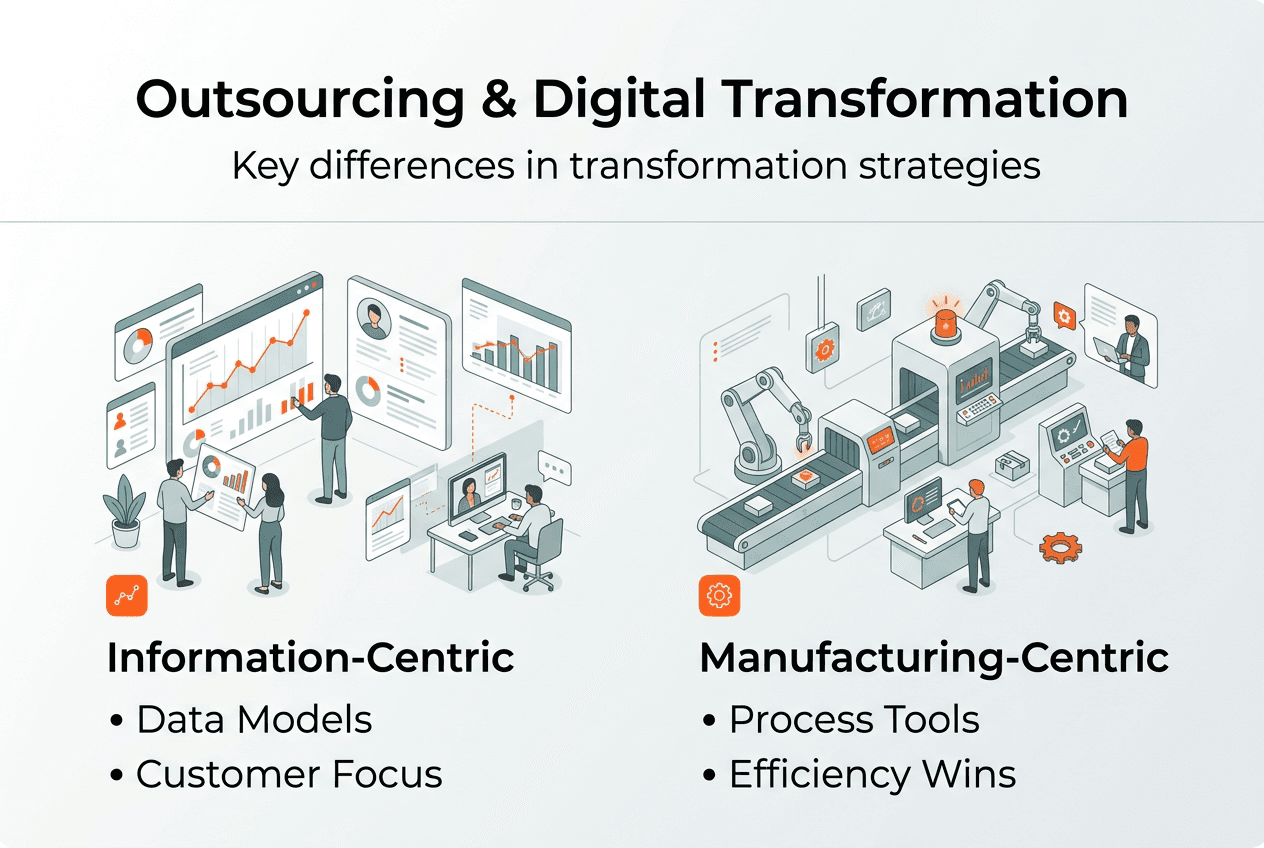
The implications extend beyond simple outsourcing volume. IDT requires partners who understand your industry’s data landscape and can collaborate on innovation initiatives. MDT demands partners with proven manufacturing expertise and quality control systems. Matching your transformation type to the right outsourcing strategy prevents costly misalignment and accelerates results.
The evolving role of outsourcing in digital transformation strategies
Outsourcing has transformed from basic labor arbitrage into strategic technology and talent orchestration. Organizations now expect partners to drive innovation, not just execute predefined tasks. This shift reflects broader market dynamics and technological capabilities.

AI integration exemplifies this evolution. 83% of surveyed executives leverage AI as part of outsourced services, making artificial intelligence mainstream in outsourcing relationships. Partners now deliver AI-powered automation, predictive analytics, and intelligent process optimization alongside traditional services. This capability expansion enables organizations to access cutting-edge technology without building every capability internally.
Market growth validates the strategic value shift. The global IT outsourcing market reaches $850.73 billion by 2030 with 5.48% compound annual growth, driven by demand for specialized expertise and rapid technology adoption. Companies recognize that building internal teams for every emerging technology creates unsustainable cost structures and talent competition.
“81% of organizations want providers as strategic collaborators, not just vendors, seeking partners who understand business objectives and contribute to transformational outcomes.”
This collaboration mindset reshapes partner selection criteria. Technical competence remains essential, but strategic alignment, innovation capacity, and business acumen now differentiate top partners. Organizations evaluate whether potential partners can challenge assumptions, propose better approaches, and adapt to evolving requirements.
The engineering outsourcing guide principles apply broadly across digital initiatives. Successful partnerships require:
- Shared understanding of business objectives beyond technical specifications
- Proactive communication about risks, opportunities, and alternative approaches
- Investment in relationship building and knowledge transfer between teams
- Flexibility to adjust scope and priorities as transformation initiatives evolve
- Commitment to continuous improvement and innovation exploration
Organizations implementing AI-powered change management particularly benefit from strategic outsourcing partnerships. External partners bring fresh perspectives on AI adoption, help navigate organizational resistance, and accelerate capability building through hands-on collaboration.
The talent orchestration aspect deserves emphasis. Rather than simply providing bodies to fill roles, strategic partners curate teams with complementary skills, manage knowledge transfer, and ensure continuity through personnel changes. This orchestration capability becomes increasingly valuable as technology landscapes grow more complex and specialized skills become harder to source.
Common challenges and strategic considerations for outsourcing digital transformation efforts
Despite outsourcing’s strategic potential, organizations face significant obstacles that undermine digital transformation success. Understanding these challenges helps you build more resilient strategies and select better partners.
Talent shortages constrain outsourcing effectiveness across industries. 77% of employers face difficulties finding skilled talent, directly impacting outsourcing quality and delivery timelines. This scarcity affects both internal teams and outsourcing partners, creating competition for specialized expertise in AI, cloud architecture, and cybersecurity.
High failure rates compound the challenge. Digital transformation initiatives fail 70% of the time, often due to misaligned expectations, poor governance, or inadequate change management. Outsourcing adds complexity to already difficult initiatives, requiring careful coordination between internal and external teams.
Common outsourcing mistakes slow delivery despite potential benefits like scaling and cost control. These mistakes include:
- Unclear scope definition leading to mismatched expectations and scope creep
- Insufficient governance structures creating accountability gaps and coordination failures
- Inadequate knowledge transfer preventing effective collaboration and continuity
- Wrong partner selection based on cost rather than strategic fit and capabilities
- Poor integration planning leaving outsourced work disconnected from broader initiatives
Pro Tip: Regularly reevaluate digital owner roles every six months and maintain mixed skill teams combining internal and external expertise. This practice improves outcomes by ensuring accountability remains clear and knowledge stays distributed across your organization.
Strategic considerations for maximizing outsourcing success start with partner selection. Look beyond technical credentials to evaluate cultural fit, communication practices, and strategic thinking capabilities. The best partners challenge your assumptions constructively and propose alternatives you haven’t considered.
Governance structures must balance oversight with autonomy. Micromanaging outsourced teams destroys the efficiency and innovation benefits you’re seeking. Instead, establish clear success metrics, regular review cadences, and escalation paths for issues. Trust your partners to manage day-to-day execution while you focus on strategic direction.
Integration planning deserves upfront investment. Define how outsourced work connects to internal systems, processes, and teams before engagement begins. This planning prevents the common scenario where technically sound deliverables fail to integrate smoothly, creating rework and delays.
The software development outsourcing guide provides detailed frameworks for addressing these challenges in software-intensive digital transformations. Apply these principles across all outsourcing relationships to build more effective partnerships.
Maximizing value from outsourcing: best practices and leadership strategies
Successful digital transformation through outsourcing requires deliberate leadership strategies and proven best practices. Organizations that treat outsourcing as a strategic capability rather than a tactical necessity achieve dramatically better results.
Leadership role definition makes the difference between success and failure. Successful digital transformation relies on strategic choices with future-ready enterprises using mixed skills teams and clear accountability structures. Appointing a digital owner who reports directly to the CEO signals strategic importance and ensures transformation initiatives receive executive attention.
The collaboration versus vendor mindset fundamentally shapes outcomes. Three out of four companies want help with transformational outcomes beyond transactional tasks. This expectation requires treating partners as extensions of your team rather than external service providers.
Implement these best practices to maximize outsourcing value:
- Select partners based on strategic alignment and innovation capacity, not just cost and technical skills
- Establish governance frameworks that define clear accountability while preserving partner autonomy for execution
- Integrate AI capabilities throughout outsourced services to accelerate automation and insights generation
- Build mixed skill teams combining internal domain expertise with external technical specialists
- Foster continuous innovation by encouraging partners to propose improvements and challenge existing approaches
- Align outsourcing decisions with long-term enterprise vision rather than short-term project needs
| Traditional Outsourcing | Strategic Transformation Outsourcing |
|---|---|
| Cost reduction focus | Value creation and innovation focus |
| Transactional vendor relationships | Strategic partnership collaboration |
| Fixed scope and deliverables | Adaptive scope responding to learning |
| Minimal partner involvement in strategy | Partners contribute to strategic planning |
| Success measured by cost savings | Success measured by business outcomes |
Pro Tip: Foster mixed skill teams by embedding outsourced specialists within internal product teams rather than isolating them in separate workstreams. This integration accelerates knowledge transfer, improves communication, and ensures outsourced work aligns tightly with business objectives.
Leadership structures supporting outsourcing success require executive sponsorship and cross-functional coordination. The digital owner role should have authority to make technology decisions, allocate resources, and resolve conflicts between business units. Without this authority, digital transformation initiatives bog down in committee discussions and political maneuvering.
Regular reevaluation of roles and responsibilities prevents drift as initiatives evolve. What worked during initial planning may not serve execution and scaling phases. Schedule quarterly reviews to assess whether current structures support your goals or need adjustment.
Explore digital transformation solutions that combine strategic consulting with technical execution. The most effective approaches integrate strategy development, capability building, and hands-on implementation rather than treating these as separate phases.
Consider agentic AI insights when planning AI integration within outsourced services. Agentic AI systems that can act autonomously within defined parameters offer significant productivity gains but require careful governance and ethical considerations.
The alignment between outsourcing strategy and enterprise vision cannot be overstated. Every outsourcing decision should advance your long-term competitive position, not just solve immediate capacity constraints. Ask whether each partnership builds capabilities you’ll need in three to five years, not just what you need today.
Explore expert outsourcing solutions to accelerate your digital transformation
Applying these strategic outsourcing principles requires partners who understand both technology and business transformation. DevPulse combines deep technical expertise with practical business insight to help organizations leverage outsourcing effectively for digital initiatives.
Our software engineering services support everything from modernizing legacy systems to building AI-powered solutions and enterprise platforms. We work as strategic collaborators, not just vendors, contributing to your transformation vision while delivering reliable technical execution.
Explore our strategic outsourcing guide for detailed frameworks on partner selection, governance, and value maximization. Review real-world case studies showcasing how organizations across healthcare, cybersecurity, and enterprise software have accelerated digital transformation through strategic outsourcing partnerships.
Frequently asked questions
What types of digital transformation benefit most from outsourcing?
Manufacturing-centric digital transformations typically benefit most from increased outsourcing to access specialized production expertise and scale capabilities globally. Information-centric transformations require more selective outsourcing focused on non-differentiating technical work while keeping core innovation and data strategy internal.
How can leaders avoid common pitfalls in outsourcing digital initiatives?
Establish clear governance structures with defined accountability, invest in upfront integration planning, and select partners based on strategic fit rather than cost alone. Regular reevaluation of digital owner roles and maintaining mixed skill teams combining internal and external expertise significantly improves outcomes and prevents common coordination failures.
What role does AI play in outsourced digital transformation?
83% of organizations now leverage AI as part of outsourced services for automation, predictive analytics, and intelligent process optimization. AI integration enables partners to deliver more value through enhanced capabilities while helping organizations access cutting-edge technology without building every AI capability internally. Learn more about software outsourcing benefits including AI integration.
How should companies choose strategic outsourcing partners?
Evaluate partners on strategic alignment, innovation capacity, and cultural fit beyond technical credentials. The best partners challenge assumptions constructively, propose alternative approaches, and demonstrate business acumen alongside technical expertise. Review outsourcing tips for tech execs for detailed selection criteria.
What leadership structures support outsourcing success?
Appoint a digital owner reporting directly to the CEO with authority to make technology decisions, allocate resources, and resolve cross-functional conflicts. This executive sponsorship signals strategic importance and ensures transformation initiatives receive necessary attention and resources to succeed.
Recommended
- Why outsource software development? Strategic guide 2026
- Engineering outsourcing guide for tech executives in 2026
- Digital Transformation in 2025: A Comprehensive, Step-by-Step Guide – devPulse
- Digital Transformation Solutions | Legacy Modernization | devPulse
- De ce să externalizezi marketingul digital în 2026
- Elektrotechnik Outsourcing: Chancen, Risiken und Praxis – Elektrotechnik Ernst