














Scaling engineering teams is one of the toughest challenges facing SaaS and enterprise leaders today. Adding headcount without a solid foundation often creates chaos, not capacity. Communication breaks down, quality suffers, and velocity stalls. The good news? Effective scaling is entirely achievable with the right preparation, structure, and continuous improvement mindset. This guide walks you through proven strategies to grow your engineering organization while sustaining collaboration, maintaining code quality, and accelerating delivery. You’ll learn how to prepare your systems, choose optimal team structures, onboard efficiently, and measure what matters.
Table of Contents
- Preparing To Scale Your Engineering Team
- Choosing The Right Team Structure And Collaboration Model
- Managing Growth: Workflows, Onboarding, And Minimizing Scaling Challenges
- Measuring Success And Iterating Scaling Strategies
- Enhance Your Engineering Scaling With Devpulse Services
- How To Scale Engineering Teams Frequently Asked Questions
Key takeaways
| Point | Details |
|---|---|
| Prepare before you scale | Establish robust workflows, clear roles, and scalable tools before adding team members to avoid coordination chaos. |
| Choose the right structure | Select team models like cross-functional squads or feature teams based on your company’s maturity and project complexity. |
| Anticipate common pitfalls | Proactively address communication breakdowns, cultural dilution, and tool sprawl as your team expands. |
| Onboard with intention | Implement structured onboarding processes to integrate new engineers quickly without sacrificing team momentum. |
| Measure and iterate | Track key metrics and gather feedback to continuously refine your scaling strategy and ensure long-term success. |
Preparing to scale your engineering team
Before you post a single job listing, take stock of your current state. Scaling a broken system just amplifies existing problems. Start by assessing where your team struggles today. Are deployments delayed by manual processes? Do engineers spend hours in meetings instead of coding? Identifying bottlenecks now saves massive headaches later.
Define clear roles and responsibilities across your organization. Ambiguity kills productivity, especially as teams grow. When everyone knows who owns what, decision-making accelerates and duplicate work disappears. Document these roles in a shared wiki or handbook that new hires can reference immediately.
Next, implement workflows that support sustainable growth. Developing workflows and systems that support sustainable team growth is essential for effective scaling. Consider adopting DevOps practices to automate testing, deployment, and monitoring. Automation reduces manual overhead and lets your team focus on building features instead of fighting fires.
Strategic engineering outsourcing can supplement your core team during rapid growth phases. Outsourcing specialized tasks or overflow work provides flexibility without long-term hiring commitments. Just ensure you have solid processes in place first, so external contributors integrate smoothly.
Invest in scalable communication and collaboration tools early. Slack channels, project management platforms, and documentation systems become critical as headcount increases. Choose tools that grow with you and integrate well with your existing stack.
Pro Tip: Map out your ideal team structure at 2x and 3x your current size before hiring anyone. This exercise reveals gaps in your current setup and helps you hire strategically instead of reactively.
Finally, explore digital process automation to eliminate repetitive tasks. Automating code reviews, deployment pipelines, and incident response frees engineers to tackle complex problems. The time you invest in automation now pays exponential dividends as your team scales.
- Audit current workflows for inefficiencies and bottlenecks
- Document roles, responsibilities, and decision-making authority
- Automate repetitive tasks through DevOps and process automation
- Select collaboration tools that scale beyond your immediate needs
- Consider outsourcing strategically to maintain flexibility
Choosing the right team structure and collaboration model
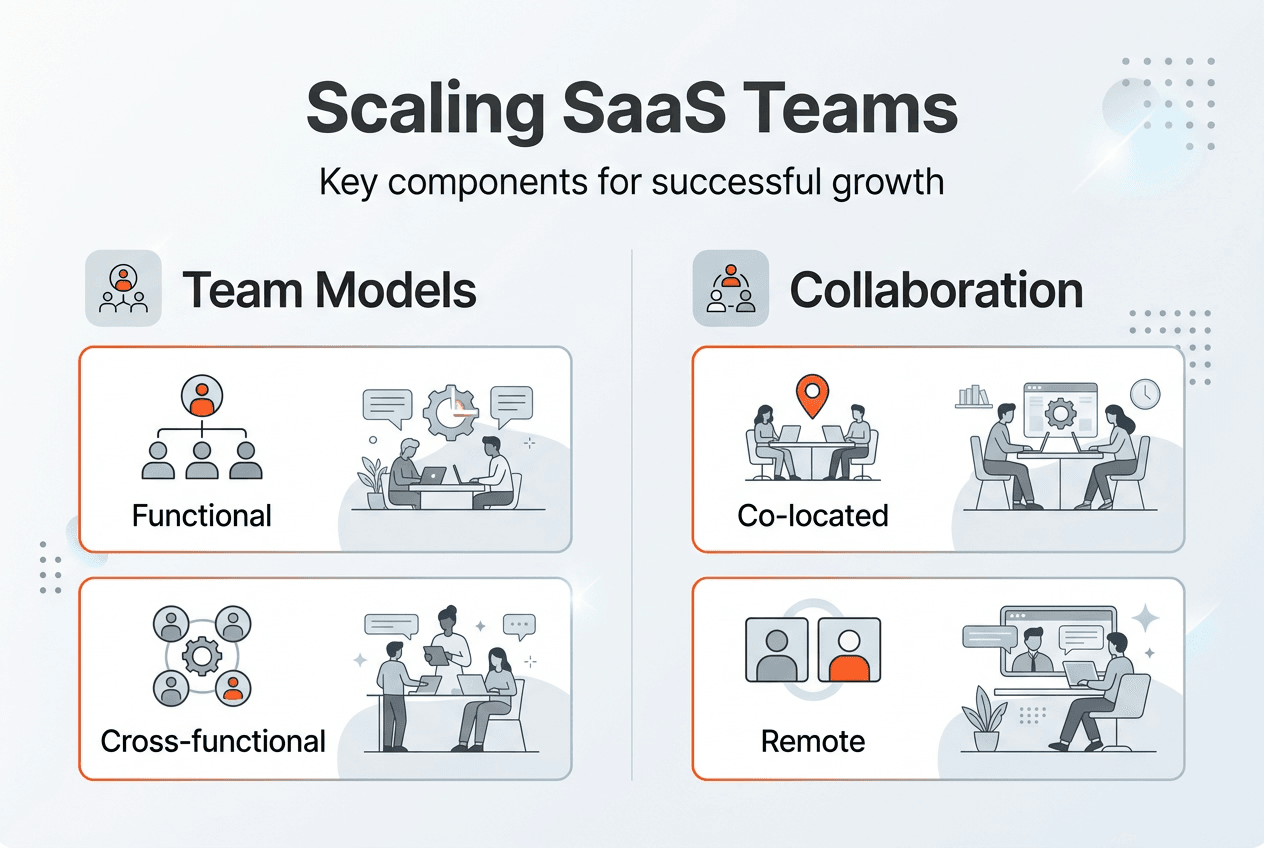
Team structure dramatically impacts how effectively you scale. Functional teams organize around disciplines like frontend, backend, and QA. This model works well for smaller organizations where deep expertise matters more than cross-functional speed. However, functional silos can slow decision-making as you grow.
Cross-functional teams bring together engineers, designers, and product managers around shared objectives. These squads own entire features or products end to end, enabling faster iteration and clearer accountability. Types of remote teams have significant impact on productivity and collaboration when scaling. Feature teams, a subset of cross-functional teams, focus on specific product areas and make autonomous decisions within their domain.
Dedicated teams can boost software project success by improving focus and accountability. When engineers work exclusively on one project or product, they develop deep context and move faster. This model shines for complex enterprise software where domain knowledge is critical.

Collaboration models add another dimension. Co-located teams share physical office space, enabling spontaneous conversations and rapid problem-solving. Distributed teams span multiple offices or time zones, requiring more deliberate communication but accessing broader talent pools. Remote teams work entirely online, offering maximum flexibility but demanding strong asynchronous practices. Hybrid models blend these approaches, giving teams autonomy to choose what works best.
Each model has tradeoffs. Co-located teams build culture quickly but limit your hiring radius. Remote teams access global talent but require intentional relationship building. Distributed teams balance these extremes but introduce coordination complexity across time zones.
Pro Tip: Start with a pilot team structure before rolling it out organization-wide. Run a three-month experiment with one squad, gather feedback, and iterate before committing to a permanent model.
Align your structure choice with company culture and project complexity. Early-stage startups often thrive with small, scrappy cross-functional teams. Mature enterprises with multiple products may need functional centers of excellence plus feature teams. There’s no universal answer, only what fits your context.
| Team Structure | Best For | Key Advantage | Main Challenge |
| — | — | — |
| Functional | Small teams needing deep expertise | Specialization and skill development | Slower cross-team coordination |
| Cross-functional | Mid-size teams prioritizing speed | End-to-end ownership and autonomy | Requires strong generalists |
| Feature teams | Large orgs with complex products | Deep product context and focus | Potential knowledge silos |
| Dedicated teams | Projects needing sustained focus | Continuity and domain expertise | Less flexibility for shifting priorities |
Managing distributed teams requires explicit communication norms. Document decisions in writing, record meetings for async viewing, and establish core overlap hours for real-time collaboration. Over-communicate initially until these practices become second nature.
- Match team structure to your company’s maturity and goals
- Consider hybrid models that blend co-located and remote work
- Pilot new structures before full organizational rollout
- Establish clear communication protocols for distributed teams
- Prioritize autonomy and ownership to maximize team velocity
Managing growth: workflows, onboarding, and minimizing scaling challenges
Onboarding determines whether new hires accelerate or slow your team. Onboarding processes are critical to integrating new hires seamlessly in growing engineering organizations. A structured 30-60-90 day plan sets clear expectations and builds confidence. Here’s a proven framework:
- Pre-boarding: Send equipment, credentials, and welcome materials before day one so new hires hit the ground running.
- Week one: Focus on culture, tools, and codebase orientation. Pair new engineers with buddies who answer questions and provide context.
- Month one: Assign small, well-defined tasks that touch multiple parts of the system. This builds familiarity without overwhelming complexity.
- Month two: Gradually increase scope and autonomy. Encourage new hires to participate in planning and code reviews.
- Month three: Expect full productivity. New engineers should own features and contribute to architectural decisions.
Maintaining velocity during rapid growth requires intentional effort. Managing expansion requires optimized IT staffing workflows and proactive obstacle handling. Protect your team’s focus by limiting context switching and meeting overload. Batch similar tasks together and establish no-meeting blocks for deep work.
Common scaling challenges include communication breakdowns, tool sprawl, and cultural dilution. As teams grow, informal hallway conversations no longer suffice. Implement structured communication rhythms like daily standups, weekly planning, and monthly retrospectives. These rituals keep everyone aligned without constant interruptions.
Tool sprawl happens when different teams adopt their own solutions without coordination. Standardize your core stack while allowing flexibility for team-specific needs. Too much rigidity stifles innovation, but too much chaos creates integration nightmares.
Cultural shifts are inevitable as headcount increases. Your scrappy startup vibe evolves into something more structured. Acknowledge this openly and involve the team in defining your new culture. Preserve what matters most while adapting to new realities.
Pro Tip: Create a scaling playbook that documents your onboarding process, communication norms, and decision-making frameworks. Update it quarterly based on what’s working and what’s not. This living document becomes your institutional knowledge as people come and go.
Continuous process improvement keeps scaling efforts on track. Hold regular retrospectives to identify friction points and experiment with solutions. Small, iterative changes compound over time into major productivity gains.
Leverage technical support and maintenance services to handle operational overhead so your core team focuses on building new features. Outsourcing infrastructure management, monitoring, and incident response frees engineers for higher-value work.
- Implement structured 30-60-90 day onboarding plans
- Protect focus time by batching meetings and limiting context switching
- Standardize core tools while allowing team-specific flexibility
- Hold regular retrospectives to identify and fix friction points
- Preserve cultural values while adapting to organizational growth
Measuring success and iterating scaling strategies
You can’t improve what you don’t measure. Tracking the right metrics reveals whether your scaling efforts are working or need adjustment. Start with deployment frequency, which indicates how quickly your team ships value. High-performing teams deploy multiple times per day, while struggling teams ship weekly or less.
Lead time for changes measures how long it takes from code commit to production deployment. Shorter lead times mean faster feedback loops and quicker iteration. Mean time to recovery (MTTR) shows how quickly you bounce back from incidents. Lower MTTR indicates robust systems and effective incident response.
Change failure rate tracks what percentage of deployments cause problems requiring rollback or hotfixes. This metric balances speed with quality. Aim for a failure rate below 15% while maintaining high deployment frequency.
Beyond these DevOps metrics, track team health indicators like employee satisfaction, retention, and velocity trends. Using metrics and feedback loops enables continuous improvement and verification of scaling effectiveness. Quarterly surveys reveal morale issues before they become crises.
Qualitative feedback matters as much as quantitative data. Conduct regular one-on-ones with engineers to understand their challenges and frustrations. Anonymous feedback channels surface issues people hesitate to raise publicly.
Common pitfalls in measuring success include vanity metrics that look good but don’t drive decisions. Lines of code written or hours worked tell you nothing about actual productivity. Focus on outcomes like features shipped, bugs resolved, and customer satisfaction instead.
Another mistake is measuring without acting. Data is worthless if you don’t use it to improve. Establish a regular cadence for reviewing metrics, identifying trends, and implementing changes based on what you learn.
Align measurement with business goals and product delivery timelines. Engineering metrics should connect directly to customer value and revenue impact. If you can’t draw a line from a metric to business outcomes, question whether it’s worth tracking.
| Metric | What It Measures | Target Range |
|---|---|---|
| Deployment frequency | How often code ships to production | Multiple times per day |
| Lead time for changes | Time from commit to deployment | Under 1 day |
| Mean time to recovery | How quickly issues get fixed | Under 1 hour |
| Change failure rate | Percentage of deployments causing problems | Below 15% |
Create a framework for iterating team structures and processes based on data. When metrics trend negative, dig into root causes before jumping to solutions. Is low deployment frequency caused by manual testing, unclear requirements, or technical debt? Each root cause demands a different intervention.
Run small experiments to test improvements. Change one variable at a time so you can isolate what works. Give experiments enough time to show results, typically 4-6 weeks, before declaring success or failure.
- Track deployment frequency, lead time, MTTR, and change failure rate
- Supplement quantitative metrics with qualitative feedback from engineers
- Avoid vanity metrics that don’t inform decisions or drive action
- Connect engineering metrics directly to business outcomes and customer value
- Run controlled experiments to test process improvements before scaling them
Enhance your engineering scaling with DevPulse services
Scaling engineering teams is complex, but you don’t have to figure it out alone. DevPulse specializes in software enhancement and engineering services that help SaaS companies and enterprises build, modernize, and scale digital products effectively. Our team combines deep technical expertise with practical business insight to deliver solutions tailored to your scaling challenges.

We’ve helped clients across healthcare, cybersecurity, legal tech, and edtech successfully scale their engineering organizations while maintaining quality and velocity. Our case studies demonstrate proven results in complex enterprise environments and fast-growing startups alike.
Beyond initial scaling support, our technical support and maintenance services ensure your systems remain reliable and performant as you grow. From DevOps automation to infrastructure optimization, we handle the operational overhead so your team focuses on innovation. Partner with DevPulse to accelerate your engineering team’s growth and achieve sustainable success.
How to scale engineering teams frequently asked questions
What is the first step to scale an engineering team?
Assess your current workflows, tools, and bottlenecks before adding headcount. Document roles clearly and implement automation to handle repetitive tasks. Scaling a broken system just amplifies existing problems, so fix foundational issues first.
How do remote teams affect scaling efficiency?
Remote teams access global talent pools and offer flexibility, but require strong asynchronous communication practices and intentional culture building. Success depends on clear documentation, structured onboarding, and regular synchronous touchpoints for relationship building.
What common mistakes should be avoided when scaling?
Avoiding premature scaling without solid processes, neglecting onboarding quality, and failing to measure results are critical mistakes. Also watch for tool sprawl, communication breakdowns, and losing cultural cohesion as headcount increases. Address these proactively through structured workflows and regular retrospectives.
How long does it typically take to see results from scaling?
Expect 3-6 months before new team members reach full productivity and scaling efforts show measurable impact. The first month focuses on onboarding, months two and three on ramping up, and months four through six on sustained contribution. Patience and structured support during this period determine long-term success.
Which metrics are most important to track in scaling?
Prioritize deployment frequency, lead time for changes, mean time to recovery, and change failure rate as core DevOps metrics. Supplement these with team health indicators like employee satisfaction, retention rates, and velocity trends. Connect all metrics to business outcomes and customer value for maximum relevance.
Recommended
- Engineering outsourcing guide for tech executives in 2026
- Types of remote teams: boost productivity in 2026
- Why dedicated teams boost software project success in 2026
- Software Enhancement | Product Modernisation Experts – DevPulse
- Events in lead generation: B2B success strategies 2026
- De nieuwe standaard in leadgeneratie: persoonlijk en schaalbaar – Re:Positive