










Real-Time Medical Signal Analysis Software for Healthcare Diagnostics
Applications delivered
Expert Team
Years Of Partnership period
Client Background
Our client is one of the leading medical technology companies in Ukraine, specializing in functional diagnostic systems. Their product line includes Electroencephalography (EEG), Electrocardiography (ECG), Fetal and Holter ECG monitoring, Rheography (REG/ICG), and Spirometry (SPR) systems — all designed to provide precise, data-driven insights for clinicians. Their systems are used in clinical and research environments where accuracy, speed, and reliability are critical.
Case Attributes
Services used
Platform development
Quality Engineering
Technology
ConcRT / C++11
Microsoft PPL
Intel IPP / AMD ACML
DirectX (3D / Draw / Sound)
MFC / GDI / GDI+
XML / XSLT / XPath
COM WDK / DeviceIoControl / FTDI
SQL / Access DB
LibCURL / OpenSSL
HTML5 (reports)
Team Composition
3 Developers
PM
QA Engineer
Let’s enhance your team together
Business Challenge
The company sought to develop a suite of desktop applications — including NeuroCom (EEG), ReoCom (REG/ICG), and SpiroCom (SPR) — that could deliver deep signal analysis and maximum computational efficiency on standard Windows-based computers, even on older or low-spec machines.
These challenges limited the system’s ability to deliver consistent performance and constrained further product development.
Real-time processing of high-frequency physiological data streams
Continuous data from medical devices needed to be processed instantly without delays, requiring highly efficient and low-latency data pipelines.
Ensuring low-latency data analysis for near-instant diagnostics
The system needed to deliver insights almost immediately to support timely clinical decisions and real-time monitoring scenarios.
Maintaining accuracy and stability under continuous data load
Long-running data streams increased the risk of signal distortion, data loss, or inconsistencies, requiring robust validation and error-handling mechanisms.
Scaling the system for broader clinical and research use
The architecture needed to support growing data volumes, additional signal types, and wider adoption without compromising performance.
The solution
We designed and implemented a real-time medical signal analysis software capable of processing complex physiological data streams with high accuracy and low latency. responsiveness to operational needs.
The solution provides:
- Real-time acquisition and processing of medical signals
- Multi-channel data analysis for complex diagnostic scenarios
- High-performance computation optimized for continuous data streams
- Scalable architecture for clinical and research environments
- Reliable and consistent data processing under sustained workloads
We focused on efficiency, modularity, and low-level optimization. The core system is implemented in C++ with a modular architecture and a small, centralized application kernel managing dependencies. Performance-critical modules use hardware-optimized math libraries and multi-threading to accelerate signal processing while keeping memory usage minimal.

Key Achievements
High efficiency on low hardware
Real-time performance without expensive equipment.
Secure & modern storage
Hybrid SQL + binary, XML/XSLT, encrypted REST
Modular architecture
Load only active modules to save memory
Clinical-grade analytics
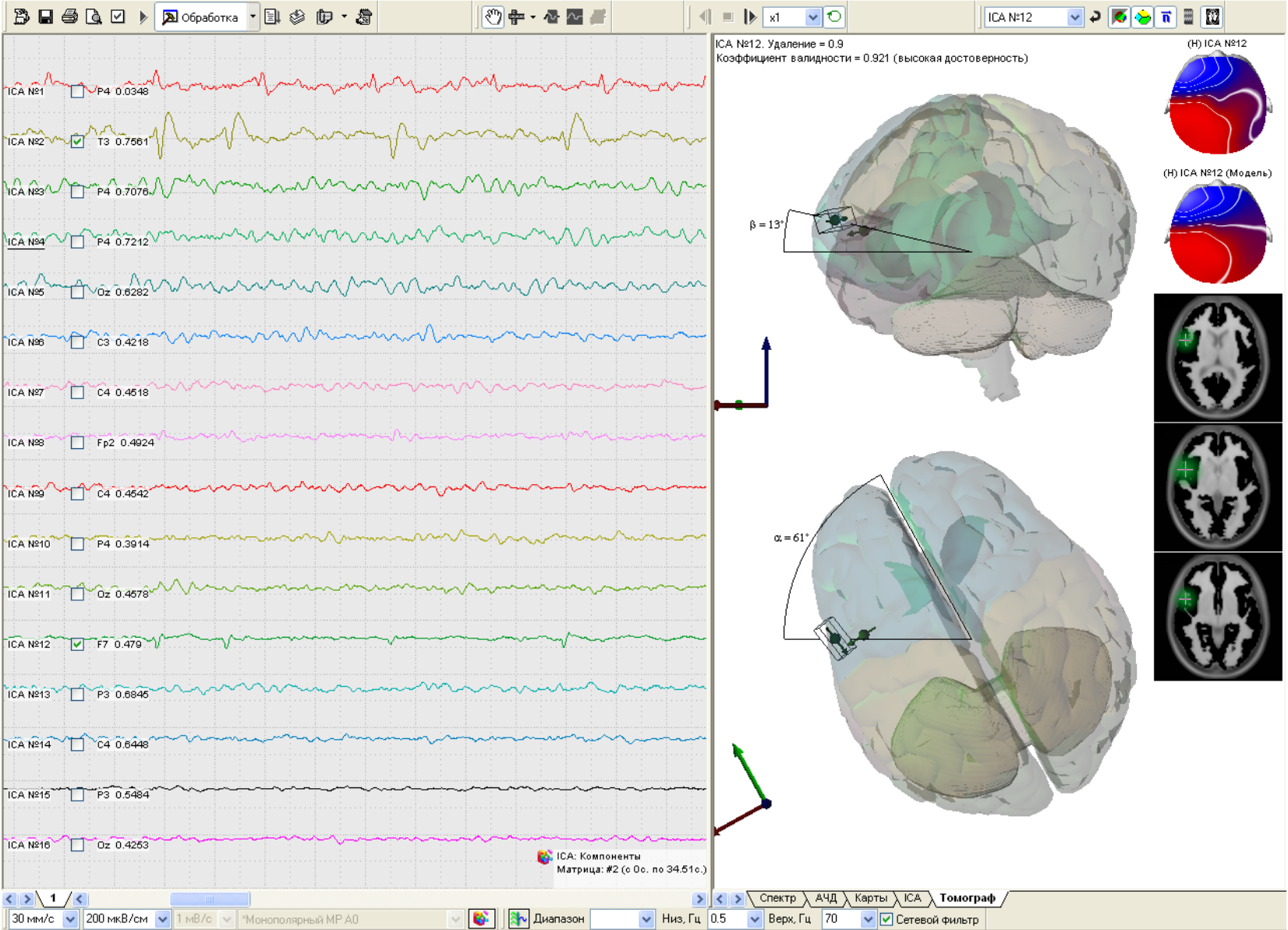
ICA, 3D tomography, artifact removal
Clinician-friendly UI
Tabbed MDI, docking, multi-monitor support
How It Works
The software system processes incoming physiological data streams through a high-performance pipeline optimized for real-time analysis:
Key Technical Decisions
To ensure reliability and performance in a healthcare environment, several critical architectural decisions were made.
Low-latency processing architecture
The system was designed to minimize processing delays, enabling near real-time diagnostics and continuous monitoring.
Optimized data pipelines
Efficient data handling mechanisms were implemented to process high-frequency signals without bottlenecks.
Multi-threaded and parallel processing
Parallel execution allowed the system to handle multiple data streams simultaneously without performance degradation.
Scalable system design
The architecture supports increasing data volumes and additional signal types without requiring major redesign.
The Result
The engagement resulted in the delivery of a suite of diagnostic applications that provided the client with a reliable and scalable software foundation for real-time medical signal analysis across clinical and research environments.
The new system improved overall performance and diagnostic capabilities by enabling faster data analysis, more accurate signal interpretation, and stable operation under continuous high-load conditions. This allowed the client to expand the solution for broader use while maintaining the consistency and reliability required in healthcare workflows.
Business Applicability
This solution is applicable in healthcare and research environments where real-time data processing and high-performance analysis are critical.
Clinical diagnostics systems
Supports real-time analysis of physiological signals for faster and more accurate medical decision-making.
Medical research platforms
Enables processing of large volumes of experimental data for advanced analysis and experimentation.
Multi-signal monitoring environments
Suitable for systems that require simultaneous analysis of multiple physiological signals.
High-performance healthcare software systems
Provides a foundation for scalable and reliable medical data processing applications.
Value Delivered by devPulse
This solution is applicable in healthcare and research environments where real-time data processing and high-performance analysis are critical.
01
Consistent real-time performance on standard and legacy PCs (including dual-core machines)
02
Robust data integrity with immediate persistence and fault-tolerant design
03
Significantly faster signal analysis due to parallelized, hardware-optimized pipelines
04
Intuitive UI tailored for clinicians and multi-monitor workflows
05
Modular architecture enabling rapid integration of new research algorithms
Building a real-time medical or data-intensive system?
Let’s design a scalable, high-performance architecture tailored to your needs.