














About 51% of companies experience major disruption or temporary process stoppages at ERP go-live. Custom ERP software development is worth pursuing only when it replaces legacy capabilities in controlled stages, rather than forcing the enterprise through a single high-risk cutover.
That changes the central question. The issue isn't whether you should buy a suite or build every module yourself. The serious question is how to modernize fragmented finance, supply chain, HR, reporting, and operational systems without interrupting the business that pays for the transformation.
A custom ERP should become a modular operating platform, not a monolithic replacement project. Keep stable capabilities where they work, isolate high-risk dependencies, and replace the parts that constrain growth, compliance, or operational control. This approach demands stronger architecture and governance at the start, but it gives leadership measurable checkpoints, reversible decisions, and a safer path from legacy complexity to coordinated enterprise data.
Table of Contents
- Where ERP Projects Break Down
- Defining Your Requirements and Architecture
- Strategies for Legacy Modernization
- Designing Accessible and Actionable Dashboards
- Implementing AI and Automation Wisely
- Real-World ERP Scenarios and Outcomes
Where ERP Projects Break Down
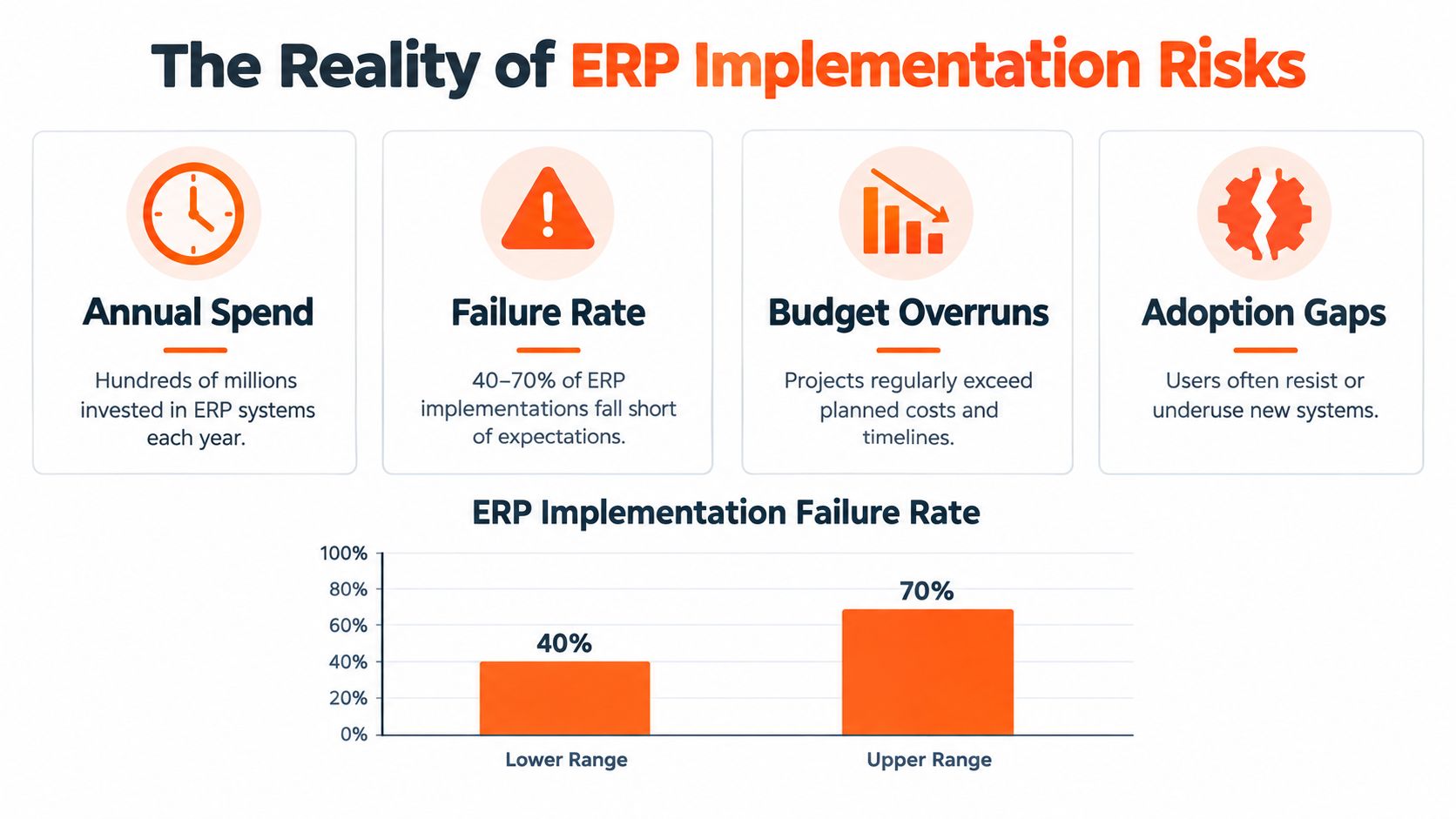
ERP projects fail in more ways than a cancelled deployment. A system can launch on schedule and still fail operationally through unusable workflows, unreliable migrated data, weak adoption, or reports that departments refuse to trust. A peer-reviewed review of ERP research reports internationally cited failure rates ranging from 40% to 70%, although definitions vary across cancellation, major delay, budget overrun, and failure to achieve expected benefits. The review of ERP failure research makes the correct interpretation clear: the range signals unusually high delivery risk, not proof that most projects collapse.
ERP risk comes from the interaction of software engineering, process redesign, data migration, organizational change, and cross-department integration. A finance ledger, inventory record, employee profile, and sales order each carry different ownership rules, timing requirements, permissions, reconciliation needs, and consequences when records become inconsistent. Treating them as ordinary application objects creates defects that surface in daily operations, not just in testing.
Why go-live creates operational exposure
The transition often creates more exposure than the new feature set. Verified evidence reports that 51% of companies experience major disruption or temporary process stoppages at go-live. The ERP implementation statistics source associates disappointing outcomes with insufficient testing and failure to redesign underlying processes, not only with programming defects.
A clean codebase cannot compensate for an undocumented approval path, an unresolved customer duplicate, or a warehouse team that still relies on a spreadsheet because the new screen conflicts with the physical workflow. A launch date is not a control mechanism. Treat go-live as a production experiment with measurable conditions, rollback options, and named decision-makers.
Use incremental releases, production-like pilots, explicit exit criteria, and contingency capacity for remediation. One published analysis reports that ERP projects average 2.5 times their projected duration, run 178% over budget, and realize only 30% of agreed benefits. It also reports that approximately 70% of implementations fail, while acknowledging that definitions vary. The published ERP outcome analysis supports staged delivery rather than a single irreversible cutover.
What leadership should control
Engineering must make risk visible before the organization commits to broad deployment.
- Scope control: Separate mandatory operational capabilities from convenience features. Require an owner, impact assessment, and explicit trade-off for every new requirement.
- Data readiness: Treat financial balances, inventory, identities, and regulated records as release-blocking domains when reconciliation fails.
- Integration proof: Test fragile external systems early, before the full architecture becomes difficult to change.
- Adoption evidence: Require representative users to complete real tasks in user acceptance testing, not merely approve screenshots.
- Executive decisions: Give a steering committee authority to defer scope, fund remediation, and select phased deployment when evidence changes.
Practical rule: If the organization cannot state how it will detect a bad migration, stop a faulty release, and return users to a working process, it is not ready for go-live.
The right response to ERP risk is controlled modernization. Engineer the transition in smaller, observable increments, and test requirements, data, integrations, and user behavior as one operating system. A strangler approach lets each proven component replace a defined legacy capability while the business continues operating.
Defining Your Requirements and Architecture
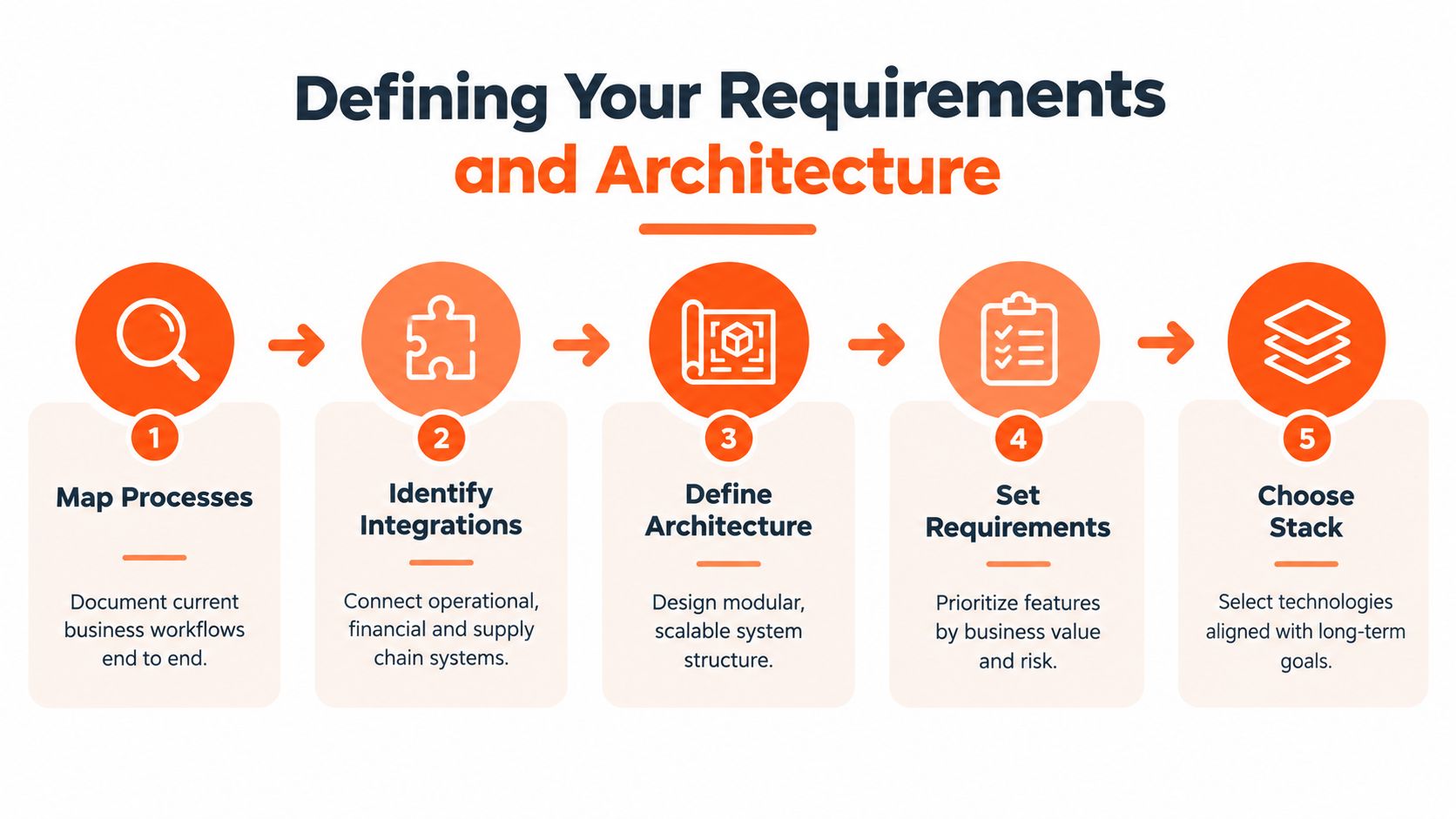
Don't choose a technology stack before you understand the business system you're building. Custom ERP software development is fundamentally an integration discipline. The architecture must connect operational, financial, and organizational data while preserving ownership, auditability, and the ability to change one domain without destabilizing every other domain.
Start with process discovery, then move through target-process design, architecture definition, iterative development, controlled data migration, integration testing, user acceptance testing, phased deployment, and post-go-live measurement. This sequence is supported by ERP implementation research that identifies weak scope definition, poor business-process redesign, insufficient executive sponsorship, weak change management, and low user acceptance as recurring failure factors. The ERP success-factor research also groups success conditions across infrastructure, process management, project management, team capability, culture and communication, and training.
Map the current operating model
Document each process from trigger to outcome. For procure-to-pay, that means more than listing purchase orders and invoices. Capture who requests an item, who approves it, how supplier terms are checked, how receipt is recorded, what happens when quantity differs, and how the ledger receives the final transaction.
Do the same for order-to-cash, hire-to-retire, inventory replenishment, production planning, expense management, and regulatory reporting. Mark manual handoffs, duplicate data entry, spreadsheet dependencies, undocumented exceptions, and points where teams bypass the official system.
Then define the target process. Don't copy every legacy workaround into the new ERP. Preserve controls and business differentiation, but remove steps that exist only because an old database, disconnected tool, or paper approval requires them.
Establish accountable ownership
Create an executive steering committee with authority over scope, risk, and sequencing. Appoint a process owner for each domain, including finance, procurement, supply chain, HR, sales, and compliance. The process owner must be accountable for decisions, not merely available for occasional interviews.
Define baseline KPIs before development begins. Examples include reconciliation status, order-processing latency, exception volume, inventory accuracy, approval aging, report preparation effort, and unresolved data defects. The metric must have an owner, a source system, a calculation rule, and a target state.
A requirements traceability matrix should connect every requirement to:
- A business workflow that explains why it exists.
- A data object and its ownership rules.
- An integration or interface where applicable.
- A test case that proves the behavior.
- An acceptance criterion that a named process owner can approve.
This prevents a common enterprise failure: a requirement appears in a workshop, disappears into a backlog, and returns late as an expensive architectural surprise.
Design boundaries before services
Choose modular boundaries around business capabilities and data ownership, not around fashionable technical labels. Finance, identity, workflow, master data, reporting, and document management may need different release cadences and security rules. A modular architecture can still use a coherent platform and shared standards without turning every function into an independently operated service.
Use a fit-gap decision for each capability. Keep standard platform behavior when it supports the target process. Build custom modules when differentiation, regulatory control, or operational necessity justifies the additional ownership burden. Document the reason for every customization, including the cost of testing, upgrading, monitoring, and supporting it.
For a practical introduction to the product and organizational decisions involved in building custom ERP for founders, compare the proposed build with platform extension and controlled coexistence. For architecture trade-offs, review these software architecture patterns before locking the integration model.
The deliverable at the end of discovery isn't a long feature list. It is a target operating model, a dependency map, an architectural direction, a prioritized backlog, named decision owners, and acceptance criteria that the delivery team can test.
Strategies for Legacy Modernization
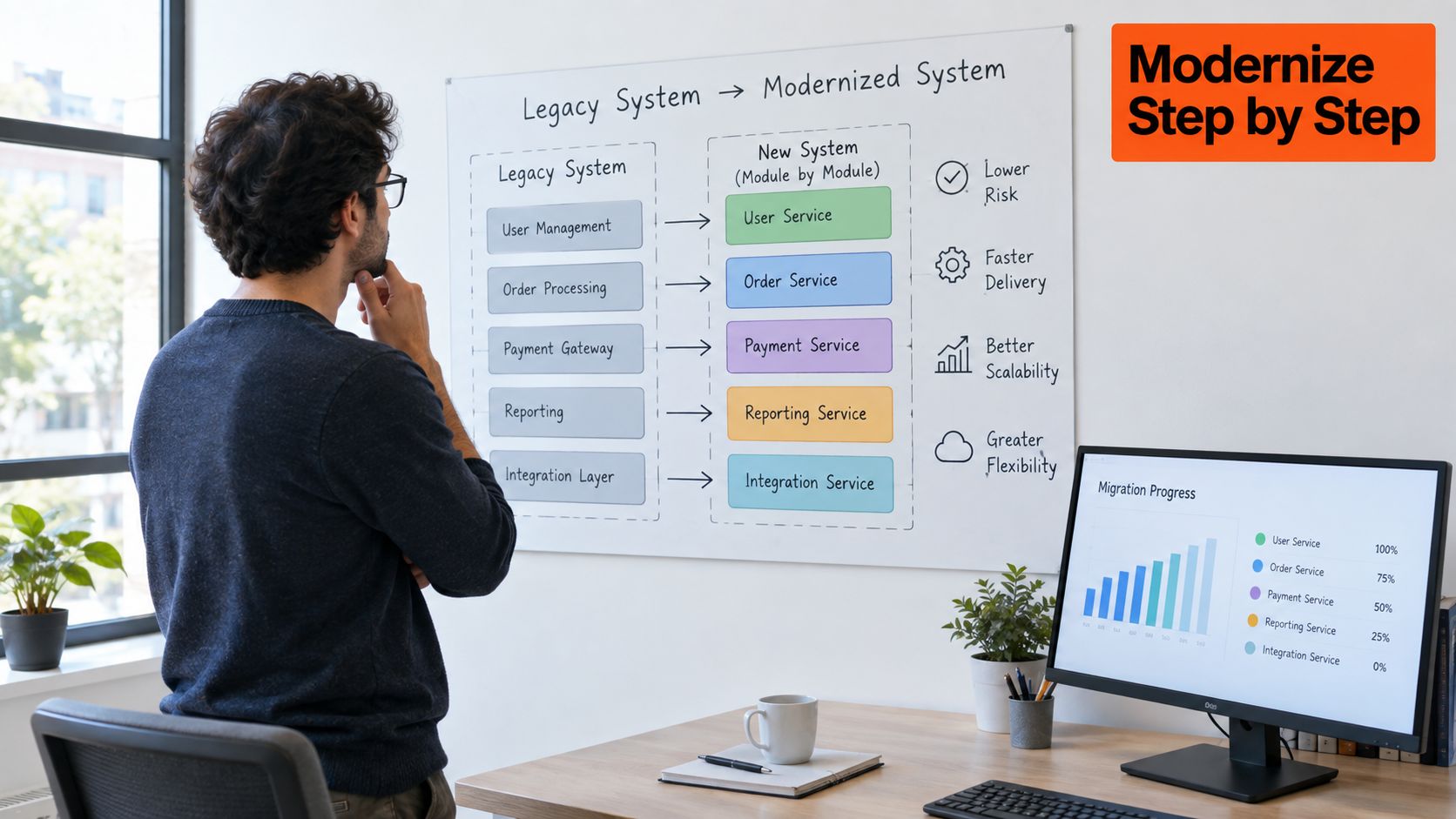
A strangler modernization strategy replaces a legacy ERP capability by capability. New modular services take ownership of selected workflows while the existing systems continue handling functions that have not yet moved. This approach limits the blast radius of each release and keeps business operations running throughout the transition.
A big-bang replacement concentrates migration, integration, training, and operational risk into one event. It also forces teams to change stable processes before they have proved the replacement. Use a staged transition instead. Set a target operating model, then define the sequence of changes that can reach it without making continuity dependent on a single launch date.
Replace capabilities, not everything
Start with the legacy components that combine high business risk, slow change, and clear strategic value. A fragile reporting layer may deserve attention before a stable ledger. A manual inventory process may come first when poor stock visibility threatens customer commitments.
Define a coexistence map for every capability:
- System of record: Which system owns the authoritative value at each transition stage?
- Data flow: Which events, APIs, or batch processes carry changes between old and new?
- Reconciliation: How will finance and operations prove that both systems agree?
- Fallback: Which process remains available if the new component fails?
- Retirement condition: What evidence allows the team to switch off the old component?
This map turns modernization into a controlled transition. The interim architecture may be less centralized than the final design, and that is acceptable. Finance, workflow, analytics, content, and master data can move at different speeds when their dependencies, controls, and release constraints differ.
Use guidance on legacy system modernization and business growth to extend this discipline beyond application code. Infrastructure, release management, support ownership, and operating procedures must change with the services they support.
Rehearse data migration repeatedly
Give data migration its own engineering backlog. Run repeated extract, transform, and load rehearsals with representative legacy data. Automate checks for duplicates, missing mandatory fields, invalid references, inconsistent statuses, and referential-integrity failures.
Route defects into exception queues instead of hiding them inside a failed batch. Business owners need a controlled way to review questionable records, approve valid transformations, and reject data that requires correction in the source system. Reconcile totals and record counts at every stage. Set release gates for financial balances, inventory, identity data, and regulatory records.
Treat migration rehearsal as a release test, not a one-time conversion exercise.
Integration tests must cover failure conditions as well as successful API responses. Test delayed messages, duplicate events, partial updates, unavailable dependencies, and rejected transactions. From the first release, production monitoring should expose latency, error rates, queue depth, batch completion, and reconciliation status. Without those signals, teams discover migration failures through user complaints or incorrect business results.
Sequence releases around business value
Begin with a bounded value stream, a single business unit, or a non-critical operational capability. Use that release to prove the data model, integration behavior, support process, and user workflow. Expand only after it meets defined exit criteria.
Do not migrate a domain because it appears first on an architecture diagram. Migrate it when the organization can operate the replacement, reconcile its results, support users, and recover from failure. Retire the old component only when ownership, data integrity, and fallback procedures have been demonstrated in production.
Designing Accessible and Actionable Dashboards
An ERP dashboard isn't successful because it contains attractive charts. It succeeds when a finance manager can verify a number, an operations lead can identify an exception, and a screen-reader user can reach the same underlying records without relying on visual interpretation.
Every meaningful chart should have a structured tabular alternative. The U.S. Web Design System guidance for data visualizations recommends textual representations of axis values and labels, along with access to the underlying data in a table. That requirement also improves auditability, reconciliation, spreadsheet export, and review on small screens.
Design the chart and the evidence together
A chart should communicate a conclusion quickly, then let the user inspect the evidence. A procurement visualization might summarize that quarterly spend exceeded budget in Q3, while its table exposes the month-by-month values, suppliers, categories, and source records.
Use a compact design contract for every chart:
| Dashboard element | Required behavior |
|---|---|
| Title | State the business question, not just the metric name |
| Text summary | Describe the important trend or exception |
| Visual encoding | Use labels, symbols, patterns, or annotations in addition to color |
| Data table | Expose exact values and relevant dimensions |
| Drill-down | Link aggregates to authorized source records |
| Export | Provide a usable dataset for audit and reconciliation |
Don't rely on color to distinguish approved from rejected transactions, budget from actual spending, or high from low risk. Guidance derived from WCAG identifies a minimum 3:1 contrast ratio for meaningful graphical elements such as bars, lines, and points against adjacent colors, while ordinary chart text generally requires 4.5:1 contrast against its background. This chart accessibility guidance also supports secondary encodings such as labels, line styles, and patterns.
Make interaction operable without a mouse
Every mouse interaction needs a keyboard equivalent, or the underlying information must be reachable through an accessible table. Filters, legends, date selectors, drill-down controls, tooltips, and individual data points all need explicit focus behavior.
Hover-only details are a common implementation shortcut and a poor operational choice. Information shown on hover should also appear on keyboard focus and remain visible long enough to review. The accessible chart interaction guidance describes the practical implication: the user must be able to operate the chart or reach an equivalent non-visual path.
Complex visualizations need both concise alternative text and a longer description or data table. Give every chart a heading, label the chart items visibly, summarize what the table shows, and preserve permission rules when users drill into records. Accessibility isn't a presentation layer added after analytics is complete. It is part of the data contract.
Implementing AI and Automation Wisely
AI shouldn't become the probabilistic source of truth for financial postings, payments, clinical decisions, or legal determinations. The transaction core must remain deterministic, permission-controlled, and auditable. AI belongs beside that core first, where it can classify, search, detect, draft, and triage without altering authoritative records.
Survey evidence on AI adoption indicates that confidence depends on independently demonstrated accuracy and performance benchmarks (35%), trust in outputs (32%), and security or compliance assurances (30%). The AI adoption survey points to a practical conclusion: an AI feature needs an evaluation and governance system, not just a model endpoint.
Start with bounded workflows
Choose use cases that are useful, reversible, and easy to compare with a human decision. Strong early candidates include:
- Document classification: Route invoices, contracts, forms, and supporting files to the correct workflow.
- Anomaly detection: Flag unusual transactions, inventory movements, or approval patterns for review.
- Exception triage: Group operational failures and recommend the next queue or owner.
- Enterprise search: Retrieve permission-aware records and documents with source references.
- Draft generation: Prepare summaries, explanations, or responses that a named employee approves.
Don't allow a model to post a journal entry, release a payment, change a regulated record, or make a clinical or legal determination without deterministic rules and human authorization. A recommendation can be probabilistic. The final transaction should remain governed by explicit permissions, validation, and an auditable approval path.
Prove safety in production
Define an evaluation dataset before launch. Measure false positives, false negatives, abstentions, latency, source retrieval accuracy, and operational effort. Set an abstention threshold that sends uncertain cases to a human queue instead of forcing an answer.
Version prompts, models, retrieval indexes, policies, and evaluation results. Store the sources used for each recommendation and preserve the decision trail when a user accepts, edits, or rejects it. Separate retrieval errors from model errors, because the remediation is different.
AI connected to unsecured legacy systems can introduce new attack surfaces. Use permission-aware retrieval, zero-trust controls, continuous authentication, anomaly monitoring, and strict separation between read assistance and write operations. The AI governance framework guidance is useful when translating these controls into ownership, review, and release policies.
The correct architecture is not “AI inside every module.” It is deterministic ERP processing with probabilistic assistance at carefully controlled edges.
Real-World ERP Scenarios and Outcomes
Consider a manufacturing organization with inventory data scattered across spreadsheets and a fragile legacy database. The wrong response is to rebuild finance, production, procurement, warehouse operations, and reporting simultaneously. That approach multiplies dependencies before the team has proved the master-data model.
A safer sequence starts with inventory visibility and replenishment workflows. The new inventory service reads relevant product and supplier data, validates stock movements, and produces replenishment recommendations while the legacy system continues handling unaffected transactions. Warehouse users test receiving, transfers, adjustments, and exception handling against real operating conditions. Finance receives reconciled inventory movements through a controlled integration rather than an untested direct replacement.
Once the organization trusts the inventory data and support process, the team can extend the platform into procurement and production planning. The old database remains active only where it still has a defined responsibility. Each retirement decision follows evidence from reconciliation, user acceptance, incident history, and operational reporting.
A regulated healthcare transition
A healthcare provider faces a different constraint. Patient records, billing, scheduling, and compliance workflows may need to share information, but the provider can't treat a clinic's daily operations as a convenient test environment. A phased architecture can introduce a controlled integration layer first, preserving existing clinical workflows while improving the movement of authorized billing and operational data.
The delivery team should define which system owns each record, limit access by role and purpose, and test failure behavior before expanding the integration. A clinic can continue operating if a downstream reporting component is unavailable, while reconciliation queues identify records that need review. New administrative workflows can then be introduced by location, department, or capability instead of forcing every user onto an unproven system at once.
The same principle applies to legal, education, and other regulated organizations. Measure auditability, data lineage, recovery objectives, permission behavior, and change risk alongside feature coverage. A modern platform that cannot explain where a value came from or who approved a change is not operationally mature.
What changes for finance, supply chain, and HR
In finance, the strongest outcome is not a more elaborate dashboard. It is a reliable chain from source transaction to approved entry, reconciliation, report, and audit record. In supply chain, value comes from shared product, supplier, order, and inventory context that reduces manual handoffs and exposes exceptions earlier.
HR requires equally deliberate boundaries. Employee identity, access rights, organizational structure, time records, and workflow approvals must remain consistent without giving every operational user access to sensitive personnel data. The architecture should make authorized collaboration possible while preserving least-privilege access and a clear audit trail.
A custom ERP earns its cost when it turns disconnected processes into a system the organization can operate, inspect, and evolve. That doesn't require every capability to move at once. It requires a modernization roadmap that protects continuity, proves each release, and retires legacy components only after the replacement has earned trust.
For enterprises modernizing fragile ERP systems, devPulse provides discovery, architecture, custom software engineering, integration, data and AI delivery, quality engineering, DevOps, and long-term support. Visit devPulse to turn your legacy replacement plan into a phased, measurable modernization roadmap.