













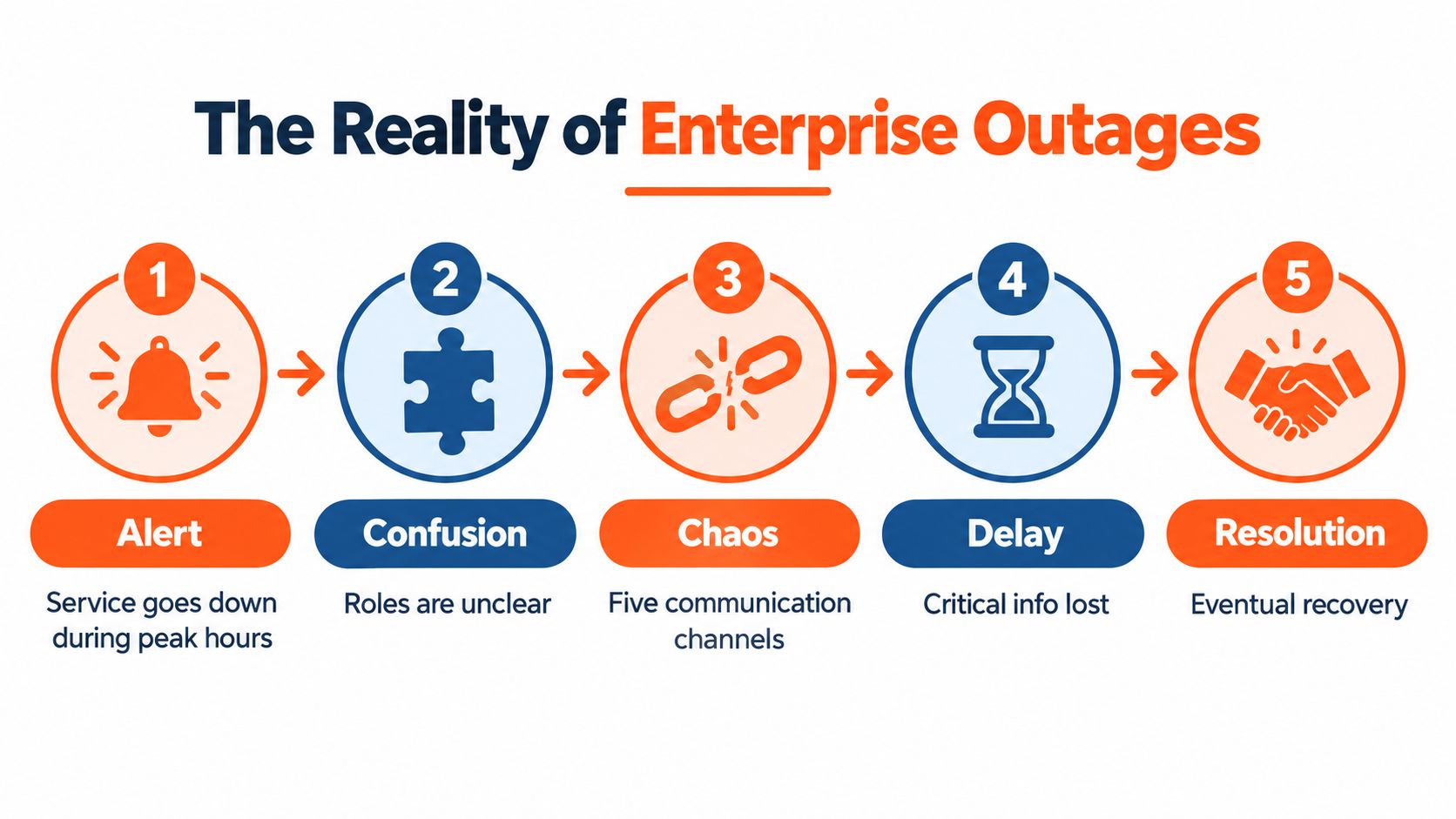
A critical service fails during peak hours. The first alert lands in PagerDuty, a support ticket appears, an engineer opens a Slack channel, a product manager starts a separate thread, and an executive asks for an update by email. Nobody is sure who owns the response, which message contains the latest evidence, or whether the rollback decision belongs to the service team or an incident commander.
That's the operational reality behind many outage reviews. The technical fault may be familiar, but unclear authority, scattered context, and weak learning loops turn a recoverable failure into a prolonged business interruption. Incident management exists to restore service quickly, protect customers and revenue, and give the organization a reliable way to improve after the emergency ends.
A mature incident management process connects detection, coordination, recovery, and learning. It also distinguishes restoring service from finding the deeper cause, which belongs to problem management. The widely used workflow contains seven stages, incident identification, logging, categorization, prioritization, assignment, task management, and incident response, with response covering diagnosis, escalation, investigation, recovery, and postmortem work. PagerDuty's incident management overview describes this lifecycle in operational terms.
Table of Contents
- The Reality of Enterprise Outages
- Defining Roles and Runbooks
- Building a Tooling Strategy That Reduces Toil
- Establishing Severity Levels and Escalation Rules
- Postmortems and Compliance in Regulated Environments
- Breaking the Automation Paradox
- Your Implementation Roadmap
The Reality of Enterprise Outages
Within the first five minutes of an outage, it becomes clear whether an organization has a process or merely a collection of tools. An alert reports that checkout is unavailable. The on-call engineer starts investigating while support receives customer reports, a database specialist is pulled into a direct message, and the status-page owner cannot be reached. Two managers then issue conflicting guidance about whether to roll back.
The technical failure is only part of the event. Without a shared operating picture, engineers repeat checks, stakeholders request updates through separate channels, and decision-makers cannot distinguish a mitigation from a permanent correction. Customers encounter one service failure. Internally, monitoring, ticketing, communication, and recovery workflows create a second failure through unassigned authority and fragmented context.
Why the process matters
Incident management operates across engineering, support, product, and leadership, rather than serving only as a help desk activity. ITIL formalized incident management as a core service-management process, with roots in the 1980s and the initial Service Support publication released in 1989. The Atlassian incident management benchmark links that history to the financial pressure of downtime, reporting an estimated average unplanned downtime cost of $8,662 per minute, a median of $7,200 per minute in one survey, and an average major-incident response-team assembly time of 27 minutes.
These figures do not call for panic. They show why decision rights must exist before an outage. Teams need explicit answers to four questions: who can declare the incident, who owns stakeholder communication, which service takes priority, and when mitigation should take precedence over diagnosis. Tool sprawl cannot supply those answers.
A lifecycle that supports decisions
A useful process moves through identification and logging, categorization, prioritization, assignment, task management, and response. Response includes diagnosis, escalation, investigation, service restoration, recovery confirmation, and capture of lessons.
The workflow can return to investigation when a rollback exposes another failure. Discipline comes from recording decisions as they occur, keeping communication in one operational space, and showing ownership at every stage. Those records also create the learning loop that governance requires. Otherwise, an incident ticket may close while unclear authority, duplicated effort, and the same escalation gap remain active.
Defining Roles and Runbooks
Role clarity is one of the fastest ways to reduce confusion during an outage. A responder shouldn't have to decide whether to investigate a failing queue or write the executive update. Assign the work explicitly when the incident is declared, then let the incident commander change assignments as conditions evolve.
The four roles that protect response capacity
The Incident Commander owns the response, not the bug. This person sets priorities, requests resources, decides when to escalate, and keeps the team aligned. The IC should avoid hands-on debugging because technical work narrows attention at exactly the moment the wider response needs oversight.
The Technical Lead directs diagnosis and proposes mitigations. They don't need to perform every investigation personally. Their job is to divide technical work, challenge weak hypotheses, and make sure someone validates the recovery.
The Communications Lead maintains the status page and stakeholder updates. They translate technical facts into customer-relevant information, establish a predictable cadence, and prevent product, support, and leadership teams from interrupting responders for separate briefings.
The Scribe maintains the timeline. They record alerts, observations, decisions, commands, ownership changes, and recovery checks. A useful timeline captures what the team knew at the time, not a polished story created after the fact.
Ownership is a recovery control
In a large incident benchmark, assigning clear roles reduced mean time to recovery by 42%, while using a service catalog reduced MTTR by 36%. Those findings are reported in FireHydrant's incident management analysis. The practical lesson is straightforward: a service catalog should identify the owner, severity expectations, dependencies, and runbook for every production service.
A runbook should help a tired engineer make the next safe decision. It shouldn't be a long explanation of architecture. Link each runbook to a specific alert and include:
- Trigger: What signal declares the failure?
- First checks: Which dashboards, recent changes, and dependencies should the responder inspect?
- Safe mitigations: Which rollback, failover, feature-flag, or traffic-routing actions are approved?
- Escalation condition: What evidence means the primary team needs a specialist or manager?
- Recovery test: How will the team confirm that customers can use the service again?
Practical rule: A runbook that doesn't name an owner, a safe mitigation, and a recovery check is documentation, not operational guidance.
Review runbooks after the incidents that use them. If responders skip a step, hesitate over a command, or discover that an ownership link is stale, update the document while the evidence is fresh. A concise, tested runbook reduces cognitive load. It won't replace judgment, but it gives judgment a dependable starting point.
Building a Tooling Strategy That Reduces Toil
Adding another incident tool feels productive because it creates an immediate place to put a missing function. Monitoring may be in Datadog, paging in PagerDuty, tickets in Jira, chat in Slack, and post-incident work in a document system. Each product can perform its own job well, yet the team still has to transfer context between them during the most expensive minutes of an outage.
A major benchmark found that organizations use an average of 3.8 tools across the end-to-end incident management process. Decision-makers reported 4.0 tools, while practitioners reported 3.6 tools, a gap that suggests leaders and responders may experience the workflow differently. The same benchmark identifies MTTR as the most widely used performance indicator. The InvGate incident management statistics benchmark provides that comparison.
Consolidation is a risk decision
Another benchmark estimates the average cost per incident at $14,985, making fragmented handoffs more than an inconvenience. The Atlassian incident management benchmark report supports a practical conclusion: consolidate the workflow where context changes hands, even if you keep specialist tools for detection or diagnosis.
| Tool Category | Common Examples | Coordination Risk |
|---|---|---|
| Monitoring | Datadog, Grafana, New Relic | Alerts lack ownership or business context |
| Paging | PagerDuty, Opsgenie | Escalation rules become detached from service metadata |
| Collaboration | Slack, Microsoft Teams | Decisions disappear into parallel channels or direct messages |
| Ticketing | Jira, ServiceNow | Follow-up work loses the incident timeline |
| Documentation | Confluence, Google Docs | Runbooks and postmortems drift from live systems |
The target isn't one vendor for every function. It's one operational record that connects intake, triage, roles, communication, evidence, and follow-up actions. Teams evaluating custom workflows can also review healthtech internal software solutions when standard systems don't fit regulated or specialized operating requirements. A customized interface may help, but customization creates a maintenance obligation, so define ownership before building.
For broader implementation context, use this DevOps implementation guide to align incident workflows with delivery, infrastructure, and platform practices. The same rule applies to AI features: automate context gathering, channel creation, paging, timeline capture, and draft documentation first. Don't automate a poorly defined escalation decision and assume the process has improved.
Establishing Severity Levels and Escalation Rules
Severity is a governance mechanism, not a label added to a ticket after the technical work starts. If responders debate priority while customers are blocked, the matrix has failed before the incident has been diagnosed.
A practical model distinguishes SEV0 through SEV4 by customer impact, business criticality, data risk, and urgency. A published SEV0 to SEV4 framework associates SEV0 with catastrophic events such as data loss, security breach, or total outage, with a 15-minute acknowledgment target. It associates SEV1 with a core service unavailable to everyone and a 30-minute target, SEV2 with major degradation and a 1-hour target, and SEV3 with minor issues handled during business hours. Runframe's incident severity framework provides those examples.
Compare impact, not volume
| Level | Decision test | Escalation path |
|---|---|---|
| SEV0 | Is there catastrophic impact, material data risk, or a total outage? | Immediate executive, security, and technical coordination |
| SEV1 | Is a core service unavailable for the affected population? | Incident commander, technical leads, communications, leadership |
| SEV2 | Is a major capability degraded but still partially usable? | Service owner, on-call escalation, stakeholder updates |
| SEV3 | Is the impact limited and manageable in normal operating hours? | Owning team and standard support workflow |
| SEV4 | Is there no meaningful functional impact? | Backlog or routine maintenance |
When multiple incidents occur across time zones, rank them by business impact and dependency risk, not by which team posts most loudly. Ask which incident affects the largest customer population, threatens regulated data, blocks a critical revenue path, or prevents other responders from working. If two incidents compete for the same specialist, the IC or operations lead must make that trade-off visible and record it.
The escalation policy should specify who can raise severity, who can pause lower-priority work, and who communicates the decision. It should also define acknowledgment, update, and handoff expectations. A service-level agreement can clarify these commitments, and the service-level agreement guide for business leaders offers useful business context for setting them.
A severity matrix must also govern learning. The benchmark cited earlier found that retrospectives occurred after only 29% of low-severity incidents and 42% of high-severity incidents, which means even serious events can leave no durable corrective action. The matrix should state when a postmortem is mandatory, who owns it, and how action items enter engineering planning.
Postmortems and Compliance in Regulated Environments
Closing the incident ticket is an administrative event. Completing the learning loop is an engineering and governance event. A postmortem should explain what happened, what customers experienced, which decisions the team made, how service was restored, and what will change to reduce recurrence.
That distinction matters in healthcare, legal technology, and other regulated environments. Leaders may need evidence that alerts were reviewed, access was controlled, decisions were documented, recovery was validated, and corrective actions were assigned. A postmortem that exists only as a narrative document won't satisfy that need if the timeline, approvals, ownership, and remediation status live somewhere else.
Make the review blameless and actionable
A blameless review doesn't avoid accountability. It directs accountability toward systems, incentives, controls, and decisions rather than turning one person's mistake into the explanation for a complex failure.
Use a consistent review sequence:
- Reconstruct the timeline: Capture alerts, changes, symptoms, decisions, and recovery checks.
- Describe customer impact: State which services, workflows, or users were affected.
- Separate mitigation from resolution: Record how the team restored service and how it addressed the underlying cause.
- Test the controls: Ask why monitoring, review, ownership, or escalation didn't catch the risk earlier.
- Assign durable actions: Give each action an owner, acceptance condition, and place in the delivery backlog.
Documentation continuity is often the weak link. Intake records may omit affected services, responders may use private messages, and the final review may rely on memory. Better tooling won't compensate for poor intake quality or missing ownership. For physical infrastructure and operational assets, methods designed to prevent recurring equipment failures offer a useful parallel, because recurrence prevention depends on evidence and corrective action rather than on closing the immediate work order.
A control matrix can connect each incident decision to its owner, evidence, and review status. Teams building that governance layer can use this risks and controls matrix guide as a reference point. The implementation choice may be a service-management platform, a structured repository, or an integrated workflow, but auditors and engineers need the same thing: a traceable record that survives staff changes and tool migrations.
Breaking the Automation Paradox
Automation can reduce coordination work, but it can also scale a bad process. If an alert opens a channel, pages three teams, creates duplicate tickets, and generates noisy summaries, the organization has automated confusion.
The available trend data makes the contradiction clear. One 2026 state-of-incident-management report says operational toil rose from 25% to 30% even as AI adoption expanded, while 78% of developers still spend at least 30% of their time on manual toil. Atlassian's incident management guidance presents those findings alongside the broader shift toward AI and chat-native response workflows.
Automate the handoffs first
The best automation removes repetitive coordination while preserving human decisions. Start with actions that are deterministic and easy to audit:
- Create shared context: Open the incident record and communication space with service ownership, recent changes, dashboards, and runbooks.
- Route by ownership: Page the primary responder and follow a documented backup path if acknowledgment doesn't occur.
- Capture evidence: Record alerts, messages, decisions, and timestamps without asking the scribe to copy information between systems.
- Generate drafts: Produce a timeline or postmortem draft for human review, rather than publishing unverified conclusions.
- Close the loop: Create remediation work with an owner and acceptance condition when the incident is closed.
AI is useful for summarizing a long timeline, finding similar historical incidents, and identifying missing fields. It is less reliable when asked to make an irreversible production decision without clear policy and current evidence.
Automation should remove coordination overhead, not remove decision ownership.
The paradox usually appears when teams measure the wrong outcome. Faster ticket creation doesn't mean faster recovery if responders still search for the service owner, argue about severity, or re-enter the same facts in three systems. Measure whether the process gives people cleaner context, fewer duplicate actions, and clearer authority. If it doesn't, adding another automation layer will increase maintenance toil rather than reduce it.
Your Implementation Roadmap
Start with the workflow you have, not the workflow you wish you had. Review recent incidents and trace the path from first signal to recovery, including every handoff, private message, duplicate ticket, and delayed decision.
Build the operating baseline
Create a service inventory with owners, dependencies, criticality, runbook links, and escalation contacts. Then record the current tool inventory and identify where the same fact is entered more than once. Use MTTR as a process signal, not an individual performance score, and add measures for detection, acknowledgment, change-related failures, and postmortem completion.
The first version doesn't need every service or every severity nuance. It needs enough coverage to make one real incident easier to coordinate.
Establish decision rules
Publish a severity matrix with customer-impact examples and acknowledgment expectations. Define who can declare an incident, who becomes incident commander, who can raise or lower severity, and who owns external communication. Make the rules accessible from the alert and service record, not buried in an internal handbook.
Run a tabletop exercise using a plausible failure, such as a core dependency outage during a regional handoff. Test whether participants can identify the owner, choose severity, escalate without personal contacts, communicate consistently, and record the decision trail.
Turn learning into delivery work
Require a postmortem for the incidents your policy defines as significant, then assign remediation items to normal engineering planning. Review whether actions have owners, deadlines, acceptance tests, and links to the original evidence. If an action remains open because nobody owns the decision, the review has exposed a governance gap that needs escalation.
Use this implementation checklist:
- Map the current flow: Document detection, triage, escalation, recovery, closure, and learning.
- Name accountable owners: Assign service, incident, communication, and remediation ownership.
- Reduce handoffs: Keep one operational record and automate repetitive evidence capture.
- Exercise the process: Test severity and escalation rules before the next outage.
- Review the signals: Compare MTTR, change failure rate, detection, acknowledgment, and postmortem completion qualitatively and over time.
- Improve one constraint: Fix the most expensive coordination gap before adding more tooling.
devPulse helps engineering organizations design and maintain reliable digital systems through DevOps, observability, automation, SRE practices, and incident response support. If your teams need clearer ownership, integrated operational workflows, or stronger post-incident governance, visit devPulse to discuss a practical implementation path.