













If your business needs only a brochure site or a small shop, a site builder gets you online this week; if you need custom workflows, integrations, or data-driven features, you need a development partner. The reason is simple: builders win on cost and speed, custom engineering wins on scalability and ownership. Your first move either way is the same: write a one-paragraph brief covering your audience, your goal, and the one action you want a visitor to take.
TL;DR:
- Custom web development becomes necessary when projects involve complex features, integrations, or proprietary workflows that site builders cannot support reliably.
- Choosing a niche and packaging services clearly helps command higher prices, attract targeted clients, and streamline project scope management.
- A fixed-price scope with a thorough discovery process reduces scope creep and ensures budget accuracy for projects of varying complexity.
- Ongoing maintenance, security updates, and technical support are crucial to keep business websites secure, fast, and functional over time.
- When projects require extensive customization or future scalability, engaging a full-cycle development partner with structured discovery and support is essential.
Choosing Your Niche and Packaging Business Web Development Services
Trying to serve every type of client is the fastest way to underprice your work and confuse your marketing. A general “we build websites” pitch competes against thousands of freelancers on price alone. A specific pitch, like “we build booking systems for boutique fitness studios” or “we modernize outdated WordPress sites for law firms,” lets you charge more and close deals faster because the prospect immediately understands why you’re a fit.
Niche focus also simplifies everything downstream: your portfolio examples, your case studies, even your cold outreach templates all get sharper when you’re not trying to speak to everyone at once.
Once you’ve picked a lane, build your packages around it. Most successful web shops and freelance developers structure their offerings in tiers similar to this:
- Brochure site: 3 to 6 pages, contact form, basic SEO setup, usually built on a CMS or builder
- E-commerce site: product catalog, payment processing, inventory sync, shipping rules
- Web application: custom dashboards, user accounts, third-party integrations, database-backed features
- Ongoing maintenance: updates, security patches, content edits, uptime monitoring
Each package needs a defined scope: what’s included, what deliverables the client receives (source files, admin training, documentation), and what happens after launch. Vague packages create scope creep; specific ones create trust, and a well-crafted package with clear deliverables and post-launch support helps clients compare quotes without confusion.
How you deliver the work depends on scale. Solo operators handle brochure sites and small shops directly. Once projects involve custom application work, most shops bring in subcontracted specialists (a backend developer, a UI designer) rather than hiring full time. Larger, recurring client bases eventually justify a small retained team, which is when service delivery starts to resemble a genuine agency rather than a freelance practice.
DIY Site Builder or Custom Web Development?
Run every project through two questions before you touch a keyboard or sign a contract: how complex is the functionality, and how much do you need to own the platform long term? A brochure site with a contact form scores low on both. A booking system tied to your inventory, your CRM, and a payment processor scores high on both, and that’s your signal to go custom.
Platforms like Wix, Squarespace, Webflow, and WordPress each solve a specific version of the simple case well. Wix and Squarespace favor speed and visual polish for small brochure sites. Webflow gives designers more control over layout without writing code. WordPress dominates content-heavy sites and blogs because of its plugin ecosystem. Choosing among them should come down to the feature you actually need (ease of use, e-commerce depth, or design flexibility) rather than which one you’ve heard of most.
Here’s a quick way to test which side of the line your project falls on:
- List every feature you need beyond text, images, and a contact form.
- Check if a builder plugin or app genuinely covers each feature, not just approximately.
- Count how many systems the site needs to talk to (payment processor, CRM, inventory, internal database).
- If that count is two or more, or if any feature involves custom logic, move to custom development.
Custom engineering becomes necessary once you’re dealing with multi-user workflows, proprietary integrations, or performance and security requirements a plugin can’t guarantee. Businesses with custom workflows or integration needs typically outgrow site builders and end up needing scalable, owned infrastructure anyway, often after paying twice.
Watch for red flags that mean skip the builder entirely: you’re handling sensitive customer data beyond basic checkout, you need role-based permissions for different staff, or your product roadmap already includes features no plugin currently supports.
Pro Tip: If you’re not sure which category you’re in, sketch your homepage and your most complex user action on paper. If that action involves more than filling out a form and clicking submit, you’re probably looking at custom development.
Essential Pages and Trust Signals Every Business Site Needs
A handful of pages have to exist regardless of whether you build on a platform or commission custom code. A standard professional business website includes a homepage, an about page, a services or products page, a contact page, and a 404 error page, plus privacy and terms pages if you collect any customer data.
Beyond the required pages, certain elements consistently move the needle on whether a visitor trusts your business enough to act:
- Professional photography, not stock images, since strong visuals and trust signals raise perceived value faster than minor design tweaks
- Testimonials or short case studies tied to real outcomes
- A clear, singular call to action on every page, not three competing buttons
- A visible privacy policy and cookie notice, especially if you run analytics or ads
On the technical side, a handful of baseline decisions determine whether your site holds up over time: HTTPS by default, analytics installed from day one, automated backups, mobile-first responsive layout, and basic accessibility (readable contrast, alt text, keyboard navigation). None of these are optional in 2026, and skipping them tends to cost more to fix later than to build correctly the first time.
Your choice of CMS, hosting provider, and integrations also shapes future costs more than most business owners expect. A platform with unclear export or ownership policies can quietly lock you in, so checking how easily you can migrate your content and data before committing saves real money down the line. Thoughtful design work here, including how the interface guides visitors toward action, is where professional UI/UX design pays for itself.
Realistic Pricing and Timelines for Web Development Projects
Timelines vary because the underlying work varies enormously, even when two projects both get called “a website.” A brochure site with focused content typically ships in 2 to 6 weeks. An e-commerce build with product catalogs and payment integration usually runs several weeks. A custom web application, with discovery, design, and iterative sprints, commonly takes multiple months depending on how many systems it needs to talk to.
Pricing models map to that same complexity curve:
- Fixed-price: best when scope is clearly defined upfront, like a brochure site or a standard e-commerce build
- Retainer: fits ongoing work such as monthly content updates, feature additions, or maintenance
- Hourly: reasonable for small, unpredictable changes where scoping in advance doesn’t make sense
The single biggest lever you have over getting an accurate fixed-price quote is writing a real discovery brief before you ask anyone to bid. Spell out your audience, your primary goal, the pages or features you need, any systems you need to integrate with, and your timeline. A short, focused discovery brief materially improves quote accuracy and cuts down on scope creep once the project starts.
For anything beyond a brochure site, build in phases rather than trying to launch everything at once. Ship a minimum viable version with your core pages and primary conversion action, then add features once you’ve seen how real visitors behave. Phased delivery, starting with an MVP and layering in enhancements, remains the most common cost-control tactic for businesses moving from a simple site to a full product.

Finding Your First Clients or the Right Development Partner
Whether you’re the one building sites or the one hiring someone to build yours, early traction comes from the same handful of channels, just aimed in opposite directions.
- Start with your existing network. Ask former colleagues, past employers, and local business groups directly if they know anyone who needs a site built, rather than posting a vague “open for work” update.
- Use LinkedIn for short, value-first outreach. Skip the generic pitch. Point out one specific thing about the prospect’s current site (a broken mobile menu, a missing contact form) and offer a concrete fix, then follow up once after a week if you hear nothing.
- Treat marketplaces as a stepping stone, not a destination. Platforms like Upwork and directories like Clutch can generate early leads and reviews, but the goal is to convert that first project into an owned case study you control and can show off without a middleman.
- Price your first few projects to earn a strong testimonial, not to give the work away. A modest discount in exchange for a detailed case study and a reference call is a fair trade; working for free sets an expectation you’ll struggle to undo later.
If you’re on the hiring side of this equation, the same channels work in reverse: ask your network for a referral first, review a shortlist’s actual case studies (not just their homepage), and be wary of any vendor who can’t show you a past project similar in complexity to yours.
How to Start a Web Development Business
Starting a web development business begins with narrowing your service and proving you can deliver it, not with incorporating or building a fancy portfolio site first. Pick one or two service packages from your niche, build one strong example project (even a paid discount project for a friend’s business counts), and get one honest testimonial before you spend money on branding.
Legally, most solo developers start as a sole proprietorship or a simple LLC, mainly for liability protection once you’re handling client payments and data. Open a separate business bank account immediately, even before your first invoice, since mixing personal and business finances creates headaches at tax time and makes it harder to price your work accurately.
From there, set your initial rates based on the value of the outcome you’re delivering, not just the hours you’ll spend, and expect to adjust upward once you have three or four completed projects to point to. Most new developers underprice their first several projects significantly. That’s fine as a deliberate strategy to build a portfolio, but it becomes a problem if you never raise rates once you have proof of results.
Finally, decide early whether you’re building a personal freelance practice or a scalable agency, since that choice affects how you price, how you package services, and whether you start bringing in subcontractors from project one.
Contracts and Legal Basics for Web Development Projects
Every project, no matter how small, needs a written agreement before work starts. A verbal handshake or a Slack message thread is not a contract, and disputes over scope almost always trace back to something that was assumed rather than written down.
At minimum, your contract or statement of work should define the exact deliverables, the payment schedule (a deposit upfront, milestones tied to specific outcomes, final payment on delivery), and what happens if the client requests changes outside the original scope. Include a clear ownership clause specifying who owns the final code, design files, and content once the invoice is paid in full.
Intellectual property terms matter more than most first-time developers realize. If you’re using licensed stock photography, third-party plugins, or a proprietary framework, spell out what the client can and cannot do with those assets after handoff. A confidentiality clause protects both sides if the project involves sensitive business data.
Finally, decide upfront how disputes get resolved and what triggers a project pause or termination, so that a disagreement over one feature doesn’t derail the entire relationship. None of this needs to come from an expensive lawyer for a straightforward brochure site, but any project involving customer data, payment processing, or ongoing retainers is worth having a professional review once.
Ongoing Maintenance: Keeping a Business Website Running
A website is not a one-time deliverable. Software dependencies age, browsers change their rendering rules, and security vulnerabilities get discovered in plugins and frameworks long after launch. Skipping maintenance is how a perfectly good site from eighteen months ago becomes slow, broken, or an actual security liability.
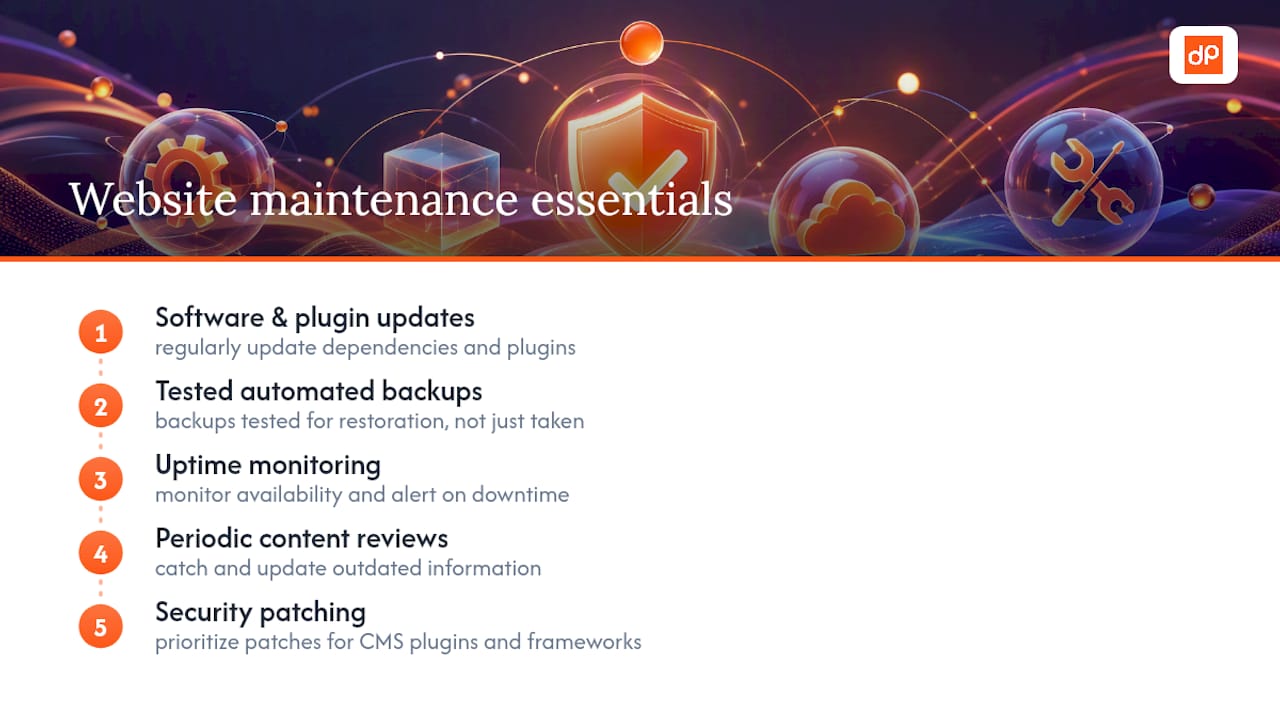
At minimum, a maintenance plan should include regular software and plugin updates, automated backups tested for restoration (not just taken and forgotten), uptime monitoring, and periodic content reviews to catch outdated information. Security patching deserves particular attention, since outdated CMS plugins remain one of the most common entry points for site breaches.
Budget for maintenance the same way you budget for the build. A retainer arrangement, whether with a freelancer, an agency, or through ongoing support and maintenance services, keeps this predictable rather than reactive. The alternative, waiting until something breaks to call someone, almost always costs more and happens at the worst possible time.
Tools and Technologies That Speed Up Development Workflows
The right toolkit shapes how fast a project moves from brief to launch. For version control and collaboration, Git paired with GitHub or GitLab is close to universal, letting multiple developers work on the same codebase without stepping on each other’s changes.
For design and handoff, Figma has become the standard for turning wireframes into developer-ready specs, cutting down the back-and-forth that used to happen over static mockups. On the development side, frameworks like React and Vue speed up building interactive interfaces, while headless CMS options (Contentful, Sanity) separate content management from the front end, which matters if you expect to redesign the site without rebuilding your content structure.
Project management tools like Trello, Asana, or Linear keep client communication and internal task tracking from living in scattered email threads, which is one of the most common reasons small projects run late. And for testing across devices, browser tools like BrowserStack catch the rendering issues that would otherwise surface only after a client complains.
None of these tools replace clear scoping or communication, but the right combination measurably shortens the gap between a signed contract and a live site.
SEO Basics Every Business Website Needs From Day One
Search visibility starts with structure, not keyword stuffing. Every page needs one clear H1, a descriptive title tag, and a meta description that actually reflects the page’s content, since these are what show up in search results before anyone clicks through.
Site speed and mobile usability matter as much as content quality at this point. A slow-loading site or one that breaks on a phone screen loses visitors and ranking position regardless of how well-written the copy is. Behind the scenes, running a proper technical audit catches issues like broken links, missing alt text, and duplicate content that hold sites back, and tools built for exactly this, like the technical SEO toolkit from Babylovegrowth, can surface those problems faster than manual review.
Local businesses should claim and fully complete a Google Business Profile, since local search results often weigh that signal heavily for anyone searching “near me” or by city name. Beyond the technical basics, consistent, genuinely useful content (a services page that actually answers buyer questions, a blog that addresses real customer problems) tends to outperform any shortcut, because it’s what both search engines and actual readers are looking for.
When to Bring In a Full-Cycle Development Partner
Hire a partner once your project stops being “a website” and starts being a system: legacy platforms that need modernizing, workflows that require integrating multiple internal tools, or features involving AI and large language models where getting the architecture wrong is expensive to unwind later. Cross-platform desktop or mobile builds fall into this category too, since the complexity compounds fast.
A quality vendor treats discovery as its own phase, not a sales call. Expect a paid discovery period that ends in a fixed-price proposal, followed by delivery in short sprints with visible progress rather than a single “big reveal” at the end. Post-launch support should be part of the conversation from day one, not an afterthought once something breaks. Devpulse has taken exactly this approach on projects like modernizing a legacy desktop application with WebAssembly, where the technical complexity demanded structured discovery before a single line of new code got written.
When you’re evaluating any partner, ask how they scope fixed-price work, what their post-launch support actually includes, and whether they can show you a project of comparable technical depth. A vendor who can’t answer the first two questions clearly, or who wants to skip discovery entirely, is a red flag worth taking seriously.
— Vlad
Ready to Build Custom Software That Grows With You
Site builders solve the brochure and small shop problem well, but once your business needs custom workflows, integrations, or AI features. Devpulse is the partner built for that exact gap between DIY convenience and enterprise-grade engineering. We offer Full-Cycle Development, covering everything from product discovery through delivery, along with cloud migration and engineering for businesses outgrowing their current infrastructure, and generative AI development for teams ready to add intelligent features to their platform.

A discovery call with a development partner should start with understanding your actual business goal, not pitching a package. From there, you should get a scoped, fixed-price proposal before any development begins, so you know your budget upfront rather than discovering it mid-project. If your current site or platform has hit its ceiling, reach out through our services page to schedule a discovery conversation and see whether custom engineering is the right next step for where your business is headed.
Sources
- Small business website design best practices (Forbes Advisor)
- Website design for small business (SBDCNet)
- Best website builders for small business (Zapier)
FAQ
What Is a Web Development Business?
A web development business builds, customizes, or maintains websites and web applications for clients, ranging from simple brochure sites to complex custom platforms. Services typically fall into packages like site builds, e-commerce setups, custom web apps, and ongoing maintenance retainers.
Is 40 Too Old to Become a Web Developer?
No. Web development rewards problem-solving skills and client communication as much as raw coding speed, and many successful developers start or pivot into the field later in life. Business experience from a previous career often makes client-facing work and scoping projects easier, not harder.
Is Web Design Still Worth It in 2026?
Yes. One in three businesses still lack a website, and among those without one, roughly 20% rely solely on social media, which leaves real room for well-built sites to win customers. Demand remains strong for both DIY builder setups and custom development, since business needs range across that entire spectrum.
Is Web Development a Stressful Job?
It can be, particularly around tight launch deadlines or when scope isn’t clearly defined upfront. Clear contracts, a real discovery process, and phased delivery (as covered above) reduce most of that stress by preventing the scope creep and miscommunication that cause the worst crunches.
How Much Does Custom Web Development Cost?
Costs vary widely based on complexity, since a brochure site and a custom application with integrations sit on completely different ends of the pricing spectrum. Devpulse scopes every project individually after a discovery conversation, and current pricing details are available directly through the Devpulse services page.