













TL;DR:
- A global delivery model distributes work internationally while maintaining centralized strategic governance for efficiency. Effective implementation requires standardized processes, strong orchestration, and phased growth to ensure quality and scalability. Proper focus on governance and layered planning enables organizations to leverage global talent and continuous service delivery successfully.
A global delivery model (GDM) is a structured operational framework that distributes work across multiple international locations while maintaining centralized strategic governance. Companies like Salesforce, IBM, and Accenture use this model to access specialized talent pools, reduce labor costs, and maintain 24/7 service continuity across time zones. The core principle is straightforward: centralized governance with distributed execution, where leadership controls strategy and quality while regional teams handle delivery. For business leaders evaluating how to scale operations or optimize service delivery, understanding the global delivery concept is no longer optional. It is a foundational workforce and operational strategy for 2026 and beyond.
What is the global delivery model and how is it defined?
The global delivery model is the recognized industry term for what many organizations informally call distributed outsourcing or multi-location delivery. At its core, global service delivery covers IT and software development, managed services, compliance-heavy operations, analytics, and 24/7 customer support. The model separates strategic decision-making from operational execution, placing each where it performs best geographically.

What distinguishes a GDM from simple outsourcing is the orchestration layer. This layer routes work not just by location, but by complexity, urgency, and collaboration requirements. A routine software bug fix routes to an offshore center in Bangalore. A client-facing architecture decision stays onshore in New York. This intelligent routing prevents coordination overhead and keeps delivery quality consistent regardless of where work is performed.
The model gained traction in the early 2000s with IT services firms and has since expanded into healthcare, legal tech, financial services, and edtech. Today, any enterprise operating across multiple markets or requiring continuous service uptime has a practical case for adopting it.
How does the global delivery model work operationally?
The operational backbone of a GDM is the follow-the-sun workflow. Follow-the-sun handoffs transfer active work between regional teams at the end of each shift, creating uninterrupted delivery across a 24-hour cycle. A practical example: a Singapore team resolves tickets during their business hours, documents progress in a shared platform, and hands off to a London team at shift end. London then passes to Houston, completing the global loop.
This sounds simple. In practice, it requires three non-negotiable foundations:
- Standardized documentation: Every handoff must include complete context. Partial notes cause rework and stalled resolution.
- Unified platforms: Shared ticket systems, knowledge bases, and project management tools give each regional team identical visibility into case history and priorities.
- Consistent processes: Teams in different countries must follow the same workflows, escalation paths, and quality standards. Without this, process misalignment causes handoff failures that erode the model’s core value.
The orchestration layer sits above these regional teams and acts as the routing intelligence. It assigns incoming work based on complexity and collaboration needs, not just time zone availability. High-complexity or client-sensitive work routes to onshore teams. Execution-heavy, well-defined tasks route offshore. Collaboration-intensive development work routes to nearshore teams with overlapping business hours.
Pro Tip: Before launching follow-the-sun operations, run a two-week pilot with a single workflow type. Map every handoff point, identify documentation gaps, and fix process inconsistencies before scaling to additional work streams. Premature scaling is the most common reason GDM implementations stall.
What are the primary types of global delivery models?
Global delivery models differ by geography and the role each location plays in the overall delivery structure. Understanding the four primary types helps leaders make deliberate decisions rather than defaulting to the cheapest option.
Onshore delivery places teams in the same country as the client. Cost is highest, but time zone alignment, cultural familiarity, and regulatory compliance are easiest to manage. Onshore teams typically handle strategic oversight, client-facing work, and compliance-sensitive functions.
Nearshore delivery uses teams in adjacent or nearby countries, often within one to three time zones. A U.S. company working with teams in Mexico City or Bogotá gains significant cost savings while preserving enough overlap for real-time collaboration. Nearshore is the preferred model for collaboration-heavy software development and product design work.
Offshore delivery places teams in distant geographies, typically in South Asia, Southeast Asia, or Eastern Europe. Cost savings are the primary driver, and the work is predominantly asynchronous. Offshore centers in cities like Hyderabad, Warsaw, or Manila handle execution-focused tasks: coding sprints, QA testing, data processing, and infrastructure management.
Hybrid delivery combines two or more of the above. Most mature enterprises operate hybrid models, using multiple delivery centers that combine onshore, nearshore, and offshore capabilities under coordinated leadership. This approach optimizes each function for the geography best suited to it.
| Delivery type | Cost level | Time zone overlap | Best use case | Scalability |
|---|---|---|---|---|
| Onshore | High | Full | Strategic oversight, compliance | Limited |
| Nearshore | Moderate | Partial (1-3 hrs) | Collaborative development | Moderate |
| Offshore | Low | Minimal | Execution, QA, data work | High |
| Hybrid | Variable | Managed | Full-cycle enterprise delivery | Very high |
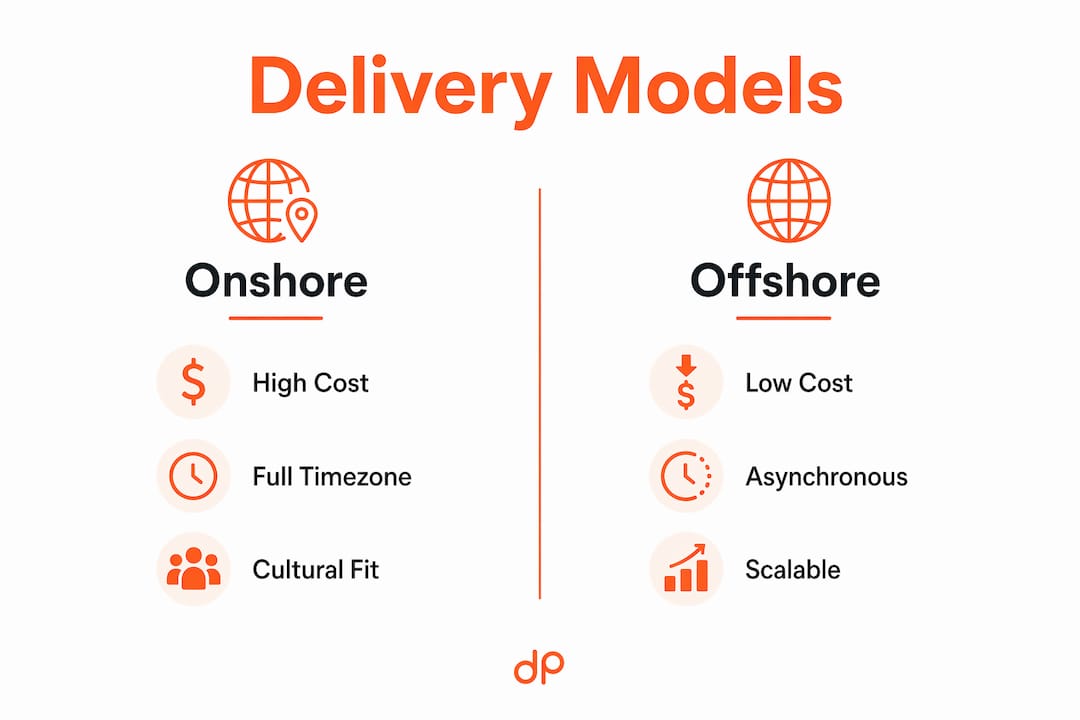
The table above reflects the core trade-offs. No single model wins across all dimensions. The right choice depends on your delivery mix, collaboration intensity, and risk tolerance.
What benefits does adopting a global delivery model provide?
The benefits of global delivery are well-documented: continuous coverage, team scalability, access to global talent, and cost optimization. Each benefit compounds the others when the model is implemented with proper governance.
Continuous coverage is the most immediate operational gain. A software product with users across North America, Europe, and Asia cannot afford an 8-hour support gap. A GDM eliminates that gap by design. Customer responsiveness improves, and brand perception strengthens as a direct result.
Scalability is the second major advantage. When a product launch requires doubling engineering capacity for 90 days, a GDM allows you to activate an existing offshore or nearshore center rather than hiring locally. IT workforce scalability becomes a managed process rather than a reactive scramble. Teams scale up and down based on delivery demand without the overhead of permanent headcount changes.
Cost optimization through labor arbitrage is real, but it is not the primary reason mature enterprises adopt GDMs. The deeper value is access to specialized talent that does not exist locally. A cybersecurity firm in Austin may find the specific DevSecOps expertise it needs in Krakow or Kyiv. A legal tech company in London may source AI engineers from Bangalore at a fraction of the local market rate.
- 24/7 support coverage across all customer time zones
- Rapid team scaling without permanent hiring commitments
- Access to global talent pools in specialized technical disciplines
- Labor cost arbitrage that improves unit economics on execution-heavy work
- Risk distribution across geographies, reducing single-point-of-failure exposure
Pro Tip: The most common mistake leaders make is treating cost savings as the primary KPI for a GDM. Measure delivery quality, handoff success rates, and time-to-resolution instead. Cost savings follow naturally from a well-governed model. Chasing cost first produces a poorly governed model that costs more to fix.
What challenges should leaders anticipate when implementing a GDM?
A global delivery model introduces coordination complexity that does not exist in single-location operations. Leaders who underestimate this complexity build models that generate overhead rather than efficiency. The challenges are predictable and manageable, but only if you plan for them before deployment.
-
Delivery management capability. Managers running a GDM need specific skills in work routing, cross-site dependency management, and quality assurance. A project manager who excels in a co-located team may struggle with asynchronous coordination across three time zones. Invest in training or hire experienced delivery managers before scaling.
-
Continuity risk from broken handoffs. Without a single source of truth in shared systems, handoffs cause rework and stalled resolution. Shared ticket history and knowledge bases are non-negotiable. Jira, ServiceNow, and Confluence are common platforms that support this requirement, but the platform matters less than the discipline of keeping it current.
-
Cultural and collaboration friction. Distributed teams bring different communication norms, decision-making styles, and expectations around feedback. This is not a soft issue. Unaddressed cultural friction slows delivery, increases misunderstandings, and raises attrition in offshore centers. Structured onboarding, regular cross-site video sessions, and explicit communication protocols reduce this risk significantly.
-
Premature governance formalization. Global delivery maturity evolves in phases: start with a single offshore team, add nearshore for collaboration-heavy work, then formalize governance and orchestration. Organizations that try to build full governance frameworks before their first offshore team is stable consistently over-engineer the model and delay value realization.
-
Technology infrastructure gaps. A GDM depends on reliable, low-latency connectivity, consistent tooling across sites, and security controls that work across jurisdictions. Cloud platforms like AWS and Azure solve much of the infrastructure challenge, but security architecture for distributed teams requires deliberate design, particularly for remote IT teams handling sensitive data.
Key takeaways
A global delivery model succeeds when centralized governance, standardized processes, and intelligent work routing operate together as a system rather than as separate initiatives.
| Point | Details |
|---|---|
| Core definition | A GDM distributes execution globally while keeping strategic governance centralized. |
| Follow-the-sun operations | Continuous delivery requires standardized documentation, unified platforms, and consistent processes. |
| Four delivery types | Onshore, nearshore, offshore, and hybrid each serve distinct functions based on cost, collaboration, and complexity. |
| Primary benefits | Continuous coverage, scalability, global talent access, and cost optimization compound when governance is strong. |
| Implementation approach | Start with one offshore team, add nearshore for collaboration, then formalize orchestration in phases. |
Why governance matters more than geography
I have worked with enterprise clients who built global delivery models by geography first and governance last. The pattern is consistent: they stand up an offshore center, reduce costs for 12 to 18 months, and then watch quality degrade as handoff failures accumulate and delivery managers burn out managing coordination overhead that was never designed out of the system.
The uncomfortable truth about GDMs is that location is the easy part. Finding a delivery center in Hyderabad or Warsaw takes weeks. Building the orchestration layer, the shared knowledge infrastructure, and the management capability to run it takes 12 to 24 months. Most organizations underinvest in that layer because it is invisible to stakeholders who are focused on headcount costs.
What I have seen work consistently is a phased approach that treats governance as the product. The first offshore engagement is a learning exercise, not a cost-reduction program. You are building the documentation standards, the handoff protocols, and the quality benchmarks that will govern every subsequent center you add. Organizations that treat phase one this way build models that scale cleanly. Those that treat it as a cost play spend phase two fixing what phase one broke.
The other factor that separates successful GDMs from struggling ones is the quality of the orchestration function. Enterprise leaders who focus on governance and orchestration rather than just distributing teams by location consistently outperform those who do not. This is not a technology problem. It is a management design problem. Solve it before you scale.
— Vlad
How DevPulse helps you build and scale distributed delivery
DevPulse works with SaaS companies, enterprise clients, and technology-driven businesses that need to build or modernize distributed software delivery capabilities. Whether you are standing up your first offshore engineering team or formalizing governance across an existing multi-site operation, DevPulse brings the technical depth and delivery experience to get it right. Our software engineering services cover custom development, legacy modernization, AI-powered solutions, and cloud-based systems built for distributed team environments. We do not just write code. We help you design the delivery architecture that makes global execution reliable. If you are ready to move from ad hoc outsourcing to a structured global delivery model, talk to our team about where to start.
FAQ
What is a global delivery model in simple terms?
A global delivery model is an operational framework where a company distributes work across teams in multiple countries while maintaining centralized control over strategy and quality. It is the structure that enables enterprises to run 24/7 operations, access global talent, and optimize costs simultaneously.
How does the follow-the-sun model work within a GDM?
The follow-the-sun model divides the workday into regional shifts, with teams in Asia, Europe, and the Americas each handling active work during their business hours and passing it to the next region at shift end. Success depends on shared platforms, standardized documentation, and consistent processes across all sites.
What is the difference between offshore and nearshore delivery?
Offshore delivery places teams in distant geographies, typically for cost savings and asynchronous execution-heavy work. Nearshore delivery uses teams in nearby countries with partial time zone overlap, making it better suited for collaboration-intensive work like product development and design.
What are the biggest risks of implementing a global delivery model?
The primary risks are broken handoffs from inconsistent documentation, coordination overhead from underdeveloped management capability, and cultural friction in distributed teams. A phased implementation approach that formalizes governance before scaling reduces all three risks significantly.
How long does it take to implement a global delivery model?
A single offshore team can be operational within weeks, but a mature GDM with formalized governance, orchestration, and multi-site coordination typically takes 12 to 24 months to build correctly. Organizations that rush governance formalization consistently face quality and continuity problems at scale.