














Selecting the right technology partner determines whether your software project succeeds or stalls. Technology executives face mounting pressure to evaluate partners effectively, yet many lack structured frameworks to assess capabilities, cultural fit, and long-term viability. Poor partner selection leads to project delays, budget overruns, and strategic misalignment. This guide delivers a practical, step-by-step evaluation framework designed for 2026, helping you make confident decisions that align technology partnerships with business objectives and minimize risks throughout the development lifecycle.
Table of Contents
- Understanding Your Project Needs And Prerequisites
- Step-By-Step Evaluation Process To Assess Technology Partners
- Common Pitfalls And How To Avoid Them In Partner Evaluation
- Validating Your Technology Partner Choice And Setting Up For Success
- Empower Your Technology Partner Selection With Devpulse
- What Criteria Are Most Important When Evaluating A Technology Partner?
- How Can I Verify A Technology Partner’s Technical Capabilities?
- What Common Mistakes Should I Avoid During Technology Partner Evaluation?
- How Do I Ensure A Successful Partnership After Selection?
Key takeaways
| Point | Details |
|---|---|
| Clear criteria ensure alignment | Defining specific evaluation criteria helps match technology partners with your business goals and project requirements. |
| Structured evaluation reduces risks | A systematic assessment process minimizes common selection pitfalls and improves decision quality. |
| Comparison frameworks enable confidence | Weighted scoring matrices and pilot projects validate partner capabilities before full commitment. |
| Due diligence spans multiple dimensions | Effective evaluation includes technical expertise, operational reliability, cultural fit, and financial stability. |
| Real-world validation matters most | Case studies and reference checks provide concrete evidence of partner performance and project success. |
Understanding your project needs and prerequisites
Before engaging potential technology partners, you must document your project scope and success metrics with precision. Defining clear project scope and success metrics helps align partner capabilities and expectations from day one. This foundational work prevents misunderstandings and ensures evaluation criteria match actual business needs.
Your project documentation should cover several critical areas. Technical stack requirements specify programming languages, frameworks, and infrastructure preferences. Timeline expectations outline delivery milestones and launch dates. Budget parameters establish cost constraints and payment structures. Compliance requirements detail industry regulations, security standards, and data protection needs. Integration specifications describe connections with existing systems and third-party services.
Prioritizing evaluation criteria requires mapping partner capabilities to business objectives. Revenue-generating features demand partners with proven product development expertise. Mission-critical systems need partners demonstrating high reliability and support capacity. Innovation initiatives benefit from partners showing emerging technology proficiency. Cost optimization projects require partners with efficient delivery processes and transparent pricing.
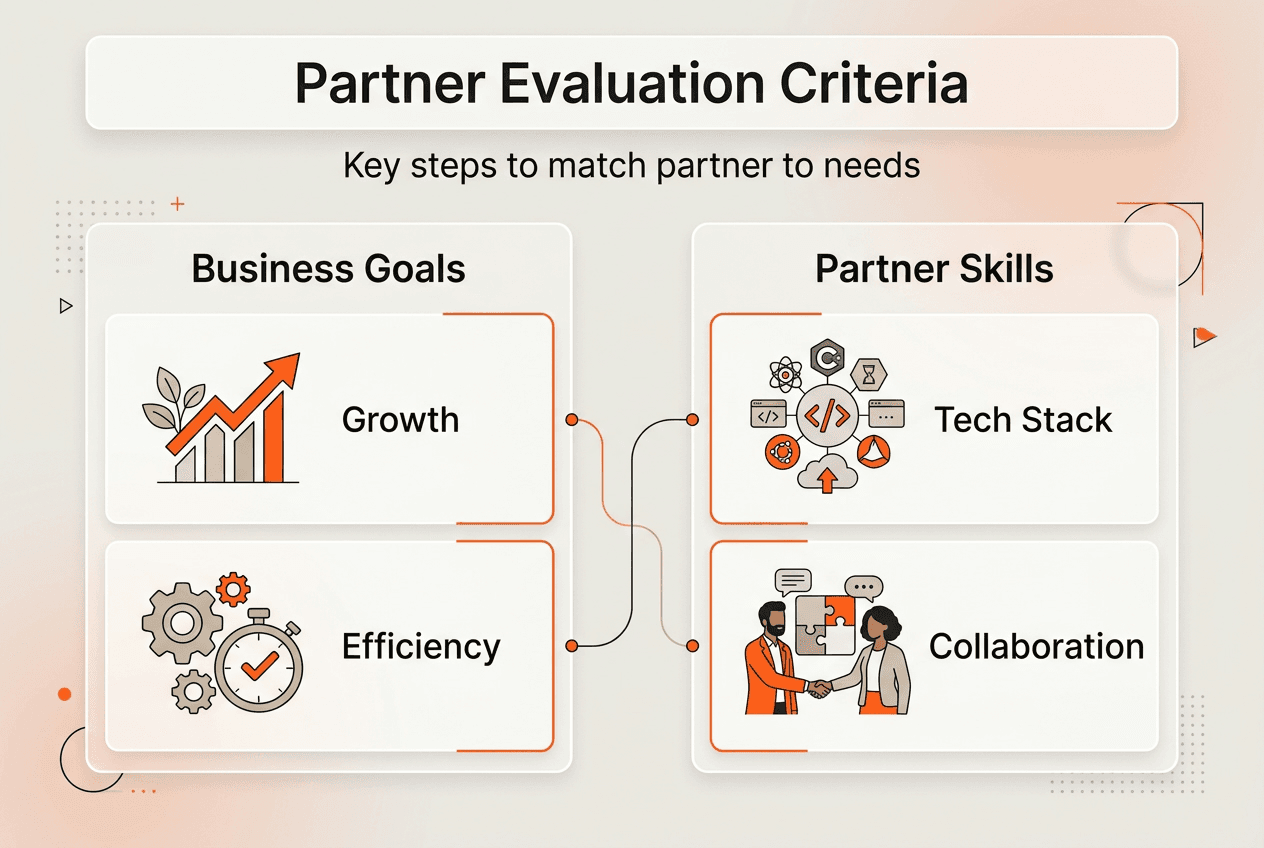
Communication and collaboration styles significantly impact project outcomes. Define your preferred meeting cadence, reporting formats, and decision-making processes upfront. Some executives prefer daily standups and real-time messaging, while others favor weekly summaries and asynchronous updates. Clarifying these preferences helps identify partners whose working styles complement your organizational culture.
Pro Tip: Engage cross-functional stakeholders early in the requirements definition process to avoid scope gaps. Product managers, engineering leads, security teams, and business unit leaders each bring unique perspectives that strengthen evaluation criteria and prevent costly oversights during partner selection.
Exploring software enhancement expertise helps you understand the range of capabilities modern technology partners should offer. This knowledge informs more effective requirement documentation and evaluation conversations.
Step-by-step evaluation process to assess technology partners
A structured evaluation process transforms partner selection from guesswork into a data-driven decision. Using formal evaluation frameworks reduces subjectivity and captures critical partner capabilities across multiple dimensions.
Follow these five steps to assess potential technology partners systematically:
-
Partner discovery and initial screening begins with building a candidate list through industry research, peer recommendations, and online platforms. Screen candidates using basic criteria like relevant industry experience, technical stack alignment, team size, and geographic considerations. Eliminate partners who clearly miss fundamental requirements before investing time in detailed assessments.
-
Detailed capability assessment uses scorecards to evaluate technical expertise, domain knowledge, and service offerings. Request portfolio examples demonstrating similar project complexity. Review technical certifications, partnership status with major platforms, and contributions to open-source communities. Assess team composition, including senior talent retention rates and skill development programs.
-
Technical and business fit interviews probe deeper into partner capabilities and working styles. Conduct technical discussions with their engineering leads to gauge problem-solving approaches and architectural thinking. Interview account managers to understand communication practices and escalation procedures. Request client references and conduct thorough reference checks focusing on project challenges and partner responsiveness.
-
Comparing partners using weighted criteria matrices brings objectivity to final selection. Assign importance weights to each evaluation dimension based on your project priorities. Score each candidate against criteria like technical capability, cultural alignment, cost competitiveness, and risk factors. Calculate weighted totals to identify top candidates quantitatively.
-
Final due diligence examines security posture, compliance certifications, financial stability, and legal considerations. Review security policies, penetration testing results, and incident response procedures. Verify relevant compliance certifications like SOC 2, ISO 27001, or HIPAA. Assess financial health through credit reports and stability indicators. Examine standard contract terms, intellectual property rights, and liability provisions.
| Evaluation Criteria | Weight | Partner A Score | Partner B Score | Partner C Score |
|---|---|---|---|---|
| Technical Expertise | 30% | 8.5 | 9.0 | 7.5 |
| Cultural Fit | 20% | 9.0 | 7.0 | 8.5 |
| Cost Competitiveness | 15% | 7.0 | 8.5 | 9.0 |
| Domain Experience | 20% | 8.0 | 9.5 | 7.0 |
| Security & Compliance | 15% | 9.0 | 8.0 | 8.5 |
Pro Tip: Leverage recent case studies from prospective partners to validate claims about capabilities and outcomes. Request detailed project documentation, including challenges faced and solutions implemented, rather than accepting polished marketing materials at face value.
Examining full-cycle development services and tech consulting services provides benchmarks for the comprehensive capabilities strong technology partners should demonstrate.
Common pitfalls and how to avoid them in partner evaluation
Technology executives frequently make predictable mistakes during partner selection that compromise project success. Understanding these pitfalls helps you implement safeguards throughout your evaluation process.
Overreliance on cost as the primary selection factor creates false economies. The cheapest partner rarely delivers the best value when factoring in quality issues, timeline delays, and rework costs. Price should inform decisions but never dominate evaluation. Focus on total cost of ownership, including maintenance, support, and potential failure costs, rather than initial development rates.
Neglecting cultural and communication fit with technology partners generates friction throughout projects. Technical capability means little if communication breaks down, time zones create coordination challenges, or working styles clash fundamentally. Assess communication responsiveness during the evaluation process itself. Partners who respond slowly or unclearly during courtship rarely improve after contract signing.

Inadequate verification of partner technical capabilities and references leads to unpleasant surprises post-engagement. Marketing materials and sales presentations paint optimistic pictures that may not reflect actual delivery capacity. Always conduct independent reference checks, request code samples for review, and verify claimed expertise through technical interviews with actual project team members, not just sales staff.
Underestimating the importance of clear contract terms and service level agreements creates ambiguity when issues arise. Vague deliverable definitions, missing performance metrics, and unclear escalation procedures leave both parties vulnerable to disputes. Invest legal and technical resources in contract negotiation upfront to establish shared understanding and accountability mechanisms.
Misaligned expectations and skipping technical due diligence are leading causes of project failure. The pressure to move quickly often pushes executives to shortcut evaluation steps, but this speed creates downstream problems that cost far more time and resources than thorough initial vetting would require.
Rushed decision-making under deadline pressure compounds all other evaluation mistakes. Artificial urgency from sales teams or internal stakeholders should not override systematic assessment. Building buffer time into partner selection timelines protects against hasty choices that haunt projects for months or years.
Reviewing engineering outsourcing tips provides additional strategies for avoiding common partner selection mistakes and building successful technology partnerships.
Validating your technology partner choice and setting up for success
Final validation steps confirm your partner selection and establish foundations for productive collaboration. These verification activities reduce risk and build mutual confidence before full project commitment.
Pilot projects and phased engagement reduce risks and build mutual trust through controlled, limited-scope initiatives. Structure pilots to test critical capabilities relevant to your full project. Define clear success criteria, deliverables, and evaluation metrics upfront. Use pilot performance as final validation before proceeding with larger commitments. This approach provides concrete evidence of partner capabilities beyond promises and presentations.
Contacting references yields firsthand insights on partner performance that marketing materials cannot provide. Prepare specific questions focusing on challenge response, communication quality, and long-term relationship dynamics. Ask references about unexpected issues and how partners handled them. Probe for weaknesses and areas where partners fell short. Candid reference conversations reveal patterns that predict future performance.
Key contract components require careful attention to protect both parties and clarify expectations. Include these essential elements:
- Detailed deliverable specifications with acceptance criteria and definition of done for each milestone
- Timeline commitments with milestone dates, dependencies, and delay penalty provisions
- Payment terms linking compensation to deliverable acceptance and project progress
- Intellectual property rights clearly assigning ownership of code, designs, and project artifacts
- Confidentiality and data protection obligations covering sensitive business information
- Performance guarantees and service level agreements with measurable metrics and remedies
- Change management procedures for handling scope modifications and requirement evolution
- Termination clauses specifying conditions, notice periods, and transition assistance
Establishing governance models and communication cadence post-selection creates operational frameworks for ongoing partnership success. Define decision-making authority for different issue types. Specify meeting schedules for status updates, planning sessions, and executive reviews. Implement project tracking tools and reporting dashboards providing visibility into progress and blockers. Assign dedicated points of contact on both sides to streamline coordination.
Pre-onboarding validations ensure readiness before project kickoff:
- Confirm team member assignments and verify their availability and qualifications
- Validate access to required systems, tools, and environments
- Review and approve project plans, technical architectures, and development approaches
- Establish security protocols, VPN access, and credential management procedures
- Conduct kickoff meetings introducing all stakeholders and clarifying roles
- Set up communication channels, collaboration platforms, and documentation repositories
Exploring real-world software case studies demonstrates how successful partnerships navigate challenges and deliver results. Learning from proven examples helps you set realistic expectations and adopt best practices.
Leveraging technical support & maintenance services ensures long-term partnership success extends beyond initial development into ongoing optimization and evolution.
Empower your technology partner selection with devPulse
Applying this evaluation framework positions you for confident technology partner selection, but expert guidance accelerates results and reduces risks further. devPulse offers comprehensive engineering services tailored to your specific project needs and business objectives. Our team combines deep technical expertise with practical business insight, delivering reliable solutions across custom software development, AI integration, and digital transformation initiatives.

Explore our software development case studies demonstrating successful partnerships across healthcare, cybersecurity, legal tech, and enterprise software domains. These real-world examples show how structured evaluation and collaborative execution deliver measurable business outcomes.
Partner with experienced technology consulting services to streamline your partner evaluation efforts and leverage proven frameworks. Our consultants guide executives through requirements definition, capability assessment, and partnership structuring, ensuring your technology investments align with strategic goals.
Pro Tip: Early collaboration with consulting experts streamlines partner evaluation efforts by bringing external perspective and industry benchmarks to your selection process, helping you avoid common pitfalls and identify optimal partners faster.
What criteria are most important when evaluating a technology partner?
Focus on technical expertise matching your project requirements, cultural fit supporting effective collaboration, and communication practices enabling transparency. Prioritize reliability through reference checks and past performance evidence. Assess security compliance and data protection capabilities relevant to your industry. Ensure alignment between partner capabilities and your specific business goals rather than generic technical skills.
How can I verify a technology partner’s technical capabilities?
Request code samples and portfolio reviews demonstrating similar project complexity and technical challenges. Conduct small pilot projects testing critical skills before full engagement. Check references focusing on technical delivery quality and problem-solving effectiveness. Review contributions to open-source projects and technical community engagement. Interview actual project team members, not just sales representatives, to assess depth of expertise. Explore real-world software case studies showing concrete examples of technical execution and outcomes.
What common mistakes should I avoid during technology partner evaluation?
Avoid focusing solely on price without thorough capability assessment and total cost of ownership analysis. Don’t skip technical and cultural due diligence under time pressure or artificial urgency. Beware of rushing decisions without adequate verification through references, pilots, and code reviews. Never accept marketing claims at face value without independent validation. Resist pressure to compromise on essential requirements like security compliance or communication standards. Review engineering outsourcing tips for additional guidance on avoiding selection pitfalls.
How do I ensure a successful partnership after selection?
Set clear milestones with measurable acceptance criteria and regular progress checkpoints. Implement governance frameworks defining decision authority, escalation procedures, and accountability mechanisms. Engage in continuous collaboration through regular communication, feedback loops, and relationship reviews. Establish shared project tracking tools providing visibility into progress and blockers. Address issues promptly rather than letting small problems compound. Leverage technical support & maintenance services to maintain partnership value beyond initial development phases.